You're probably here because life changed recently. Maybe you got married, bought a home, had a baby, or took a job that finally made you think, “I should get this in place.” Life insurance often sits on the to-do list until one of those milestones turns it from abstract to urgent.
The good news is that learning how to get a life insurance policy isn't as complicated as it used to be. You can often compare quotes online, apply from your laptop, and in some cases avoid a medical exam entirely. The part that trips people up is that “easy” doesn't always mean “automatic,” especially with digital no-exam options. If you know what insurers look for before you apply, the process gets much smoother.
Table of Contents
- Securing Your Family's Future Starts Here
- How Much Life Insurance Do You Really Need
- Choosing Your Policy Type and Term Length
- Comparing Providers and Getting Your Quotes
- The Application and Underwriting Process Explained
- Finalizing Your Policy and Next Steps
Securing Your Family's Future Starts Here
Life insurance is one of those decisions that feels heavier than it needs to. You're not just buying a financial product. You're making sure the people who depend on you could keep paying the mortgage, cover everyday bills, and keep moving forward if you weren't there.
That can feel intimidating, especially if you're searching for how to get life insurance policy options while juggling work, kids, and everything else. But the process is much more approachable now than many people expect. Most shoppers start online, compare a few offers, answer health questions, and move toward approval without endless paperwork.

Why people usually wait too long
People don't delay because they don't care. They delay because they assume it will be confusing, expensive, or time-consuming. Others think employer coverage is enough, then realize later that it may not fully protect a spouse, child, or business obligation.
A better way to think about life insurance is this: it's a tool for buying stability in advance. You're setting up a plan so your family doesn't have to make major financial decisions while grieving.
Practical rule: Buy life insurance when your health is good and your need is clear, not when life gets more complicated.
What the modern process looks like
Most buyers move through a few basic steps:
- Estimate your coverage need. Focus on real obligations such as debt, income replacement, housing, and future education costs.
- Choose a policy type. For many young families and professionals, term life is the simplest fit.
- Compare quotes online. This helps you see how price changes with coverage amount, term length, and health profile.
- Apply truthfully. Small omissions can create delays or denials later.
- Review the final offer. Confirm the benefit amount, premium, term, and beneficiary details before accepting.
The digital process is convenient, but there's one part many guides miss. No-exam life insurance is fast when you fit the insurer's criteria, but it can be surprisingly strict behind the scenes. Knowing that early helps you avoid the most common frustrations.
How Much Life Insurance Do You Really Need
The fastest way to overbuy or underbuy life insurance is to guess. A better approach is to tie your coverage to the financial responsibilities you'd leave behind. That gives you a number you can defend, instead of one that feels random.
A useful benchmark can help you sense-check your estimate. As of 2024, the average life insurance policy size for new contracts in the United States was $209,000, which reflects how buyers are matching coverage to obligations like mortgages and future college costs, according to Choice Mutual's life insurance statistics research. For many households, that figure will be too low. For others, it may be a reasonable starting point.
Start with the DIME method
A practical framework is DIME, which stands for Debt, Income, Mortgage, and Education.
- Debt includes personal loans, car loans, credit card balances, and any other amount your family would have to clear.
- Income means the money your household would lose if you died. Think in terms of how long your spouse or family would need support, not just your annual salary.
- Mortgage is separate because housing is usually the largest ongoing obligation. If paying off the home would relieve major pressure, include that amount.
- Education covers future costs you want to fund for children or dependents.
This method keeps the conversation anchored in actual responsibilities. It also helps couples talk through tradeoffs. You may decide to fully pay off the mortgage but only partially replace income, or the other way around.
A simple real-life example
Say a newly married couple has a mortgage, one car loan, some student debt, and plans for children. One spouse earns more, and their income would be harder to replace. In that case, the higher earner may need a larger policy, while the lower earner still needs meaningful coverage because childcare, household management, and future expenses also carry economic value.
Here's the key point: the goal isn't to buy the biggest policy the insurer will approve. The goal is to buy enough coverage so the surviving spouse has options. They should be able to stay in the home, take time to grieve, and avoid rushing into big financial decisions.
A good coverage number usually feels specific. It connects to bills, goals, and the life you want your family to keep living.
How to pressure-test your estimate
Once you have a rough DIME number, ask yourself three questions:
- Would this pay off my biggest obligations?
- Would my family need to move or dramatically cut expenses right away?
- Would this still feel adequate if childcare, education, or caregiving costs changed?
If you want a more guided worksheet, this life insurance coverage calculator and planning guide can help organize the numbers.
Common mistakes when choosing coverage
Some buyers make the mistake of matching the national average without considering their own life stage. Others only insure the highest earner and leave the other spouse uninsured, even though replacing that person's work at home or in a family business could be expensive.
Watch for these traps:
- Using a generic rule of thumb only. Rules can help you start, but they don't reflect your debts and goals.
- Ignoring future children. If kids are part of your plan, account for that before you apply.
- Forgetting shared debt. A surviving spouse may still carry legal or practical responsibility for balances.
- Buying for today's budget only. Premium matters, but shrinking the policy too far can undermine the whole point of coverage.
A strong estimate gives the rest of the process structure. Once you know the amount, picking the policy gets much easier.
Choosing Your Policy Type and Term Length
Most buyers don't struggle with the idea of life insurance. They struggle with the menu. Term life, whole life, permanent coverage, cash value, conversion rights. The labels sound technical, but the decision is usually simpler than it appears.
For young families and busy professionals, the main choice is often between term life insurance and whole life insurance. One is designed for a set period. The other is built to last for life and includes features that make it more complex.
Term and whole life side by side
| Feature | Term Life Insurance | Whole Life Insurance |
|---|---|---|
| Coverage length | Covers you for a selected term | Designed to stay in force for life |
| Cost | Usually more affordable | Usually higher cost |
| Purpose | Income protection during key years | Lifelong coverage with added features |
| Simplicity | Easier for most buyers to understand | More complex structure |
| Flexibility later | Often includes conversion options | Already permanent coverage |
For many households, term life is the practical choice because the need itself is temporary. You may want protection while your children are young, while you're paying off a mortgage, or while your spouse relies on your income most heavily.
Whole life can make sense in some planning situations, especially for people who want permanent coverage and are comfortable with the higher cost. But most first-time buyers need affordable protection first, not product complexity.
Why term life fits many modern buyers
Term life lines up well with how life insurance is commonly used. For many, lifelong coverage at the highest possible price isn't necessary. Instead, strong coverage is needed during the years when a death would be most financially disruptive.
One often overlooked feature makes term life even more flexible. Most term life policies include a convertible provision that allows you to exchange the term policy for a whole life policy later without a new medical exam, preserving your original health rating, as explained by The American College's guide to choosing life insurance.
That conversion feature matters if your health changes after you buy the policy. It gives you a path to permanent coverage without starting from scratch.
How to choose the right term length
Think about the financial event you're trying to protect against. The right term length usually maps to that timeline.
- A shorter term may fit if you only need coverage until a specific debt is gone.
- A mid-length term often works for couples with a new mortgage or young children.
- A longer term may suit families who want protection through the full child-raising years and much of the mortgage period.
Instead of asking, “What term is standard?” ask, “When would my family be least dependent on this payout?” That answer is more useful.
Decision cues that make this easier
If you're stuck, use this quick filter:
- Choose term life if your priority is affordable protection for a specific season of life.
- Look more closely at whole life if you already know you want permanent coverage and you're comfortable paying more for it.
- Pay attention to conversion rights if you want flexibility later without betting on perfect future health.
This isn't about choosing the most complex policy. It's about choosing the one you'll keep, understand, and feel good about paying for.
Comparing Providers and Getting Your Quotes
Quotes are where the process starts to feel real. You stop thinking in abstract terms and start seeing what a specific amount of coverage might cost. That's useful, but it can also be confusing because quotes vary for reasons that aren't always obvious.
Insurers look at a set of risk factors to price a policy. Some are straightforward, like age and coverage amount. Others, like smoking status or medical history, can shift the rate more than buyers expect.
What changes your rate
A concrete example helps. For a nonsmoking 30-year-old man, a $500,000 20-year term life policy can cost approximately $18 per month, while a nonsmoking 30-year-old woman might pay around $15 per month for the same coverage, according to Guardian's life insurance pricing overview. That example shows how age, gender, health, and policy design shape cost.
Here are the main variables insurers tend to weigh:
- Age at application. The younger you are when you apply, the better your odds of a lower premium.
- Health history. Current conditions, past diagnoses, prescriptions, and family history can all matter.
- Smoking or nicotine use. This is one of the clearest pricing factors.
- Coverage amount. More protection usually means a higher premium.
- Term length. A longer term often costs more than a shorter one because the insurer is covering you for more years.
- Lifestyle and occupation. Some hobbies or work environments may trigger extra review.
How to compare quotes without getting overwhelmed
The goal isn't just to find the cheapest number on the screen. It's to compare the same thing across carriers.
Focus on these questions:
- Is the coverage amount identical?
- Is the term length identical?
- Is the quote based on the same health assumptions?
- Does the policy include features you care about, such as conversion?
If one quote seems dramatically lower, check the details before assuming it's a better deal. Sometimes the difference comes from a different underwriting assumption, not a better value.
A simple quoting workflow
A clean approach looks like this:
- Decide on your coverage amount first.
- Narrow your preferred term length.
- Pull multiple quotes close together in time.
- Answer health questions consistently.
- Review the policy features, not just the monthly cost.
If you want a starting point for side-by-side shopping, this term life insurance rate comparison tool can help you organize quotes more efficiently.
Cheap coverage that doesn't match your needs isn't a win. Good quoting means comparing like for like.
Where people get tripped up
Some buyers compare a no-exam quote to a fully underwritten quote and assume they're interchangeable. Others change details between applications because they can't remember what they entered the first time. That creates friction fast.
Before you submit any formal application, save a copy of the coverage amount, term, beneficiary plan, and health details you used. Consistency makes the underwriting stage much smoother.
The Application and Underwriting Process Explained
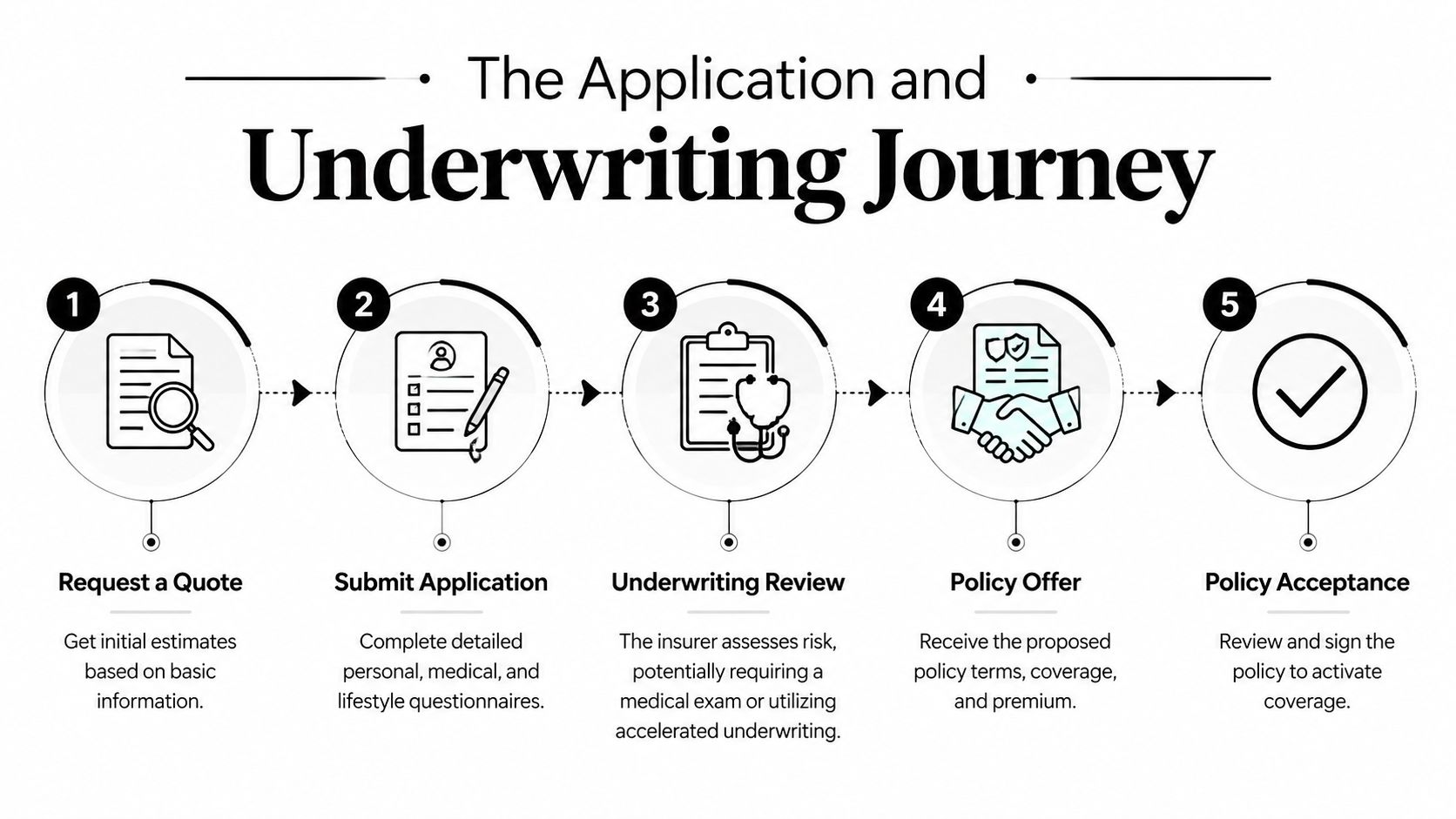
This is often a point of concern, mostly because applicants don't know what happens after they click apply. In practice, the process is fairly structured. You provide personal details, answer health and lifestyle questions, the insurer reviews your information, and then you receive an offer, a request for more information, or a decline.
What's changed in recent years is speed. Many applicants can move through digital forms and accelerated underwriting without scheduling a nurse visit or lab work. But speed comes with stricter data screening, and that's where surprises happen.
A high-level view makes the flow easier to follow.
What you'll need before you apply
Start with the basics. To apply for life insurance, insurers typically ask for identifying and tax-related information such as your full name, date of birth, and Social Security Number or Individual Taxpayer Identification Number, according to TruStage's life insurance application checklist.
You'll also usually need to answer questions about:
- Your health history
- Current and past prescriptions
- Tobacco or nicotine use
- Occupation and hobbies
- Beneficiaries
- Your desired coverage amount and term
It helps to gather this information before you start. Digital applications move quickly, and rushed answers are where mistakes creep in.
Traditional underwriting versus no-exam underwriting
Traditional underwriting often involves more steps. The insurer may ask for medical records, order a paramedical exam, or request lab work. This route can take longer, but it may be the better fit if your health profile doesn't line up well with accelerated programs.
No-exam underwriting is different. You still answer health questions, but the insurer may rely on digital data sources, prescription history, medical records, and algorithmic risk models instead of sending you for an exam.
A lot of people hear “no exam” and assume “easy approval.” That isn't always true.
Later in your research, it can help to review a more detailed explanation of life insurance underwriting and how insurers evaluate risk.
Before going deeper, it helps to hear a quick walkthrough in plain language.
The hidden eligibility gap in no-exam policies
This is the part many articles gloss over. Accelerated underwriting can be convenient, but it often uses strict filters. Data shows that 40% of applicants seeking no-exam term insurance are denied due to undisclosed prescription history or chronic conditions that algorithms flag instantly, according to Fabric's explanation of the no-exam life insurance process.
That doesn't mean no-exam policies are bad. It means buyers need realistic expectations.
Common reasons applicants hit friction include:
- Prescription history doesn't match the application. Even a forgotten medication can trigger questions.
- Chronic conditions appear manageable to the applicant but still fall outside accelerated criteria. Diabetes and high blood pressure are examples mentioned in the cited explanation.
- The application path is wrong for the profile. Someone who might qualify through full underwriting can still be declined in a no-exam flow.
If you've been treated for a chronic condition, don't assume a digital application will ignore it just because you feel fine today.
How to improve your odds of a smooth application
A few habits can save a lot of frustration:
- Be exact about prescriptions. List what you take and why, even if the condition feels minor now.
- Use your regular medical history, not your best-case memory. Insurers compare answers against records.
- Pick the right lane. If you know your health profile is more complicated, a traditional route may be more efficient than a fast decline.
- Review your application before submitting. Small inconsistencies can cause avoidable delays.
The lesson here isn't to fear underwriting. It's to respect it. Once you understand how insurers review applicants, the process feels less mysterious and much more manageable.
Finalizing Your Policy and Next Steps
Approval feels like the finish line, but this last step matters more than many buyers realize. Before you accept the policy, read the offer carefully and confirm that the details match what you intended to buy. Check the death benefit, premium, term length, riders, exclusions, and beneficiary information.
This is also the moment to make sure the policy fits your broader financial life. You want the premium to feel sustainable, the term to line up with your goals, and the paperwork to be easy for your family to find later.

What to check before you accept
One consumer protection worth knowing is the free look period. In Washington state, every new life insurance policy includes a legally mandated 10-day free look period, during which the policyholder can return the policy for a full premium refund within 30 days if they are dissatisfied, according to the Washington State Office of the Insurance Commissioner's life insurance guide. Rules can differ by jurisdiction, so check the terms that apply to your policy.
Use your review period to confirm a few essentials:
- Beneficiaries are correct. Double-check names, spelling, and shares.
- Payment setup is clear. Know when premiums are due and how they'll be paid.
- Your family knows the policy exists. A perfect policy doesn't help if no one can find it.
Review the policy like a contract, not like a receipt. This is where you catch mismatches before they become problems.
A practical checklist for staying organized
Once the policy is active, keep it useful with a few simple habits:
- Store copies in two places. Keep a digital version and a secure physical copy.
- Tell the right people. Your spouse, executor, or another trusted person should know where the policy is.
- Revisit the policy after major life changes. Marriage, children, a home purchase, or a business change can all affect whether the coverage still fits.
- Keep payments on autopilot if possible. Lapses usually happen because of logistics, not intent.
If you've been searching for how to get life insurance policy coverage without turning it into a month-long project, the path is straightforward. Estimate the right amount, choose the right type, compare real quotes, answer the application truthfully, and review the final offer with care. That's how you turn a vague financial goal into protection your family can rely on.
If you want a digital-first way to explore term life coverage, Coveredly offers online life insurance designed for busy families and professionals. You can review options, move through the process online, and find coverage that fits your life without making the experience harder than it needs to be.