You've just welcomed a child, moved into a larger home, or combined finances after getting married. You open a life insurance quote online, see a monthly price, and wonder whether a “discount” is available before you commit. The confusing part is that life insurance discounts don't always look like coupon codes. A lower price may come from your health class, tobacco status, payment schedule, employer benefit, or a faster application route that changes the process without changing the insurer's underlying risk price.

That distinction matters because younger shoppers often start with an inflated idea of what coverage costs. Adults age 30 and younger overestimated the cost of a $250,000, 20-year term policy by roughly 10–12 times, while fewer than one-quarter said they understood underwriting. Nearly half of Millennials, 48%, and 39% of Gen Z respondents cited perceived cost as a reason for lacking coverage, according to LIMRA's coverage research.
A useful starting point is a step-by-step family budget guide that helps you place premiums alongside housing, childcare, debt, and savings. You can also review financial planning resources for young families before comparing policies. Once the budget is clear, the next task is identifying which savings are genuine price reductions, which are lower-risk classifications, and which only make buying easier.
Table of Contents
- Why Life Insurance Discounts Matter for Young Families
- How Life Insurance Discounts Really Work
- Main Types of Life Insurance Discounts Explained
- Preferred Health Pricing and How Long Savings Last
- How to Qualify for Each Discount Without Stress
- Real World Examples and Online Savings Tips
- Smart Next Steps to Lock In Your Best Rate
Why Life Insurance Discounts Matter for Young Families
A young couple named Maya and Daniel might begin with the same question many new parents ask: “Can we get enough coverage without squeezing every other part of our budget?” They compare online quotes, notice that one insurer mentions preferred rates, another promotes wellness rewards, and a third offers a lower cost for annual payment. The word discount appears in all three conversations, but the pricing mechanism may be completely different.
A nonsmoker classification can reduce the insurer's expected mortality risk. A preferred health class can do the same. Paying once a year may reduce billing and collection costs. A workplace policy may provide basic protection through an employer, while a simplified application may reduce paperwork without guaranteeing a lower premium. Treating all these options as interchangeable can lead a family to choose a cheaper-looking policy that provides less protection or carries conditions they didn't expect.
The useful question isn't “Where's the coupon?” It's “What changed the insurer's expected cost, and is the lower price guaranteed?”
For a new parent, the answer affects more than the monthly bill. A policy should fit the years when children depend on household income, a mortgage still needs to be paid, and one partner might pause work. A small improvement in pricing can make adequate coverage easier to keep, but only if the policy's term, benefit, exclusions, and premium schedule still match the family's needs.
The biggest opportunity may be correcting a price assumption rather than finding a promotional offer. If you believe coverage costs many times more than it does, you might postpone applying while waiting for a better financial moment. Waiting can mean applying later with a different age, health history, or underwriting result. For young families, applying while healthy can matter more than chasing a temporary incentive.
This guide separates the main levers. You'll see how tobacco status and preferred health pricing work, why payment frequency can affect total cost, what wellness programs may require, how group coverage is taxed, and how online underwriting differs from a true premium discount. The goal is a quote you can understand before you accept it.
How Life Insurance Discounts Really Work
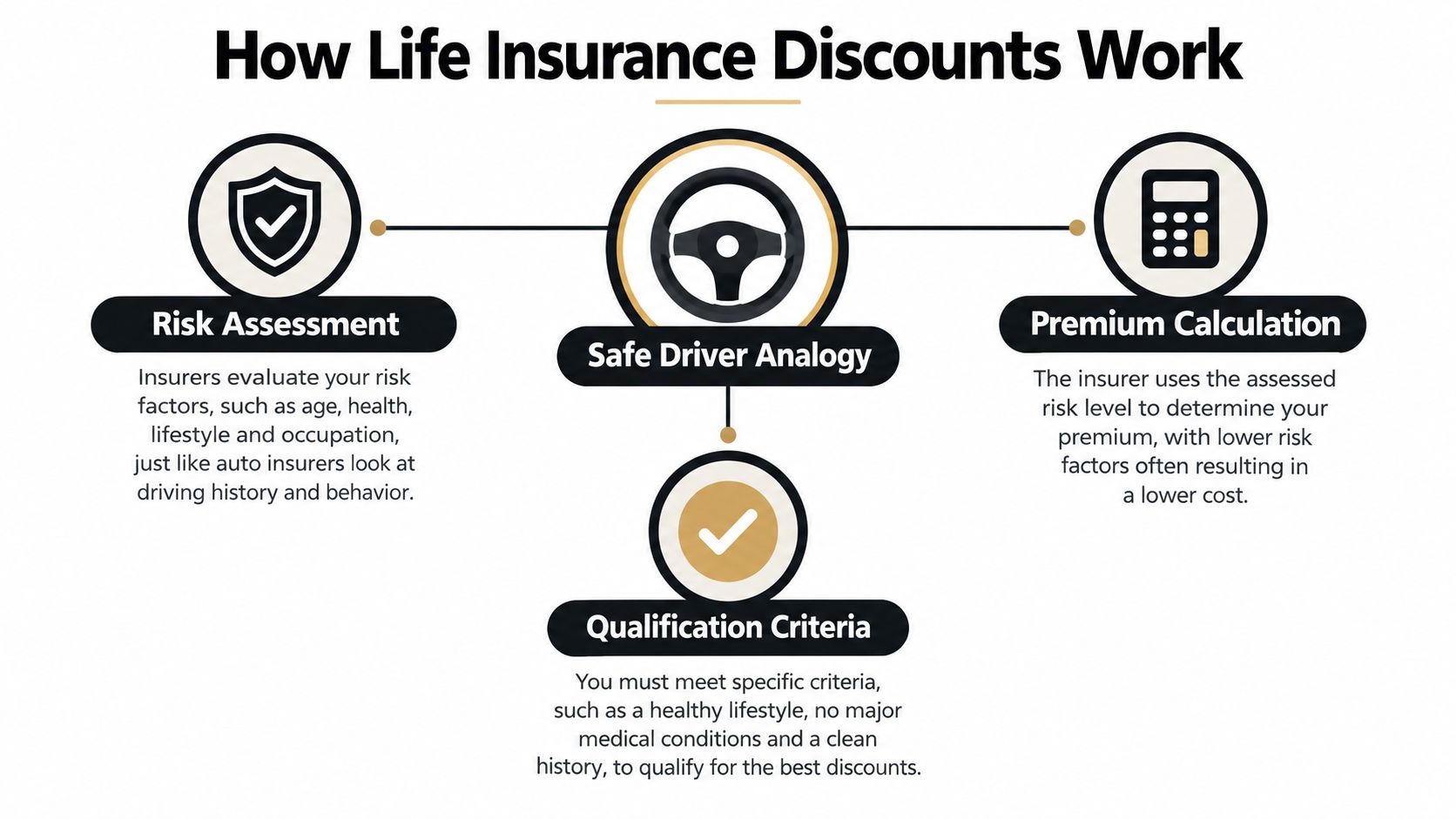
Think about safe-driver pricing in auto insurance. A driver with fewer risk indicators may receive a lower rate because the insurer expects fewer costly claims. Life insurance uses a similar logic, but the risk being priced is the likelihood and timing of death during the policy period.
Risk pricing comes first
An insurer starts with a base rate and adjusts it using information such as age, tobacco use, medical history, family history, occupation, hobbies, and the amount and duration of coverage. A person who qualifies for a favorable risk class may pay less because the insurer expects lower mortality for that group. That's an underwriting-based price difference, even if the quote doesn't call it a discount.
Tobacco pricing shows how this idea entered mainstream life insurance. The first nationally promoted nonsmoker's life-insurance discount emerged in the United States in 1964, shortly after the U.S. Surgeon General released its landmark report on smoking and health in January of that year. State Mutual Life Insurance Company of Massachusetts introduced a 5% premium reduction for qualifying nonsmokers, as described in this history of smoking and life insurance pricing.
That history helps explain why “discount” can be misleading. The insurer isn't necessarily handing back part of a standard retail price. It may be placing you in a different risk category from the beginning. A nonsmoker rate, preferred rate, or standard rate reflects different assumptions about expected claims.
Billing savings work differently
Payment frequency is another matter. If you pay premiums annually instead of in smaller installments, the insurer may have fewer billing and collection tasks. Some carriers reflect that difference in the total cost, while others publish different payment-mode prices.
Marketing perks sit outside both categories. A gift card, partner offer, or wellness reward may provide value, but it might not lower the guaranteed premium. Before comparing life insurance discounts, separate the guaranteed premium from conditional rewards and calculate the total annualized cost.
For a deeper explanation of the questions insurers ask and how evidence affects classification, review how life insurance underwriting works.
Main Types of Life Insurance Discounts Explained
Different savings paths suit different households. A healthy nonsmoker may benefit from preferred underwriting, while a busy employee may first use workplace coverage. A couple with several policies might ask about bundling, and a household with predictable cash flow might compare annual payment against monthly installments.

Healthy lifestyle and nonsmoker pricing
Health-based pricing considers medical information and lifestyle factors that affect expected mortality. Nonsmoker status can be particularly important because tobacco use is assessed separately by many insurers. Healthy blood pressure, favorable medical history, and strong overall health may support a preferred classification, but each insurer sets its own rules.
This isn't the same as earning points for good behavior. The insurer may require medical records, prescription information, laboratory results, or answers to health questions. A wellness program, by contrast, may offer a reward for completing activities after the policy begins.
Bundling and group access
Bundling may be available when you purchase more than one policy or combine life coverage with other insurance products. Ask whether the savings apply to the life premium itself, another policy, or a broader account relationship. Don't assume that putting policies with one company is cheaper until you compare the combined price and coverage.
Occupational, professional, association, and employer-sponsored programs can also change access or price. Group coverage may require less individual underwriting, but it can have limits, conversion rules, or reduced portability if you leave the employer.
Payment frequency
Payment mode can affect the effective cost even when health information stays the same. In a U.S. federal appellate case involving Liberty National Life Insurance Company, policy provisions granted a 5% discount when industrial-life premiums were paid 26 weeks in advance and a 10% discount when premiums were paid 52 or more weeks in advance, according to the court record.
Pricing principle: A health classification changes the risk price. A payment option changes the billing economics. A reward may change neither.
Wellness-linked programs
Wellness programs may connect premium refunds, discounts, credits, or rewards to activity, health engagement, or data sharing. They can suit someone who already tracks activity and is comfortable following the program's rules. They may be less suitable for a parent with an irregular schedule, a person with a disability, or anyone who doesn't want to share wearable-device information.
Use this video as a visual introduction to the broader idea of comparing life insurance pricing and policy features:
Preferred Health Pricing and How Long Savings Last
A young family may see two online quotes for the same death benefit and term, yet receive different prices because the applicants fall into different health classes. Preferred pricing comes from that classification. In U.S. term-life experience analyzed by SCOR, Super Preferred policyholders had mortality rates 44% lower than Residual risks, while Preferred mortality was 34% lower, according to SCOR's term-life mortality analysis.
The insurer estimates expected claims for each class. If the expected mortality is lower, the risk portion of the premium can also be lower while the insurer still targets an appropriate margin. The lower price reflects that estimate for the class rather than a reward in the ordinary sense.
The first-year quote isn't the whole story
Preferred status can make an online quote look attractive at the start, but its advantage may change as the insured grows older. WTW's analysis of TOAMS-5 experience found that the effect of preferred underwriting appears to wear off mainly with attained age, rather than with policy duration alone. Depending on the risk class, the initial difference can decline substantially at advanced ages. One reported class retained about 34% of its initial discount, while another retained roughly 56%.
That does not make a preferred policy poor value. It shows why a first-year comparison cannot answer the long-term pricing question alone. A family buying coverage for mortgage protection or children's financial security should review the guaranteed premium schedule, policy term, benefit amount, and underwriting class together.
Compare the full schedule
Ask the insurer or agent to identify these four items:
- Initial classification: Is the quote Preferred, Super Preferred, Standard, or another class?
- Guaranteed premiums: Does the premium stay level for the selected term, and what contract terms apply?
- Age-related assumptions: Does the quote show how pricing changes as the insured gets older?
- Coverage fit: Will the benefit still match income, debt, and family responsibilities as they change?
Health management can support broader family planning, including resources about app-connected home health management. An app or tracking device, however, does not automatically produce a preferred life insurance class. The insurer still applies its own underwriting rules and evidence requirements.
The practical lesson is simple: compare the guaranteed premium schedule, not just the percentage shown beside the first quote. A smaller initial reduction with clearer long-term pricing may be easier to budget than a larger apparent discount whose value changes with age.
How to Qualify for Each Discount Without Stress
A young parent opens an online application hoping a few healthy habits will lower the quote. The safest route is accuracy first. Tobacco questions may cover cigarettes, vaping, cigars, nicotine replacement products, or other use, depending on the insurer's definition. Guessing or minimizing an answer can create problems later, including during a beneficiary's claim.
Prepare before opening the application
Gather your current medications, physicians' details, diagnoses, dates of major procedures, tobacco history, occupation, hobbies, and family medical history. Keep the information nearby while completing the form. If the application offers accelerated or simplified underwriting, answer each question carefully. A no-exam process changes how the insurer collects evidence. It does not promise preferred pricing or approval.
Payment frequency can affect the total cost. Ask for monthly, quarterly, semiannual, and annual prices before selecting a schedule. Compare the amount paid over a full year, not only the smallest installment displayed online. Also confirm whether any payment reduction is guaranteed in the contract or depends on a temporary promotion.
Newly married couples should ask whether the insurer offers separate individual policies, joint arrangements, or bundled products. Compare the protection each person needs instead of assuming identical policies are suitable. One partner may have higher income, more debt, or different employer coverage.
Use this qualification snapshot
| Discount Type | What Proves Eligibility | Best Fit |
|---|---|---|
| Preferred health pricing | Medical answers, records, prescription history, and any required exam or laboratory evidence | Healthy applicants seeking a lower risk class |
| Nonsmoker pricing | Accurate tobacco-use answers and any verification required by the insurer | Applicants who meet the carrier's nonsmoker definition |
| Payment-mode savings | The insurer's written premium schedule for each payment frequency | Households able to budget a larger, less frequent payment |
| Bundling | Eligibility through multiple policies, an account relationship, or a qualifying organization | Couples and households comparing several insurance products |
| Employer group coverage | Enrollment through the employer and the plan's eligibility rules | Employees who want accessible baseline protection |
| Wellness incentives | Completion of stated activities, verification, and ongoing participation | People comfortable with program conditions and data rules |
Read the wellness fine print
New York's Department of Financial Services requires filings for a premium refund, discount, charge reduction, or policy-value credit to include actuarial material. That material must show the adjustment follows sound actuarial principles and reflects actual or reasonably anticipated experience. Evidence summarized by the Society of Actuaries indicates that a fully underwritten term-life wellness program could reduce aggregate mortality and lapse rates by up to 3%–4% across an insurer's entire book. The same analysis estimated that programs reaching 40% engagement could increase profitability by as much as 9%. Rewards, lower premiums, implementation, and administration reduce the gross benefit. These filing requirements appear in the New York DFS wellness guidance.
Ask what happens if activity falls, whether a wearable supplies the data, how verification works, and whether the base premium remains competitive without the incentive. A wellness program may affect the price, while preferred health pricing comes from underwriting your individual risk. Those are separate levers, so an online shortcut or activity reward should not be treated as proof of a better health class.
Real World Examples and Online Savings Tips
Consider four households comparing life insurance discounts. A nonsmoking young parent may qualify for a favorable health class after answering medical questions. The price difference comes from underwriting, not from entering a promotional code. A newly married couple may ask whether combining policies creates a genuine premium reduction, but they should compare separate quotes first because bundling rules vary.

An employee might use workplace group-term life insurance as a convenient foundation, then check whether it remains available after changing jobs. Under Internal Revenue Code Section 79, the first $50,000 of employer-provided group-term life insurance coverage is generally excluded from an employee's taxable income. When coverage exceeds $50,000, the value of the excess is generally treated as imputed income, as explained by the IRS group-term life insurance guidance.
That doesn't make employer coverage bad. It means the employee should understand both the protection and the payroll treatment. The tax calculation uses an age-based table for the excess coverage, rather than copying the amount the employer pays.
Shop the quote, not the headline
When comparing online offers, save the same inputs for each carrier. Use the same coverage amount, term length, tobacco answer, health information, and payment mode. Then check whether the quote is guaranteed, conditional, employer-linked, or dependent on future engagement.
A wellness reward may look attractive to someone who already uses a tracker every day. Another parent may prefer a predictable premium that doesn't depend on gym access, pregnancy-related limitations, disability accommodations, or ongoing data sharing. Even everyday health-related shopping, such as looking for organic superfood discount offers, shouldn't be confused with qualifying for an insurance risk class.
For an easy comparison, instant online life insurance quotes can help you see how the same applicant details produce different offers. Review the insurer, benefit, term, premium schedule, exclusions, and underwriting conditions before focusing on the word "discount."
Practical comparison: A lower quote is useful only when it buys the coverage your family actually needs under terms you can keep.
Smart Next Steps to Lock In Your Best Rate
The most reliable savings strategy combines clear expectations with an early, accurate application. First, decide how much income replacement, debt protection, childcare support, and household stability your family would need. Then choose a term that matches the years when those obligations matter most.
Next, compare the pricing levers separately. A preferred health class can lower the risk price. Nonsmoker status can place you in a different category. Annual payment may reduce the effective cost through billing economics. A workplace benefit can provide accessible baseline coverage, but you should review portability and the tax treatment of coverage above the applicable exclusion.
Don't let an underwriting shortcut create false confidence. Accelerated or simplified underwriting may reduce friction, but it doesn't automatically create a lower premium. Wellness programs may offer value, but only if you understand the participation rules, privacy terms, durability of the incentive, and base premium without the reward.
Coveredly offers digital term life insurance with coverage up to $3 million and no exams for most applicants. That option may fit shoppers who want to compare coverage online while still reviewing the actual insurer terms, underwriting outcome, and guaranteed premium schedule.
Revisit your protection after marriage, a home purchase, a new child, a major income change, or a change in employer benefits. The right amount today may not remain right forever. A policy review can reveal whether you need additional coverage, different payment timing, or a clearer separation between personal coverage and workplace benefits.
The best life insurance discounts usually aren't hidden tricks. They come from applying while healthy, answering accurately, comparing carriers, choosing coverage deliberately, and selecting payment terms that fit your household cash flow.
Coveredly helps young families and professionals compare digital term life insurance, with coverage up to $3 million and no exams for most applicants. Visit Coveredly to review your options and request a personalized quote based on the coverage your family needs.