A grocery store worker checks the household budget after rent, food, transport, and childcare have been paid. There isn't much left, yet one question keeps returning: what would happen to the family if the main wage earner died? Life insurance can feel like a luxury in that moment, but the right policy isn't about buying the biggest possible payout. It's about creating a practical safety net that fits an already stretched budget.
For households with limited income, the useful question isn't just, “What's the cheapest policy?” It's, “What protection do we need now, and how can we build it in layers?” This guide explains the main policy types, how insurers set prices, ways to reduce premiums, simplified-issue and no-exam applications, household examples, common misunderstandings, and a straightforward buying checklist.
Table of Contents
- Why Life Insurance Matters on a Tight Budget
- The Core Types of Life Insurance Explained Simply
- How Underwriting and Pricing Actually Work
- Smart Strategies to Lower Your Premium
- Applying Online With a Simplified or No-Exam Policy
- Sample Coverage Scenarios for Real Households
- Common Misconceptions Worth Clearing Up
- Your Next Steps and a Quick Checklist
Why Life Insurance Matters on a Tight Budget
Life insurance is a contract that pays a death benefit, meaning a lump sum, to the people you name if you die while the policy is active. That money can help cover funeral expenses, rent, food, childcare, debts, or the income your household suddenly loses.
The financial shock can be especially severe when savings are limited. A higher-income household may have more room to absorb lost wages, while a lower-income family can face immediate borrowing, missed bills, or dependence on relatives. Life insurance doesn't remove grief, but it can reduce the number of urgent financial decisions survivors must make.
The connection between income and coverage is clear in Chicago Fed data on life insurance ownership. Only 34.4% of households with incomes up to $18,000 had a member with life insurance, compared with 51.4% of households earning $19,000 to $33,000 and 83.9% of households above $87,000. Among low-income households that did have coverage, about 43% held cash-value policies, showing how affordability and product type are connected.
Start with the financial problem
Before comparing insurers, write down what your family would need if your income stopped:
- Immediate costs: Funeral arrangements, travel, urgent bills, and unpaid obligations.
- Income replacement: Money to help a partner, child, parent, or sibling maintain basic living expenses.
- Debt protection: Balances that could otherwise fall to a co-signer or surviving family member.
- Care responsibilities: Childcare or support for a dependent adult.
You don't need to solve every future financial risk with one policy. A modest policy that stays active may be more useful than a larger policy that becomes unaffordable.
A broader household budget also matters. Guidance on practical low income savings tips can help you find room for premiums without sacrificing essentials. Even a small, consistent payment needs to fit alongside food, housing, utilities, and emergency savings.
The Core Types of Life Insurance Explained Simply
Think of life insurance as a safety net. You make regular premium payments, and the insurer promises a larger payment to your named beneficiaries if you die under the policy's terms. A beneficiary can be a person, trust, or organization, depending on the policy and local rules.

Term life
Term life insurance covers a set period. If you die during that period and the policy is active, the insurer pays the death benefit. If you outlive the term, the policy generally ends unless you renew or convert it under the contract.
Term life usually offers the most protection for each premium dollar because it focuses on a death benefit and doesn't build cash value. For a working parent, the term might match the years when children need care or when a mortgage and income replacement matter most.
Permanent life
Permanent life insurance is designed to remain in force for life as long as its requirements are met. Whole life and universal life are common forms. Some permanent policies build cash value, an account connected to the policy that may be accessed during the policyholder's lifetime.
That extra feature comes with higher costs and more rules. A policyholder may need to understand surrender charges, loans, withdrawals, lapse risks, and how missed payments affect coverage. For a household with limited income, permanent coverage may be difficult to maintain unless there is a clear lifelong need and enough room in the budget.
Burial or final expense coverage
Burial insurance, also called final expense coverage, is a smaller policy intended mainly for funeral and related costs. Guaranteed-issue policies may accept applicants without a full medical review, but they often offer limited coverage and may use a graded benefit, meaning the full payout isn't available for every cause of death immediately.
The right starting point depends on the need. Term life is often the first option to investigate for working-age adults, while final expense coverage may suit someone whose priority is a smaller, predictable funeral benefit. For additional general reading, you can browse insurance related posts from Morgan & Morgan Attorneys at Law P.C.
How Underwriting and Pricing Actually Work
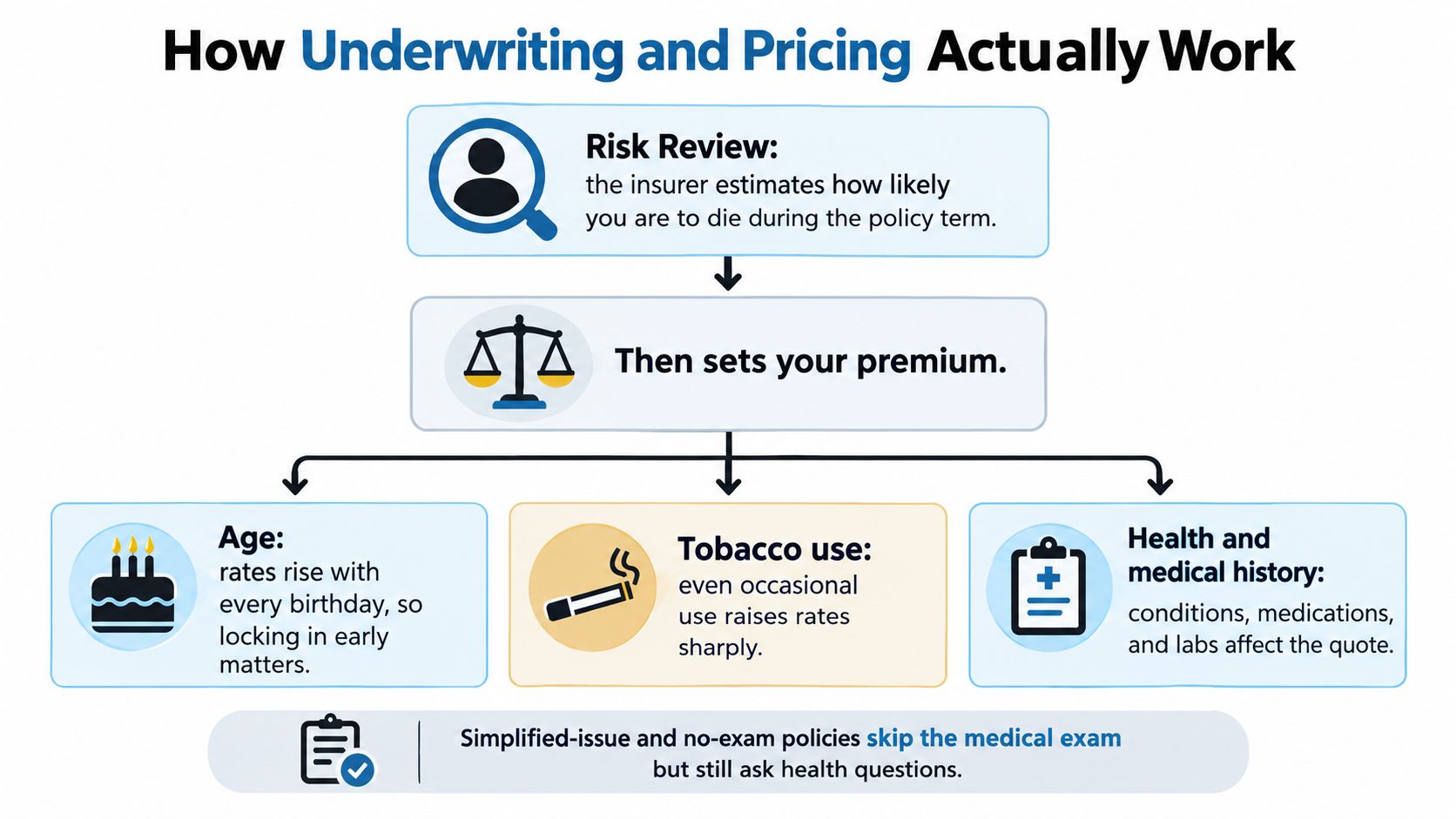
Underwriting is the insurer's risk review. The company estimates how likely an applicant is to die during the requested policy period, then uses that assessment to decide whether to offer coverage and what premium to charge.
Three factors usually shape the quote.
Age sets the starting point
Age is a major pricing factor because the probability of serious illness and death generally increases over time. Two people requesting the same policy can receive different prices because the insurer expects a different length of risk exposure.
Health adds another layer. An application may ask about diagnoses, prescriptions, hospital visits, tobacco use, height, weight, and family medical history. Some applications also require medical records or blood and urine tests. Insurers may place applicants into categories such as preferred, standard, or substandard, with different premiums for each class.
Lifestyle can affect the assessment as well. Tobacco use, dangerous hobbies, and a poor driving history may increase the price. Answer every question accurately. A low quote isn't useful if incomplete or incorrect information later gives the insurer grounds to challenge the claim.
Why simplified issue can help
A simplified-issue policy replaces a traditional medical exam with a health questionnaire and data checks. It may cost more than fully underwritten coverage because the insurer has less medical information, but it can offer a faster and less complicated application.
A no-exam policy doesn't necessarily mean no questions. The insurer may still ask about health, medications, tobacco, and recent treatment. Some insurers also use a soft credit inquiry for identity or fraud screening. A soft inquiry generally isn't the same as a hard credit application, but applicants should ask how the company uses the check.
Guaranteed acceptance goes further by skipping medical underwriting, but the trade-off is usually a smaller benefit, higher cost for the amount of coverage, and a graded payout during the early policy period. Read the benefit schedule before buying. The life insurance underwriting guide can help you understand the questions insurers use and why they affect eligibility.
Deloitte estimates that about 102 million U.S. adults are uninsured or underinsured, representing roughly a $12 trillion coverage gap, with the need especially pronounced among lower-income households. Deloitte's analysis of the life insurance coverage gap supports a practical conclusion: shorter underwriting paths and smaller, layered term amounts can be more realistic than waiting for one large policy that may never fit the budget.
Smart Strategies to Lower Your Premium
The cheapest policy isn't automatically the best value. A policy that covers the wrong risk, expires too soon, or becomes unaffordable doesn't provide dependable protection.
Right-size the benefit
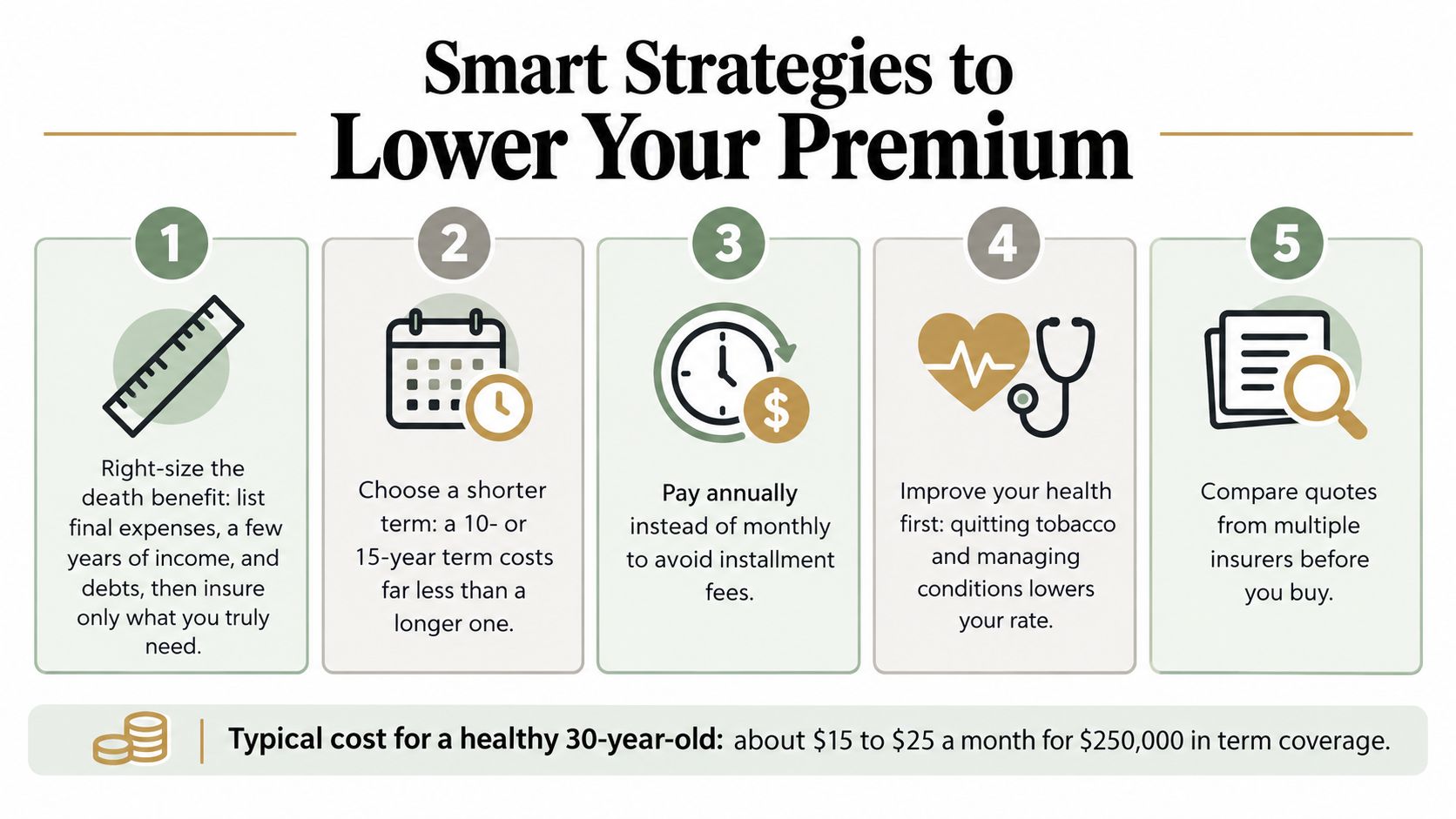
Start by identifying the actual financial gap. List final expenses, debts, childcare, and the income a survivor would need to replace. Don't automatically choose a large round number because an advertisement suggests it. A smaller benefit that addresses the most urgent obligations may be more sustainable.
Use a ladder instead of one oversized policy
Laddering means combining policies with different coverage amounts and end dates. One policy can handle the years when children are young or debts are high, while a smaller policy continues for a longer period to cover final expenses or a remaining dependent.
This approach turns one large purchase into several smaller decisions. It also lets coverage taper as responsibilities change. A household might begin with a basic term policy, then add another layer after a new child, mortgage, or business obligation appears.
Practical rule: Protect the years with the greatest dependency first. Don't pay indefinitely for needs that are likely to shrink.
Match the term to the responsibility
Choose a term matching the period when someone relies on your income. A shorter term may cost less, but it shouldn't end while a dependent still needs support. Ask whether the policy is renewable or convertible, and understand what happens to the premium after the initial term.
Paying annually may reduce installment costs when the insurer offers that option, but only choose it if the larger payment won't disrupt the household budget. A missed annual payment can create a bigger problem than a manageable monthly payment.
Health improvements can also affect pricing. Stopping tobacco use, following treatment plans, and managing ongoing conditions may help an applicant qualify for a better class when the insurer reviews those factors.
For a tight budget, final expense coverage may be a starting point. For working years, level term is usually easier to compare. Permanent insurance deserves careful scrutiny until income is stable enough to support its higher and more complex costs.
Applying Online With a Simplified or No-Exam Policy
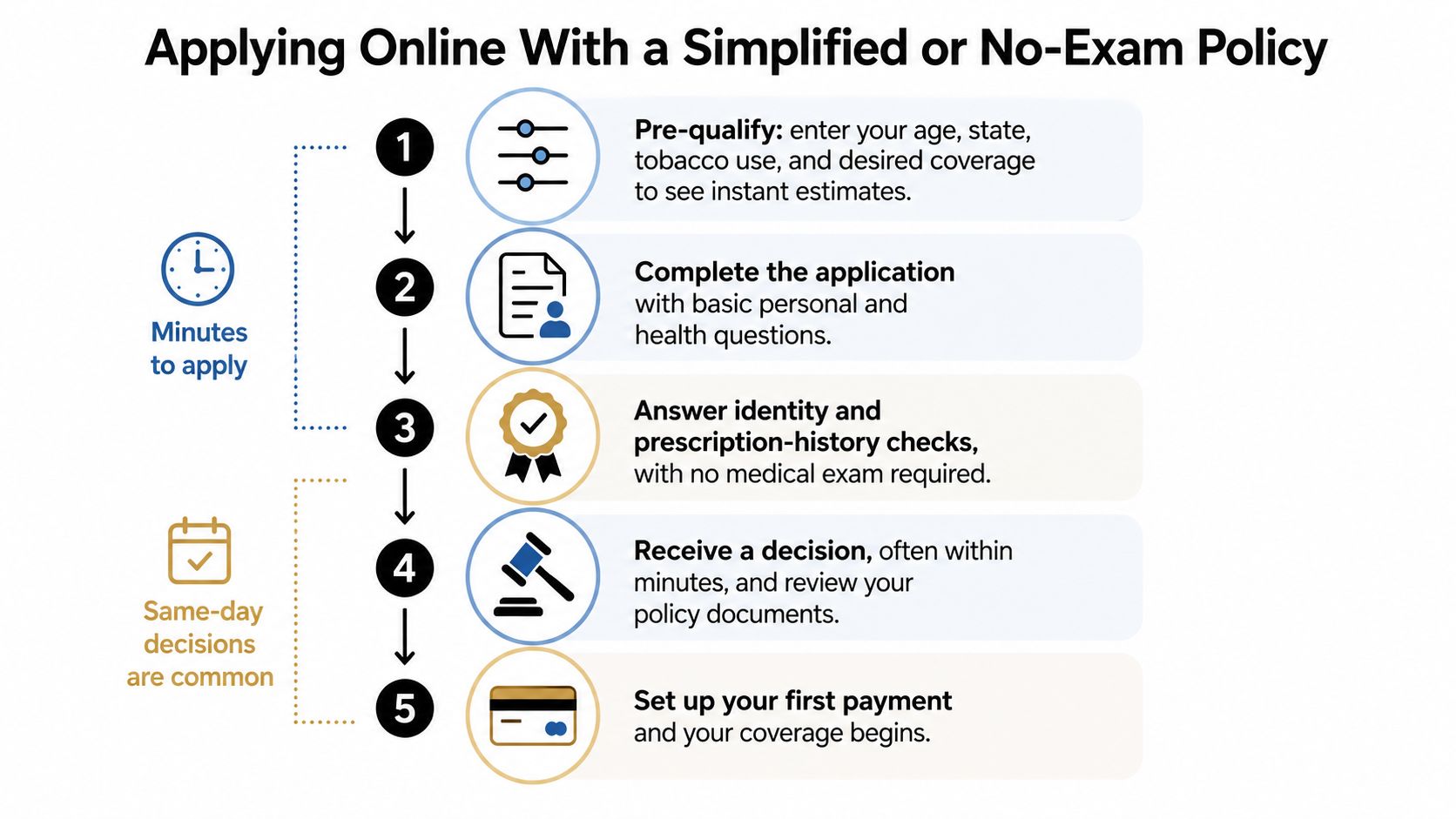
An online application can feel less intimidating when you know what each screen is asking for. The process usually begins with pre-qualification, not a final offer.
Step one is an estimate
You may enter your age, state, tobacco use, and desired coverage to receive an initial estimate. Treat that result as illustrative pricing. It can change after the insurer verifies your identity, checks available records, and reviews your health answers.
Don't change an answer to chase a lower quote. The final application must match your actual circumstances.
The application gathers personal details
The formal application usually asks for your legal name, date of birth, address history, employment details, beneficiary choice, and payment information. A health questionnaire may ask about diagnoses, prescriptions, hospital visits, procedures, height, weight, and tobacco use.
Have a current medication list nearby. If you don't remember a medical term, use the name on the prescription label or contact your clinic rather than guessing.
Verification doesn't always mean an exam
A company may verify identity, prescription history, and other application information without requiring a medical exam. A soft credit check may support identity and fraud screening, but it generally isn't used like a hard credit application. Ask the insurer to explain the check if you're uncertain.
Some smaller applications receive decisions quickly. Larger simplified-issue applications may take longer because the insurer needs more records or review. Once approved, read the policy PDF carefully. Check the insured person, beneficiary, premium, benefit amount, exclusions, payment date, renewal terms, and any graded-benefit language.
The simplified-issue life insurance guide explains how no-exam applications work and what information applicants should prepare. If the policy includes a free-look period, use it to compare the delivered contract with the original quote and cancel according to the stated instructions if it doesn't meet your needs.
Sample Coverage Scenarios for Real Households
These examples show the decision process, not guaranteed quotes. Actual premiums depend on age, health, tobacco use, state, coverage amount, term, and the insurer's underwriting rules.
A single adult with modest wages
A single adult without dependents may focus on final expenses, a small debt balance, and leaving money to a relative. A smaller simplified-issue term policy could provide a practical starting point, especially if the applicant wants a straightforward online process.
The trade-off is that a modest benefit won't replace years of income. Guaranteed-issue coverage may be easier to obtain, but the applicant should compare its cost, waiting rules, and benefit limits with simplified issue.
A new parent with a working partner
A new parent has a different exposure. The household may need income replacement, childcare, housing costs, and support during the years when a child depends on both adults.
A longer level-term policy may be appropriate for the main income risk, with a smaller final expense policy as a separate layer. The couple should compare the cost of insuring each parent, not just the higher earner. A stay-at-home parent also provides childcare and household work that would be expensive to replace.
A single caregiver supporting an adult sibling
A caregiver responsible for an adult sibling with disabilities may face a need that lasts longer than a standard working-years obligation. The priority could be predictable lifelong support, a trust, or money for a future caregiver.
Permanent coverage may deserve consideration if the premium remains sustainable, but a long simplified-issue term policy can be a more accessible alternative. The buyer should ask what happens when the term ends and whether conversion is available without another medical review.
| Profile | Recommended product | Coverage and term | Estimated monthly premium |
|---|---|---|---|
| Single adult with modest wages | Simplified-issue term or final expense coverage | Modest benefit matched to funeral costs and small debts | Request quotes based on health and state |
| New parent with a working partner | Level term plus a smaller final expense layer | Main policy matched to income replacement and childcare years | Compare separate quotes for both parents |
| Single caregiver for an adult sibling | Long simplified-issue term or carefully reviewed permanent coverage | Benefit coordinated with lifelong support planning | Confirm affordability, renewal terms, and benefit rules |
A useful policy is one the household can keep active. Review beneficiaries and coverage after marriage, a birth, a major debt, a job change, or a change in caregiving responsibility.
Common Misconceptions Worth Clearing Up
Myth one, life insurance is always too expensive. Many buyers overestimate the price of basic term coverage. A 2024 LIMRA fact sheet says 72% of Americans overestimate the cost of a basic term policy, and a separate 2024 Insurance Barometer report found that only about a quarter of respondents correctly estimated the cost of a 20-year, $250,000 level-term policy for a healthy 30-year-old. 61% thought it would cost at least $500 per year, while the average was around $200 per year. Quotes still vary, but guessing high can stop people from applying.
Myth two, a pre-existing condition makes approval impossible. Health conditions can affect eligibility and price, but they don't produce one universal answer. Simplified underwriting, graded benefits, and guaranteed-issue products may create alternatives. Complete every health answer accurately.
Myth three, someone without children doesn't need coverage. Dependents can include a parent, partner, adult sibling, or anyone relying on your money or unpaid care. Final expenses and co-signed debts can also become a family problem.
Myth four, employer coverage is enough. Workplace insurance can be valuable, but it may be limited and may end or change when employment ends. Treat it as one layer, then check whether a personal policy is needed to protect against job changes.
Your Next Steps and a Quick Checklist
The laddered approach changes the buying decision. You don't have to predict every future expense or purchase the largest policy available. Start with the responsibility that would create the most harm, cover that risk affordably, and add protection when your household changes.
Use this quick checklist:
- Estimate the gap: List final expenses, debts, income that would need replacing, and the people who depend on you.
- Choose the household tier: Consider whether you need starter protection for final expenses, a middle layer for debts and short-term support, or broader family protection.
- Pre-qualify carefully: Use a simplified-issue online application to review illustrative rates and ask whether the inquiry is a soft pull.
- Gather details: Prepare your date of birth, address history, beneficiary information, tobacco history, and current medication list.
- Compare terms: Request quotes for more than one term length, then decide whether a ladder would fit better than one policy.
- Read before paying: Check exclusions, graded benefits, renewal rules, conversion rights, beneficiary details, and the free-look instructions.
- Protect the policy: Set a payment method that won't cause missed premiums and review the coverage after major life changes.
Revisit the decision when your income, health, dependents, debts, or caregiving duties change. Even modest coverage can give the people left behind more time and choice after a devastating loss.
Coveredly offers online term life insurance with an instant application and no medical exam for most applicants, which can give households a convenient way to explore coverage that fits their circumstances. Visit Coveredly to review your options and begin comparing protection for your family.