You can do everything right on paper, share rent, split the grocery bill, even keep a joint calendar for the mortgage, and still leave your partner exposed if one of you dies tomorrow. That's the quiet trap with life insurance for unmarried couples. The policy can exist, the premium can be paid, and the payout can still land in the wrong place if the paperwork is sloppy or the legal setup is weak.
If you're living together and building a life without a marriage certificate, you need to stop assuming the law will clean up the mess for you. It won't. The right policy helps, but the true protection comes from how you own it, who you name, and whether your estate documents match your relationship.
Table of Contents
- Why Unmarried Couples Need Life Insurance
- The Legal and Financial Gaps Unmarried Partners Face
- Choosing the Right Policy Structure for Your Relationship
- How Much Coverage Do Unmarried Couples Actually Need
- Beneficiary Mistakes That Could Cost Your Partner Everything
- Setting Up Your Life Insurance Policy Step by Step
- Protecting Your Partner Beyond the Policy Payout
Why Unmarried Couples Need Life Insurance
A couple can share a home, split bills, and build a future together for years, then discover the law doesn't treat them like spouses at all. That matters most when one partner dies and the survivor needs cash, fast. Without a plan, the surviving partner can be left paying the mortgage, handling funeral costs, and fighting over assets at the exact moment they're least equipped to do it.
The legal default doesn't protect you
For unmarried couples, life insurance becomes the replacement for legal protections that marriage would normally supply automatically. In many places, cohabiting partners don't get the same inheritance rights or benefit access that spouses receive, and the planning burden falls on the couple instead of the state. The practical fix is simple, but it has to be deliberate, naming the right beneficiary, writing a will, and setting up the policy so the money reaches the person who needs it.
Many couples believe eligibility is the problem. It isn't. The core issue is whether the policy is structured to pay cleanly when it matters most.
Practical rule: If you and your partner aren't married, act as if no one is coming to rescue the survivor financially. Build the rescue plan yourselves.
That's why I treat life insurance for cohabiting couples as a foundation, not a nice extra. It protects income replacement, debt coverage, and the breathing room a survivor needs to stay in the home and keep life from blowing apart overnight.
Don't wait for a crisis to reveal the gap
The strongest time to buy coverage is before anyone gets sick, before a breakup changes the paperwork, and before one partner assumes the other “already knows what to do.” Once there's a death, there's no room left to tidy things up. The policy only helps if it was built with the relationship's legal reality in mind.
The Legal and Financial Gaps Unmarried Partners Face
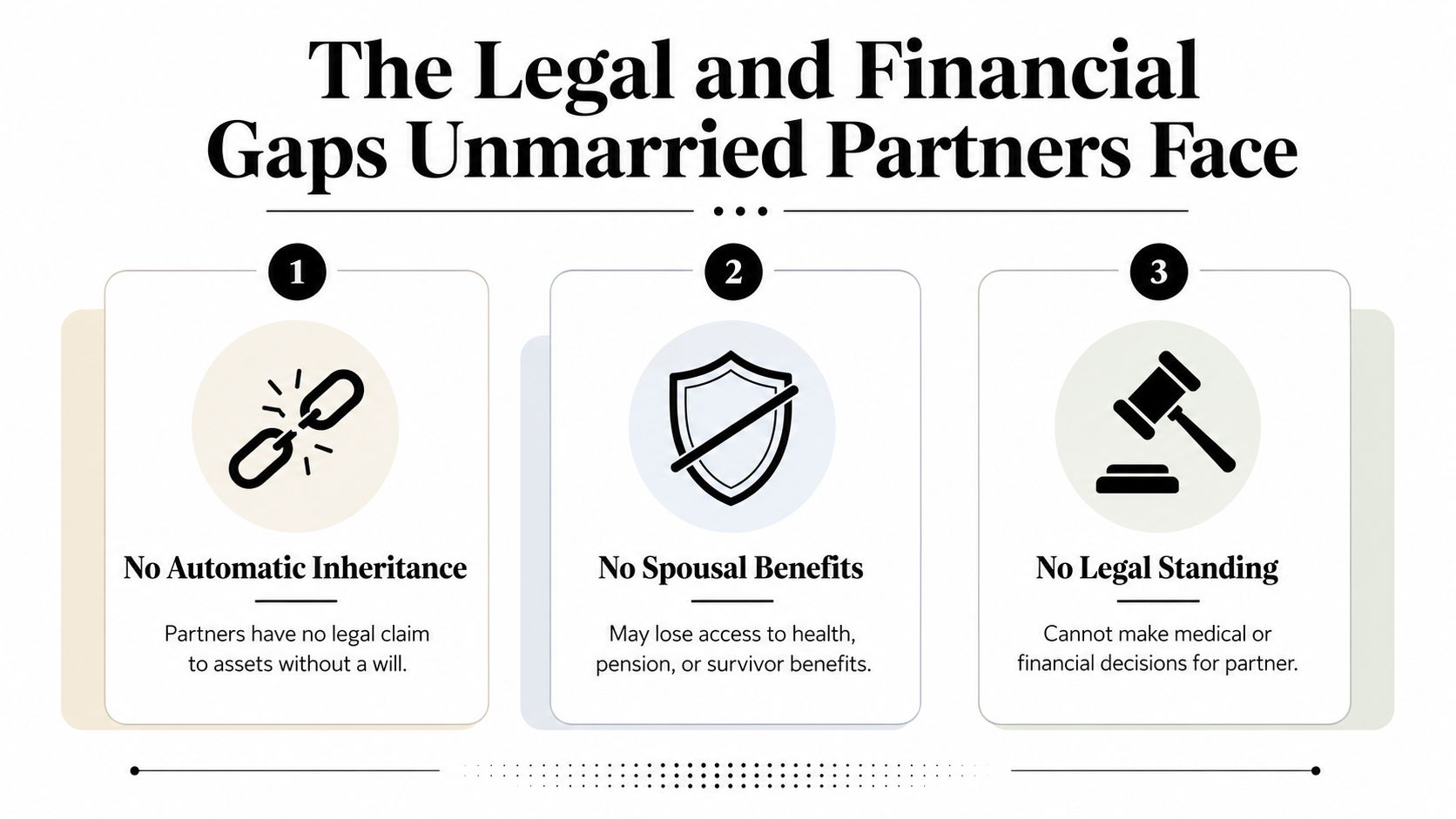
Buying a policy does not fix the legal gap by itself. If you and your partner are unmarried, the payout can still miss the person it was meant to protect unless the beneficiary form, will, and estate plan all line up. That is the part couples overlook, then they are surprised when the money gets delayed, redirected, or pulled into the estate.
The bigger mistake is assuming “we live like spouses” means the system will treat you like spouses. It does not. In the UK, research cited by SVWM says more than 2.4 million cohabiting families do not have life insurance, and 73% of cohabiting families lack a policy compared with 56% of married couples. That gap is a warning sign, because unmarried partners usually have to build their own protection instead of relying on the legal defaults that marriage gives automatically (SVWM).
What the law does not do for cohabiting partners
Unmarried partners often do not inherit automatically, and they may not receive the same state benefits a spouse could access. If the home is in one name only, or if the will is out of date, the surviving partner can be left with no direct claim to assets. A surviving partner may also face 40% inheritance tax on inherited assets above £325,000 unless the estate is arranged differently, which is why ownership records and wills matter as much as the policy itself.
The money problem does not stop with inheritance. A life insurance payout only solves the right problem if it reaches the surviving partner directly and quickly. If the policy pays into the estate, or if the beneficiary designation is missing, outdated, or vague, the survivor can end up waiting while bills keep coming due.
The law does not care how committed you feel. It cares what is on the forms.
That is why beneficiary design is the first thing to get right. A UK survey of 2,000 adults found 43% of people in unmarried relationships said their partner had made no plans to ensure they were legally entitled to a life insurance payout, and only 52% knew whether their partner even had a policy. Among those who did know, 27% did not know the policy's value (Healthcare and Protection).
For couples who own, or plan to own, property together, the risk gets sharper. The same analysis reported only 23% would rely on a partner's life insurance if the partner died or became terminally ill, while 24% would sell the joint property, 8% would depend on family or friends, and 5% would risk repossession (Healthcare and Protection).
If you are also working through broader coverage decisions, the domestic partner health plan options page from Pounds Health Insurance is a useful companion to the life cover discussion, because health benefits, beneficiary choices, and estate planning should be handled together.
One more point that many guides skip. Joint cover can suit some couples, but it changes how the money is paid and who controls it. Before you choose that route, compare it with joint life insurance policy structures and make sure the payout setup still matches your actual ownership, debt, and inheritance plan.
Choosing the Right Policy Structure for Your Relationship
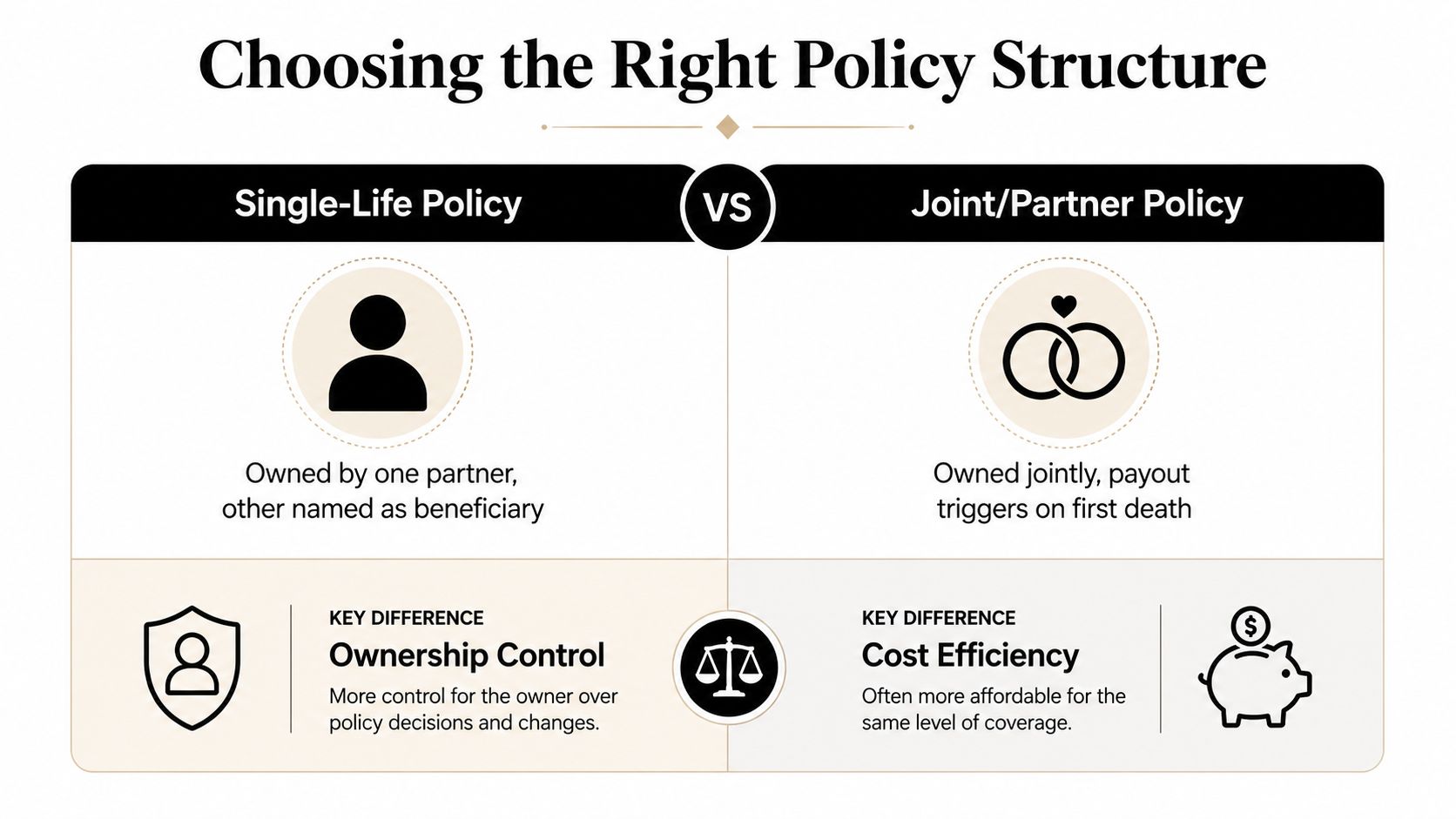
For most unmarried couples, the cleanest setup is single-life ownership with beneficiary designation. One partner owns the policy, pays the premiums, and names the other partner as beneficiary. That structure usually avoids the extra underwriting friction of proving insurable interest while still sending the death benefit directly to the person you're trying to protect (Progressive).
Single-life ownership is usually the sharper tool
This is the structure I'd start with unless there's a specific reason not to. It's straightforward, easier to maintain, and less likely to create delay when the claim is filed. For many cohabiting couples, that simplicity matters more than anything else, because the payout is supposed to solve a cash problem, not create a paperwork project.
There is a catch. In most markets, you can name an unmarried partner as beneficiary without proving insurable interest, but taking out a policy on a partner usually requires proof of financial interdependence, like a joint mortgage, shared debts, or cohabitation records (Progressive). That's not a moral test. It's an underwriting one.
When joint or partner-owned policies make sense
Joint or partner-owned policies can work in tighter, more integrated financial setups, but they come with more moving parts. The ownership question matters, the claim trigger matters, and the documentation matters. If your goal is speed and clarity, I'd usually favor the simpler ownership path over a structure that asks the insurer to sort out more moving pieces later.
If you want a deeper look at the mechanics of shared coverage, the guide on joint life insurance lays out the main structural tradeoffs. Use that kind of comparison before you sign anything.
Bring the right paperwork to the conversation
If your application depends on showing financial interdependence, gather the documents early. Joint lease agreements, mortgage statements, shared debt records, and cohabitation proof can all support the case. Don't wait until underwriting asks for them, because delays often come from missing proof, not from the coverage itself.
How Much Coverage Do Unmarried Couples Actually Need
A lot of people start with a blunt income multiple and call it a day. That's lazy planning. The better question is how long your partner would need help if your income vanished, and what bills would still keep arriving.
Use the income multiple as a floor, not the finish line
A common rule of thumb is 5 to 10 times annual income (M Life Insurance). I like that as a starting point, not a final answer. It gives you a rough number, but it doesn't account for a split-income household, joint debts, or the way cohabiting couples often rely on one another without combining every financial account.
The better method is to total the things your partner would still have to fund alone. Shared living costs matter. So do debts. So does the number of years support would be needed.
Build the number from actual obligations
If one partner covers a bigger share of rent, childcare, or loan payments, the policy should reflect that imbalance. If you run a business together, the coverage conversation should include business debt and transition costs. If one of you would need time to reorganize housing or childcare, that time belongs in the number too.
Bottom line: Coverage should match the survivor's cash need, not a textbook formula.
Here's a simple way to consider it:
| Coverage Calculation Scenarios for Unmarried Couples | Annual Income | Shared Debts | Years of Support Needed | Recommended Coverage |
|---|---|---|---|---|
| Primary earner, partner relies on income | Use the higher earner's income as the base | Include all shared debt balances | Choose the years the survivor would need to stay stable | Start with the income multiple and add debt and support needs |
| Split-income household, both contribute evenly | Use combined income only if one death would strain the household | Include mortgage, car loans, and shared credit | Estimate the time needed to adjust housing and spending | Combine debt payoff with several years of replacement income |
| Partner with children and shared household costs | Use the partner whose income is hardest to replace | Include childcare-related obligations and debts | Cover the years needed to cover care and household transition | Increase beyond the income multiple if responsibilities are ongoing |
If you want a calculator-style approach, the guide on how much life insurance do I need is a decent place to sanity-check your number, then refine it based on your actual life.
Beneficiary Mistakes That Could Cost Your Partner Everything
Buying the policy is the easy part. The payout is where couples get sloppy. A policy that names the wrong person, names no one clearly, or uses outdated paperwork can leave the survivor with nothing, even though premiums were paid for years.
The beneficiary form beats your assumptions
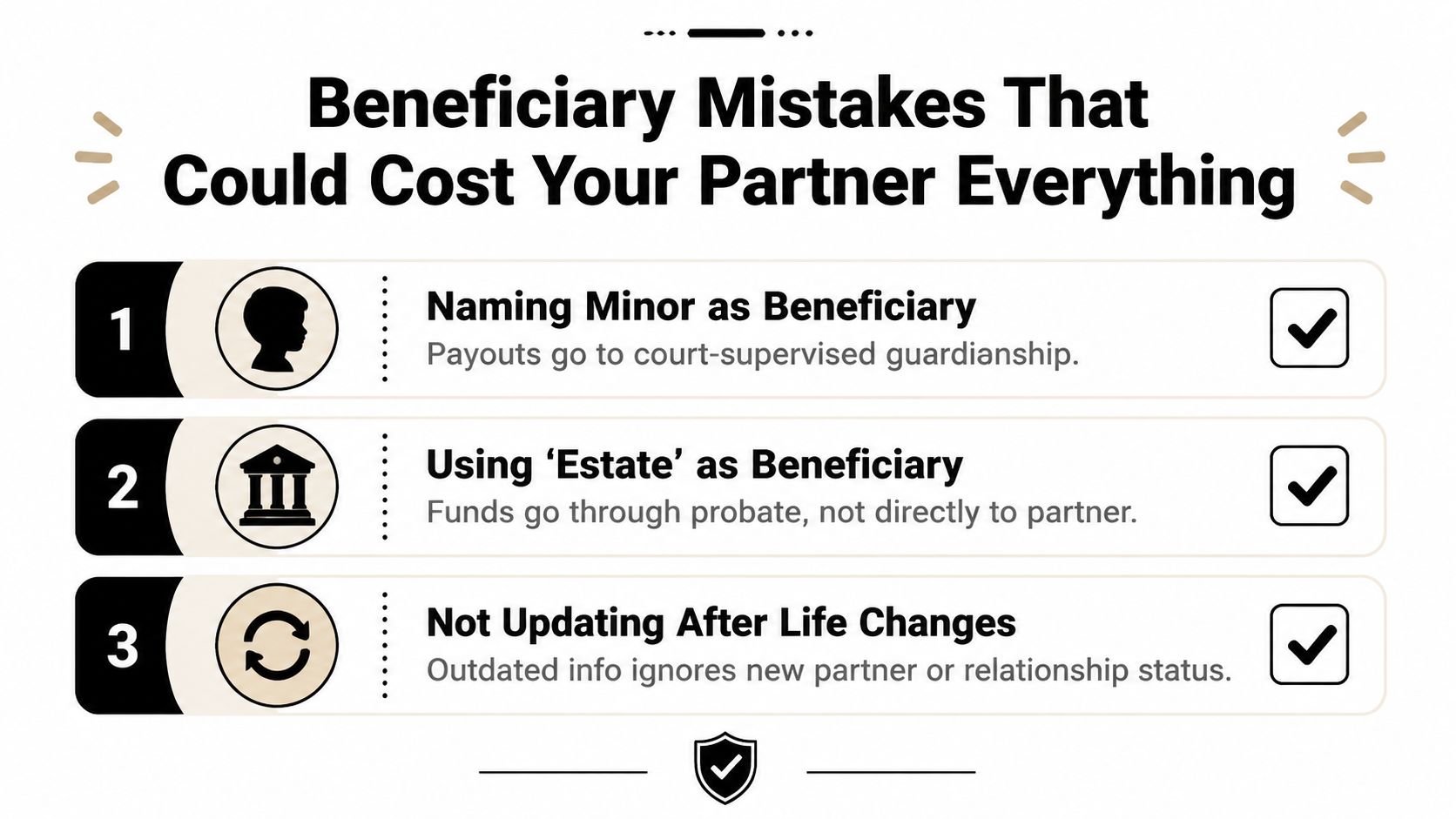
A survey reported by Corporate Adviser found that almost half of unmarried couples could miss a life insurance payout because their partner was not named as beneficiary (Corporate Adviser). That's the ugly truth most guides dodge. People focus on eligibility and ignore the beneficiary line, which is the line that decides who gets paid.
If you use “estate” as beneficiary, you've invited probate into the process. If you forget to update the form after a breakup, a move, or a new family structure, the policy can still point to the wrong person. If you name a minor, you've just pushed the payout into court-supervised guardianship, which is the opposite of fast and clean.
For a practical walkthrough on fixing the form itself, the guide on how to change life insurance beneficiary is worth keeping handy.
Update the paperwork when life changes
The biggest mistake isn't a bad first draft. It's never revisiting the file. Unmarried couples change houses, income splits, and relationship status just like everyone else, but the policy doesn't update itself. Neither does the will.
Keep your beneficiary form, will, and property documents in the same conversation. If one changes, review all three.
Here's the mindset I'd use: every time your living situation changes, check whether the money would still go to the person you intended. If the answer is anything other than a clean yes, fix it immediately.
Setting Up Your Life Insurance Policy Step by Step
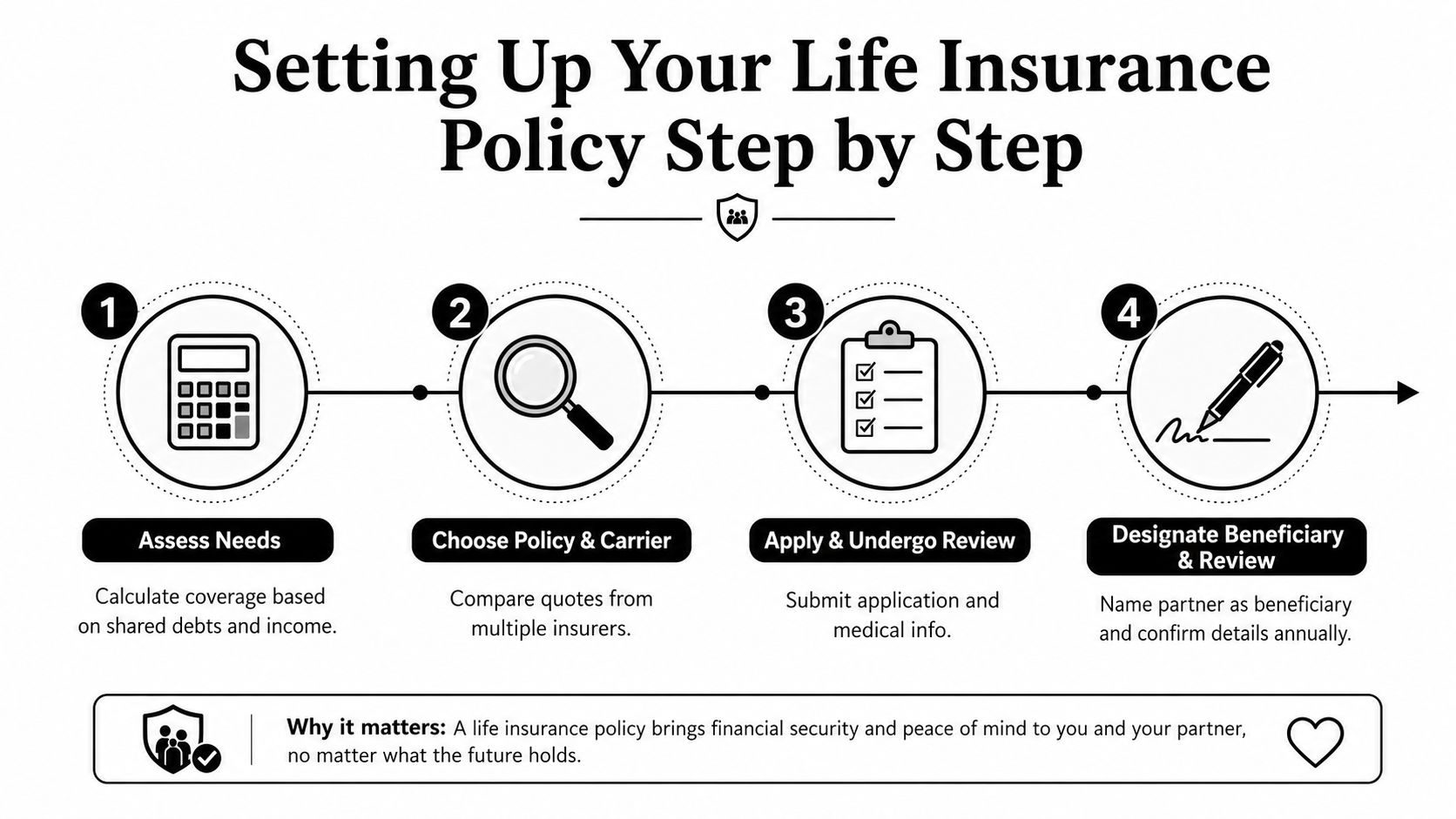
Start with the structure, not the sales pitch. One partner owns the policy, the other is named as beneficiary, and the documents supporting that setup are kept current. That's the core move for most unmarried couples, because it keeps the claim path direct and avoids unnecessary friction.
Step 1, match the policy to the household
Look at who pays what, who depends on whose income, and which debts would survive a death. If one of you would struggle to stay in the home alone, that cost belongs in the coverage amount. If the relationship is financially interdependent, the policy should reflect that reality rather than a vague idea of fairness.
Step 2, apply with the right ownership structure
If you're buying a policy on your own life, the application is usually simpler. If you're buying coverage on your partner, be ready to show financial interdependence through shared leases, mortgages, debts, or cohabitation records (Progressive). That step isn't bureaucratic fluff, it's what keeps the insurer from questioning whether the coverage is legitimate.
Step 3, name the beneficiary clearly
Use the actual person, not a vague label. If you want your partner to receive the money, put your partner on the form. Then make sure the will doesn't contradict the policy, because mixed instructions create confusion right when clarity matters most.
Step 4, consider a trust if probate would slow things down
In the UK, practitioners commonly recommend placing the policy in trust so the proceeds bypass probate and reduce payout delay and estate-administration risk (Life Cover For You). That's especially useful when the survivor needs access to funds quickly to handle housing, debt, or household expenses.
Step 5, review it after major life events
A breakup, move, refinancing, or new child should trigger a policy review. The file has to follow your life, not your old assumptions. If your partner is still the person you want protected, the paperwork should say so without ambiguity.
Protecting Your Partner Beyond the Policy Payout
A policy can look solid on paper and still fail your partner at the point of claim. That happens when the beneficiary form, the will, the trust, and the rest of the estate paperwork all point in different directions. For unmarried couples, that mismatch is where payouts get delayed, redirected, or swallowed by avoidable estate issues.
Build the estate plan around the relationship you actually have
If you live together and rely on each other, the paperwork has to reflect that reality. Unmarried partners do not get the legal shortcuts married couples often assume, so a death can trigger tax and inheritance problems that catch people out after the fact. The answer is to treat life cover as one part of the wider estate plan, not as a standalone purchase.
A will is not optional here. Without one, the law decides who gets what, and that can leave the surviving partner exposed if the home, savings, or debts sit in one name only. Even where the policy pays out, the money may not be enough on its own if the rest of the estate is badly arranged.
Make sure the documents agree with each other
The beneficiary form, the will, and any trust need to tell the same story. If they conflict, you create confusion right when your partner needs certainty. Keep the beneficiary named clearly, keep the will updated, and make sure any trust is set up to match the way you want the money handled.
If you want to check whether your wider setup is consistent, use a tool like run a digital relationship check before you compare policies. It does not replace proper estate planning, but it can surface the kind of record errors and mismatches that create problems later.
A policy only protects your partner if the legal paperwork backs it up. Get the ownership right, keep the beneficiary current, use a trust where probate would slow access to the money, and make sure the will does not contradict the policy. That is what turns life insurance from a promise on paper into money your partner can use.