Life Insurance Funeral Costs: A Practical Planning Guide
$8,300 for a burial with viewing and $6,280 for cremation. That's the price band families should start with, and it's why life insurance for funeral costs is first a cash-flow problem and second a policy-size problem.
A young family doesn't need a vague promise. You need a plan that covers the bill your loved ones will face, in the market where they live, at the moment the funeral home wants payment.
Table of Contents
- What Funerals Actually Cost in 2026
- Anatomy of a Funeral Bill
- How Life Insurance Products Fit Funeral Costs
- Sizing Coverage for a Household
- Claims, Payout Timing, and the Cash Gap
- Life Insurance vs Prepaid Plans vs Savings vs Benefits
- Two Real-World Coverage Scenarios
- Your Next Steps This Week
What Funerals Actually Cost in 2026
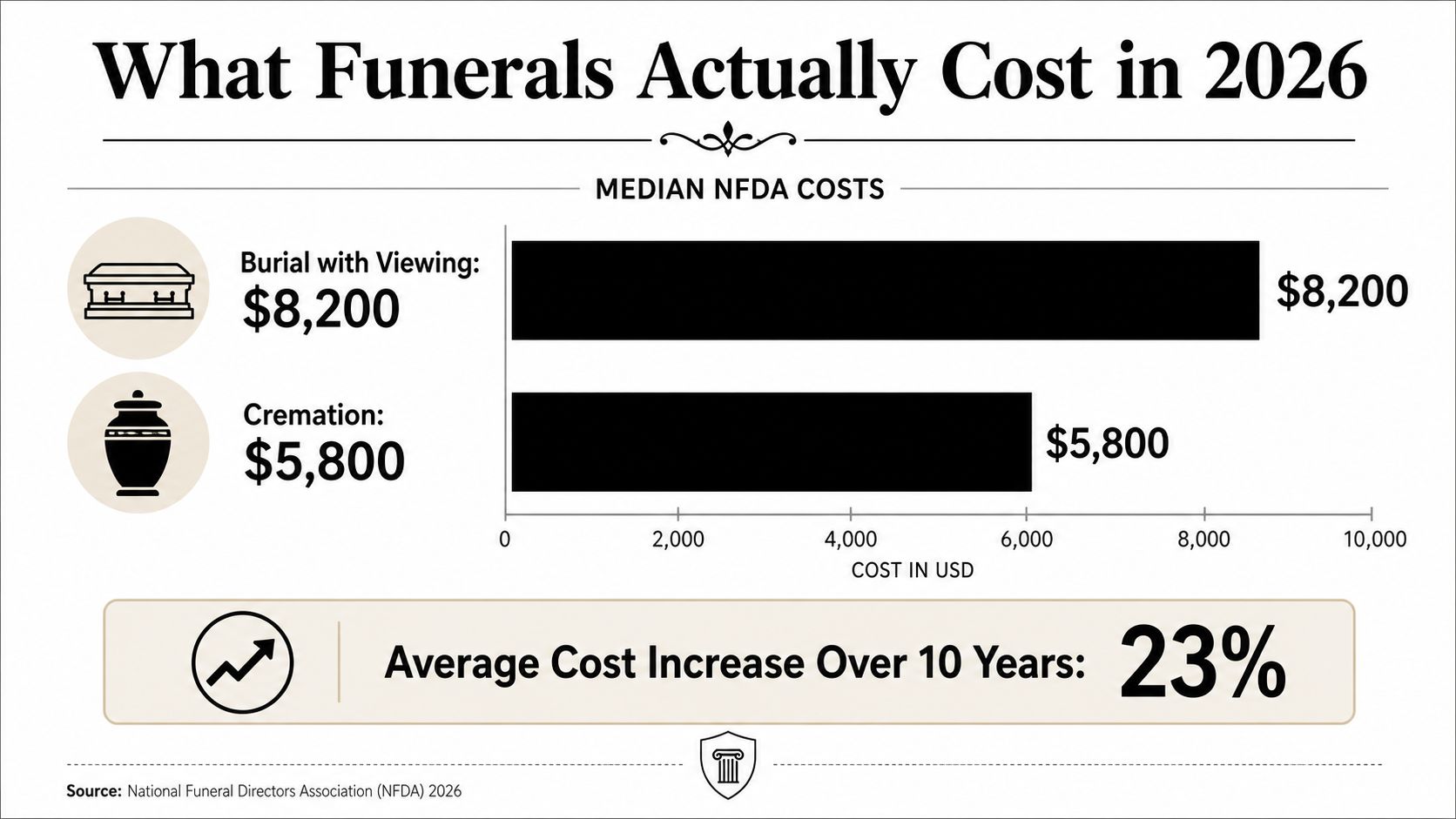
The number that matters most is still the one families feel immediately. The National Funeral Directors Association reported that the median cost of a funeral with viewing and burial was $8,300 in 2023, while a funeral with viewing and cremation was $6,280. Those figures were up from $7,848 and $5,810 in 2021, which means the pressure didn't disappear, it grew, and families who delay planning are starting from a worse place than they were a few years ago. Trustage's summary of NFDA final expense data gives the same core benchmark.
Start with the funeral, then widen the lens
That funeral bill sits inside a larger end-of-life cost picture. MoneyGeek reported that the average total end-of-life cost in the U.S. was $88,300 in 2025, made up of about $80,000 in final-year medical expenses plus $8,300 for burial with viewing. The point isn't that every family will face that exact total, it's that the funeral is often the first bill to land, not the only one that matters. MoneyGeek's end-of-life cost breakdown makes that layering obvious.
Regional pricing matters too. The same source noted that Northeast burial costs average $8,500 to $9,000, while the South ranges from $6,700 to $8,000. A family in Dallas should not size coverage off a New York assumption, and a family in Boston should not plan as if they live in a lower-cost market. Find affordable funeral coverage if you want a starting point that reflects real price pressure instead of wishful thinking.
Practical rule: If you want a policy that actually solves the problem, anchor it to your local funeral market first, then add a buffer for medical bills or travel costs only if your household needs it.
The cleanest takeaway is simple. Burial costs more than cremation, regional prices swing meaningfully, and the funeral bill is only the front edge of a much bigger financial hit. If you're buying insurance for this purpose, start with the funeral number, not a round guess pulled from nowhere.
Anatomy of a Funeral Bill
A funeral bill looks like one line item on a brochure, but it's really a stack of separate charges. Some are fixed by the service you choose. Others are optional, but they're easy to say yes to when emotions are high and everyone is under pressure.
What gets added to the base price
The funeral home's professional service fee is usually the first layer. Then comes the body preparation, use of facilities for viewing or ceremony, transportation, and paperwork. A casket or rental casket can move the total sharply, and cemetery-related costs can add more if burial is chosen. Obituary notices, flowers, and certified death certificates can also sit on top of the core bill.
Direct cremation changes the shape of the bill, but it doesn't erase the need for cash. You may avoid the viewing, burial equipment, and cemetery charges, yet you still have provider fees, transportation, and required documentation. The result is lower than a traditional burial, but not free, and not something a family should try to cover casually out of pocket while grieving.
The biggest mistake is confusing “cheaper than burial” with “cheap enough to ignore.” Cremation trims the bill, it doesn't remove the liquidity problem.
This is why final expenses should be treated as a bundle of charges, not one number. Families can trim flowers, choose a simpler service, or skip certain add-ons, but the total can still land in the thousands quickly. That's also why insurance sized for funeral costs works better than trying to negotiate line by line while you're emotionally drained.
The smart move is to separate non-discretionary charges from the extras. If the family knows which items are mandatory, they can make calm decisions about the rest instead of approving every add-on because the room is moving fast. That discipline matters more than any brochure promise.
How Life Insurance Products Fit Funeral Costs
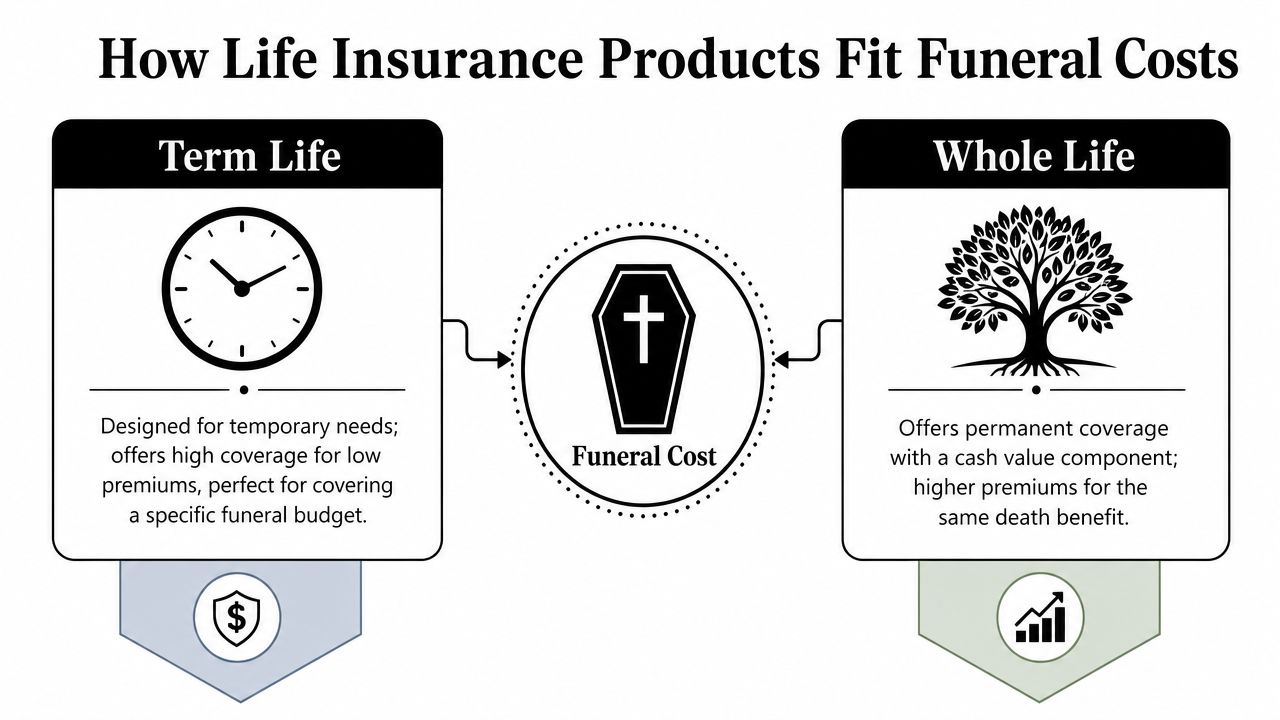
Not every policy is built for the same job. If the goal is to cover funeral costs, I'd judge each product by one question, how well does it solve a near-term bill without wasting money?
Term life fits broad family protection
Term life insurance is the cleanest option for young families who already need income replacement. It gives you a larger death benefit for a lower premium than permanent coverage in many cases, and that benefit can cover the funeral bill along with mortgage payments, child care, or debt. It's the flexible option when funeral costs are only one piece of the risk picture.
Whole life fits lifetime certainty
Whole life insurance is permanent coverage with a cash value component. That makes it more expensive for the same death benefit, but it also gives you coverage that doesn't expire after a set term. If your goal is to guarantee that money exists for end-of-life expenses no matter when death happens, whole life can do that.
Burial insurance fits the funeral bill most directly
Final-expense and burial policies are usually small whole-life contracts with face amounts often in the $5,000 to $25,000 range, level premiums, and lifetime coverage. MoneyGeek's explanation of final-expense policy structure makes the design clear. These policies are built for funeral costs first, which is exactly why they're popular for families who want a dedicated pool of money without buying more insurance than they need.
That said, the beneficiary still controls the payout unless the policy is formally assigned in another way. So even when the amount is sized perfectly, the coverage still has to clear the timing hurdle covered later. The policy type matters, but the payout mechanics matter just as much.
Sizing Coverage for a Household
Sizing coverage is straightforward if you stop overcomplicating it. Take the local funeral cost, add only the other expenses you want covered, then subtract any cash already set aside for the job.
A simple way to calculate the number
Use this formula in plain English, funeral cost in your area plus other end-of-life expenses minus available cash or prepaid coverage. If you're a young family with kids and a mortgage, the funeral number is not enough on its own, because you may also want a larger death benefit for income replacement. If you're single and only want burial protection, the funeral number can be the main target.
A family in a higher-cost region should not underbuy because a national median looked tolerable. A family in a lower-cost region should not overpay for excess coverage they won't use. The point is to buy the amount that closes your actual gap, not the amount that sounds safe in the abstract.
Regional ranges make the target move
| Region | Burial with Viewing | Cremation with Viewing | Direct Cremation |
|---|---|---|---|
| Northeast | $8,500 to $9,000 | Qualitatively higher than lower-cost regions | Qualitatively lower than burial |
| South | $6,700 to $8,000 | Qualitatively lower than Northeast markets | Qualitatively lower than burial |
These regional differences are why coverage calculators matter. A policy sized for a Southern burial may come up short in a Northeast market, and a policy sized for a large urban funeral could be more than a family needs elsewhere. If you want a cleaner framework for deciding how much life insurance you need, this coverage guide is a useful place to pressure-test your own number.
Bottom line: If funeral costs are the only target, buy just enough to cover the service, plus a small cushion. If the policy also has to protect your household income, separate those goals and size them independently.
That's the mistake too many families make. They blur funeral protection into broad life insurance planning and end up either underinsured for the bill or overpaying for coverage they don't need.
Claims, Payout Timing, and the Cash Gap
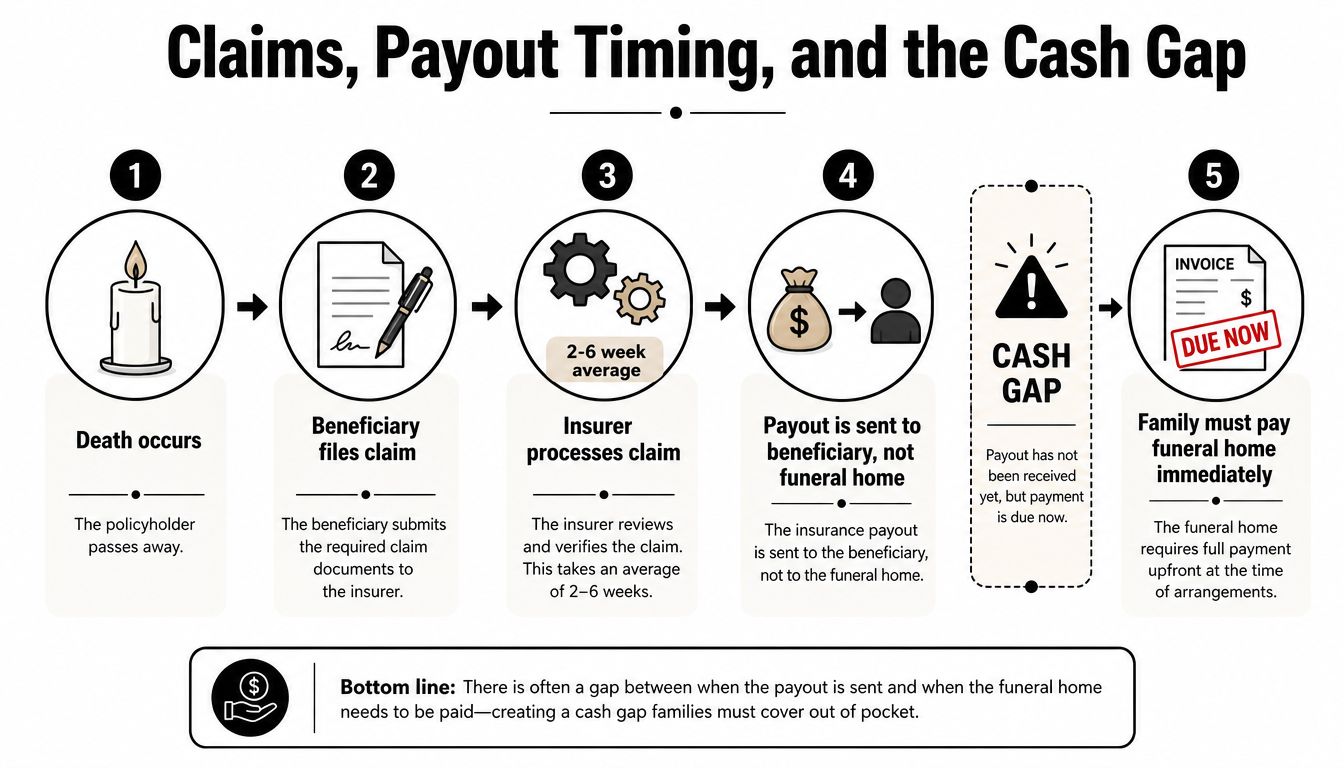
Life insurance usually pays the named beneficiary, not the funeral home. That means the family still has to manage the bill before the money lands, and that's where good planning breaks down if nobody has near-term cash.
What has to happen after a death
The family notifies the insurer, submits the death certificate and claim form, and waits for review. In practice, the bottleneck is rarely the idea of coverage, it's paperwork, timing, and whether the household has cash on hand while the claim is being processed. This payout timing guide is worth reviewing before you assume the money will arrive instantly.
The short version is blunt. If the funeral home expects payment before the insurer releases funds, the family needs a bridge. That bridge can be a payment plan, a credit card, or a small emergency reserve, and each one is better than scrambling while a grieving spouse tries to make financial decisions on the spot.
The cash gap is the real risk
This is the part most policy discussions skip. A benefit that is large enough on paper can still fail in practice if nobody can pay the funeral home immediately. That's why final-expense planning should always include a simple question, who pays the upfront invoice if the claim takes longer than expected?
You can't hand-wave that away. The beneficiary may have the right to the money, but the funeral home still needs cash now. If your household doesn't have even a modest reserve, the payout structure, not the policy size, is what determines whether the plan works.
Life Insurance vs Prepaid Plans vs Savings vs Benefits
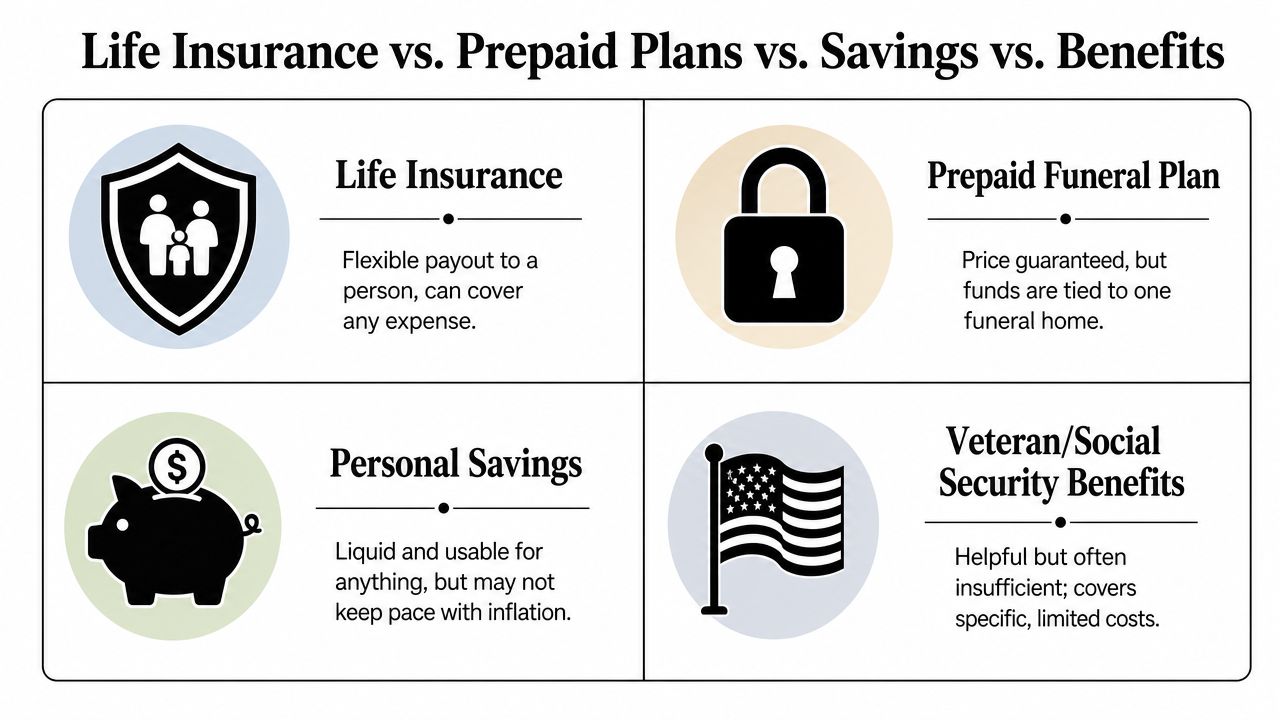
Life insurance, prepaid plans, savings, and limited government benefits each solve a different problem, and pretending they're interchangeable leads to bad decisions.
What each tool does best
Life insurance is the most flexible tool. The beneficiary gets the payout and can use it for the funeral, rent, debt, or anything else urgent.
Prepaid funeral plans lock in a service and a provider, which can solve the timing problem cleanly if your household can't maintain a reserve. The trade-off is flexibility, because the money is tied to one provider and one arrangement.
Personal savings are the most liquid choice. They're available immediately, but you have to keep the money parked and resist using it for something else.
Government benefits can help in limited situations, but they're not a full funding plan. If you're also sorting through an estate, this probate sale guide can be useful for turning household assets into cash, but that's a separate process from funeral funding itself.
A useful comparison page is this guaranteed life insurance resource if you're trying to understand how permanent coverage differs from a prepaid arrangement.
The right answer depends on the household's risk profile. If you want maximum flexibility, insurance wins. If you want a locked-in service and don't care about broader use, a prepaid plan can make sense. If you already have cash sitting idle, savings may be enough. If you want the most reliable answer for a family that needs both speed and usefulness, sized life insurance is usually the best fit.
Two Real-World Coverage Scenarios
A young married couple with a toddler and a mortgage should not buy funeral coverage in isolation. They should buy enough term life insurance to replace income, then add a small final-expense layer or dedicated burial policy so the funeral home doesn't become an immediate cash crisis. Their target is the household's true gap, not just the service bill.
For a single thirty-something professional with no dependents but aging parents, the job is narrower. A small final-expense policy can handle funeral costs, and a modest term policy can clear any debt the family doesn't want to inherit. The goal here is not to overbuy, it's to keep the estate from turning into a burden.
The monthly premium depends on age, health, and policy type, but the planning logic is the same. Start with the funeral number, then decide whether you're also protecting income or debt. If you're not, keep the policy small and direct.
A policy should match the job you gave it. If it has to cover a funeral and nothing else, don't pay for more insurance than that job requires.
The next move for either household is simple. Get a quote that matches the budget, not the fantasy budget, and make sure the beneficiary information is up to date before anyone needs it.
Your Next Steps This Week
Pull the last two years of funeral-related receipts or estimates. That tells you whether your family leans toward burial or cremation, and it gives you a real anchor instead of a guess. Check: you can name the service you'd choose.
Set your target number using your local market, then decide whether you want funeral-only coverage or broader income replacement. Check: you can say the number out loud without hedging.
Request a no-exam quote from a digital provider and compare that premium to what you already spend each month on non-essentials. Check: you know what the policy would cost.
Confirm the beneficiary, the claim contact, and where the policy document lives. Check: your spouse or parent could find it in under a minute.
A CTA for Coveredly. If you want a quote that fits your actual funeral budget and doesn't force your family into a cash scramble, start there and lock in the coverage while you're healthy enough to choose it.