If skipping the exam is supposed to make life insurance no exam easier, why do so many healthy buyers still end up paying more for less protection? The label sounds like a simple yes. In practice it is an eligibility pathway, and the price you pay over a full term can move the wrong way if you never compare it with an exam-based quote.
Table of Contents
- What No-Exam Life Insurance Actually Means
- No-Exam, Simplified and Traditional Policies Compared
- Pros and Cons of Skipping the Medical Exam
- Who Typically Qualifies for No-Exam Coverage
- What Drives the Price of No-Exam Policies
- Two Households, Two Different Answers
- Confirm the Right Path Before You Apply
What No-Exam Life Insurance Actually Means
No-exam life insurance is coverage an insurer may approve without a paramedical exam. That usually means no blood draw, urine sample, or nurse visit at home or work.
How does an insurer assess risk without an exam? It can review your application alongside records it already uses, much like a lender assessing a mortgage application from financial records rather than an in-person visit. This approach is often called accelerated underwriting. Predictive models or machine learning can replace some or all of the traditional underwriting steps, allowing eligible applicants to skip an exam and fluid collection.
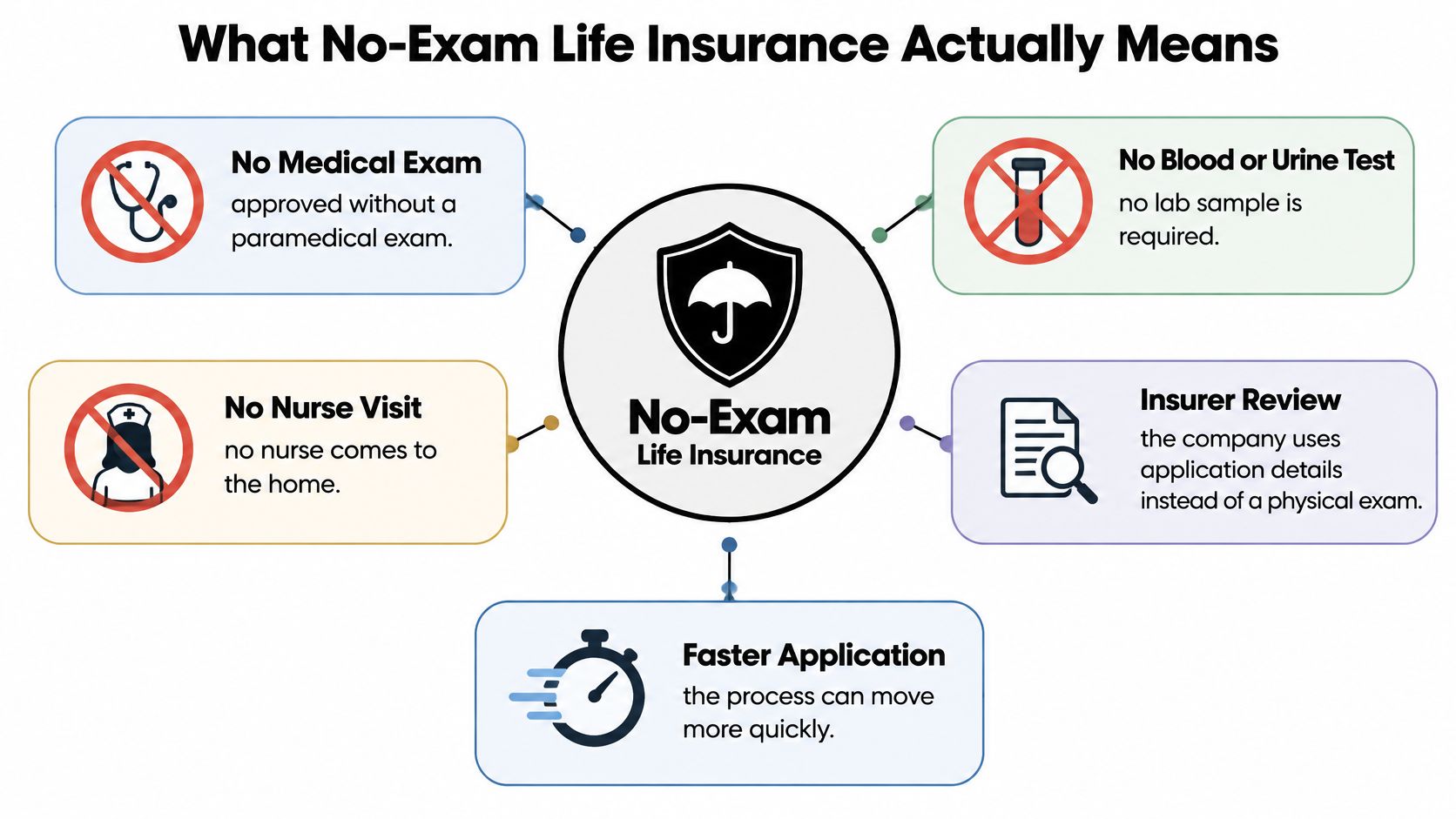
The insurer may compare your answers with prescription history, motor-vehicle records, medical-information databases, and electronic health data. Many policies are approved using digital underwriting and health data, so an exam may not be needed. Consistent records can help the review move quickly. If the information is incomplete or falls outside the insurer's criteria, it may request an exam or medical records, or use traditional underwriting instead.
Three points the label hides
No exam does not mean no underwriting. The insurer still assesses risk; it relies on records and data instead of a physical exam. That assessment affects eligibility, premiums, and the amount of coverage offered. For a healthy applicant, skipping the exam can mean paying more over the full term than with an exam-based policy.
Access to coverage is also part of the picture. The 2024 LIMRA and Life Happens Insurance Barometer Study surveyed nearly 5,000 household financial decision-makers. 51% of adults reported owning life insurance, down from 63% in 2011. Meanwhile, 42% of adults, about 102 million people, said they needed coverage or more of it.
Guaranteed-issue coverage is different from accelerated underwriting. Approval is close to automatic, health questions are limited or absent, and the benefit is usually small. No-exam accelerated coverage still involves an assessment of your risk.
If prescription, motor-vehicle, or other records do not provide enough information, the insurer may delay a decision, request an exam or records, change the risk class and premium, or move the application to traditional underwriting. That is not necessarily a decline, but it can change the terms.
Before comparing quotes, check three details:
- Pathway, not a promise. Ask whether “no exam” means accelerated underwriting, simplified issue, or guaranteed issue.
- Fallback in writing. Ask what happens if the available data are insufficient and whether you can withdraw without a penalty.
- Same benefit, same term. Compare the same coverage amount and policy term, since both affect the value and cost of the offer.
No-Exam, Simplified and Traditional Policies Compared
| Feature | No-Exam (Accelerated) | Simplified Issue | Fully Underwritten |
|---|---|---|---|
| Medical exam or fluids | Often waived if data pass | Usually not required | Usually required |
| Data used | Application, prescriptions, motor-vehicle and health databases | Application health questions | Exam, lab tests, medical records and application |
| Typical decision time | About 9 days on average (LIMRA) | Often a few days | About 27 days on average (LIMRA) |
| Premium for healthy applicants | Often higher than fully underwritten | Typically higher | Usually lowest |
| Coverage amount | A carrier face-amount cap you should read on the quote | Often a lower cap | Often the highest available face amount |
| Risk of extra requirements | Exam may be requested if data are unclear | Low once questions are accepted | Requirements are already part of the file |
The two rows that surprise first-time buyers are speed and price.
LIMRA reports that three out of four life insurers in the United States and Canada have an automated or accelerated underwriting program, and one in two has both. Insurers in that research reported an average of three days from a complete application to the medical questionnaire or interview, versus eight days under traditional underwriting. The average time to a final decision was nine days through automated or accelerated underwriting versus 27 days through traditional underwriting. The time saved is real. It is not the same thing as guaranteed approval, and a paramedical exam can still appear if your profile doesn't fit the program rules.
Price runs the other direction for many healthy applicants. Simplified issue usually skips exams and fluids, then charges more and caps the death benefit lower. Fully underwritten coverage, with labs and records, is where a healthy non-smoker most often lands the lowest rate class and the largest face amount. Accelerated underwriting sits between them. It can cost more than an exam-based policy for someone in strong health, and it is faster and less invasive.
Those cells describe typical patterns, not one carrier's rulebook. Read each quote for the cap, the class, and any conversion option. If you want a closer look at the middle path, our guide to simplified issue life insurance separates health questions from a full medical file. Compare the same coverage amount and the same term across all three paths before you treat speed as the winner.
Pros and Cons of Skipping the Medical Exam
Pros
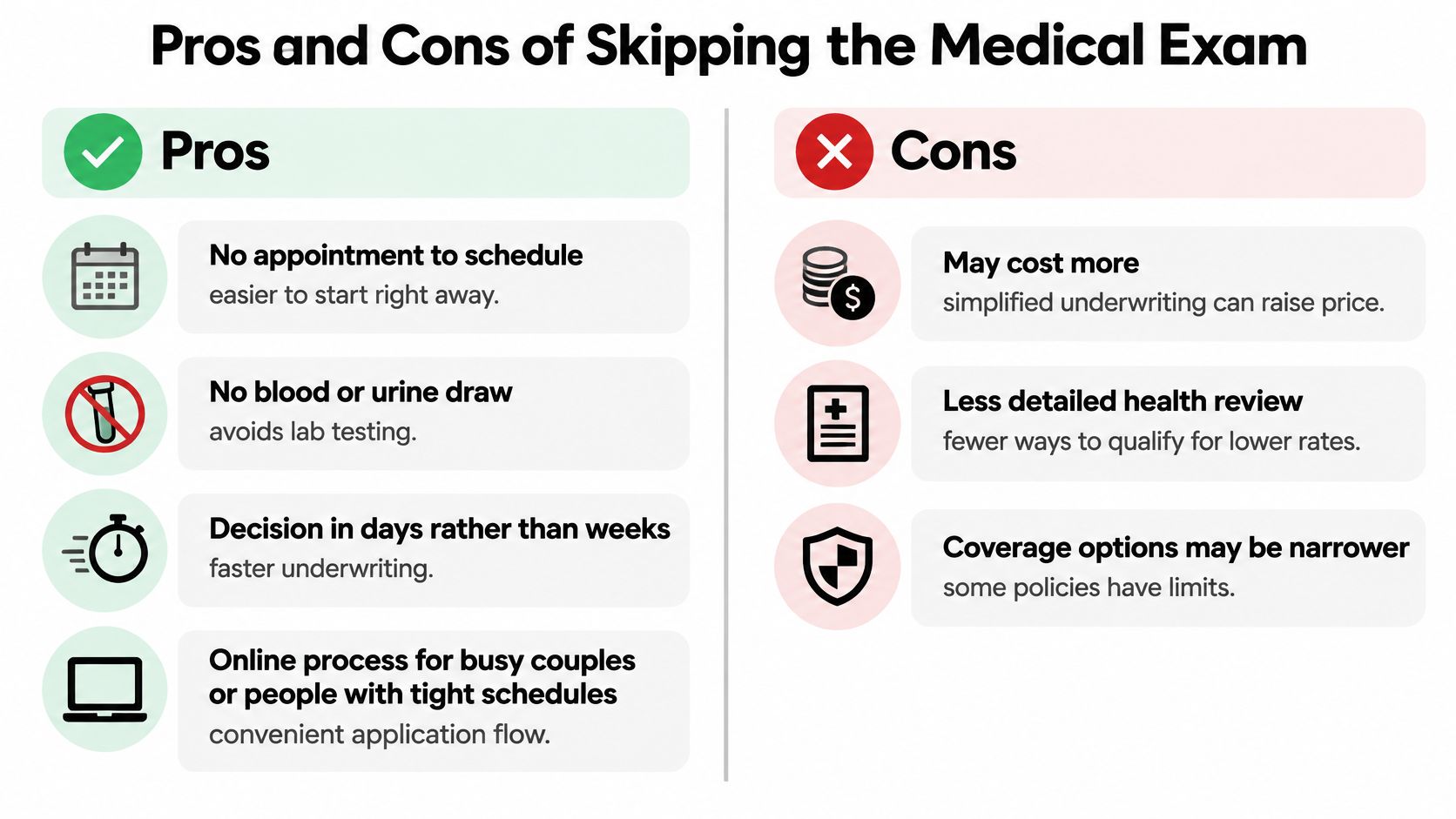
- No appointment to schedule: You can start from a laptop after the kids are in bed.
- No blood or urine draw: There is no lab visit and no fasting.
- A decision in days rather than weeks: Busy couples and people who dread exams can finish without blocking a calendar.
- An online flow: The application stays digital from the first questions through the decision for most files.
Cons
- A healthy applicant may pay more than with an exam that documents a preferred class.
- Approval can flip into a referral for an exam or records when the data don't match.
- Coverage limits can be lower, so the policy that felt easy may not replace income or a mortgage.
The graded-benefit trap
The serious miss is treating every exam-free policy as high-limit term. The New York Department of Financial Services describes senior life insurance, also called graded-death-benefit coverage, as minimal whole life sold without a medical examination. If the insured dies in a set early period, generally the first two or three policy years, the payout is often only a return of premium or a minimum graded benefit. Permissible issue ages run from 50 to 75, and the maximum issue amount is $25,000. The agency also says these policies are usually more expensive than fully underwritten coverage when the applicant qualifies as a standard risk.
That product can fit a final-expense need. It is not a stand-in for term coverage meant to carry a mortgage or childcare. A waiting period, a graded benefit, a low ceiling, or a higher price should be visible on the illustration before you pay.
Coverage typically begins once the policy is approved and the first payment is processed. Ask any carrier three questions. Is the full death benefit payable from day one? What is the maximum amount? What happens, including timing and price, if an exam is requested?
Who Typically Qualifies for No-Exam Coverage
The record that does the most work is the pharmacy file. LIMRA reports that prescription-drug databases are the most common electronic data source among insurers with accelerated underwriting programs: 83% of those insurers use prescription data. The median hit rate is 90%, so the insurer finds an applicant's prescriptions in about nine of ten searches. An accurate medication list is not optional. A blank answer next to a full pharmacy history is how a fast file turns into a slow one.
A typical application asks for basic personal info, health history, and lifestyle questions. Many carriers offer flexible underwriting options for people with pre-existing conditions, so a diagnosis is not an automatic decline. The path still hinges on how cleanly your answers match the databases.
| Applicant Situation | Likely Path | What to Verify First |
|---|---|---|
| Healthy, no regular prescriptions | Often eligible for no-exam | Accurate lifestyle and driving answers |
| One controlled condition on one medication | Possible no-exam if the data match | Exact drug names, doses, and start dates |
| Multiple prescriptions or a recent hospital stay | Often referred to full underwriting | Whether an exam is required before a firm quote |
| Recent serious diagnosis such as cancer or a heart attack | Often referred, or limited to guaranteed issue | Eligibility rules for that condition |
| Tobacco or nicotine use | Often eligible, priced in a tobacco class | Declare use accurately, including vaping |
| Poor driving record | Possible referral off the accelerated path | Contents of the motor-vehicle report |
What to disclose before you hit submit
- Medications: Drug names, doses, and start dates, including drugs you stopped in the last few years.
- Diagnoses and hospital stays: Recent admissions, surgeries, and ongoing specialist care.
- Tobacco or nicotine: Cigarettes, cigars, pouches, and vaping, with the last-use date.
- Driving: Suspensions, DUIs, and multiple moving violations.
- Hobbies and travel: Scuba, aviation, climbing, or extended time abroad if the form asks.
Inconsistencies between the form and the records can change the risk class or trigger full underwriting. Our walkthrough of life insurance health questions shows how those answers are read. A healthy applicant with few or no prescriptions usually fits the no-exam path. A complex medical history more often ends in a referral, not a silent decline.
What Drives the Price of No-Exam Policies
No-exam coverage is not automatically cheaper. The National Association of Insurance Commissioners buyer's guide, as published for consumers, says a policy that asks for little or no detailed health information usually costs more and provides less coverage than one that uses a fuller medical review. The same guidance notes that a healthy consumer will generally receive a lower rate by completing the exam on a traditionally underwritten policy, while a no-exam guaranteed-issue policy is more often suitable for someone with medical problems.

The sticker shock people expect is often larger than the bill. The NAIC Life Insurance Buyer's Guide materials note that three-quarters of Americans overestimate life-insurance costs, and 66% of prospects cite perceived expense or competing financial priorities as reasons for not buying. A higher monthly draft on a thin-underwriting policy can still be the wrong trade if an exam would have opened a better class.
Six drivers that move the premium
Age at purchase and tobacco or nicotine use set the base. Health class is where the underwriting path shows up: fewer details often mean fewer ways to earn a preferred rate. Coverage amount and term length scale the bill. A common guideline is 10 to 15 times annual income, then adjust for the mortgage, childcare, education costs, and other debts. The underwriting path is the sixth driver. Accelerated, simplified, and fully underwritten files can price the same person differently.
Judge any two offers on the same death benefit and the same term by total premium across the full term. A smaller monthly draft can hide a lower cap, a shorter term, or a graded benefit. Carrier rules differ, so these are patterns, not a single national price. A side-by-side of life insurance cost per month keeps the comparison on total cost rather than the first invoice.
Two Households, Two Different Answers
These two households are illustrations, not quotes and not promised savings.
Maya is 34, a non-smoker with no regular prescriptions, a new mortgage, and plans for children. She finishes the application on a weeknight. The data check clears her without blood, urine, or a nurse visit, on a timeline closer to the faster automated average than a traditional file that can stretch for weeks. She still requests an exam-based quote for the same benefit and the same term. Fuller underwriting usually prices a healthy applicant lower, so she schedules the exam and does not treat the faster quote as her final cost.

Daniel is 36 and takes one daily blood-pressure medicine that has been controlled for three years. His prescription record matches the form, which matters because that database is the electronic source accelerated programs use most, and it is found in the large majority of searches. The insurer still asks for records before it sets the rate class. He is approved at a standard rate after the review. The file was delayed and checked, not rejected. A guaranteed-issue alternative would skip the questions, and it can cost more and pay less, including a return of premium or a graded benefit in the early policy years.
Maya's lesson is to price the exam path before she locks the convenient one. Daniel's lesson is that the drug list decides whether no-exam stays no-exam.
Confirm the Right Path Before You Apply
Accelerated life insurance no exam fits when you need a decision in days, an exam is a real barrier, or the need is modest. Fully underwritten coverage fits a healthy applicant who can attend an exam and wants the lower rate and higher cap that fuller information usually brings. Simplified or guaranteed issue fits only after the benefit, the graded period, and the dollar cap are clear. New York's senior example, issue ages 50 to 75 and a $25,000 maximum, is a warning case, not a personal quote.
- Match the pharmacy file. List every drug name, dose, and start date so a prescription search doesn't contradict the form.
- Pair the quotes. Place one no-exam quote beside one exam-based quote for the same amount and the same term.
- Read the whole contract shape. Compare total premium, maximum benefit, exclusions, and any waiting period.
- Name the fallback. Ask whether unclear data means a delay, an exam, a new price, or traditional underwriting, and whether you can withdraw.
- Confirm the start date. Coverage starts after approval and the first premium, not when you click submit.
While you are naming who receives the money, it is worth understanding contingent beneficiaries in California so a backup person is named if the primary beneficiary can't take the proceeds. Our team guides you through each of those checks, answers questions, and helps you choose coverage for your situation before you commit.
Coveredly offers digital term life insurance that uses health data and underwriting questions so most eligible applicants can apply without a medical exam. If you are weighing a faster no-exam quote against an exam-based price for the same benefit and term, we can walk through that comparison with you. Visit Coveredly to see what fits your household before you lock in a policy.