You're halfway through a life insurance application when the questions suddenly become personal. The form asks about diagnoses, prescriptions, hospital visits, tobacco, alcohol, family history, and activities such as skydiving. You pause because you're not sure whether a controlled condition matters, whether vaping counts as smoking, or whether an old medical visit will slow everything down.
That pause is normal. Life insurance health questions aren't a test of whether you're healthy enough to deserve coverage. They give the insurer a structured picture of your medical history, current treatment, and lifestyle so the underwriting team can decide whether to issue a policy, what risk class fits, and whether additional evidence is needed. The safest approach is calm, specific, and complete.
Table of Contents
- What to Expect When You Start a Life Insurance Application
- What Life Insurance Health Questions Really Ask
- Common Health Questions and Realistic Sample Answers
- How Your Answers Shape Underwriting and Pricing
- Medical Exams Versus No-Exam Policies
- How to Prepare Before You Answer
- Honest Answers and Common Misconceptions
- Timing, Edge Cases, and Your Next Step
What to Expect When You Start a Life Insurance Application
Most applications begin with ordinary information. You'll enter your name, address, date of birth, employment details, beneficiaries, and the coverage you want. The health section usually comes later, when the carrier has enough context to connect your requested policy with your personal risk profile.
A typical path looks like this:
- Personal details: You identify yourself and provide contact information.
- Policy design: You choose the coverage type, term, amount, and beneficiaries.
- Health questionnaire: You answer questions about your conditions, treatment, medications, habits, and family history.
- Evidence step: The insurer may schedule an exam, request medical records, or run a digital data check for an accelerated or no-exam product.

The health questionnaire often takes roughly 15 to 30 minutes, while the underwriting process may take 20 to 45 days, depending on the policy and evidence required. Those figures are practical planning estimates, not guarantees, and the carrier may finish sooner or take longer when records are incomplete or an answer needs clarification.
Why the health section matters
The form isn't a casual checkbox exercise. Your answers become part of the carrier's underwriting file, alongside information the insurer may obtain through authorized records, prescription sources, or other verification systems. Industry underwriting guides commonly use a broad medical-history window, often asking about physician visits, medications, hospitalizations, surgeries, tests, and family history over the past five years. Some condition-specific questionnaires request five to ten years of history, as shown in Sun Life's underwriting guide.
That long lookback helps the insurer distinguish a resolved event from an active pattern. A diagnosis by itself may not tell the whole story. The carrier may also want to know whether the condition is controlled, whether treatment is ongoing, and whether follow-up testing remains pending.
If the policy will be owned by a trust for estate-planning reasons, a resource such as ILIT for Texas families can help explain how ownership and beneficiaries may fit into a broader plan. Separately, anyone unfamiliar with consent and underwriting paperwork can review this evidence of insurability form guide before starting.
Prepare rather than panic. The application works best when you treat it as a factual timeline, not an opportunity to defend or minimize your history.
What Life Insurance Health Questions Really Ask
Think of the questionnaire as a risk snapshot. The insurer isn't trying to label you as a good or bad person. It's collecting separate facts that help predict the likelihood and timing of a claim during the policy term.
One answer rarely tells the whole story. A diagnosis, for example, may be weighed alongside the date of diagnosis, medication, dosage, control, follow-up care, and related conditions. The same condition can produce different underwriting outcomes when one applicant is stable and another has unresolved tests or recent treatment changes.
The answers are generally reviewed by the carrier's underwriting team. Depending on the application path, a third-party administrator, medical examiner, or records provider may also handle parts of the evidence process. The insurer uses the information to compare your risk with its underwriting standards and actuarial models, rather than to make a personal judgment.
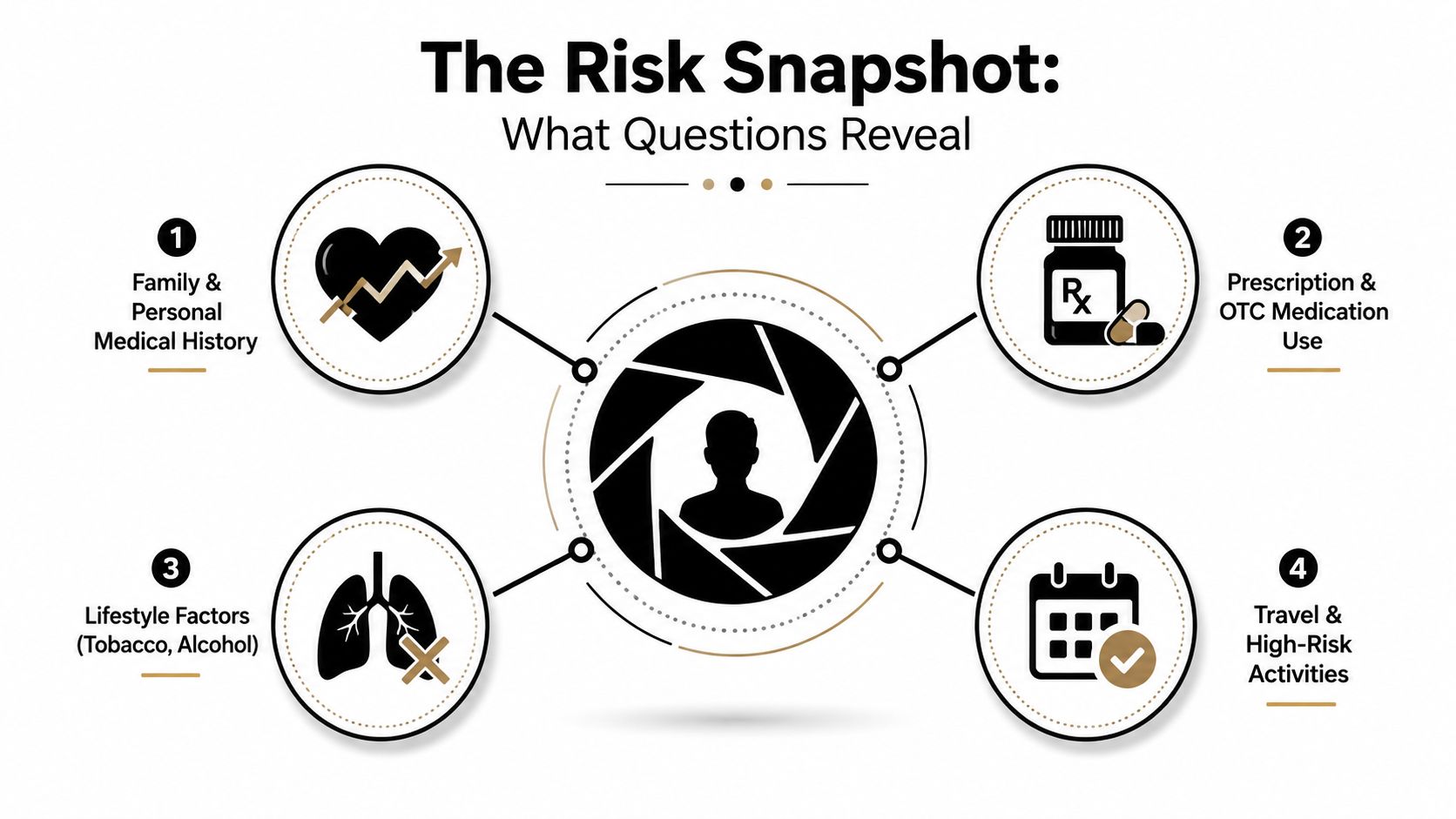
The four recurring question groups
Current medical conditions include diagnosed illnesses, symptoms under evaluation, and treatment that is current or expected. The form may ask when a condition began, when you last saw a doctor, and whether additional testing has been recommended.
Hospitalizations and procedures cover emergency-room visits, inpatient stays, surgeries, biopsies, imaging, and other significant investigations. A procedure that happened years ago may be less important than a recent procedure with unresolved follow-up.
Lifestyle and behavior questions commonly cover tobacco, nicotine, marijuana or recreational drugs, alcohol, driving history, and higher-risk hobbies. The wording matters. Some forms distinguish cigarettes from vaping, cigars, or other nicotine products, while others ask about tobacco or nicotine more broadly.
Family history focuses on conditions that may affect inherited risk, such as heart disease, cancer, or diabetes. The insurer may ask which relative was affected and the age at diagnosis or death.
Answer the question that appears
Don't interpret the question in your favor. If the form asks whether you've used nicotine, don't assume occasional vaping is irrelevant because you don't smoke cigarettes. If it asks about treatment, don't answer only with the original diagnosis when medication is still being adjusted.
Practical rule: Give the carrier a clean fact pattern. State the condition, date, treatment, current status, and pending follow-up without adding guesses about what the underwriter “really means.”
Narrow, precise questions are becoming more important because research on application design found that separating compound questions into distinct checkboxes increased disclosure of mental health conditions, tobacco products, and substance-use support questions. The Society of Actuaries redesign study illustrates why careful wording can improve the quality of information insurers receive.
Common Health Questions and Realistic Sample Answers
The strongest answer is usually neither a long explanation nor a one-word response. It's a concise record that gives the underwriter the details needed to assess stability and determine whether follow-up evidence is necessary.
| Common Question | Realistic Sample Answer |
|---|---|
| Have you been diagnosed with diabetes or another chronic condition? | “Yes. Type 2 diabetes, diagnosed March 2022. Managed with metformin, 500 mg daily. Prescribed by my primary-care physician. No hospitalization and no pending testing.” |
| Have you received treatment recently? | “Yes. I had physical therapy for a shoulder injury from April through June. Treatment is complete, and I have no scheduled follow-up.” |
| Do you use tobacco or nicotine products? | “I don't smoke cigarettes. I vape nicotine occasionally and have one cigar at social events. My last cigar was in the month and year shown on the application.” |
| What are your height and weight? | “I'm 5 feet 10 inches and weigh 185 pounds. These are my current measurements.” |
| How much alcohol do you drink? | “Usually two drinks per week, with no alcohol-related treatment, driving incident, or medical restriction.” |
| Do you participate in hazardous activities? | “Yes. I scuba dive recreationally, approximately a few times each year. I don't participate in skydiving or other listed activities.” |
| Has a close family member had heart disease, cancer, or diabetes? | “My father was diagnosed with type 2 diabetes before age 60. My mother has no history of the conditions listed.” |
| Have you had a change in medication? | “My dosage changed recently from one prescribed amount to another because my physician was adjusting treatment. The change was made on the date listed, and follow-up is scheduled.” |
These answers show the level of detail the form is trying to capture. Dates, dosage, treatment status, and unresolved care often matter more than a vague label. “I have high blood pressure” leaves open whether the condition is controlled, newly diagnosed, or associated with recent complications. “Diagnosed on a specific date, taking the prescribed medication, readings stable, no pending evaluation” gives the carrier a more usable picture.
Small clarifications can shift the review. Someone who describes themselves as a “social smoker” may need to disclose vaping or cigars if the question includes nicotine or tobacco products. A medication change may lead to more questions because the insurer needs to understand whether treatment is stable. A family-history answer can also become more significant when the form asks about an early diagnosis in a close relative.
Don't manufacture precision. If you don't know an exact date, say so and provide the best accurate month, year, or approximate period. The goal isn't to produce a perfect answer from memory. It's to avoid hiding relevant facts and give the underwriter enough information to verify the record.
How Your Answers Shape Underwriting and Pricing
A checked box starts a review, not a final price. The carrier combines your answers with available evidence, which may include prescription history, medical information sources, and, in some cases, records or reports requested from treating professionals. Underwriting guidance describes targeted questions and additional evidence such as investigation results, clinical correspondence, or hospital discharge summaries when the initial information leaves uncertainty. The underwriting evidence guide from UHG explains why medical information supports an objective assessment of mortality and morbidity risk.
How risk classes work
Carriers use different names and rules, but common categories include Preferred Plus, Preferred, Standard Plus, Standard, and Table ratings. A person with stable health, favorable measurements, and no unresolved concerns may be considered for a preferred class. A recent cardiac treatment, uncontrolled condition, or complicated medication history may place the applicant in a more heavily rated class.
| Risk Class | Typical Health Profile | Premium Impact |
|---|---|---|
| Preferred Plus | Strong overall profile with favorable, stable information | Usually the lowest available pricing tier |
| Preferred | Generally healthy, with limited manageable risk factors | Often priced above the top tier |
| Standard Plus | Acceptable risk with additional considerations | Commonly costs more than preferred classes |
| Standard | Ordinary or moderately elevated underwriting risk | Usually higher than preferred pricing |
| Table ratings | Health or lifestyle factors create materially higher assessed risk | Adds a rating charge or produces a higher premium |
These labels aren't universal. One insurer may treat controlled blood pressure more favorably than another, and carrier rules can differ by age, history, and product.
A single answer doesn't automatically dictate a class. For example, an applicant may report a medication change, and the underwriter may ask whether the change reflects routine optimization or an unresolved problem. The same medication can appear in very different files depending on diagnosis date, dosage, response, and physician follow-up.
When extra evidence enters
Follow-up evidence isn't always a default step. Underwriters request attending physician statements, lab work, or other records when the answers don't resolve an important question. In accelerated underwriting, the carrier may use digital information selectively, and a mismatch between the questionnaire and available records can move the file into deeper review.
For a plain-language explanation of this behind-the-scenes process, see this guide to underwriting life insurance. It can help you understand why a fast application sometimes changes path after the insurer reviews the initial data.
Medical Exams Versus No-Exam Policies
Suppose your answers mention stable treatment, but the insurer still wants current measurements. A fully underwritten application can add an appointment, while a no-exam application may rely on records and electronic data to decide whether you qualify for a faster policy path.
With full underwriting, a paramedical professional may record your height, weight, and blood pressure, then collect blood and urine samples. Aflac's life insurance materials lists personal and family medical history, a physical examination, and lab testing as typical components. The carrier may also request an attending physician statement, or APS, when your medical records need clarification. See this overview of the life insurance medical exam process for the types of measurements and samples an appointment may include.
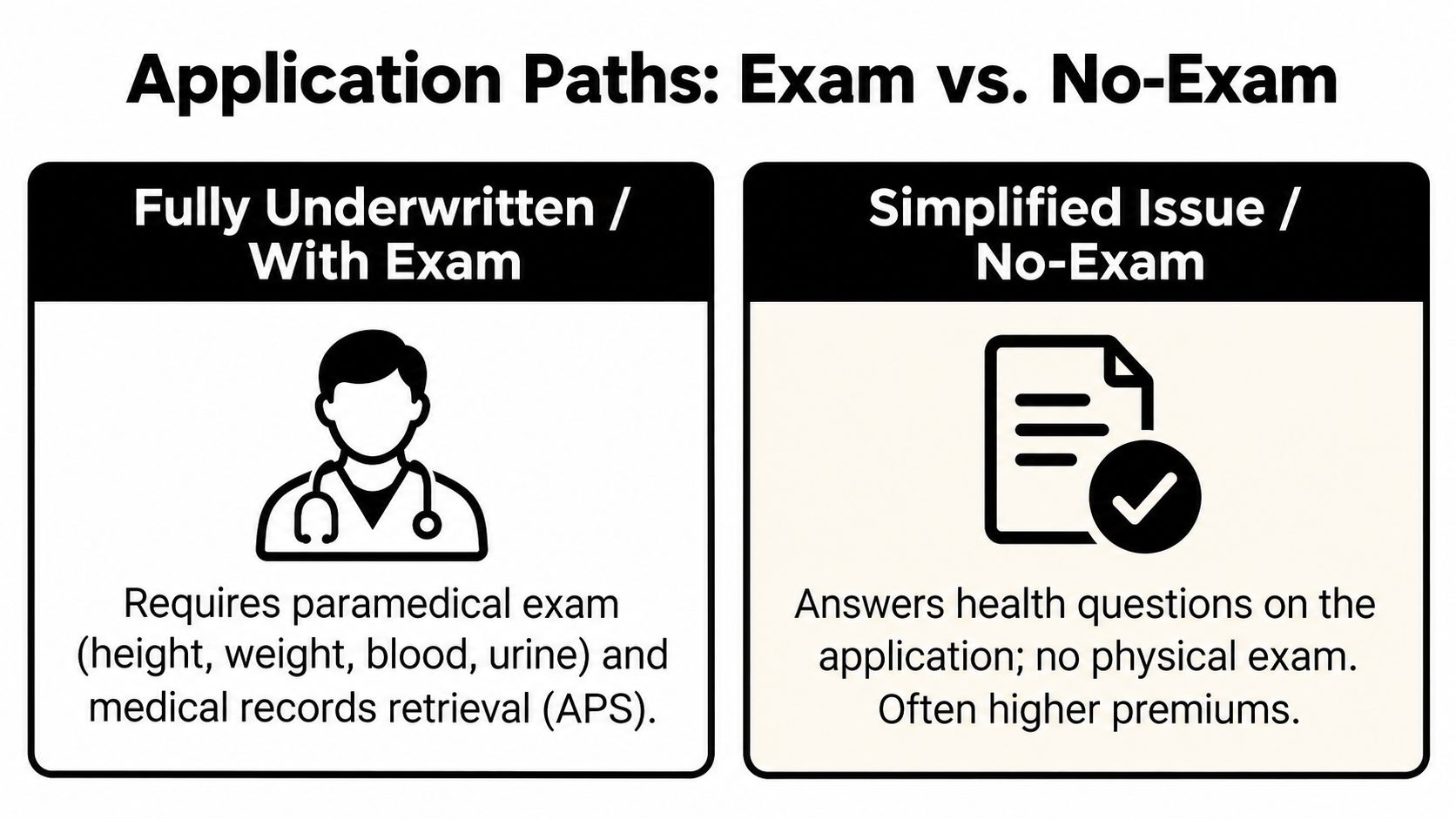
The no-exam, or accelerated, route usually replaces fluids and physical measurements with a health questionnaire and electronic sources. Depending on the carrier and applicant, these may include prescription history, MIB information, electronic health records, claims, or lab data. Digital underwriting research describes sources such as EHRs, medical claims, and aggregated labs, while noting that carriers use them selectively. “No exam” therefore means fewer appointment requirements, not an absence of underwriting.
The trade-off
Skipping the exam may save time and support a faster decision. The trade-off can be lower coverage limits, higher pricing, or stricter eligibility. Full underwriting requires more effort, but additional evidence may help an insurer assess a complicated history instead of relying on simplified answers alone.
Consent controls access to medical records. The insurer needs your authorization, as explained in Legal & General's medical records policy. If blood collection is part of the appointment, Lola's phlebotomy preparation explains how to prepare.
Choose no-exam coverage when speed and convenience matter and your history fits the product's rules. Consider full underwriting if you need more coverage, have a complicated medical history, or want current measurements and records reviewed in greater depth. Ask whether an initial digital application could be referred to traditional underwriting if your answers require more evidence.
How to Prepare Before You Answer
You can prepare most of what you need in one calm sitting. The objective isn't to recreate your entire medical chart. It's to create a reliable reference so you don't guess at a medication, forget a procedure, or confuse the date of a diagnosis.
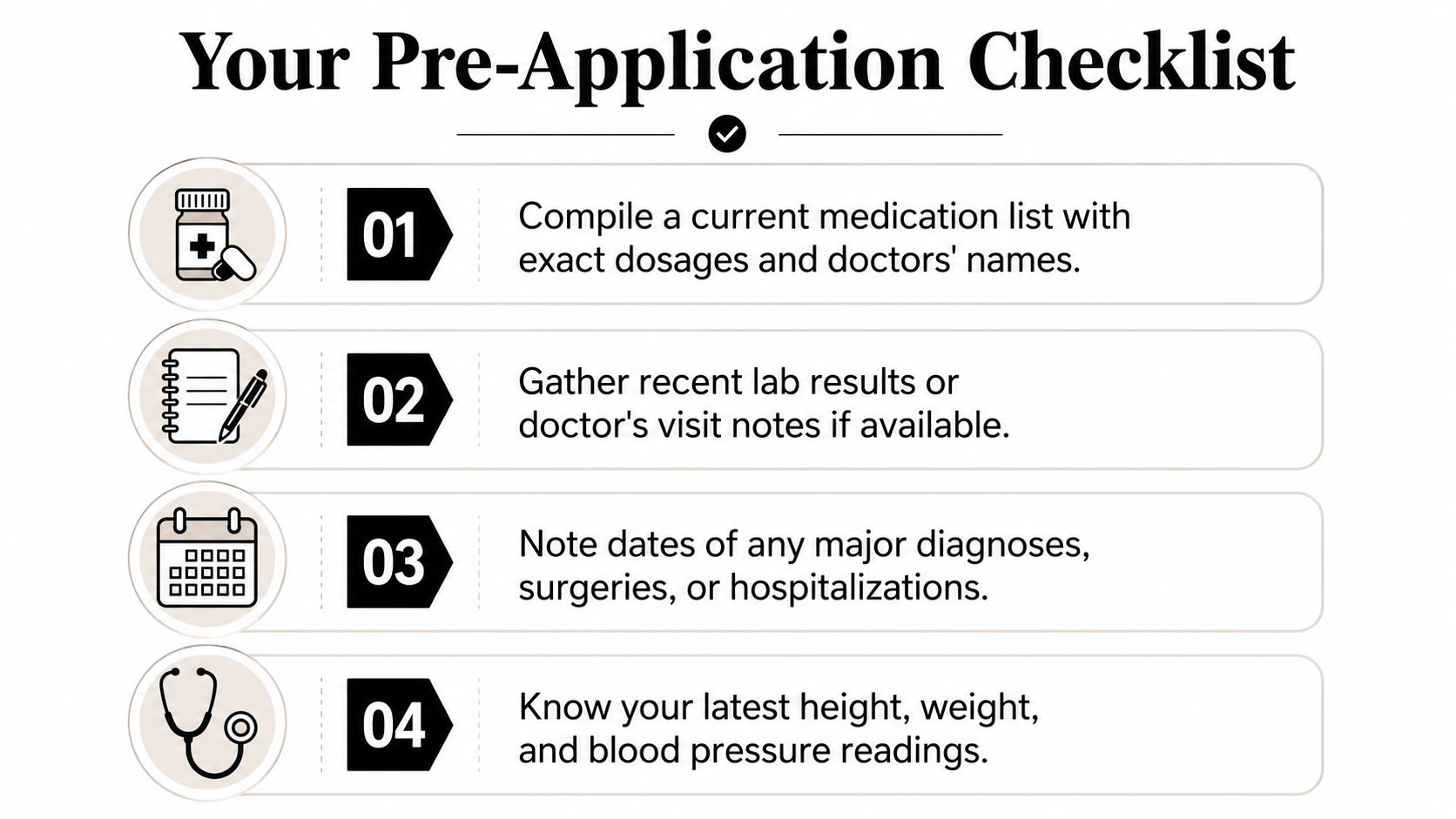
Start with four checkpoints:
- Medication list: Write each prescription, over-the-counter medication, dose, frequency, prescribing doctor, and reason for use. Include recent changes rather than relying on memory.
- Medical timeline: Sketch the past five years, marking diagnoses, surgeries, hospitalizations, emergency visits, major tests, and completed treatment.
- Doctor contacts: Keep the names, practice details, and contact information for your primary-care doctor and relevant specialists.
- Recent information: Gather lab results, imaging reports, or visit notes that may clarify a condition, especially if the application asks about current monitoring.
Use facts instead of labels
A label such as “heart issue” or “stomach problem” isn't enough for an underwriting file. Write down what the doctor called it, when it happened, what treatment followed, and whether another appointment or test is pending.
The same preparation helps with height, weight, and blood pressure. Underwriting guides may separate blood-pressure assessment by age band and control status. For example, one Sun Life guide lists 130/75 for ages 18 to 39 as a blood-pressure underwriting threshold in its framework, so current and accurately measured readings may matter when the carrier evaluates your profile. Rules differ by insurer, and a guide isn't a promise of a particular outcome.
For an exam-based application, follow the appointment instructions carefully. Avoid caffeine and alcohol the night before if the examiner or carrier recommends that preparation, and arrive ready to provide consistent information.
Before you submit: Read every “no” twice. If a question is unclear, ask the agent or carrier to explain its scope rather than choosing the answer that feels safest.
Don't omit a condition to save time. Insurers may verify information independently, and an undisclosed issue can threaten the policy later. Accurate preparation protects the coverage's purpose, which is to provide dependable support for the people who rely on you.
Honest Answers and Common Misconceptions
A controlled condition doesn't automatically disqualify you. Well-managed anxiety, depression, high blood pressure, cholesterol, sleep apnea, or a past sports injury may receive a different review from a current, unstable, or recently treated condition. Underwriters look at context, including treatment, control, follow-up, and the rest of the application.
Consider two heart-history answers. “A benign arrhythmia treated several years ago, no current medication, no monitoring scheduled” gives a different picture from “arrhythmia currently under specialist monitoring with additional testing pending.” The diagnosis label overlaps, but the stability and unresolved-care details don't.
A small fib can create a larger problem than the original health issue. Leaving out a recent emergency-room visit, minimizing alcohol use, or treating vaping as unrelated to nicotine may create a conflict when the carrier checks available records or asks follow-up questions.
That conflict can affect the policy's validity and the family's expected protection. The Texas Department of Insurance consumer guide explains that insurers use underwriting to decide whether to sell coverage and may consider health, habits, and other risk factors.
Honesty isn't a strategy for getting the lowest quote. It's part of making sure the policy matches the person it's meant to protect.
One declined application also isn't a universal verdict. Carriers use different underwriting rules, products, and evidence requirements, so a difficult outcome with one insurer may not determine every available option. Answer fully, then ask whether another policy type or underwriting path is appropriate.
Timing, Edge Cases, and Your Next Step
A new diagnosis doesn't always mean you should stop planning for coverage, but it can change the application path. A recent diagnosis, medication adjustment, pending test, or hospitalization may prompt deeper review, while an established and controlled condition may be evaluated through the standard process. Waiting can provide more treatment history, yet delaying coverage also means applying later with an older age and potentially changed circumstances.
If your health changes after you submit an application, tell the carrier or agent. Don't assume the original answers remain sufficient because the application is already underway. Accelerated underwriting may react to new data differently from fully underwritten coverage, so ask whether the file needs an update or a new review.
Return to the laptop at the kitchen table. The page of medical prompts isn't asking you to predict the underwriting result. It's asking for a structured account of what happened, when it happened, how it was treated, and what remains active.
Gather your medication list, choose whether an exam or no-exam route fits your needs, and request a quote using complete answers. That single preparation step gives the insurer better information and gives you a clearer basis for comparing coverage.
Coveredly offers digital life insurance applications that use health history and other underwriting information to evaluate eligible applicants, including term coverage with no exam for most applicants. Visit Coveredly to review your options and start a quote with your prepared medical details.