You've got a lot going on. Maybe you just bought a house, got married, or brought home a new baby. You know life insurance belongs on the grown-up checklist, but the old picture in your head is still the same: phone calls, forms, a nurse visit, bloodwork, and waiting.
That's why life insurance no health questions sounds so appealing. It promises speed, simplicity, and one less task hanging over your head.
The catch is that this phrase means something very specific in life insurance. And once you understand that meaning, you can make a much smarter decision. For some people, a true no-health-questions policy is a useful fallback. For many others, it's not the best value or the best protection.
Table of Contents
- The Appeal of Instant Life Insurance Coverage
- What No Health Questions Really Means
- Comparing the Types of Fast-Approval Policies
- The Hidden Costs and Common Pitfalls
- Who Should Consider These Policies and Who Should Not
- How to Get the Right Coverage the Easy Way
The Appeal of Instant Life Insurance Coverage
A lot of people start shopping for coverage in the middle of a life transition. They aren't leisurely comparing policy language on a quiet afternoon. They're squeezing in research between daycare pickup, work meetings, and mortgage paperwork.
A young couple with a newborn is a good example. They know they need protection. If something happened to one parent, the other would need help covering bills, daily life, and future plans. But when they see the traditional insurance process, it feels like too much friction.

That's where fast-approval life insurance grabs attention. The promise is simple. No exam. No awkward scheduling. No waiting around for someone to come take blood. Just answer a few prompts online, get a decision, and move on with your life.
Why speed matters so much
People don't only want convenience because they're impatient. They want it because delay creates risk.
When buying coverage feels complicated, it's easy to postpone it for weeks or months. Then one more bill shows up, work gets hectic, or a family event takes over. The task slips again. A quick online experience reduces that drop-off because it fits into real life, not an idealized version of it.
A fast quote process also feels emotionally easier. Life insurance forces you to think about worst-case scenarios. It's understandable to prefer handling that job quickly, clearly, and without a long back-and-forth. If you're exploring instant online life insurance quotes, that motivation makes sense.
Practical rule: The easier it is to start, the more likely you are to finish the application while the need is still top of mind.
Why the phrase causes confusion
The trouble starts when shoppers assume all “fast” policies are the same. They're not. Some policies ask no health questions at all. Others skip the exam but still evaluate health in different ways.
That difference affects cost, coverage size, and who each product is built for. If you miss that distinction, you can end up paying for speed in ways you didn't expect.
What No Health Questions Really Means
In everyday language, “no health questions” sounds like a broad promise. In insurance language, it usually points to a narrower category.
According to TruStage's explanation of no-medical-exam versus no-questions life insurance, no-health-questions life insurance is usually a form of guaranteed acceptance coverage. The insurer doesn't require a doctor's exam, doesn't investigate medical history, and doesn't ask health questions on the application. That's different from no-medical-exam coverage, which often still asks some health questions and may use prescription or background data to underwrite risk.
A simple way to think about it
Think of these two options like buying transportation.
A true no-health-questions policy is like stepping onto a shuttle that takes everyone on the same short route. You don't have to prove anything. But you also don't get much flexibility.
A no-exam policy with simplified or accelerated underwriting is more like using a navigation app. You still skip the long line and get moving quickly, but the route depends on information already available about you.
That distinction matters because insurers price uncertainty. When a company accepts applicants without asking health questions or reviewing health details, it takes on more unknown risk. To manage that risk, it often limits the product in other ways.
What people usually mean when they shop fast coverage
Most shoppers who search for life insurance no health questions aren't looking for “accept anyone no matter what.” They're looking for something less painful than the old-school process.
They want to avoid:
- Scheduling hassle: finding time for a paramedical exam
- Extra steps: bloodwork, urine samples, and nurse visits
- Long waits: back-and-forth during underwriting
- Paper-heavy applications: forms that feel like a second job
For those shoppers, the better phrase is often no-exam life insurance rather than true no-health-questions life insurance.
If you want a clearer picture of how insurers evaluate applications, this overview of life insurance underwriting helps connect the terminology to the actual process.
The most important question isn't “Can I avoid an exam?” It's “What kind of underwriting is happening instead?”
Once you see the difference, the market starts to make more sense. The fastest path with zero health questions is not automatically the best path for your budget or your family's protection needs.
Comparing the Types of Fast-Approval Policies
Fast approval doesn't describe one product. It describes a group of products that reach a decision without the full traditional exam-based process.
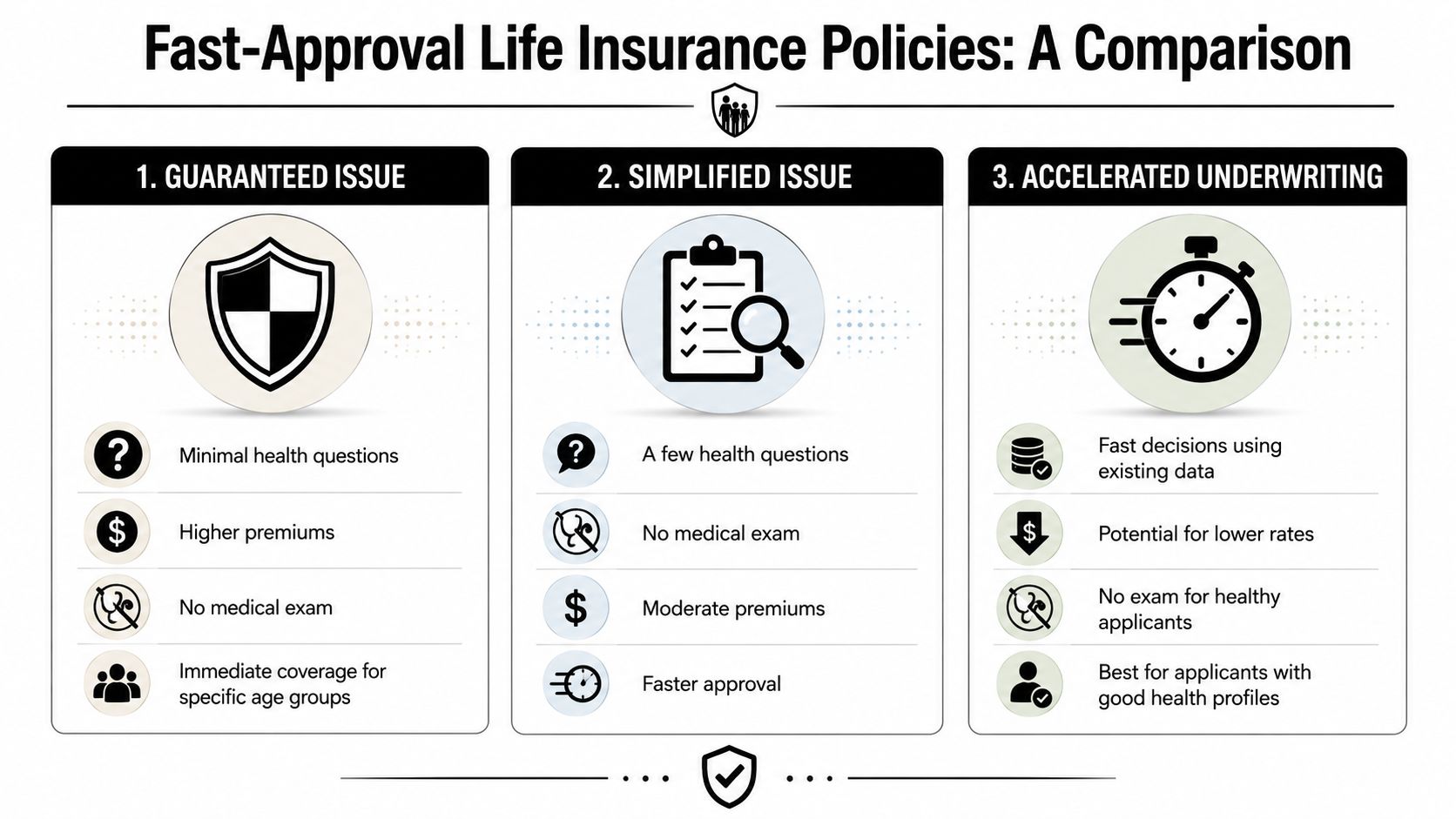
A helpful way to sort them is by asking one thing first: How much information does the insurer use before approving you? The answer usually places a policy into one of three paths.
Three paths that sound similar but work differently
Mutual of Omaha's overview of no-medical-exam life insurance notes that the no-exam market includes accelerated underwriting, simplified issue, and guaranteed issue. It also explains that simplified issue uses a health questionnaire, while no-exam underwriting can still pull third-party data such as prescription histories and driving records to price risk without a physical exam.
Here's what that looks like in plain English.
Guaranteed issue is the closest match to the phrase “no health questions.” You typically answer little or nothing about your health. The insurer keeps the process simple because the product itself is usually narrower.
Simplified issue still avoids the exam, but it doesn't avoid underwriting. You answer a health questionnaire. The insurer uses your answers to decide whether to offer coverage and on what terms.
Accelerated underwriting is the most modern path. You may answer some questions, but the insurer often relies heavily on digital data sources instead of lab work. That's why approval can move much faster than traditional underwriting.
Fast-Approval Life Insurance Compared
| Feature | Guaranteed Issue | Simplified Issue | Accelerated Underwriting |
|---|---|---|---|
| Health questions | Usually none | Usually some | Often some |
| Medical exam | No | No | No in many cases |
| Underwriting approach | Minimal screening | Questionnaire-based | Data-driven review |
| Coverage fit | Often for limited needs | Middle ground | Often best for broader protection needs |
| Cost pattern | Usually highest for the value received | Moderate | Often better value for qualified applicants |
| Approval experience | Very simple | Simple | Fast and digital |
A few practical takeaways matter more than the labels:
- If you want certainty of access: guaranteed issue may be the fallback.
- If you're comfortable answering a few questions: simplified issue opens more options.
- If you want speed without giving up as much on value: accelerated underwriting is often the strongest lane to check first.
For shoppers comparing limited-access options, this guide to guaranteed life insurance can help you see where that product fits and where it doesn't.
Fast approval is not the real benefit. The real benefit is getting enough protection without dragging yourself through an outdated process.
The big mistake is treating these categories as interchangeable. They solve different problems. Guaranteed issue helps people who may not qualify elsewhere. Accelerated underwriting helps people who want efficiency without settling for a stripped-down solution.
The Hidden Costs and Common Pitfalls
The phrase “no questions asked” sounds comforting. In practice, it can hide trade-offs that only become obvious after you've applied or after your family needs the policy.
One common problem is that people focus on the application experience and ignore the policy design. A smooth signup feels like a win. But life insurance is judged later, when someone needs the coverage to do its job.

Why the easy option can disappoint later
Western & Southern's discussion of no-medical-exam life insurance points out the core trade-off clearly: guaranteed-issue coverage is typically modest, while some accelerated or no-exam term products can reach up to $3 million for qualified buyers. That gap matters because convenience alone doesn't pay a mortgage or replace income.
Three pitfalls show up again and again.
- Higher cost for less flexibility: when the insurer asks less, it protects itself elsewhere.
- Smaller policy sizes: many no-health-questions products are built more for final expenses than for long-term family income protection.
- Feature misunderstandings: buyers sometimes assume every fast policy works like a standard term policy, even when the details differ.
That last point is where problems often begin. People hear “approved” and stop reading.
What to read before you apply
Before you choose a guaranteed-issue policy, check the fine print for items that affect how the policy pays and when it pays.
Look closely at:
- Benefit timing: some policies handle early claims differently than later claims
- Policy purpose: some products are designed mainly for burial or end-of-life costs
- Coverage adequacy: ask whether the amount would realistically support your family's needs
- Premium fit: a simple approval should still fit your monthly budget over time
This short video is worth watching if you want a quick refresher on how these trade-offs can affect real decisions.
A policy that's easy to buy can still be the wrong policy to own.
A lot of disappointment comes from buying the first product that says “no exam” or “no questions” without asking what problem it was built to solve. If your goal is broad family protection, the easiest application isn't enough. The policy also needs enough room to handle real obligations.
Who Should Consider These Policies and Who Should Not
Some people absolutely should look at true no-health-questions coverage. Others should probably move past it quickly.
The key is honesty about your situation. Not everyone needs the same underwriting path, and not every fast policy is meant for the same kind of buyer.
When guaranteed issue can make sense
Guaranteed issue often works best as a last-resort safety net.
If someone has serious health issues and expects to be declined for other forms of coverage, a guaranteed-issue policy may still offer a way to leave something behind for loved ones. In that context, the appeal isn't price or scale. It's access.
This can be the right fit for a shopper who says, “I know my options are limited, but I still want some coverage in place.” That is a valid goal.
Who usually needs a different path
A young family shopping after the birth of a child usually has a different need. They often need enough coverage to help with housing, income replacement, daily bills, and future responsibilities. A small guaranteed-issue policy usually doesn't match that job well.
A newly married couple often lands in the same position. One spouse may depend on the other's income to keep the household stable. In that case, the main issue isn't merely getting approved. It's getting a policy large enough to protect the life you're building together.
Busy professionals also tend to benefit more from modern no-exam options than from true no-health-questions products. They want speed, but they also want value. They don't want to overpay just to avoid one extra step.
Ethos explains that modern no-exam products can offer coverage from $25,000 to $3 million for qualified applicants, and notes that roughly 60% of Americans have some form of life insurance while 33% say they are underinsured. That helps explain why policies with simplified processes have become more relevant for younger families and professionals. They're not just shopping for burial coverage. They're trying to close real protection gaps.
A practical approach to this is:
- If health challenges make other approvals unlikely, guaranteed issue may be worth considering.
- If you're generally healthy and mainly want convenience, a modern no-exam route is often a better match.
- If your family depends on your income, focus first on whether the policy amount is meaningful, not whether the application is question-free.
Buying less coverage than your family needs just because it was easier to apply for is a costly shortcut.
For most healthy shoppers in Coveredly's audience, the smarter choice usually isn't “no questions.” It's less hassle with stronger underwriting value.
How to Get the Right Coverage the Easy Way
Many individuals don't need a policy with zero questions. They need a process that doesn't waste their time.
That's an important difference. The best modern experience keeps the application simple while still giving you a real chance at meaningful protection and competitive pricing.
A simpler way to apply
The old path usually meant scheduling an exam, waiting for lab work, and sitting through a longer underwriting cycle. The modern path is more digital and more direct.
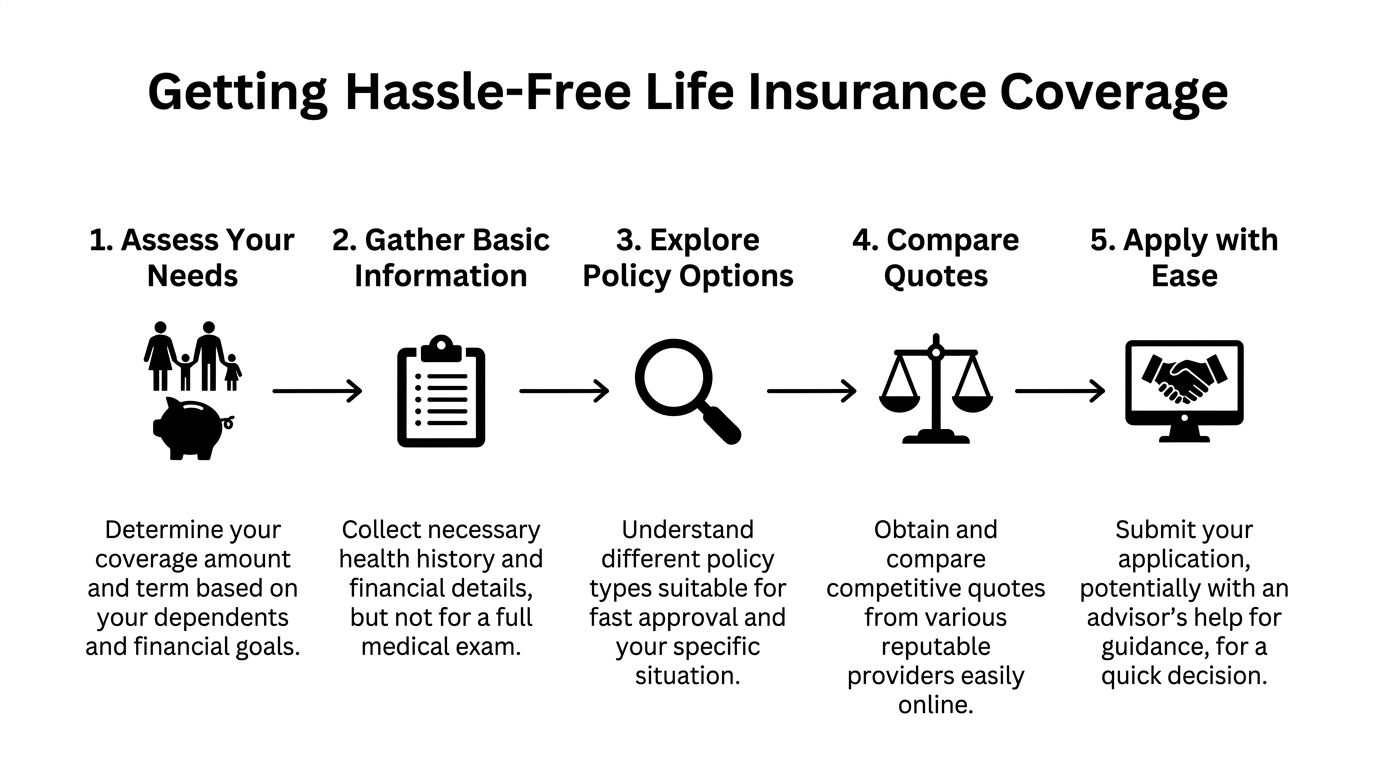
A practical application flow often looks like this:
- Estimate your need. Start with the responsibilities your policy would need to cover, such as income support, debts, or family goals.
- Answer basic application questions. Expect identity, lifestyle, and some health-related prompts depending on the product.
- Allow digital review. Many no-exam pathways use existing data instead of a nurse visit.
- Review your offer carefully. Look at price, term, and coverage amount together.
- Complete your policy online. If the fit is right, you can often finish without the traditional back-and-forth.
What to prepare before you start
You don't need a huge stack of paperwork, but a little preparation helps.
Bring these with you:
- Your goals: whether you want income protection, debt coverage, or a policy to support your family through a specific period
- Basic personal details: the standard information any application will request
- A realistic budget: enough to keep the policy in force comfortably
- A comparison mindset: speed matters, but fit matters more
If you approach the process that way, you won't get distracted by flashy wording like “instant” or “no questions asked.” You'll look for what matters: a smooth experience, sensible underwriting, and coverage that matches your life.
If you want a modern way to compare online life insurance options, Coveredly offers a digital experience built for real life. You can explore flexible term coverage, avoid medical exams in many cases, and look for protection that fits your budget and your family's needs without getting dragged through an outdated process.