
Maya is 32, has a new baby, and is sitting at the kitchen table with three carrier tabs open. Each one points her toward a familiar round number, perhaps $500,000 or $1 million, but none explains how it got there. Her mortgage, childcare plans, student debt, savings, employer benefit, and the income her family would lose are all different from the next household's.
That's exactly why a life insurance online calculator should come before a quote request. It's a planning tool, not a price comparison widget. A sound calculator turns income, debts, dependents, future goals, existing coverage, and available assets into a coverage target you can defend before you speak with an agent or start underwriting.
Skipping that step pushes buyers toward a colleague's policy size, a convenient round number, or a salary multiple that ignores the costs that threaten a family's finances. The sections below show how to gather the right inputs, choose a calculation method, model unstable income, subtract assets properly, and test the result before buying.
Table of Contents
- Why a Life Insurance Online Calculator Matters Before You Buy
- Inputs to Gather Before You Start the Calculator
- How the Three Main Calculation Methods Actually Work
- Two Worked Examples for Real Households
- Five Common Pitfalls That Quietly Underinsure Families
- From Calculator Output to Your Next Three Steps
Why a Life Insurance Online Calculator Matters Before You Buy
Maya's first instinct is understandable. She wants a quick answer and a premium she can afford. But an online quote can tell her what a policy may cost, not whether the death benefit would keep her family financially stable.
Major insurers and financial institutions use online calculators to estimate coverage from inputs such as income, debts, dependents, inflation, and expected return assumptions. The stronger tools then create a year-by-year view of future family income and expenses, rather than hiding every assumption behind one unexplained recommendation. That design reflects the move toward personalized coverage planning instead of one-size-fits-all rules. See how a life insurance calculator models family needs.
The number on the screen is only as good as the inputs
A calculator doesn't know whether your partner would keep working after your death, whether childcare would replace unpaid household work, or whether your employer coverage would follow you to a new job. You have to supply those facts and decide which obligations matter most.
That's why I don't recommend starting with a salary multiplier. It may be a quick orientation point, but it can miss the mortgage, education funding, final expenses, debt repayment, and the years of support your children would need. The question is not “How much can I qualify for?” It's “What financial gap would my family face, and what resources would already be available?”
Advisor's view: A calculator should expose the assumptions behind the recommendation. If it gives you a number without showing the math, treat that number as a prompt for further analysis, not a buying instruction.
The need for better planning is clear. An industry summary tied to LIMRA's 2025 Insurance Barometer Study says 102 million U.S. adults are uninsured or underinsured, the average policy face amount is $178,000, and the coverage gap is about 40%. Review the coverage-gap context and calculator approach.
Maya should therefore enter her household details first, create a defensible target, and only then compare premiums and policy types. That sequence prevents a low price from becoming false reassurance.
Inputs to Gather Before You Start the Calculator
A reliable estimate starts at home, not in the calculator. Pull together statements, benefit documents, loan balances, and household budget information before entering anything. If your income or spending changes often, first build a cash flow model so the calculator receives a realistic picture rather than a rough guess.
Start with income and the people who depend on it
Enter gross household income, then separate the amount contributed by each earner. A surviving spouse may continue working, reduce hours, change careers, or leave the workforce temporarily. Those possibilities produce very different coverage needs.
Record every debt separately:
- Credit cards and personal loans: Include balances that would otherwise fall on the survivor.
- Auto loans and student debt: Note the current balance and whether anyone else is legally responsible.
- Mortgage: Enter the mortgage balance in its own field. It can dominate the calculation and shouldn't disappear inside a general debt total.
- Other obligations: Include business guarantees or family support commitments when they'd create a financial burden after death.
List dependents by age, not just by number. Children under five may require years of childcare and income support, while older children may have shorter education horizons. Include adult dependents and aging parents who receive regular assistance.
Add goals, assets, and the replacement horizon
Education goals need a specific target for each child. “Help with college” is too vague to produce useful math. Add childcare costs if both parents work, and include the cost of replacing regular household services when one parent provides substantial unpaid care.
Then list existing resources:
- Employer group coverage: Record the exact face amount and whether it's portable.
- Individual policies: Include policies owned by either spouse.
- Liquid savings: Add accessible bank and brokerage balances.
- Education assets: Include 529 plans when they're intended for the same education goal.
- Other usable funds: Separate assets that can be accessed quickly from property or accounts that may carry restrictions, penalties, or delays.
Finally, choose the realistic number of years your household would need income support. A family with young children may need a longer replacement period than a couple whose mortgage is nearly paid and whose children are financially independent. Don't automatically model lifetime income replacement. The estimate should match the obligations you're insuring.
| Input Field | Where to Find It | Why It Changes the Coverage |
|---|---|---|
| Household income | Pay stubs, tax returns, contracts | Determines the income gap and each earner's contribution |
| Debts | Loan statements and credit reports | Shows obligations the survivor may need to clear |
| Mortgage | Current lender statement | Identifies whether the survivor could retain the home |
| Dependents | Family records and support agreements | Establishes childcare, support, and caregiving needs |
| Education goals | School planning and 529 records | Adds a defined future funding target |
| Existing coverage | Employer benefits and policy documents | Reduces the amount of new insurance required |
| Liquid assets | Bank, brokerage, and education accounts | Offsets the net coverage need when funds are accessible |
| Replacement horizon | Household budget and family plan | Prevents an arbitrary lifetime or salary-only estimate |
How the Three Main Calculation Methods Actually Work
Online calculators generally rely on one of three engines. The method matters because two households with the same income can need very different amounts of insurance.
Income replacement is fast, but blunt
The income-replacement method multiplies annual income by a chosen multiple. Some financial sources describe 7 to 10 times pretax annual salary as a starting point, while other guidance commonly uses 10 to 12 times annual income. Another source says many Americans may need between $500,000 and $1 million, depending on income, debts, dependents, and savings. Compare common life insurance sizing benchmarks.
This method is useful for a quick first pass. It's also incomplete. A flat multiple doesn't show whether the household has a large mortgage, substantial liquid assets, expensive education goals, or an income that rises and falls throughout the year. A credible calculator should let you adjust the horizon and assumptions instead of presenting one multiplier as a final answer.
Needs-based analysis follows the actual gap
Needs-based analysis adds the financial objectives after death, estimates the present value of required future outflows, and subtracts the present value of available resources. That means the calculation can include final expenses, debts, education, childcare, income support, and other household obligations while recognizing savings and existing policies.
The human-life-value approach follows a similar logic. It focuses on the present value of future economic contributions, rather than multiplying today's salary by a fixed number. Review the four-step human-life-value methodology.
DIME makes the assumptions visible
DIME stands for Debt, Income, Mortgage, and Education. The framework typically adds final expenses, then subtracts liquid assets and current coverage. Income support is modeled over a chosen period, not automatically for life, which makes the result sensitive to the support horizon, discount rate, and surviving spouse's earnings. See a DIME-based needs analysis.
| Method | Core Formula | Best For | Main Weakness |
|---|---|---|---|
| Income replacement | Income multiplied by a chosen multiple | A quick starting estimate | Can ignore specific debts, assets, and goals |
| Needs-based | Future obligations minus available resources | Households with detailed financial plans | Requires more assumptions and careful inputs |
| DIME | Debt plus income support plus mortgage plus education, less resources | Young families and structured planning | Can mislead if income years or education targets are unrealistic |
My recommendation is simple. Use an income multiple to orient yourself, then use needs-based or DIME analysis before purchasing. For a more detailed discussion of the decision, review how much life insurance you may need.
Two Worked Examples for Real Households
The math becomes easier once you see how the inputs interact. These examples use the specified assumptions to demonstrate the process, not to suggest that every household should copy the result.
Example one, a young family with concentrated obligations
Consider a 33-year-old primary earner with two children under five, a $290,000 mortgage, $42,000 in remaining student debt, modest savings, and $50,000 of employer group coverage. The family wants income support through age 22 for the youngest child, mortgage payoff, debt clearance, final expenses, and $120,000 of education funding per child.
The DIME structure would look like this:
- Debt: Add the $42,000 student debt and the selected final-expense amount.
- Income: Multiply annual income by the number of support years required, using the chosen replacement assumption.
- Mortgage: Add the $290,000 balance.
- Education: Add $120,000 for each child.
- Resources: Subtract the $50,000 employer benefit and eligible liquid assets.
Using the stated household inputs and assumptions, the resulting target lands at approximately $1.15 million. The key point isn't the headline figure. It's that the mortgage, children's ages, education target, income horizon, and existing coverage all appear in the calculation rather than getting buried under a salary rule.
Example two, a dual-income couple without children
Now consider a professional couple in their early forties with no children, a $480,000 mortgage, and combined household income of $220,000. Their income-replacement model uses 70% of earnings for 20 years, recognizes the surviving spouse's continued salary, and subtracts $180,000 in liquid assets.
The calculation begins with the selected income-support period, then adjusts downward because one spouse would continue earning. The mortgage remains a major obligation, while the liquid assets reduce the amount of new coverage required. Under these assumptions, the target arrives at approximately $900,000.
| Input Line Item | Young Family Example | Dual-Income Professional Couple |
|---|---|---|
| Household structure | Primary earner with two children under five | Two earners, no children |
| Mortgage | $290,000 | $480,000 |
| Other stated debt | $42,000 student debt | Not specified |
| Income approach | Support through age 22 for youngest child | 70% of combined earnings for 20 years |
| Education funding | $120,000 per child | Not specified |
| Existing resources | $50,000 employer coverage plus modest savings | $180,000 liquid assets |
| Approximate result | $1.15 million | $900,000 |
The young family lands higher despite the couple's larger mortgage and household income because the family has more long-duration obligations. Children need support, education funding, and care. The couple's surviving spouse continues earning and has significant accessible assets, so the calculator produces a smaller net gap.
Five Common Pitfalls That Quietly Underinsure Families
A calculator can produce a precise-looking answer while still using weak assumptions. These five mistakes deserve an explicit check before you buy.
1. Treating every asset as immediately available
A current account balance isn't automatically cash the survivor can use quickly. Retirement accounts may create penalties or restrictions, and some investments may carry surrender charges or take time to liquidate.
Fix: Enter only the amount the survivor could realistically access within 30 days, and exclude assets that require a costly or delayed sale.
2. Locking today's dollars into a long policy
A death benefit that looks adequate today may buy less in the future if household costs rise. Needs-based tools increasingly include inflation assumptions, but buyers still need to test whether their chosen figure keeps pace with future obligations.
Fix: Run the calculator with an inflation assumption and compare the result with the unadjusted estimate. Don't treat the lower number as automatically safer just because the premium is lower.
3. Averaging volatile income incorrectly
A commission earner, freelancer, founder, or gig worker may have a strong year followed by a weak one. A single salary field can hide the downside scenario and understate the support a family needs when income drops.
Fix: Enter a conservative sustainable income, then test a higher and lower income path. Include emergency savings and the surviving spouse's replacement needs rather than relying on one average year. Read about life insurance planning for fluctuating income.
4. Assuming the second income never changes
A surviving spouse may reduce hours, leave work, or take on additional caregiving after a death. Counting the full second salary as permanent can make the policy look sufficient when the household's practical income would fall.
Fix: Model the income the survivor could realistically maintain. If one spouse handles most childcare or household work, include the cost of replacing those contributions. This matters for life insurance for stay-at-home parents.
5. Treating employer coverage as permanent
Group life insurance may be useful, but it can be insufficient or non-portable. Don't count it as a permanent asset without checking the plan's conversion and portability terms, especially if changing jobs is possible.
Fix: Run the calculation twice, once with employer coverage and once without it. Buy individual coverage for the gap that must survive a job change.

A final underwriting detail also matters. Accelerated underwriting can approve healthy applicants without a medical exam by using application data and database checks. One source notes that many carriers offer this route especially for coverage amounts under $1,000,000, while fully underwritten policies typically require a paramedical exam with blood draw and vital checks. Understand online term-life underwriting paths.
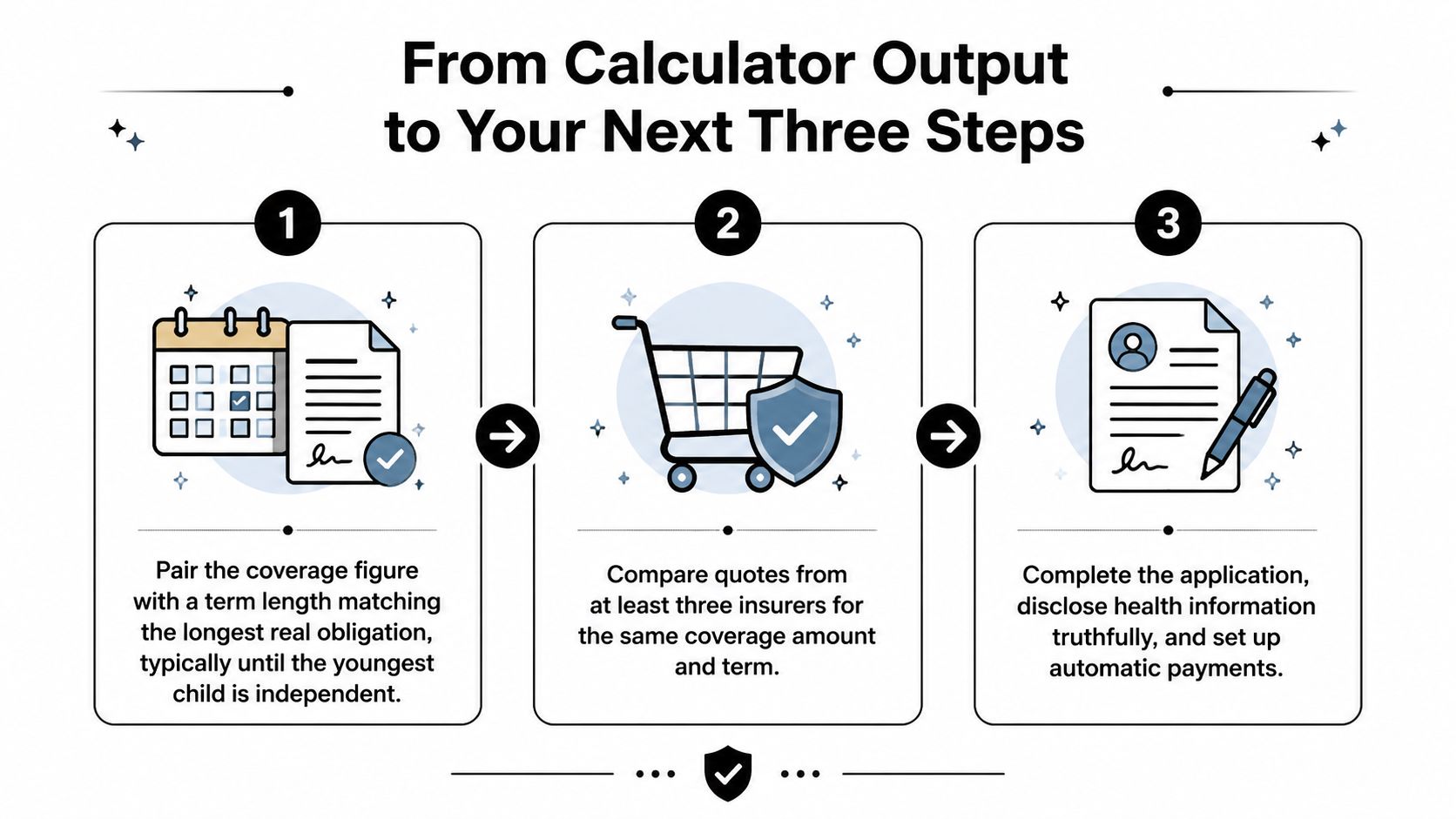
From Calculator Output to Your Next Three Steps
The calculator's answer isn't the purchase. It's the starting point for choosing a policy that matches the obligation you're trying to cover.
1. Match the term to the longest real obligation
Choose a term that reaches the longest meaningful liability on your list. That may be the mortgage payoff date or the point when the youngest child reaches age 22. Don't extend coverage beyond age 65 automatically unless a specific debt, dependent, business obligation, or estate need justifies it.
If different obligations end at different times, consider whether separate policies could match those timelines more efficiently. The right term is the one that protects the period your household is most financially exposed, not just the longest term a quote form displays.
2. Compare the policy against underwriting and affordability
Take the calculated face amount into a quote flow such as Coveredly's, then compare the monthly premium for a 20-year term with a 30-year term. Check that the requested benefit fits the carrier's underwriting band and doesn't require a table rating that makes the policy unaffordable.
Use the same coverage amount and term when comparing insurers. Otherwise, you're comparing different products rather than prices. You can also use a free term life insurance calculator to keep the coverage decision separate from the emotional pressure of an application.
3. Put the review on your calendar
Schedule a 12-month review and rerun the calculation after an income change, birth, refinance, or major asset purchase. Recheck the policy before the next premium anniversary instead of waiting until a crisis forces the conversation.
A life insurance online calculator should become part of your annual financial review. Income paths change, mortgages decline, children age, employer benefits disappear, and liquid assets move. Recalculate the gap, document the assumptions, and adjust before the old number stops protecting the people who rely on you.
Coveredly offers an online term life insurance quote flow designed to connect coverage decisions with a digital application, including no-exam options for most applicants and term coverage of up to $3 million. Visit Coveredly after you run your estimate, and compare the available policy amount and term against the gap your household needs.