A healthy 30-year-old can pay about $13 a month for a 20-year, $250,000 term life policy, yet most adults overestimate that price. The better advice isn't to find the cheapest policy, but to find the lowest-cost coverage that would protect your household.
A small premium won't help much if the benefit leaves your partner struggling with rent, childcare, or a mortgage. Equally, assuming coverage is unaffordable can keep you from getting a quote that fits comfortably into your budget.
Life insurance policy cost is a matching problem: match the benefit to the financial gap, the policy duration to the years you need protection, and the payment to an amount you can sustain.
Table of Contents
- What a Life Insurance Policy Costs Today
- What Drives the Premium and the Sample Price
- How Policy Type Changes the Total Cost
- Household Scenarios and the Protection Gap
- How to Estimate the Premium You Should Pay
- Get a Quote That Matches the Need
What a Life Insurance Policy Costs Today
The biggest pricing mistake often happens before someone requests a quote. They picture an expensive monthly bill, decide it's out of reach, and stop shopping without learning what basic protection would cost.
In the 2025 LIMRA life insurance fact sheet, roughly three-quarters of adults overestimated life insurance prices, and only 10% correctly estimated approximately $13 per month for a healthy 30-year-old buying a 20-year, $250,000 term policy. Adults aged 18 to 30 overestimated that same policy's median cost by about 10 to 12 times, while 38% of uninsured respondents identified cost as their top reason for not buying.
Life insurance policy cost benchmarks
The 2024 LIMRA life insurance fact sheet cites the NAIC benchmark of about $160 per year for a healthy 30-year-old's 20-year, $250,000 term policy, equivalent to about $13 per month.
| Example | Cost signal | How to read it |
|---|---|---|
| Healthy 30-year-old, 20-year term, $250,000 | About $160 per year, about $13 per month | NAIC benchmark for basic term; only about 10% of adults estimate it correctly |
| Adults aged 18 to 30 judging that same policy | About 10 to 12 times too high | A perception error, not the premium |
| Return-of-premium term | Higher than ordinary term | May refund premiums if no death benefit is paid |
| Whole life | Significantly higher than term | Lifetime coverage plus cash value |
These examples aren't interchangeable quotes. The basic term benchmark describes a particular applicant and contract, while refund features and lifetime coverage involve different promises.
At Coveredly, many policies start as low as $15–$30 per month, depending on age, health, and coverage amount. That's a starting-price range, not a promise that every applicant or household will qualify for adequate coverage at that payment.
Affordable should mean adequate and sustainable
Say you're newly married and share rent, a car payment, and everyday bills. Your insurance need isn't whatever benefit appears beside the lowest advertised premium. It's the money your spouse would need to keep those obligations manageable without your income.
A family with a mortgage and children has a different problem. A benefit that clears a small debt but leaves childcare and housing unfunded may look inexpensive while providing too little protection.
Practical rule: Treat a sample premium as permission to investigate, not permission to choose an arbitrary coverage amount.
A useful budget comparison therefore has two parts: can you keep paying the premium, and would the benefit cover the responsibilities you're trying to protect? Both answers need to be yes.
What Drives the Premium and the Sample Price
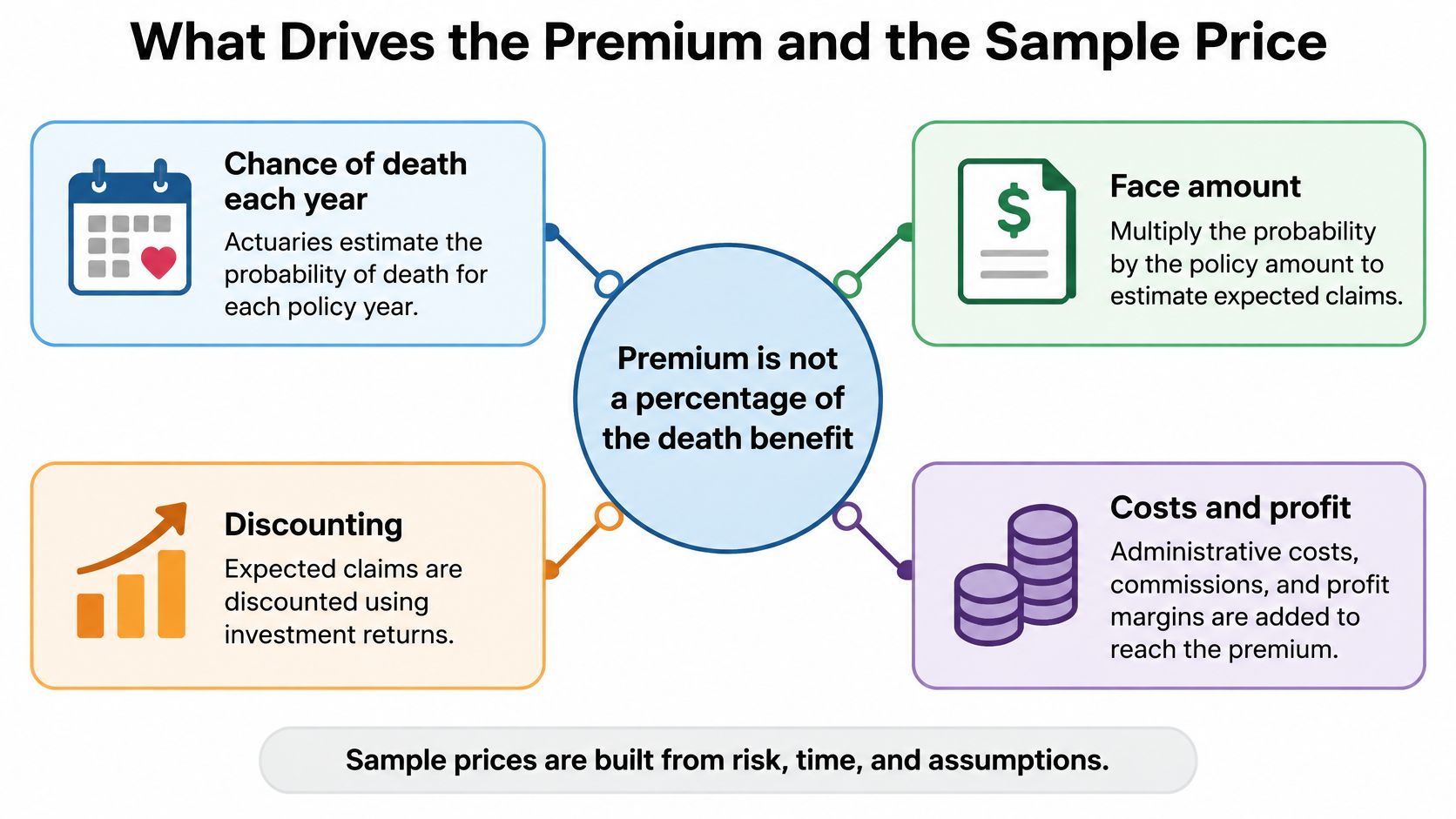
A premium isn't just a percentage of the death benefit. You're buying an insurer's promise to pay under a contract, and the insurer prices both the likelihood and timing of that payment.
The NAIC's accelerated underwriting document describes the underlying mechanics: actuaries estimate the probability of death during each policy year, multiply it by the face amount, and discount expected future claims using investment returns. The charged premium also needs to cover commissions, administration, taxes, risk capital, and other expenses, with investment income helping offset costs.
This diagram shows how those pieces fit together.
Age and health establish the starting point
Age changes the risk the insurer takes on. Buying protection when you're younger generally means the insurer is pricing years with lower expected mortality than it would for an older applicant.
That doesn't mean your payment automatically rises at every birthday after you buy. Your contract determines whether premiums stay level during the selected period. Distinguish the age used to price a new application from the payment schedule on an existing policy.
Our guide to life insurance rates by age helps explain that distinction. When comparing offers, check that each quote uses the same birth date or insurance age.
Health and tobacco use help determine your underwriting class, the insurer's risk category for your application. Medical history, current health information, and smoking status can produce different prices for applicants who otherwise look similar.
A preliminary quote may assume a favorable class. Until underwriting confirms that class, don't treat the estimate as an approved offer or assume another insurer has quoted the same risk.
Coverage amount and duration define the promise
The face amount is the death benefit stated in the policy. A larger benefit increases the insurer's potential payment, but that doesn't mean every increase follows a perfectly proportional pricing formula.
Think of comparing moving services: the final bill depends on more than the size of the truck. Insurers also allocate expenses and price risk, so use actual quotes rather than multiplying a small-policy premium to guess the cost of a larger one.
Term length determines how many years of protection the insurer must price. Extending coverage also includes later years of life, when mortality risk is generally higher, so the additional cost can be greater than a simple calendar comparison suggests.
Occupation and hazardous hobbies can affect the assessment too. Disclose them consistently rather than leaving them off one application to obtain a better-looking estimate.
What moves a life insurance premium
| Factor | What happens to the premium | Hold this constant |
|---|---|---|
| Age | Generally rises as the applicant gets older | Birthday or age band used in the quote |
| Health and underwriting class | A better class generally lowers the price | Same class, not just the same application |
| Tobacco use | Smokers generally pay more | Smoker or nonsmoker status |
| Coverage amount | A larger face amount generally costs more | Exact death benefit |
| Term length | Longer terms cost more, often disproportionately | Exact coverage duration |
| Occupation and lifestyle | Hazardous work or hobbies can lead to a higher-risk class | Same disclosed risks |
A meaningful comparison requires matching these inputs before judging the premium. Otherwise, you may be comparing a shorter guarantee or a more optimistic underwriting assumption with a stronger offer.
Ask for the guaranteed premium schedule, payment frequency, policy fees, and any non-guaranteed elements in writing. A low opening payment isn't a good comparison point if it excludes costs or changes sooner than you expect.
How Policy Type Changes the Total Cost
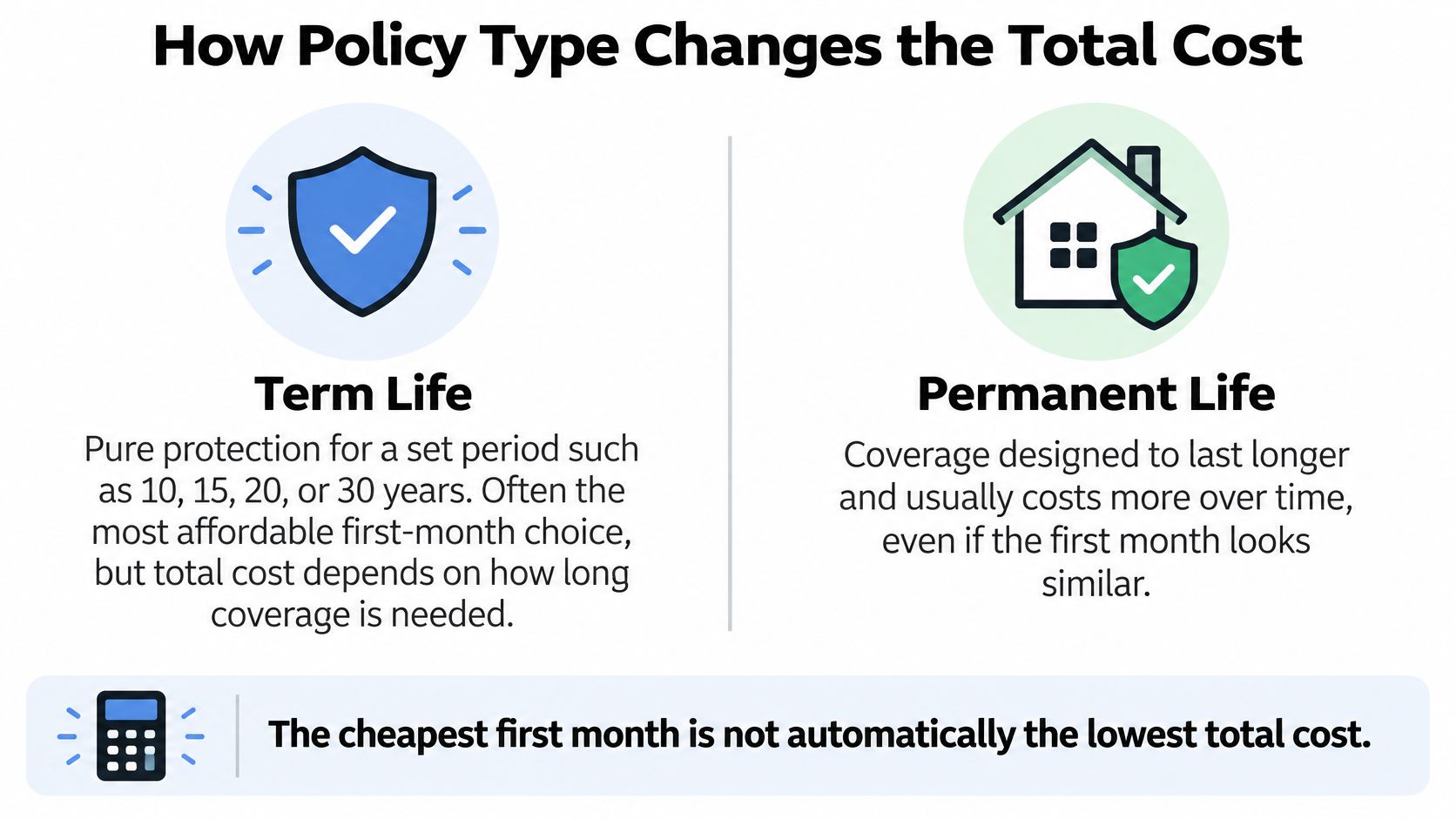
Term life insurance is the most popular and affordable type of life insurance. It provides pure protection for a set period without an investment component, making it a practical starting point for temporary responsibilities such as supporting children or paying a mortgage.
Ordinary term pays a death benefit if the insured dies during the covered period and the contract's conditions are met. If you outlive the term, there's no payout just because you kept the policy.
The main distinction is what you're asking the insurer to provide.
Refunds and cash value change the bill
The NAIC's life insurance overview explains that return-of-premium term tends to cost more than ordinary term because the insurer may have to return premiums if the insured survives the term and no death benefit is paid. It also distinguishes ordinary level-premium whole life, limited-payment whole life, and single-premium whole life.
Whole life insurance covers the insured for their entire life and includes a cash value savings component that grows over time, with premiums significantly higher than term life. Those additional features serve a different purpose from purchasing temporary income protection.
| Policy structure | What you're paying for | What deserves attention |
|---|---|---|
| Ordinary term | Protection during a defined period | Expiration date and guaranteed premiums |
| Return-of-premium term | Term protection plus a conditional premium refund | Refund conditions and added premium |
| Ordinary whole life | Lifetime protection and cash value | Level-premium requirements and guarantees |
| Limited-payment whole life | Whole life funded over a shorter payment period | Higher periodic payments and when payments end |
| Single-premium whole life | Whole life funded with a lump sum | Upfront funding commitment and contract terms |
Compare the full commitment
A refund isn't free money. You're paying more for the possibility of receiving premiums back, and the contract determines what happens if you cancel early.
Likewise, a shorter payment period for whole life doesn't mean the insurance itself is cheaper. It means the insurer collects the required funding over a different schedule.
Renewable term needs special attention. The NAIC's consumer life insurance guide explains that guaranteed renewability may let you continue coverage without a new health assessment, but renewal premiums can be substantially higher.
Our term versus whole life insurance comparison can help you separate temporary protection from permanent coverage. Choose the job the policy needs to do before deciding which payment looks attractive.
Household Scenarios and the Protection Gap
A couple reviewing insurance at the kitchen table usually isn't trying to optimize an abstract financial product. They're asking whether the survivor could keep the home, care for the children, and make decisions without immediate financial pressure.
Start with the bills and responsibilities you share.

Newly married renters sharing expenses
Say you rent together and rely on both incomes. The survivor might need money to finish the lease, pay final expenses, manage shared debts, and transition to a budget supported by one paycheck.
The relevant question isn't whether you own property. It's whether someone would face financial hardship without your contribution.
Parents balancing a mortgage and care
Add a young child and the calculation changes. The survivor may need housing support and paid childcare while continuing to work.
Include unpaid caregiving too. A parent without a salary can still provide services that would cost money to replace, so income alone doesn't capture the household's exposure.
For families helping older relatives evaluate a remaining home loan, Professional Insurance Advisors senior mortgage protection from Professional Insurance Advisors, LLC provides a separate resource focused on that stage of life. Keep the older homeowner's needs distinct from your own family's income-replacement plan.
Dual earners with workplace benefits
Two incomes don't automatically eliminate the need for separate coverage. After a death, the survivor may lose a paycheck while gaining new expenses or reducing working hours.
Workplace insurance can contribute to protection, but review what happens when employment ends. Treat a benefit that may disappear at a job change differently from personal coverage you control.
The scale of the gap is substantial: LIMRA's life insurance awareness overview reports that 51% of American adults have some life insurance and about 40% say they need more, representing nearly 100 million people. Its Canadian survey discussion also reports that 52% of uninsured adults couldn't maintain their current lifestyle for one year if the primary earner died.
Use the video as a conversation starter, then write down your household's specific obligations.
Having a policy and having enough protection are different financial conditions.
Our guide to how much life insurance you need helps organize those obligations. Revisit the calculation after marriage, a birth, a home purchase, a job change, or a substantial raise, and update beneficiaries when family circumstances change.
How to Estimate the Premium You Should Pay
You can't choose a sensible premium until you've defined what the insurance must accomplish. Start with the household gap, then test the price of covering it.
A common starting guideline is 10–15 times annual income, and Coveredly helps tailor coverage to each situation. Treat that shortcut as a reasonableness check, not a substitute for accounting for debts, dependents, and available resources.
Build the coverage amount before shopping
Add the dollars at risk. Multiply the annual income you want replaced by the years your household would need support. Add debts, childcare, education goals, and final expenses, while avoiding double-counting mortgage payments already included in income replacement.
Subtract resources you would use. Include savings earmarked for this purpose and any applicable workplace death benefit. Don't automatically count retirement assets, emergency savings, or employment benefits as permanently available.
Set the face amount to the remaining gap. That's the benefit to price first. To judge whether the payment fits, use Toya AI's explanation of how to compare fixed and variable costs and identify room in your monthly budget without assuming every flexible expense can disappear.
Match the term to the longest obligation. Consider when the mortgage ends, when children are likely to become financially independent, and when your partner could manage without replacement income. A shorter term isn't a saving if it ends while the need remains.
Request comparable offers. Keep the benefit, duration, underwriting assumptions, payment frequency, and optional features aligned. We compare multiple carriers to find competitive pricing rather than asking you to judge value from an isolated offer.
Plan for changes. We allow coverage to be raised or lowered as life changes, without starting over. Have our team explain how an adjustment would apply to your situation, including its effect on premiums and applicable policy conditions.
Reduce cost without weakening the purpose
Once you've priced the gap, consider changes that preserve the core protection.
- Use term for temporary needs. Don't add lifetime features solely because they sound more complete.
- Review optional riders. Keep benefits that address a real concern, rather than adding every available feature.
- Be accurate about tobacco and health. Disclose your history, and ask how any later change in status could affect eligibility for different pricing.
- Avoid unnecessary delay. Shopping while younger can help, but don't rush into a contract you haven't read.
Budget check: A premium is sustainable only if you can keep paying it through ordinary changes in household expenses.
If the first quote feels uncomfortable, examine the policy design before reducing essential protection. A smaller payment shouldn't come at the cost of leaving an obligation you already identified unfunded.
Get a Quote That Matches the Need
Leave the estimate stage with a proposed benefit and duration, not a belief that insurance must be either cheap or impossible. An actual underwriting result gives you something useful to evaluate.
Run a quote for the coverage you calculated. If the price is higher than expected, identify the reason before making changes: the applicant's risk assessment, the coverage duration, and optional benefits require different responses.
Turn an estimate into a clear offer
Coveredly is a licensed insurance agency that partners with carriers to issue policies. We offer term life insurance with no medical exams for policies up to $3M, and our team helps explain the available coverage.
We state that the price shown is the price paid, with no hidden costs and no sales pressure. Keep the written offer alongside your household calculation so you can judge both affordability and protection.
Before accepting, make sure you have clear answers about:
- The payment commitment. Confirm the premium, payment frequency, and any non-guaranteed elements.
- Future options. Obtain the applicable renewal schedule and conversion provisions in writing.
- The effective date. Coverage typically begins once the policy is approved and the first payment is processed, not just when you request a quote.
Get unresolved details in writing
If you're missing documents or comparing offers with your spouse, send a concise written request listing what you need confirmed. VoxNote's guide to write a professional follow-up email can help you organize that request without losing important questions in a long message.
Don't reduce the death benefit merely to make the first quote resemble an advertisement. Review extras and duration only where the resulting contract still fits your obligations.
Your next action is specific: quote the calculated amount and term, then adjust the face amount only after seeing the actual price.
We offer online term life insurance and compare multiple carriers to help you find competitive pricing for the protection your household needs. Visit Coveredly with your calculated coverage amount and term, and get a quote you can compare against your budget and financial responsibilities.