You're probably here because you need coverage, but you don't need another errand. You might be between meetings, holding a toddler on one hip, and trying to decide whether a life insurance policy no physical exam is a shortcut or a catch. That tension is real, because the process can feel wonderfully simple on the surface while still hiding underwriting decisions underneath.
Table of Contents
- Why More People Are Skipping the Physical Exam
- What a No Physical Exam Life Insurance Policy Is
- Accelerated, Simplified, and Guaranteed Issue Compared
- Pricing, Face Amounts, and the Trade-Offs You Should Know
- Eligibility and the Application Journey Step by Step
- When the Data the Insurer Pulls About You Is Wrong
- Choosing the Right Path for Young Families and Professionals
- Common Questions About No Physical Life Insurance
Why More People Are Skipping the Physical Exam
A young parent can sit down with a laptop between meetings, compare quotes, answer a few health questions, and get a decision before the coffee gets cold. That used to be a very different experience. The old model often meant waiting for a nurse visit, then waiting again for labs, then waiting once more for the final underwriting decision.
That shift is why no physical coverage feels almost frictionless today. It isn't a brand-new kind of life insurance. It's a different underwriting path, one that grew out of digital records and faster decisioning, so insurers can review risk in minutes or days instead of scheduling a paramedical appointment first. As explained in the industry guidance on no-physical coverage, the product changed the application process, not the core insurance principle that price and eligibility still depend on assessed mortality risk, not on whether someone sat for a physical exam. InsureOmni's overview of no-physical life insurance
The appeal is easy to understand. People like speed, they like convenience, and they like not having to book around a nurse's calendar. They also like that the process often stays more private, because there's no blood draw or in-home medical visit to arrange.
Practical rule: if your priority is fast approval, a no-exam route can be a good fit. If your priority is the broadest underwriting review and the strongest chance at the lowest price, a traditional exam may still deserve a look.
For readers who keep documents organized during the application process, a resource like secure medical PDF documents can help you think about what a clean record-keeping setup looks like, even if your insurer never asks for a paper file. And if you're comparing routes side by side, a broad guide such as the one collected under Coveredly's life insurance medical exam tag can make the terminology easier to decode.
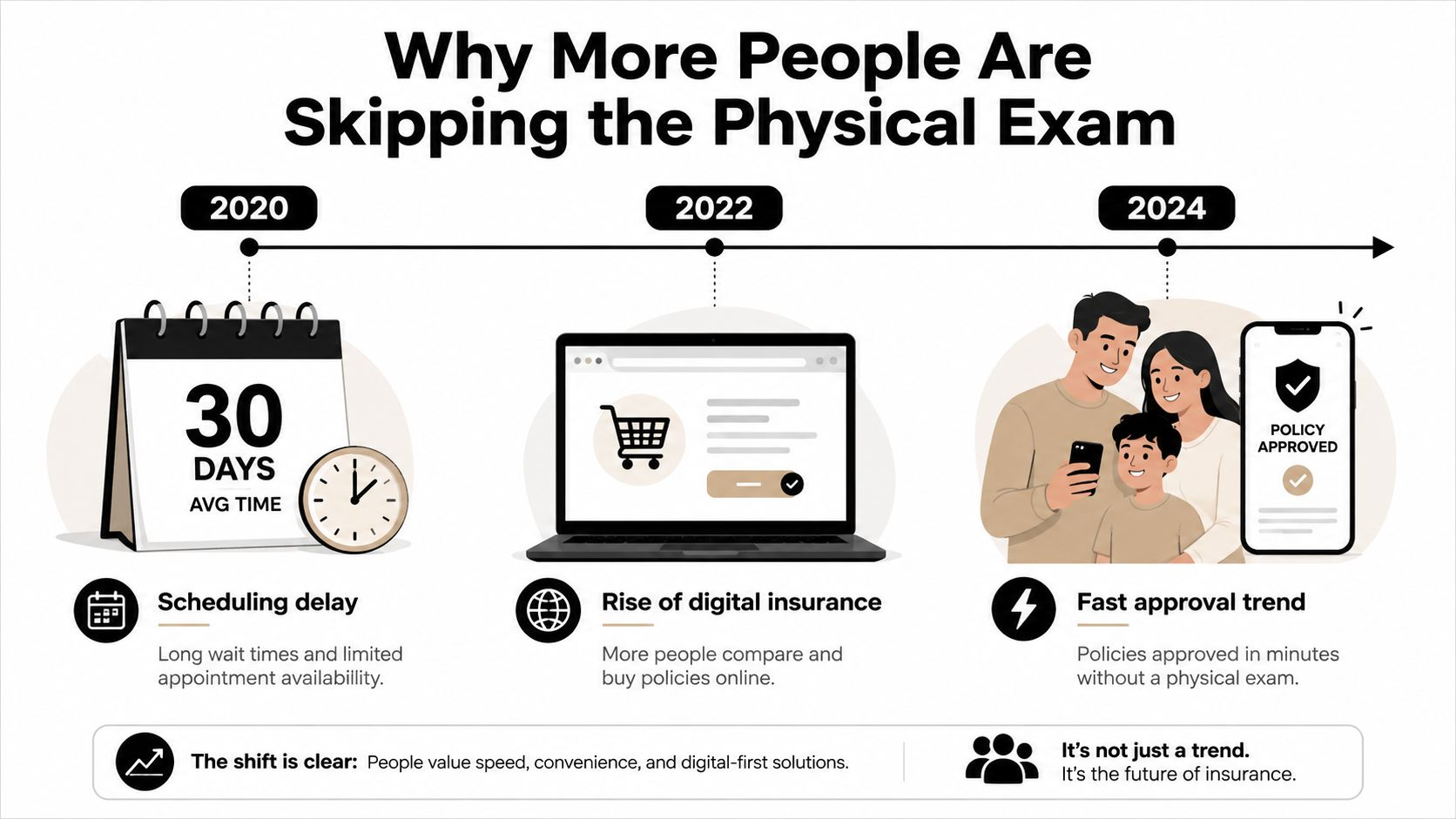
The big takeaway is simple. No physical coverage exists because insurers can now do more of the screening work digitally. That makes the experience faster for many people, but it also sets up the trade-off that matters later, the convenience is real, and so are the underwriting limits.
What a No Physical Exam Life Insurance Policy Is
The insurer changes the inputs. The decision itself stays the same. Instead of a paramedical exam with a blood draw, urine sample, height and weight check, and blood-pressure reading, the company may rely on a health questionnaire plus third-party records such as prescription history, motor vehicle records, medical databases, and prior application data. That is why the phrase no physical can be misleading if you read it too closely.
What gets removed and what stays in place
A no-exam application usually removes the in-person health check. It does not remove underwriting. Insurers still evaluate mortality risk, just through other sources of information. Nationwide describes this as an accelerated underwriting workflow that replaces labs and a physical visit with data sources like health questionnaires, prescription histories, motor vehicle records, and sometimes medical records, which is why decisions can come back in minutes to a few business days rather than the standard exam-based timeline. Nationwide's explanation of no-exam life insurance
That distinction matters because the policy contract still works the same way after it is issued. If a claim is filed years later, the beneficiary is relying on the same promise of coverage, but the approval path that led to that policy was built from digital review rather than a nurse visit. The useful mental model is different underwriting, not no underwriting.
Easy analogy: a traditional policy is like a full inspection before buying a used car. A no-physical policy works more like a records-based review. You still get a decision, but the reviewer is reading files instead of lifting the hood.
If you are sorting through the jargon, the phrase to remember is accelerated underwriting. It is the insurer's way of saying, “We will make the decision without the exam, but we are still checking your risk from multiple sources.” That is why the process can feel simple while still being very data-heavy behind the scenes.
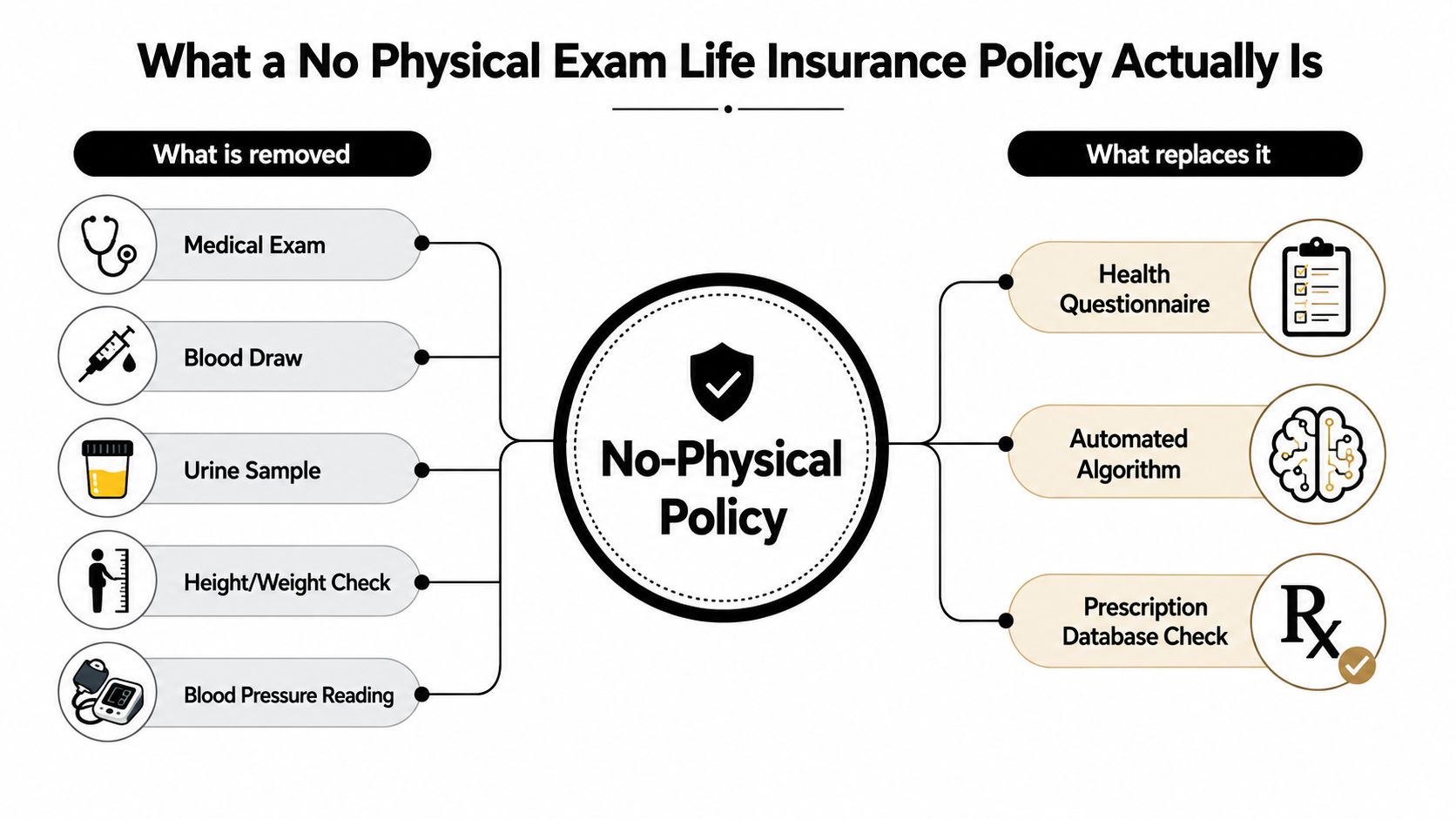
A working definition you can reuse is this. A no-physical life insurance policy is coverage issued without the traditional paramedical exam, but still underwritten using questionnaires and third-party data. That is the clearest way to understand it, and it keeps you from assuming the approval is automatic.
If you want to see how that broader no-exam category differs from other simplified paths, a guide to simplified issue life insurance can help place it in context.
Accelerated, Simplified, and Guaranteed Issue Compared
The easiest way to clear up the confusion is to stop treating all no-exam policies as one product. They are three different underwriting paths, and each one fits a different kind of applicant. The labels sound similar, but the insurer is asking for different amounts of information on each path.
A useful way to read them is like different levels of review. One route relies on more records and can move quickly, another asks more questions up front, and the last one gives the insurer the least to review. The trade-off is part of the decision, not an afterthought.
Three paths, three different experiences
Accelerated underwriting is the closest option to a fast version of traditional coverage. A healthy applicant answers health questions, the insurer checks third-party data, and the decision may come quickly. It is built for speed, but it still uses enough risk data to support a more measured offer than guaranteed issue.
Simplified issue sits in the middle. The insurer asks more health questions and may rely less heavily on outside records than accelerated underwriting, though companies still vary in how they build the process. A good way to place it is as the middle ground when you want less friction than a full exam but more screening than guaranteed issue. For a broader overview of this category, Coveredly's simplified issue life insurance tag is a helpful starting point.
Guaranteed issue is the most permissive option. The insurer generally asks no health questions and accepts most applicants, which is why this category is often used when health problems make other paths difficult. The trade-off is that it is usually a separate no-underwriting category, not a substitute for fully underwritten term life.
A quick comparison table
| Product type | Underwriting inputs | Typical decision time | Best fit |
|---|---|---|---|
| Accelerated underwriting | Health questionnaire, prescription history, motor vehicle records, and other third-party data | Minutes to a few business days | Healthy applicants who want speed |
| Simplified issue | More health questions, with lighter record review than a full exam in many cases | Fast, but varies by insurer | Buyers who want a simpler application and can answer health questions |
| Guaranteed issue | Usually no health questions and no medical exam | Often fast | Applicants who need access despite health issues |
No-exam term products are also commonly structured in set durations, with 10- or 20-year term coverage showing up often in the market, as noted by insurer guidance on no-exam offerings.
If you are trying to decide which route fits your own situation, the key question is not which one sounds easiest. It is which underwriting path matches the information you are willing to share, the amount of review you can tolerate, and the level of coverage you need.
Pricing, Face Amounts, and the Trade-Offs You Should Know
A common question is whether skipping the exam lowers the price. Usually, it does not lower the price. It saves time. That is the trade-off to keep in mind, because insurers accept more uncertainty when they issue coverage without a paramedical exam, and they usually respond by shaping the product more tightly.
Why speed often costs more
A no-exam policy may cost more per dollar of coverage than a fully underwritten policy because the insurer has fewer direct medical readings and has to rely more on models and third-party data. The company also tends to limit exposure more tightly, which is one reason these policies are usually presented as practical options rather than broad substitutes for traditional coverage.
That limit matters when you want a larger face amount. As noted earlier, insurer guidance on no-exam offerings shows that these products are usually grouped into simplified issue, guaranteed issue, accelerated underwriting, or group life insurance, rather than treated as one all-purpose category. New York Life's explanation of no-medical-exam policies
Where the trade-off usually shows up
For a healthy applicant, the key question is often whether a no-exam policy works, or whether it is the best value. If you are young, healthy, and looking for a large amount of protection, waiting for full underwriting can make sense because the fuller review may support better pricing or a higher face amount. If you need coverage quickly, maybe because of a mortgage closing or a new child, the convenience can be worth paying a bit more.
Rule of thumb: the more coverage you want, the more likely it is that a full underwriting review deserves a look before you accept the first instant offer.
Age and health also affect how much risk the insurer believes it is taking on. A minor condition may move someone into a no-exam product if the full exam would slow things down or raise the chance of a stricter review. On the other hand, a healthy buyer who can wait may find that the exam route still offers better long-term value.
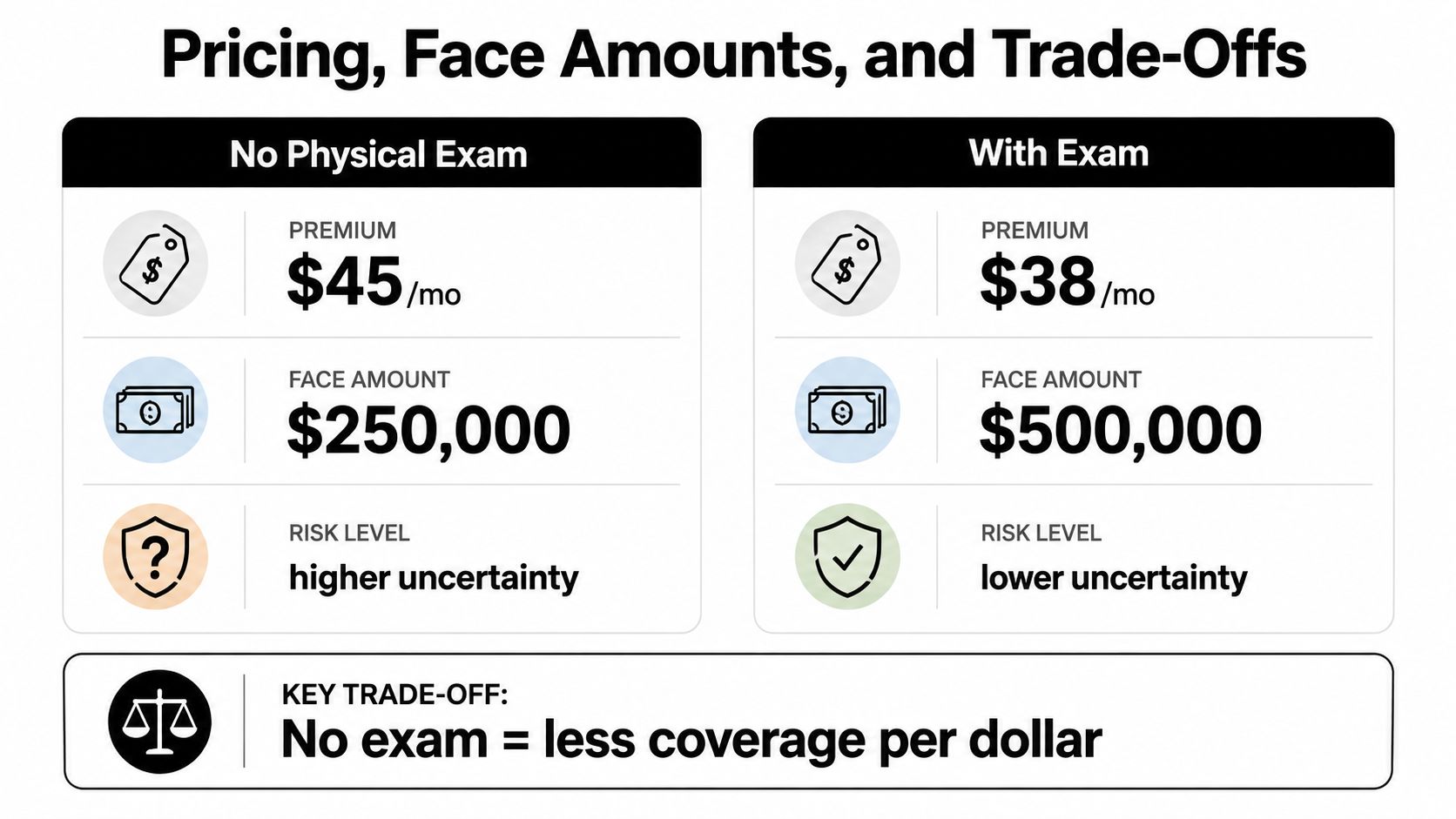
The right choice is usually a trade between speed, price, and face amount. If you are buying modest coverage and need it now, a no-physical route can make sense. If you are aiming higher and your health profile is strong, a longer underwriting process may buy you more policy for the same premium budget.
Eligibility and the Application Journey Step by Step
The application usually feels simple because the steps are online, but there's still a sequence under the hood. Knowing that sequence makes the process less mysterious and helps you avoid a stalled application because a record check came back incomplete.
The typical path from questionnaire to policy
First comes the online health questionnaire. You confirm basic health details, medications, and lifestyle information. It's the part most applicants expect, and it's usually the shortest part of the process.
Next comes the consent step. You authorize the insurer to review prescription histories, motor vehicle records, and sometimes medical records or other databases. That permission matters because the company is comparing what you said with what third-party sources show.
Then the insurer runs the automated review. The application may move quickly or slow down, depending on what the records show and how the company's rules are built. Insurers describe this as data-driven underwriting, not a no-review shortcut, which is why the process can still take longer for some applicants than for others.
After that, the insurer issues an offer or routes the file for more review. If approved, the policy documents are delivered and the coverage begins once the formal issuance steps are complete.
Where eligibility can narrow
Age bands can matter more than many buyers expect. Mutual of Omaha says some no-exam policies can be instantly approved if applicants meet age requirements of 45 to 85, with a narrower 50 to 75 range in New York, while guaranteed issue life insurance is generally a separate no-underwriting category. Trustage's no-medical-exam life insurance guidance
That means the product that looks perfect on paper may not be available to everyone. Residency rules, age rules, and product rules can all affect the result. If you're applying, have your medication list, recent treatment details, and any identity documents ready in case the insurer asks you to confirm them.
A clean application starts with accurate answers. The faster the records match your answers, the less likely your file is to get kicked into a slower review queue.
When the Data the Insurer Pulls About You Is Wrong
The biggest myth about no-exam coverage is that it involves less scrutiny. It doesn't. It often involves different scrutiny, and that difference matters when the insurer's data about you is incomplete, outdated, or flat-out wrong.
Why a clean self-report isn't always enough
Insurers commonly pull prescription data that spans roughly five to seven years, along with driving and medical records, to validate what applicants say on the form. Ethos' explanation of no-medical-exam term insurance That helps companies control adverse selection, but it also means a recent prescription, a risky driving event, or a record mismatch can send an otherwise healthy person into a slower review process or a decline.
The awkward part is that applicants may not see the exact mismatch right away. An automated rule can flag the file without giving a long explanation in the moment. The application then feels random, when the issue is often a data source, not your actual health.
What to do if the insurer's data is wrong
The Wall Street Journal notes that insurers use medical records, prescription histories, driving records, credit histories, and public records, and that consumers can access and contest inaccuracies in those reports. WSJ Buy Side's guide to information gathering for no-exam life insurance That gives you a practical path forward.
- Ask what was checked: Request the categories of data used in the decision so you know whether the issue came from prescriptions, driving, or medical records.
- Review your own records first: Confirm that the medication dates, physician notes, and driving history match what the insurer likely saw.
- Dispute the mismatch directly: If a record is incomplete or inaccurate, follow the process for contesting that source before you reapply.
- Reapply only after the fix is documented: A second application goes better when the underlying report has been corrected, not when you hope the mistake won't repeat.
If you want a more detailed consumer framework for this part of the process, the material collected under Coveredly's underwriting life insurance tag is a useful starting point. The lesson here is blunt, no-physical underwriting is data-intensive, not lenient. The applicants who do best are often the ones who check their records before the insurer does.
Choosing the Right Path for Young Families and Professionals
For young families and newly married couples, the best choice is often the one that closes the coverage gap fastest. If you just bought a home, had a baby, or are trying to protect a new household budget, no-exam term life can be the practical answer for a moderate face amount because it gets you covered before life changes again.
When speed matters more than perfect pricing
If the amount you need is in the range that no-exam products comfortably support, speed can outweigh the hunt for the absolute lowest premium. That's especially true when your real risk is leaving your family uncovered while you wait for a longer review. In that case, a no-exam policy can serve as the first layer, with the option to add or replace coverage later when you have more time.
For professionals who need higher coverage, the decision is more nuanced. Buyers who can qualify for broader term coverage may want to compare the cost of instant approval against the possible benefit of waiting for full underwriting, especially if they're healthy enough to support a stronger offer. A longer process can feel inconvenient, but it may buy you a better policy structure.
A simple decision rule
- Choose no-exam first if you need protection now, want a simple digital application, or are buying a more modest amount of term coverage.
- Wait for full underwriting if you want to pursue a larger face amount, you're healthy enough to support a fuller review, and you can tolerate a slower timeline.
- Revisit at major life events like marriage, a child's birth, a home purchase, or a business change, because your coverage needs can shift faster than your old policy can keep up.
One more habit helps a lot. Lock in coverage while you're in a favorable age band, because age and health both shape what you'll be offered. Then review the policy when your life changes, not years after the fact.
For many buyers, the smartest move is not choosing between “no physical” and “traditional” forever. It's using the faster path to avoid a coverage gap, then reevaluating later if your financial picture calls for more insurance or a larger policy.
Common Questions About No Physical Life Insurance
Can a no-exam policy be converted later? Sometimes, but not always in the same way across products. The only safe answer is to check whether the policy has a conversion option before you buy, because the feature depends on the contract, not the marketing label.
What happens if the application gets flagged or declined? The insurer may ask for more information, route the file into slower review, or decline it under its automated rules. If that happens, don't guess at the reason, review the data sources and correct any errors before trying again.
Do beneficiaries face extra scrutiny at claim time? The claim still follows the policy terms, so the cleanest protection is accurate disclosure at application time. A no-exam policy doesn't make the death benefit less real, it just changes how the insurer got to the approval.
Do age cutoffs change availability? Yes. As noted earlier, some no-exam products are only available within specific age bands, and the rules can differ by state and product type. That's why a policy that fits one buyer may not even be open to another.
If you're ready to shop with a clear view of the trade-off, start with your coverage amount, your timeline, and how much underwriting friction you're willing to accept. Then compare the no-exam route with the traditional route before you decide.
Coveredly helps people compare life insurance without turning the process into a maze, and it offers up to $3 million of term life insurance with no exams for most. If you want a digital path that fits a young family budget or a professional coverage need, visit Coveredly and see how quickly you can move from uncertainty to a real policy.