You're probably here because the number feels both reassuring and oddly vague.
Maybe you've got a mortgage, a partner who depends on your income, a new baby, or a career that finally feels stable enough to protect. Then life insurance quotes start showing up, and $1 million appears so often that it starts to sound like the default answer. It isn't always.
Million dollar insurance can be a smart, practical tool. It can also be the wrong target if you buy it just because the number sounds substantial. The better question is simpler: what amount would protect the people who rely on you? That's where most confusion starts, especially around affordability, no-exam options, and whether a million dollars is enough in real life.
This guide breaks it down in plain language, with clear examples, relevant keywords, and helpful pictures so you can make a calm, informed decision.
Table of Contents
- What Is Million Dollar Insurance
- Decoding Your Million Dollar Safety Net
- Who Really Needs a Million Dollar Policy
- The Real Cost of Million Dollar Insurance in 2026
- Getting Covered The Traditional vs Digital Way
- Is a Million Dollars Enough Common Missteps to Avoid
- Million Dollar Insurance FAQs
What Is Million Dollar Insurance
You sign the paperwork for a mortgage, set up college savings, and get used to your income covering a lot of moving parts. Then you start shopping for life insurance and keep seeing the same round number. $1 million.
Million dollar insurance usually means a life insurance policy with a $1,000,000 death benefit. If the insured person dies while the policy is active, that amount is paid to the named beneficiaries.
The simple definition is easy. The harder question is whether that number fits your life, or just sounds reassuring.
A $1 million policy works like a large financial reserve. It can help a household keep paying for big obligations, such as housing, debt, childcare, or future education costs, if one income disappears. That is why the amount gets attention. It is large enough to feel meaningful, but still common enough to be widely available through both traditional and no-exam applications.
Why this number became so common
The phrase became popular partly because insurers and shoppers both like round benchmarks. A million dollars is easy to compare, easy to market, and easy to remember. LIMRA has reported in recent market research that term life remains the largest part of individual life insurance sales, which helps explain why headline coverage amounts like $1 million show up so often in quotes and ads (LIMRA market trends).
But popularity and suitability are different things.
For one household, $1 million may be too little. For another, it may be more coverage than they need, especially if the buyer is single, has low debt, or has already built substantial savings. That nuance gets lost when the number is treated like a default target instead of a starting point for calculation.
What readers usually confuse
Three separate ideas often get bundled together under the label "million dollar insurance":
- Coverage amount: The payout amount, in this case $1,000,000
- Policy type: Usually term life, but it can also be permanent life insurance
- Application method: A traditional medical exam route or a no-exam route
Those choices affect different parts of the decision. The coverage amount answers "how much." The policy type answers "how long and in what form." The application method answers "how you qualify and what you may pay."
That last point matters more than many guides admit. A no-exam $1 million policy can be faster and more convenient, but convenience can come with stricter eligibility rules or higher premiums for some applicants. The right question is not "Can I get a million dollars of coverage?" It is "What amount does my household need, and what is the most sensible way to buy it?"
Practical rule: Start with your real financial obligations, not the headline number. Then compare whether a traditional or no-exam path gives you the best mix of cost, speed, and approval odds.
That approach turns million dollar life insurance from a catchy phrase into a planning decision.
Decoding Your Million Dollar Safety Net
At 8:15 on a Tuesday, one parent is packing lunches, answering a work message, and mentally tracking the mortgage draft due on Friday. If that income disappeared, the problem would not be one big bill. It would be a stack of obligations arriving month after month.
That is the clearest way to read a $1 million life insurance policy. It is not a trophy number. It is a pool of money meant to keep a household functioning while unfinished financial responsibilities are still very real.
What the money is meant to cover
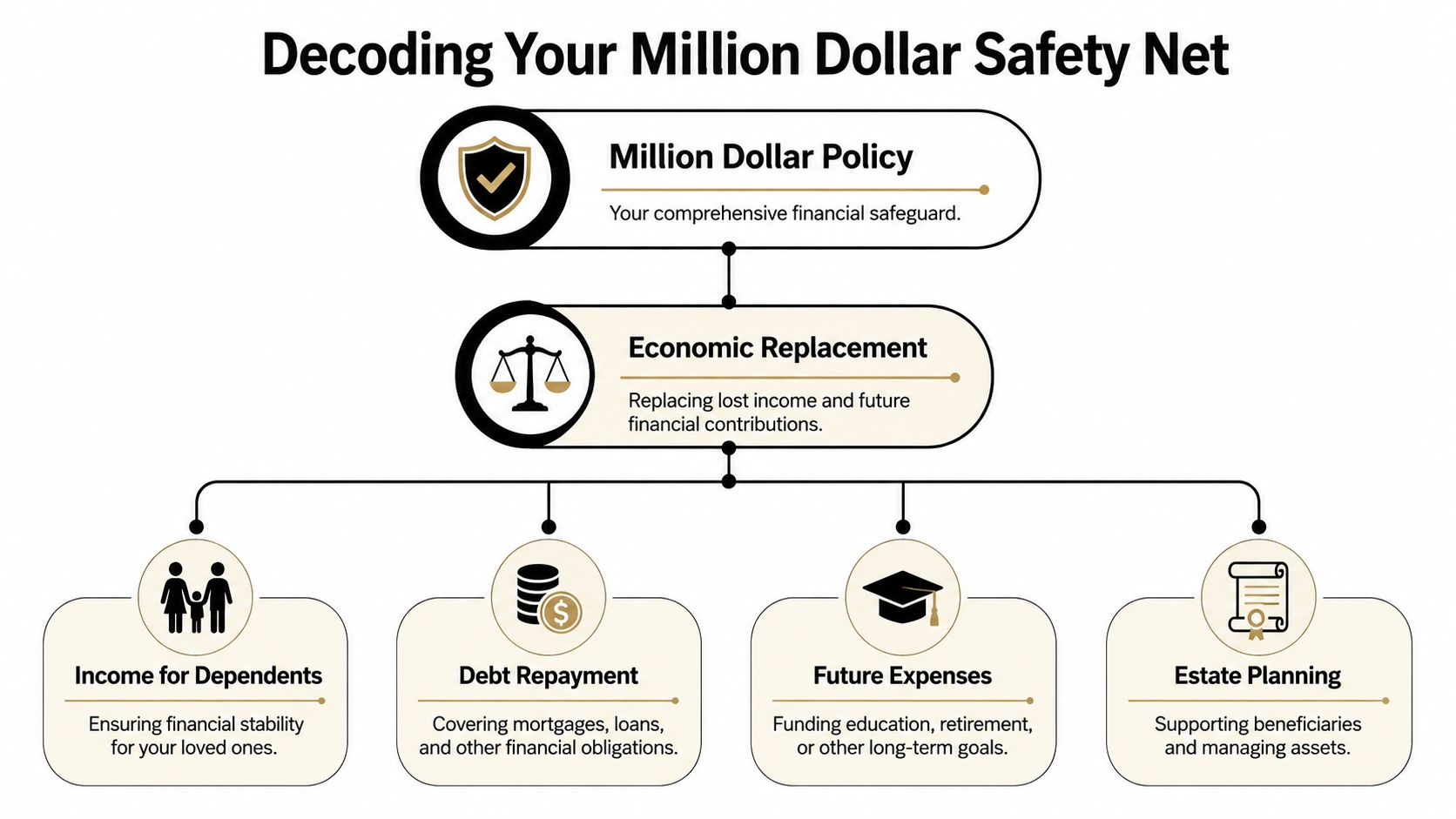
A death benefit works like a reserve fund with several jobs. One part may go to the mortgage. Another may clear debts. Another may replace income for a few years so the surviving spouse or partner does not have to make rushed decisions under pressure.
Depending on the household, the same policy might also help with:
- Housing costs: Paying off the mortgage or reducing the monthly payment burden
- Outstanding debts: Personal loans, car loans, private student debt, or shared obligations
- Ongoing income needs: Covering groceries, utilities, childcare, and other recurring bills
- Future goals: Setting aside money for college or other planned family expenses
- Family support costs: Caregiving, special-needs planning, or help managing property and assets
This is why $1 million can feel both large and surprisingly ordinary. A few major goals can use up that amount faster than people expect.
Why this number gets so much attention
The round number stuck because it is easy to remember and sounds substantial. Insurers also market it heavily because it sits at a point where coverage feels meaningful to buyers with mortgages, children, or high earning years ahead.
That does not make it the right amount for every household.
A better approach is to treat $1 million as a draft estimate, then test it against your actual numbers. Add up what would need to be paid off, how many years of income your household would need, and what future costs you want covered. A practical starting point is this life insurance coverage calculator and guide.
A simple way to make it tangible
Say a family has a mortgage, one young child, and one primary earner. If that earner brings in most of the income, the policy is less like "extra money" and more like a temporary financial stand-in. It helps cover the house payment, everyday bills, and part of the child's future costs while the family adjusts.
Now change the facts. A single person with no dependents, low debt, and strong savings may find that $1 million is far more than necessary. The headline number only makes sense after you match it to the life you are trying to protect.
That is the nuance many guides skip. The fundamental question is not whether a million dollars sounds safe. It is whether that amount fits your obligations closely enough to buy peace of mind without paying for coverage you do not need.
Who Really Needs a Million Dollar Policy
A parent dies, and the question is not whether the family receives a large number on paper. The real question is whether that money can keep the household functioning long enough to adjust. Mortgage payments still arrive. Childcare still costs what it costs. A surviving spouse may need time, flexibility, and income replacement all at once.
That is why a $1 million policy fits some households comfortably and misses the mark for others. It is less a status number than a math problem.

Households that often need more coverage
The people who most often land near $1 million usually have several responsibilities stacked on top of each other:
- Parents with young children: Income replacement has to cover both daily bills and the extra costs that come with raising kids.
- Couples who recently bought a home: A mortgage can turn a moderate coverage need into a much larger one.
- Higher earners with people depending on that income: Replacing years of earnings adds up faster than many buyers expect.
- Business owners or key professionals: Family needs may overlap with business obligations, buyout plans, or loans.
A quick rule of thumb often used in the industry is the 10x income rule. A more individualized method is DIME, which adds up Debt, Income, Mortgage, and Education. One coverage guide explains both approaches in the same place, which is useful because the shortcut and the detailed method can point to very different answers depending on your household coverage guide on million-dollar life insurance.
The shortcut versus the calculation
The 10x rule is like estimating a grocery bill by looking at the size of the cart. It gives you a fast approximation.
DIME is closer to checking the receipt line by line. It takes longer, but it shows what you are trying to fund.
That distinction matters. Someone earning a solid income with a large mortgage and future education costs may reach $1 million quickly. Someone else with similar income but no children, little debt, and strong savings may not need anywhere near that amount.
Why $1 million can feel too high, then suddenly look reasonable
Many buyers focus on balances they can see, such as a mortgage or car loan. The larger expense is often the one that does not arrive as a single bill. It arrives month after month in the form of lost income.
A policy works like a temporary paycheck replacement fund. The longer your family would need that support, the larger the coverage amount usually needs to be. That is why a seven-figure policy can be ordinary planning for one household and expensive overkill for another.
If you want to run your own numbers instead of relying on a headline amount, this life insurance needs calculator guide gives a practical starting point.
A short explainer can also help if you want to hear the logic discussed out loud:
The better question is rarely "Do I need $1 million?" It is "What amount would actually replace what my family would lose, without paying for coverage far beyond that need?"
The Real Cost of Million Dollar Insurance in 2026
The biggest surprise for many buyers is that a lot of term life insurance coverage can be affordable when you're young and healthy. The second surprise is how sharply the price changes with age.
That's why the timing decision matters almost as much as the coverage decision.
What sample pricing looks like
Guardian's pricing examples show that a healthy, non-smoking 30-year-old female typically pays about $30 to $54 per month for a $1 million, 20-year term policy, while a comparable male pays $37 to $67 per month. The same source says a 50-year-old male pays about $262 per month, and a 60-year-old male pays $771 per month for that same coverage, reflecting a 2.9x increase over a 10-year span. Guardian ties that rise directly to mortality table projections in underwriting, as outlined in this million-dollar policy cost breakdown.
Estimated Monthly Premiums for a $1M, 20-Year Term Policy (Healthy Non-Smoker)
| Age | Female Premium | Male Premium |
|---|---|---|
| 30 | $30 to $54 | $37 to $67 |
| 50 | Not provided | $262 |
| 60 | Not provided | $771 |
The table is intentionally sparse because those are the only verified price points available here. That still tells you something useful: age matters a lot.
Why premiums change so much
Insurers price life insurance around risk. The older you are, the more the insurer expects the probability of death to rise during the policy term. That changes your premium.
Other factors also influence cost qualitatively:
- Health history: Better health can improve pricing.
- Smoking status: Tobacco use generally raises premiums.
- Term length: Longer terms can cost more than shorter ones.
- Underwriting method: Exam-based and no-exam routes can price differently.
If you want a dedicated look at pricing scenarios, this guide to the cost of a million-dollar life insurance policy can help you compare what affects your budget.
Buying earlier isn't just about getting coverage in place. It can mean locking in a lower price while your age and health profile are more favorable.
For smart, busy buyers, that's often the core lesson. Million dollar insurance may be less expensive than expected in your thirties, and much less forgiving if you wait.
Getting Covered The Traditional vs Digital Way
Once you know how much coverage you want, the next question is how you want to apply.
There are two main routes. One is the traditional process with a full medical exam and deeper records review. The other is a digital, no-exam path that trades some underwriting detail for speed and convenience.
The traditional route
For a $1 million policy, carriers typically want income that supports the amount and a fuller underwriting file. One common benchmark is annual income of $80,000 to $100,000 to justify the coverage. Carriers may also require a paramedical exam, including a blood draw, urine sample, height and weight, blood pressure, plus medical records from the past 5 to 10 years and prescription history checks through MIB and Rx databases, according to this overview of million-dollar life insurance requirements.
That route can feel slower, but it may reward applicants who are in strong health and willing to complete the process.
The digital no-exam route
No-exam life insurance has obvious appeal. You answer health and lifestyle questions online, the insurer uses available records and underwriting models, and you may get a faster answer without scheduling a medical visit.

The catch is cost. A no-exam option can be convenient, but convenience isn't the same as affordability.
A verified pricing note on no-exam coverage says that a $1 million no-exam policy is available, but the monthly premium for a 20-year term can range from $105 to $945, which is a huge spread. That range appears in this no-exam life insurance pricing discussion.
Side by side comparison
| Path | What you do | What carriers review | Main advantage | Main trade-off |
|---|---|---|---|---|
| Traditional exam-based | Complete application and medical exam | Health exam results, records, prescription history, financial justification | May fit applicants seeking fully underwritten pricing | More steps and more waiting |
| Digital no-exam | Complete online questions | Data-based simplified underwriting and available records | Faster and more convenient | Price can vary sharply |
That trade-off matters most for young families. Many people hear “no exam” and assume it means easier and cheap. Easier, often yes. Cheap, not always.
If you want to compare how modern online buying works, this direct-to-consumer life insurance overview shows what a digital process looks like in practice.
Is a Million Dollars Enough Common Missteps to Avoid
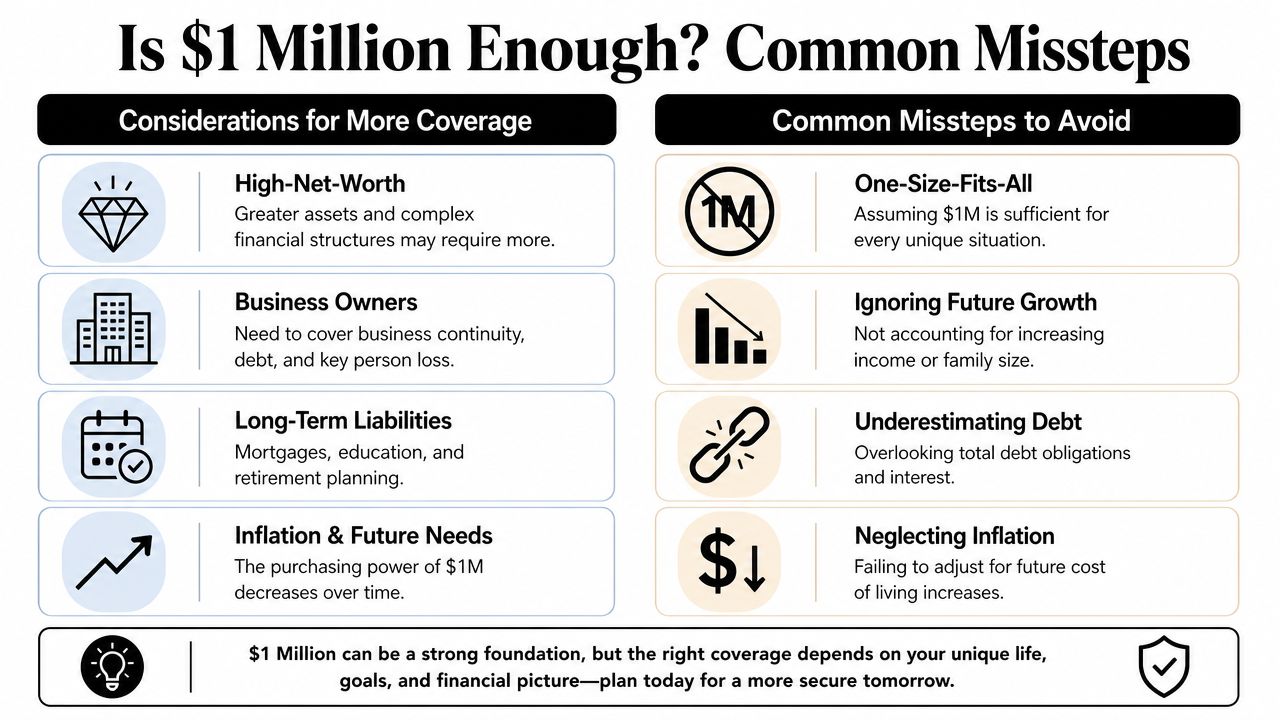
The most common mistake in million dollar insurance shopping is treating $1 million as the answer instead of a checkpoint.
For some households, it's more than enough. For others, it's just a clean round number that doesn't fully cover the actual plan.
When more coverage may make sense
A verified industry note says many consumers treat $1M as a default, but it may not be sufficient. It also notes that insurers can offer limits up to $3M, and that the premium difference between $1M and $2M can be minimal, while many guides still fail to move buyers beyond the old 10x-income shortcut. That point is discussed in this video discussion about higher life insurance limits.
That matters most for people in situations like these:
- High-cost lifestyles with real obligations: Not luxury spending. Think expensive housing, long-term family support, or big future education goals.
- Business ownership: A death can leave behind personal and business complications at the same time.
- Long income runways: If dependents would need support for many years, the shortfall can be larger than expected.
- Growing households: A newly married couple expecting children may need more than their current snapshot suggests.
Common mistakes buyers make
Some mistakes are simple, and expensive.
- Buying by headline number: People choose $1 million because it sounds responsible, not because they calculated the need.
- Waiting too long: As earlier pricing showed, age can make the same coverage much more expensive.
- Choosing too short a term: The policy should align with the years your family needs protection.
- Forgetting to review coverage: Marriage, children, a larger mortgage, or a jump in salary can all change the right amount.
Don't ask only, “Can I get a million-dollar policy?” Ask, “If my family had to use this money exactly as planned, would it be enough?”
That one question catches most underinsurance problems early.
Million Dollar Insurance FAQs
Is the death benefit usually taxable to beneficiaries
In many cases, beneficiaries receive life insurance death benefits income-tax free. Tax treatment can depend on the situation, so it's smart to confirm details with a tax professional if the estate is complex.
What happens if I outlive my term policy
If you outlive a term life policy, the coverage usually ends and no death benefit is paid. At that point, you may be able to apply for new coverage, renew under the policy terms, or decide you no longer need the same level of protection.
Can I own more than one life insurance policy
Yes. Many people hold more than one policy at the same time. For example, someone might keep an employer policy and also buy an individual term policy for added protection and portability.
How quickly is a claim paid
Payout timing depends on the insurer, the claim paperwork, and whether the claim is straightforward. Beneficiaries usually need to submit a claim form and a death certificate. Delays are more likely when documents are incomplete or the insurer needs to review details.
Is no-exam life insurance always the better option
Not always. It may be better if speed and convenience are your top priorities. If your goal is to pursue the lowest possible price and you're comfortable completing an exam, the traditional route may be worth comparing.
Should I buy exactly $1 million if I qualify for it
Only if the number fits your real obligations. Million dollar insurance is a useful benchmark, but it shouldn't replace a real needs analysis.
If you want a simpler way to explore your options, Coveredly offers online life insurance built for real life. You can compare flexible term coverage, including policies up to $3 million with no exams for most, without turning the process into a weeks-long project.