You've been meaning to buy life insurance, but the thought of scheduling a nurse, giving blood, and waiting for lab results keeps pushing the decision into next month. Maybe you're a new parent protecting a growing household, a professional with no room for another appointment, or a newly married couple trying to put the basics in place. A no exam life insurance policy can remove the medical visit without removing underwriting, but understanding what happens behind the screen matters before you apply.
The phrase “no exam” describes the application experience, not a free pass on health and lifestyle questions. Insurers still evaluate risk, review outside records, and may ask for more evidence when your profile doesn't fit the available rules. This guide explains how that process works, what data carriers use, how coverage limits vary in 2026, and when traditional underwriting may be the better route.
Table of Contents
- What a No Exam Life Insurance Policy Actually Is
- How No Exam Underwriting Differs From Traditional and Simplified Issue
- What Data Carriers Actually Use to Decide Without an Exam
- Real Cost and Coverage Expectations in 2026
- Honest Risks and Limitations Worth Knowing
- Who a No Exam Life Insurance Policy Is Really Best For
- Applying Step by Step Without Surprises
- Buyer FAQs and Your Pre-Application Checklist
What a No Exam Life Insurance Policy Actually Is
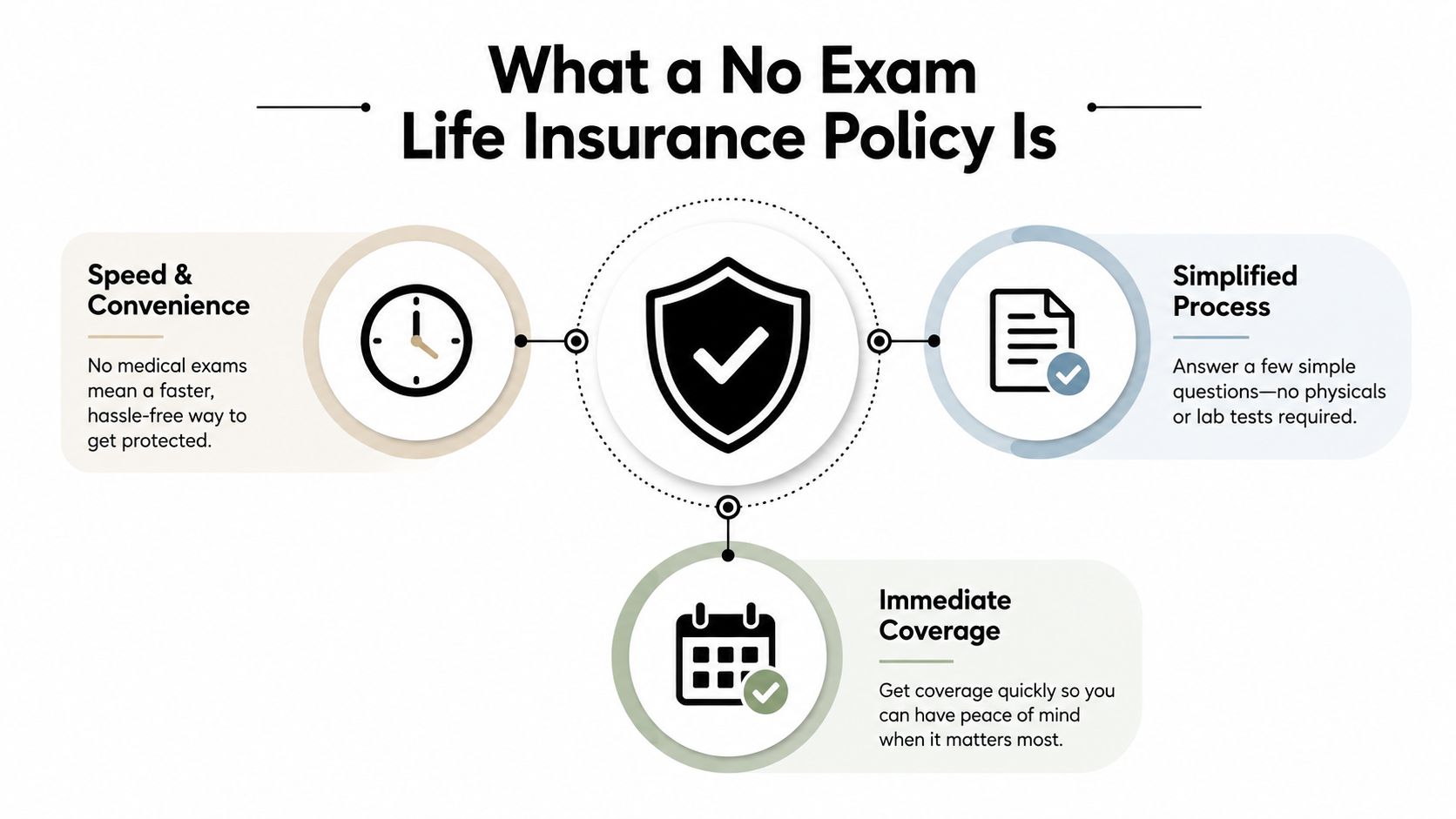
A no exam life insurance policy is life insurance that can be issued without the traditional paramedical appointment, blood draw, or urine sample. Like other life insurance, it's a contract that pays a death benefit to the policy's beneficiaries when the insured person dies, subject to the policy's terms and exclusions.
The important distinction is that “no exam” doesn't necessarily mean “no health questions.” Many policies use accelerated underwriting, which evaluates an applicant through an application, predictive models, and electronic data rather than a physical exam. The Society of Actuaries' discussion of accelerated underwriting describes the approach as emerging in the early 2000s and becoming materially more common over the following decade. The NAIC also distinguishes accelerated underwriting from simplified issue because accelerated underwriting still assesses risk, even though it avoids the physical exam.
Why the process can be faster
For qualified applicants, digital-data underwriting can reduce a decision timeline from 2–12 weeks to no more than 48 hours, according to the NAIC information discussed in the Society of Actuaries reference above. That doesn't mean every applicant gets an immediate decision. It means the insurer can make a decision quickly when the available data answers its underwriting questions and the application fits its rules.
The same shift has helped move no-exam coverage from a niche convenience toward a mainstream underwriting method used by major carriers. In 2026, eligible applicants may find no-exam term coverage reaching $3 million at some carriers, while industry reporting has also described a carrier offering as much as $5 million without an exam for certain applicants. CNBC Select's no-exam life insurance comparison reports these market limits and shows why “no exam” shouldn't automatically be confused with small final-expense coverage.
What it's designed to do
A no-exam policy often fits someone who wants term coverage for family income protection, a mortgage, or business obligations but prefers a digital process. It may also suit a healthy applicant whose schedule makes a medical appointment inconvenient.
It isn't a guaranteed approval product unless the policy specifically says it's guaranteed issue. An insurer may approve the application, ask for an exam or medical records, or decline it based on the answers and data it receives.
How No Exam Underwriting Differs From Traditional and Simplified Issue
Think of life insurance underwriting as three interviews. Accelerated underwriting is a structured digital interview supported by outside records. Simplified issue is a shorter interview that relies more heavily on application answers and generally offers less depth. Fully underwritten coverage is the most detailed process, with a broader review that may include an exam, fluids, medical records, and additional evidence.
Accelerated underwriting is the path many people mean when they search for no exam term life insurance. Carriers may waive fluids and medical exams for applicants who meet favorable risk criteria, but the process remains fully underwritten through predictive models and data feeds. Munich Re's accelerated underwriting survey notes that carriers commonly preserve standard fully underwritten premium rates even when they reduce evidence requirements. The insurer manages selection through automated rules rather than charging a convenience fee.

The three paths side by side
| Underwriting Type | Exam Required | Typical Coverage Ceiling | Premium Level | Best Fit |
|---|---|---|---|---|
| Accelerated underwriting | Usually no exam for qualifying applicants | Commonly varies from $1 million to $3 million, with higher limits available in some cases | Often standard fully underwritten rates | Applicants whose data supports an automated decision |
| Simplified issue | No exam, but health questions are common | Often lower than accelerated underwriting, depending on the carrier | May be higher because less medical evidence is collected | Applicants who value convenience and can accept narrower eligibility |
| Fully underwritten | Exam and other medical evidence may be required | Can support larger or more customized coverage needs | May offer the strongest pricing for favorable risks | Applicants seeking maximum coverage or detailed risk assessment |
The comparison of coverage ceilings comes from industry reporting on no-exam life insurance limits and should be treated as a market range, not a promise from every carrier. A consumer source from Guardian Life says the highest no-medical-exam amount typically ranges from $250,000 to $500,000, while some insurers offer up to $1 million for qualified applicants. Those figures can coexist because products, ages, and underwriting paths differ.
For a broader explanation of the middle path, compare simplified issue life insurance with accelerated and fully underwritten coverage before choosing an application route.
What Data Carriers Actually Use to Decide Without an Exam
A no-exam application replaces a physical evidence package with a digital evidence package. The carrier starts with your answers, then may compare them with third-party records and internal underwriting rules. The purpose isn't to eliminate risk assessment. It's to gather enough relevant information without sending every applicant to a paramedical appointment.
Common data sources can include:
- Prescription-drug records: These can show medications associated with ongoing or past conditions, as well as patterns that may need clarification.
- Motor-vehicle reports: Driving history can reveal information about risky behavior that affects underwriting.
- Credit-based records: Carriers may use permitted credit-related data as part of their broader risk review.
- Public records: These can help verify identity and other application details.
- HIPAA-authorized medical records: Your authorization can allow a carrier to request medical information when the automated review needs it.
Recent industry coverage from Gen Re on next-generation underwriting trends identifies these types of records and reports that accelerated underwriting approved an average 57% of eligible applicants in 2024, compared with 40% in 2021. The figures describe eligible applications in the cited industry context, not a guarantee that a particular applicant will be approved.

How the decision engine sorts an application
The carrier's rules and predictive models look for consistency. Your stated medications, health history, age, requested amount, driving record, and other data points need to fit the insurer's eligibility boundaries.
That usually produces one of three outcomes:
- Automatic approval or offer: The data matches the carrier's rules, so the application can move forward without human intervention or an exam.
- Manual review or more evidence: The carrier needs clarification, medical records, recent lab data, or a paramedical exam.
- Decline: The available information falls outside the insurer's acceptable risk range.
An unusual prescription, a complex diagnosis, inconsistent answers, a recent health event, or a coverage request that exceeds an age-based limit can push an application from automated processing into a different path. The insurer may not need to call before the system flags the case, although a follow-up request can come later.
For a deeper explanation of the broader risk assessment, see this guide to underwriting life insurance.
Real Cost and Coverage Expectations in 2026
The cost of a no-exam policy depends on the same broad factors that shape other life insurance pricing, including age, coverage amount, term length, tobacco use, health history, and underwriting class. Skipping the exam doesn't freeze the price. The carrier still places you into a risk category based on the information it can verify.
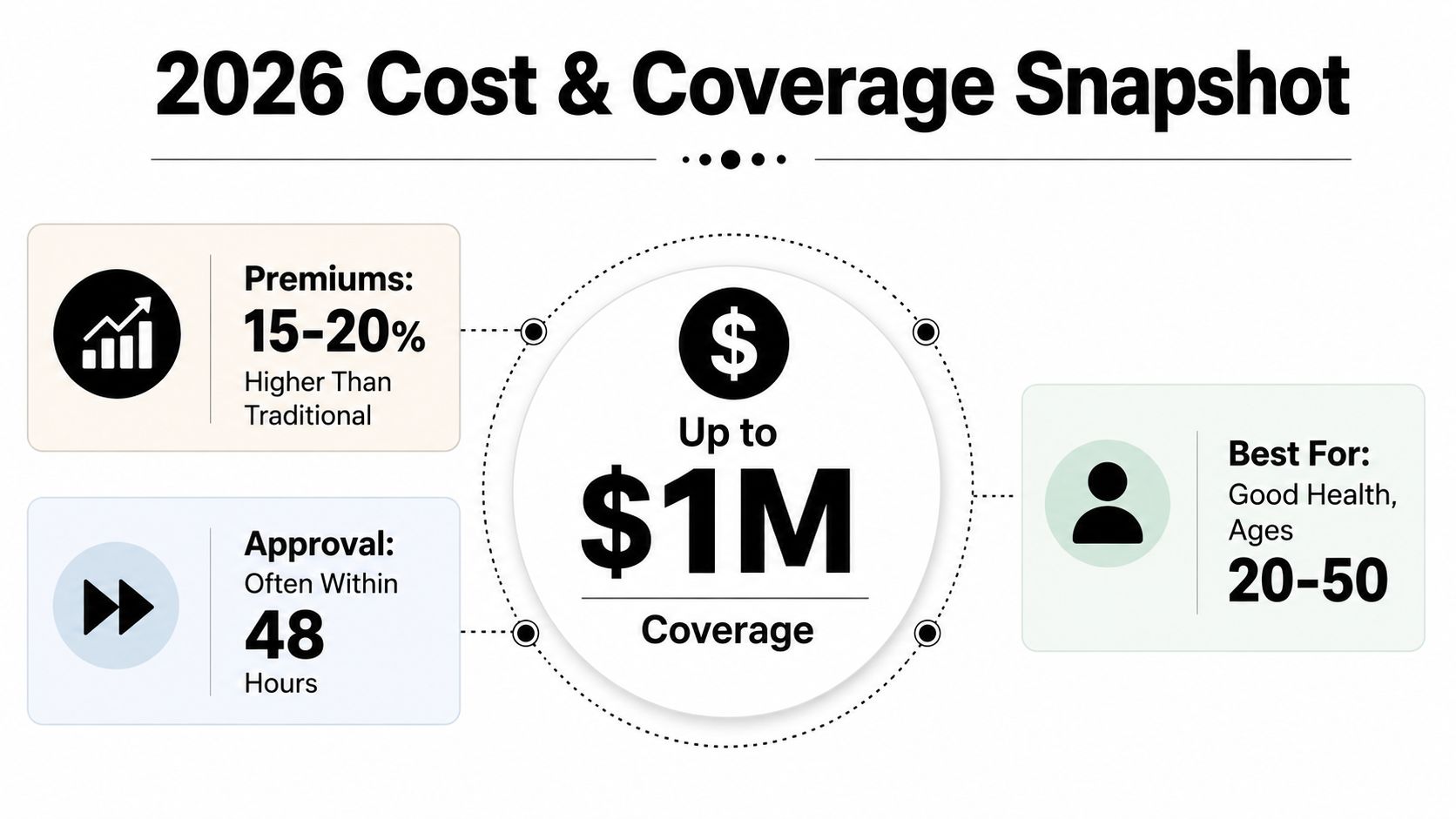
Coverage ceilings also vary by product and age. One Principal accelerated underwriting profile shows limits of up to $3 million for ages 18–40, $2.5 million for ages 41–50, and $2.5 million for ages 51–60, with higher amounts requiring more recent lab data in some circumstances. Another carrier announcement from Sun Life reported that clients aged 18–40 could qualify for up to $5 million without lab exams, increased from a prior $2 million limit for that age group.
Why the headline maximum may not be your limit
A maximum is an upper boundary, not a likely offer for every applicant. Independent reviews have found many insurers setting no-exam term maximums between $1 million and $3 million, while some market roundups distinguish express underwriting limits of up to $1 million for ages 18–60 from accelerated underwriting limits of up to $3 million for ages 18–50 and $2 million for ages 51–60. Those distinctions are summarized in this market comparison.
A healthy applicant in their early thirties might seek a long term and a substantial death benefit, then receive a no-exam offer if the carrier's model can verify favorable risk. A parent in their forties may find that age, requested amount, and medical history trigger more evidence. An older applicant seeking final-expense protection may find a smaller simplified or guaranteed-issue policy more practical than a large term policy.
How to think about premiums
Insurers may keep fully underwritten premium rates for accelerated underwriting, as described in the Munich Re survey cited earlier. That means you shouldn't assume a no-exam policy automatically costs more, or automatically costs less. Compare the actual offer, policy duration, benefit amount, exclusions, conversion provisions, and riders rather than judging the product by its application method.
Honest Risks and Limitations Worth Knowing
Convenience has a tradeoff. Accelerated underwriting can make a sound decision from digital data, but it may miss a signal that a physical exam or lab panel would have revealed. Insurers describe that risk as mortality slippage, meaning actual mortality may be worse than the model expected if the accelerated rules are too permissive.
Multiple industry studies place average mortality slippage around 10%–15%, according to the PartnerRe accelerated underwriting survey and white paper. The same source gives examples of how laboratory values can separate risk tiers, including GGT of 500+ linked to first-year relative mortality risk above 1800%, and BMI of 50+ associated with persistently high mortality around 500%. These are underwriting-analysis examples, not predictions about any individual applicant.
Practical rule: No exam means less friction for the applicant, not less responsibility for the insurer to test its model.
Carriers also use auditing to manage that uncertainty. A 2025 Gen Re survey announcement found that 66% of carriers estimated mortality slippage at 6% to 15%, while 86% either used or planned to implement pre-issue or post-issue auditing. An applicant shouldn't interpret an audit as a routine reason to fear a claim denial. The more useful lesson is that a no-exam policy remains part of a monitored underwriting system.
A switch to full underwriting can also happen before issue when the carrier needs more detail. Complex medical history, unusual medication patterns, or a request near the product's limit may lead to additional evidence. For applicants with substantial coverage needs or complicated health profiles, a fully underwritten application can provide a clearer and potentially more suitable path.
Who a No Exam Life Insurance Policy Is Really Best For
No-exam coverage tends to work well when the applicant values speed and has a profile that digital underwriting can evaluate confidently. Young families often fit because they need income protection but have limited time for appointments. Newly married couples may use it to put an initial policy in place while they organize broader financial planning.
Other suitable profiles include:
- Healthy professionals: A straightforward prescription and medical history can support a quick digital decision.
- Business owners: A no-exam application may help address an immediate protection need while larger or more complex coverage is evaluated separately.
- Applicants replacing lapsed coverage: A digital process can reduce the delay between recognizing the gap and applying for new protection.
- People managing routine health issues: Some applicants with manageable conditions may qualify, although the carrier's rules decide the outcome.
The fit changes when the application contains multiple underwriting complications. Very high coverage needs, recent serious diagnoses, substantial medication use, risky hobbies, or older age can reduce the chance of a clean no-exam decision. A traditional application may take more work but provide access to a broader underwriting review.
Where alternatives fit
Simplified issue sits between accelerated underwriting and guaranteed issue. It usually asks health questions but skips the exam, making it useful for applicants who want less friction and can accept narrower eligibility or different pricing.
Guaranteed issue generally removes health questions as well as the exam, but it can come with lower coverage, higher premiums, or graded benefits. It's designed for applicants who may not qualify elsewhere, not for someone seeking the largest death benefit at the most favorable rate.
Group coverage through an employer can provide a convenient baseline, but it may be tied to employment and may not meet a household's full protection need. Treat it as one part of the plan, not an automatic substitute for individually owned coverage.
Applying Step by Step Without Surprises
The application usually begins with a pre-qualification screen. You'll provide basic details, select a coverage amount and term, and answer initial health and lifestyle questions. The insurer then decides whether your profile appears eligible for an accelerated path.
Next, complete the application carefully. Expect identity verification, consent disclosures, and permission for the carrier to review relevant third-party data. Have your medication names, diagnoses, treatment dates, physicians, and driving history available so you don't guess.
The insurer may then review prescription records, motor-vehicle information, public records, credit-based records, and authorized medical data. You can compare digital application options through online instant life insurance quotes, but a fast quote still depends on accurate answers and carrier eligibility rules.
Your possible outcomes
- Approved: The carrier presents an offer, and you review the price, benefit, term, riders, and policy documents.
- More evidence requested: You may need medical records, recent labs, or a paramedical exam.
- Full underwriting required: The carrier moves the application to a deeper review rather than issuing it through the accelerated route.
- Declined: The application falls outside the insurer's current risk guidelines.
Before applying, check your prescription history for errors, answer every disclosure question thoroughly, and avoid assuming that recently stopping a medication removes it from your history. If you're planning an elective procedure, ask a licensed professional whether timing the application differently makes sense, because a pending or recent health event can change the evidence the carrier requests.
Buyer FAQs and Your Pre-Application Checklist
Will a no-exam policy pay a death benefit reliably? Yes, when the policy is active and the claim meets its contract terms. No exam doesn't remove the importance of truthful application answers.
How fast can approval happen? Qualified applicants may receive a decision within 48 hours, according to the NAIC information cited by the Society of Actuaries. Others may be referred for more evidence.
Can a pre-existing condition trigger an exam? Yes. The carrier may pivot to medical records, labs, or a paramedical exam when its data doesn't resolve the risk.
Are riders available? Some no-exam policies may offer riders such as accelerated death benefits or waiver of premium, but availability depends on the carrier and policy. Review the contract rather than assuming a rider is included.
Before you apply, confirm your age band, coverage need, term length, medication details, carrier reputation, and whether fully underwritten coverage better fits your situation. If the policy is part of a broader estate plan, a trust and probate lawyer in Walnut Creek can help you think through beneficiary and trust considerations.
Coveredly offers online term life insurance with no medical exams for most eligible applicants, with coverage options reaching up to $3 million subject to underwriting rules. Visit Coveredly to compare your options and begin a digital application built around the information carriers actually use.