You may be looking at life a little differently now than you did at 35. Maybe the mortgage isn't fully gone. Maybe your spouse would struggle if your income disappeared. Maybe you do not want your children to sort out bills and funeral costs while they're grieving. Those are practical, caring reasons to look into over 60 life insurance.
A lot of people assume life insurance after 60 is only for burial costs, or that it's too late to get meaningful coverage. Neither idea is always true. Some people over 60 need a small permanent policy for final expenses. Others still need a larger amount of temporary protection for a spouse, debt, or a short retirement gap.
Many buyers get stuck here. The market uses terms like term, final expense, simplified issue, guaranteed issue, and APS as if everyone already knows what they mean. Many lack that knowledge. You shouldn't need to speak insurance language to make a sound decision.
Table of Contents
- Why Life Insurance Still Matters After 60
- Your Main Options Term Final Expense and Guaranteed Issue
- Decoding Costs What to Expect for Life Insurance Over 60
- Health and Underwriting The No-Exam Rules
- Choosing Your Coverage Right-Sizing Your Policy
- Application Steps and Common Pitfalls to Avoid
Why Life Insurance Still Matters After 60
If you're in your early 60s, you may be balancing two realities at once. Retirement is getting closer, but some responsibilities are still very present. A house payment may still exist. A spouse may still count on your pension or earnings. You may want to leave something behind, or at least avoid leaving a mess.

Life insurance can still solve real problems at this stage of life. It can help replace income for a surviving spouse, cover debt that hasn't gone away yet, or provide money for final expenses. It can also give your family time and breathing room instead of forcing rushed financial decisions.
The need often changes, but it doesn't disappear
The main question usually isn't “Do I need life insurance?” It's “What job should this policy do now?”
For some people, the job is temporary. They need protection for 10 or 20 years while a mortgage shrinks, retirement savings mature, or a younger spouse reaches Medicare age. For others, the job is permanent but smaller. They want a policy that's there whenever they pass away to help with funeral and end-of-life costs.
Practical rule: Don't shop by policy name first. Shop by purpose. A policy should match the financial problem you want solved.
Why this topic is getting more attention
Older adults aren't a niche market anymore. Baby Boomers ages 60 to 78 have the highest life insurance ownership rate at 57%, compared with 50% of Millennials and 36% of Gen Z, according to these global life insurance statistics. That same source says the broader global life insurance market reached $8.25 trillion in 2025.
That doesn't mean every person over 60 needs coverage. It does mean many people your age still see life insurance as useful for security, legacy planning, and handling later-life costs.
A good over 60 life insurance decision starts with calm thinking, not pressure. If you know what you want the money to accomplish, the choices get much easier.
Your Main Options Term Final Expense and Guaranteed Issue
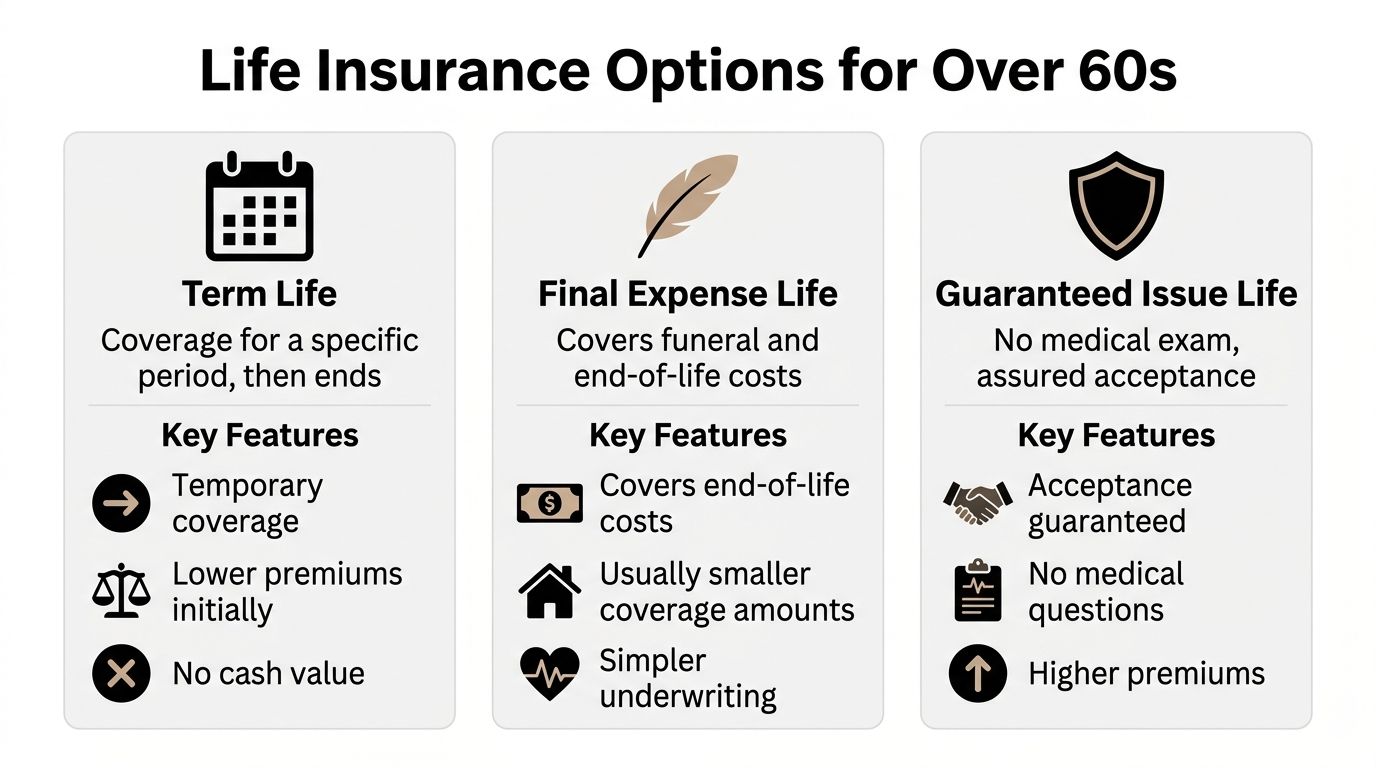
Most over 60 life insurance decisions come down to three paths. Term life is for a set period. Final expense is a small permanent policy built mainly for funeral-related costs. Guaranteed issue is the backup choice for people who may not qualify elsewhere because of health.
Term life for temporary needs
Term life is like renting coverage. You choose a period such as 10 or 20 years, and the policy pays only if you pass away during that term. This can be a strong fit if your need has an end date.
Examples help here:
- Mortgage protection: You want the house paid off if you die before the loan is gone.
- Spousal support: Your husband or wife would need income support for a limited stretch.
- Retirement bridge: You want coverage until pension income, Social Security, or savings are fully in place.
A key point for older buyers is that carriers often limit term choices. Progressive's guide to life insurance for seniors notes that insurers often restrict 30-year term availability for people 60 or older, so many applicants may only see 10- or 20-year terms. That same source notes that final expense insurance is designed for funeral costs and that applicants between 45 and 85 often cannot be turned down for that type of coverage.
Final expense for a narrow job
Final expense insurance is a form of whole life. Think of it as owning a smaller policy that stays in force as long as premiums are paid. It's designed for a specific job, not broad family income replacement.
This kind of policy is often appropriate when your goals are modest and permanent:
- Funeral costs
- Small medical or household bills
- A small cushion for family members
Because it's permanent, the structure is different from term life. You're not buying a large death benefit for a short season. You're buying a smaller lifelong policy for a narrow purpose.
If your only goal is to make sure funeral costs don't fall on your children, final expense may fit neatly. If you still have a mortgage or an income-dependent spouse, it may be too small.
Guaranteed issue as a safety net
Guaranteed issue is the simplest to qualify for and often the easiest to misunderstand. You answer no health questions, there's no medical exam, and acceptance is generally guaranteed if you meet the age rules. That accessibility matters for people with serious health conditions.
But the trade-offs are real. This guide to guaranteed life insurance is worth comparing against broader market options because guaranteed issue usually offers lower coverage limits and higher premiums than policies that ask health questions.
A few limits matter a lot:
- Coverage is usually small.
- Pricing is usually high for the amount you get.
- Many policies include a waiting period for natural death.
According to My Senior Health Plan's overview of senior life insurance, guaranteed issue policies typically include a two-to-three-year waiting period. During that time, if death occurs from natural causes, beneficiaries often receive premiums paid back plus interest rather than the full death benefit. That source also says guaranteed issue coverage usually tops out around $25,000, while simplified issue may offer roughly $25,000 to $300,000.
The easiest policy to buy isn't always the smartest one to buy. For many seniors, the better move is to look at term or simplified coverage first, then use guaranteed issue only if health leaves no better option.
Decoding Costs What to Expect for Life Insurance Over 60
A 62-year-old retiree might see two quotes on the same afternoon. One offers $10,000 of guaranteed issue coverage with no health questions. The other offers a 10-year term policy for far more coverage at a monthly cost that is closer than expected. That side-by-side comparison is where pricing starts to make sense.
Monthly premium matters, but price per dollar of coverage matters just as much. Many adults over 60 focus on the bill they will pay each month and miss the bigger question: how much insurance is that payment buying?
A useful way to judge value is to compare policies the way you would compare cars. Two vehicles can have similar monthly payments, yet one is a compact sedan and the other is a full-size SUV. Life insurance works the same way. A no-exam policy can look convenient on the surface while delivering much less coverage for each premium dollar.
What moves your premium
Insurers usually price over 60 life insurance based on a handful of factors:
- Age: Rates usually rise with each birthday.
- Health: Better health often opens lower-cost options.
- Gender: Men and women can see different rates.
- Smoking status: Tobacco use can raise premiums sharply.
- Policy type: Term, simplified issue, and guaranteed issue are priced on different risk models.
- Coverage amount: Higher death benefits usually cost more.
Age changes the math quickly. According to NerdWallet's guide to life insurance in your 60s and 70s, average monthly costs for a $20,000 guaranteed issue policy at age 60 are about $84 for a woman and $113 for a man. That is a helpful benchmark because it shows how expensive small permanent coverage can be, even before you compare it with term life.
Sample monthly life insurance premiums for a 60-year-old non-smoker
The table below uses verified figures from published sources. It is not a quote, and it does not reflect every health class, but it gives you a practical starting point.
| Policy Type | Coverage Amount | Est. Monthly Premium (Female) | Est. Monthly Premium (Male) |
|---|---|---|---|
| Fully underwritten 10-year term | $250,000 | Not specified in verified data | Not specified in verified data |
| Guaranteed issue | $10,000 | Not specified in verified data | $45 to $57 |
| Guaranteed issue | $20,000 | $84 | $113 |
The $10,000 guaranteed issue benchmark comes from Protective underwriting material, which says seniors over 60 may pay roughly $45 to $57 per month for that amount with no health questions. The $20,000 guaranteed issue benchmark comes from NerdWallet's life insurance in your 60s and 70s guide, which lists average monthly costs of $113 for a 60-year-old man and $84 for a 60-year-old woman.
The practical lesson is simple. If your health still gives you access to term or simplified issue coverage, those options often buy much more protection for each dollar than a default final expense policy.
That does not mean final expense is a poor choice for everyone. It means it should be a deliberate choice. If your goal is covering a short-term need, replacing income for a surviving spouse, or leaving a modest cushion for debts and funeral costs, affordable term life can be the smarter buy. Guaranteed issue usually makes more sense when health rules out the lower-cost lanes.
If you want a broader view of how premiums rise over time, this guide to life insurance rates by age can help you compare age-based pricing before you request quotes.
Health and Underwriting The No-Exam Rules
A 63-year-old shopping for coverage may see three ads in one afternoon. One says “no medical exam.” Another says “guaranteed acceptance.” A third offers term life with a short health questionnaire. They sound similar, but they work very differently, and the price gap can be wide.
What underwriting really means
Underwriting is the insurer's screening process. The company reviews your health and history to decide whether to approve the policy, how much coverage to offer, and what premium to charge.
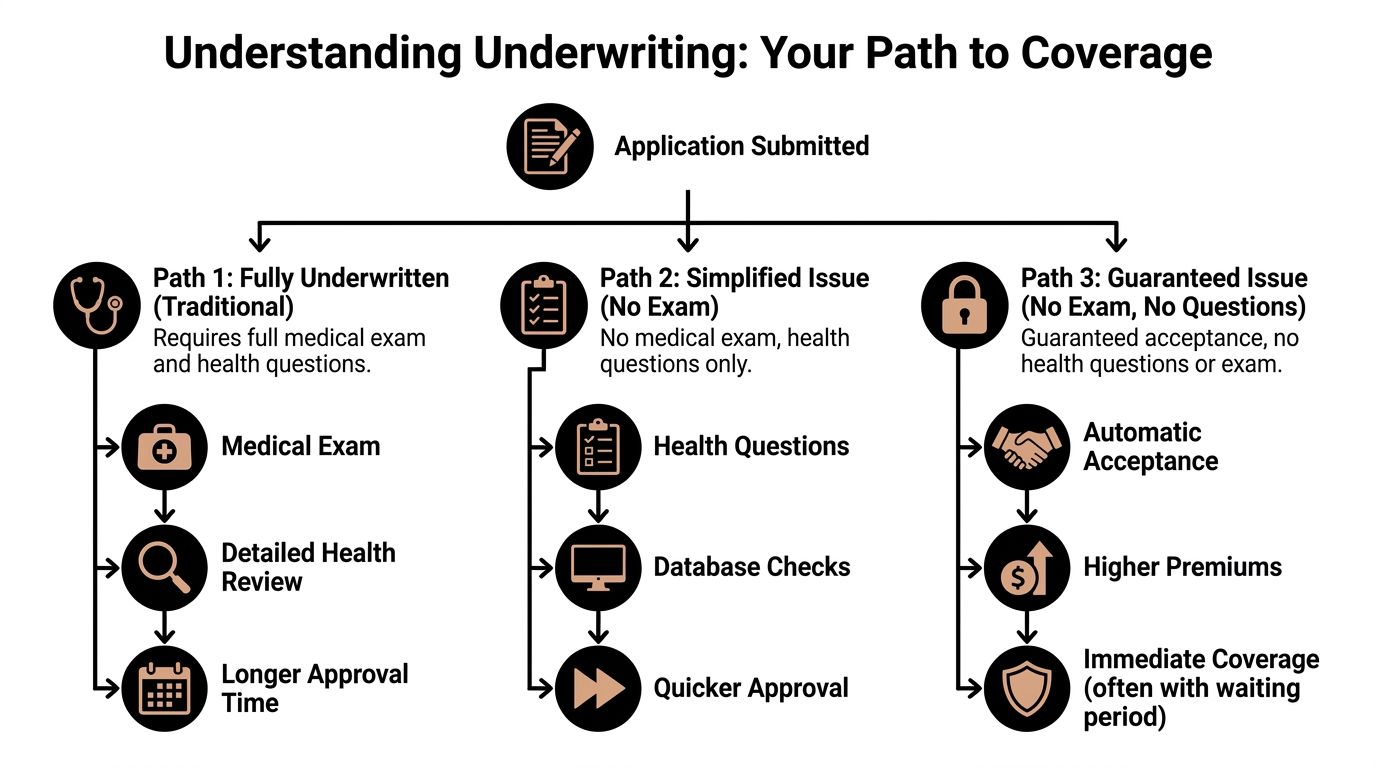
After 60, that process usually falls into three lanes:
Fully underwritten
This route may include a medical exam, detailed health questions, and a review of medical records.Simplified issue
No exam is required, but you still answer health questions. The insurer may also review prescription history, motor vehicle records, or other databases.Guaranteed issue
No exam and no health questions. If you meet the age rules, approval is generally offered.
A useful way to view these options is to compare them to airport security. Fully underwritten is the full screening line. Simplified issue is the shorter line with fewer checkpoints. Guaranteed issue is the line where nearly everyone gets through, but the ticket usually costs more.
Why medical records can slow an application
One term that surprises applicants is APS, short for Attending Physician Statement. This is a report from your doctor that helps the insurer confirm your medical history.
For adults in their 60s and beyond, insurers are more likely to ask for medical records than they are for younger applicants. That can slow the process because the carrier must request the file, the doctor's office must send it, and an underwriter must review it before a final decision is made.
That delay is one reason no-exam coverage appeals to many older buyers. The appeal is often speed and simplicity, not just fear of being declined.
No-exam does not mean no screening
This is the point that saves people money.
A simplified issue policy still asks enough questions to sort applicants by health risk. If your conditions are stable and your prescription history is fairly routine, that lighter screening can lead to better pricing than a guaranteed issue policy. A guaranteed issue policy skips the health questions, so the insurer takes on more uncertainty and usually charges more for less coverage.
This overview of life insurance without a medical exam can help you compare the main no-exam policy types before you apply.
The practical rule for buyers over 60
Start with the least expensive lane you still have a realistic chance of qualifying for.
For many people in their 60s, that means checking simplified issue term or simplified issue whole life before defaulting to guaranteed issue. This is significant because guaranteed issue is often treated like the standard senior option, even though it is usually the fallback choice for applicants with serious health issues or recent medical events.
A few points are worth keeping in mind:
- Fully underwritten coverage may involve doctor records and more waiting. If time matters, ask upfront whether the insurer is likely to request an APS.
- Simplified issue can be the sweet spot. You avoid the exam, but you may still get more coverage and a lower premium than guaranteed issue.
- Guaranteed issue usually trades price for certainty. Approval is easier, but coverage amounts are often smaller and early benefits may be limited during the first policy years.
- Age limits tighten as you get older. Some no-exam term options are easier to find in your early 60s than in your late 60s or 70s.
The key question is not “Can I get no-exam life insurance?” The better question is “Which no-exam path still gives me good value?”
If you have manageable conditions such as controlled blood pressure or treated cholesterol, simplified issue may be the smarter first quote to request. If your health history includes more serious concerns, guaranteed issue can still provide useful protection, but it should be chosen with clear eyes because the premiums are usually higher and the coverage is often modest.
Choosing Your Coverage Right-Sizing Your Policy
Many articles aimed at seniors implicitly assume one thing: you only need enough insurance to pay for a funeral. That advice fits some people. It does not fit everyone.
Start with the job your policy must do
A better approach is to list the actual obligations someone would inherit if you died.
Think through these categories:
- Debt: Mortgage, personal loans, or other balances your family would need to handle.
- Income support: Money your spouse would need to replace what you currently provide.
- Final expenses: Funeral costs, burial costs, and immediate household bills.
- Legacy or gift: A small amount left intentionally to children or grandchildren.
That list changes the conversation. Instead of asking, “What do seniors usually buy?” you ask, “What would my family need?”
A report from Experian on life insurance after 60 highlights why this matters. It says 28% of adults over 60 have a spouse under 65 who relies on their income, and 19% still carry mortgage debt. That same source points out that many guides focus only on funeral costs, even though short-term term policies can be a more affordable solution for temporary needs.
When term can be the smarter buy
If you're 62, still paying a mortgage, and your spouse would need help for the next decade, a small permanent burial policy may not solve the main problem. It may cover funeral costs and little else.
In that situation, a 10-year term policy can be a cleaner fit because the need itself is temporary. You don't necessarily need lifetime coverage for a mortgage that will be gone in less than 10 years. You need a policy built for that window.
Here's a practical way to decide:
Choose the need with the biggest financial impact.
If your spouse would struggle with housing costs, start there.Estimate how long the need lasts.
If the mortgage ends in 8 years, a 10-year term may line up well.Add final expenses only after the larger problem is covered.
Don't let a narrow burial policy crowd out more important protection.Buy for purpose, not for slogans.
“Permanent” sounds comforting, but the right answer is the policy that matches your actual risk.
Strategic clarity is especially important. Final expense insurance has a role. Guaranteed issue has a role. But if your need is short-term income replacement or debt protection, term can be the more sensible and cost-aware choice.
Application Steps and Common Pitfalls to Avoid
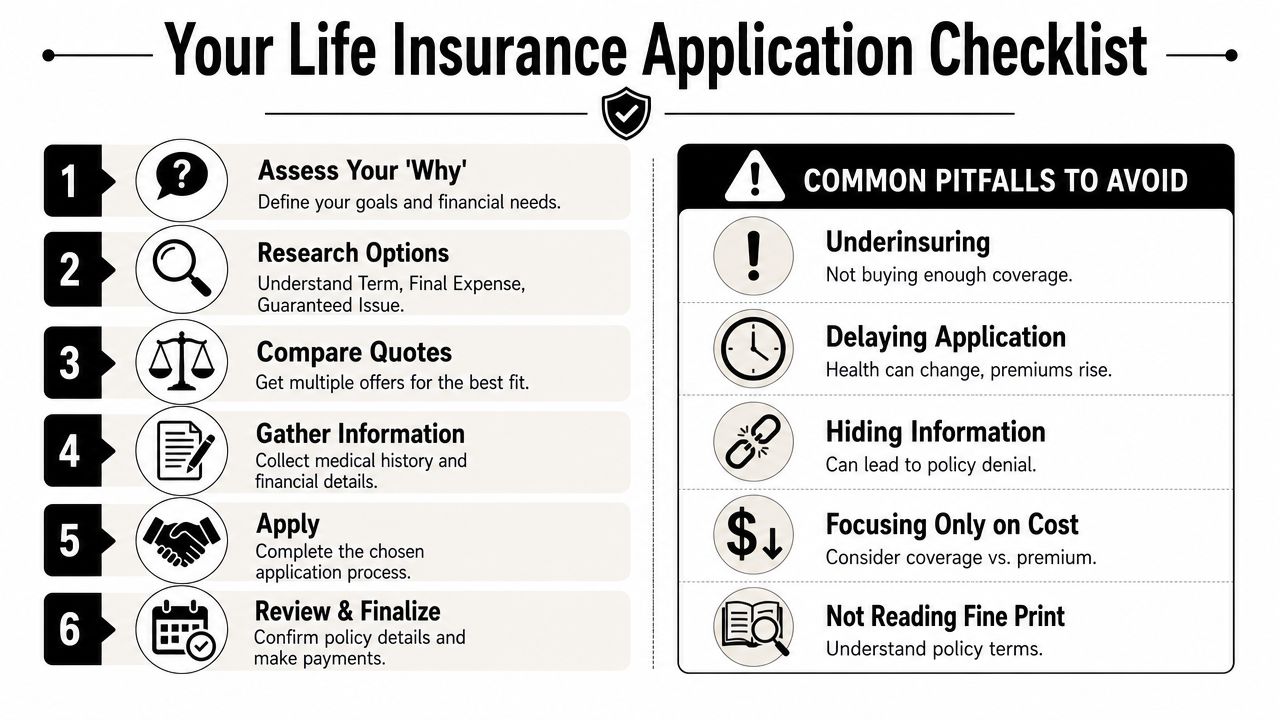
A good application process works like a checklist before a trip. A few minutes of preparation can help you avoid the expensive detours.
Many applicants over 60 run into trouble for one simple reason. They shop by advertisement first and policy details second. That is how people end up in no-exam plans that look easy at first, but cost more than necessary or include a waiting period they did not expect.
A better approach is to treat the application like a matching exercise. First identify the job the policy needs to do. Then choose the type of underwriting that gives you the best chance of affordable approval.
A practical order to follow
Start with your purpose. If the goal is to cover a mortgage for 8 more years, your application should point you toward term quotes first. If the goal is a modest burial fund and you want permanent coverage, final expense may fit better. If your health history is serious enough that regular approval is unlikely, guaranteed issue may be the fallback.
Next, gather the facts an insurer is likely to ask for. That usually includes your medications, doctors' names, major diagnoses, tobacco use, and beneficiary information. Having this ready helps you answer clearly and reduces the chance of inconsistent details between applications.
Then compare more than one company before you apply. CNBC Select's guide to life insurance for seniors notes that rates can vary significantly between companies for seniors. That matters even more in the no-exam market, where one insurer may price a controlled health condition reasonably and another may treat it as a much higher risk.
Before you submit anything, check the approval path. A simplified issue policy asks health questions but usually skips the medical exam. Guaranteed issue asks very few or no health questions, but often costs more and may include a graded death benefit for the first years. The cheapest path after 60 is often not “no questions asked.” It's “a few questions answered thoroughly.”
One more step matters. Review the policy offer before you pay the first premium. Confirm the monthly cost, the coverage amount, any waiting period, and the beneficiary name. Small errors here can create large problems later.
Common mistakes that lead to higher costs or poor fit
These mistakes show up often:
- Applying for guaranteed issue too early: If you can still qualify for term or simplified issue, guaranteed issue can be the more expensive choice for less coverage.
- Answering health questions too loosely: Insurers often check prescription history and medical records. A vague or incomplete answer can delay approval or cause trouble with a future claim.
- Buying based on the ad, not the need: A burial policy sounds reassuring, but it may leave a spouse short on mortgage or income needs.
- Focusing only on the monthly premium: A lower payment is not a bargain if the policy has a waiting period, limited benefit in early years, or too little coverage to solve the problem.
- Waiting after getting quotes: Age and health changes can push prices up. A quote is useful only if you act on it while it still reflects your situation.
Buy coverage for the problem you want solved. Price matters, but fit matters first.
If you want to avoid premium traps, ask one plain question before applying. “Am I choosing this policy because it is the best fit, or because it sounds easiest to get?” That question alone can save money and lead you toward a stronger decision.
If you want a simpler way to explore life insurance online, Coveredly offers a digital approach built around flexibility and affordability. You can review options without the usual pressure, compare coverage that fits your stage of life, and take the next step when you're ready.