Reduced paid up insurance lets you stop paying premiums while keeping a smaller permanent life insurance policy, using your policy's cash value to buy a reduced death benefit that requires no further payments. It's a practical fallback when the original premium no longer fits your budget, but you still want some lifelong protection in place.
A lot of people hit this decision during a real-life squeeze. Maybe your income changed, childcare costs climbed, or your business cash flow got tighter, and now you're staring at a whole life bill you can't comfortably keep paying. The hard part is that walking away entirely can feel too extreme, especially when you've already built value into the contract.
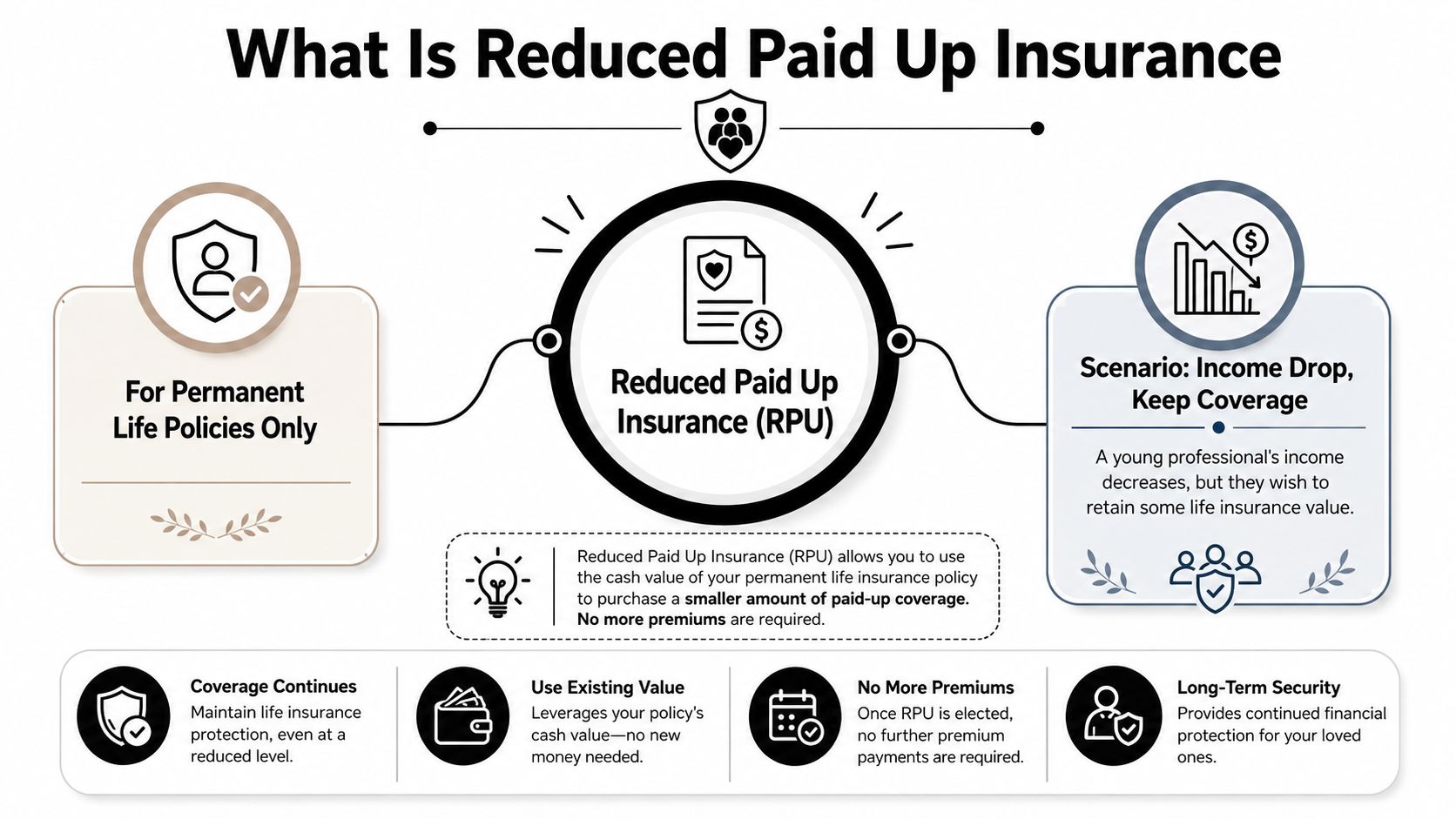
Table of Contents
- What Is Reduced Paid Up Insurance
- How Reduced Paid Up Insurance Works Step by Step
- When Reduced Paid Up Insurance Makes Sense
- Pros and Cons of Choosing Reduced Paid Up Coverage
- Reduced Paid Up vs Other Policy Options
- Tax and Beneficiary Implications of RPU
- Reduced Paid Up Insurance for Term Policyholders and Coveredly Customers
- Making Your Decision on Reduced Paid Up Insurance
What Is Reduced Paid Up Insurance
A reduced paid up insurance election can make a hard choice feel more manageable. If you have a whole life policy and you no longer want to keep paying premiums, the insurer can use the policy's accumulated cash value to buy a smaller fully paid-up death benefit, and the coverage stays in force for life with no further premiums due. Ethos explains the core structure clearly.
That can matter at very different points in life. A young professional may reach this option after a salary cut or higher household costs, while a family may want to keep some permanent protection instead of losing the policy entirely. The tradeoff is straightforward, lower payments now, but a smaller benefit for the people who would rely on it later.
Not a new policy, an internal conversion
The part that causes the most confusion is that reduced paid up insurance does not mean you buy a fresh policy somewhere else. It is an internal conversion inside your existing whole life contract, where the insurer uses your current cash value and attained age to recalculate how much paid-up coverage that value can support. Burial Senior Insurance describes that internal conversion process.
A simple way to understand it is to separate the premium from the promise. Your future premium payments stop, but the policy does not disappear. The insurer keeps the contract alive at a smaller face amount because the cash value has already done part of the funding work.
Practical rule: if you are considering RPU, treat it as exchanging future premiums for a smaller guaranteed benefit, not as getting back the full value you paid into the policy.
That distinction matters for families and business owners. Someone who wants to preserve at least some death benefit often sees RPU as a middle path between keeping the policy unchanged and letting it lapse. If you are comparing it with estate or beneficiary planning, a useful companion resource is this overview for high-net-worth individuals, because the decision often sits inside a larger protection strategy.
How Reduced Paid Up Insurance Works Step by Step
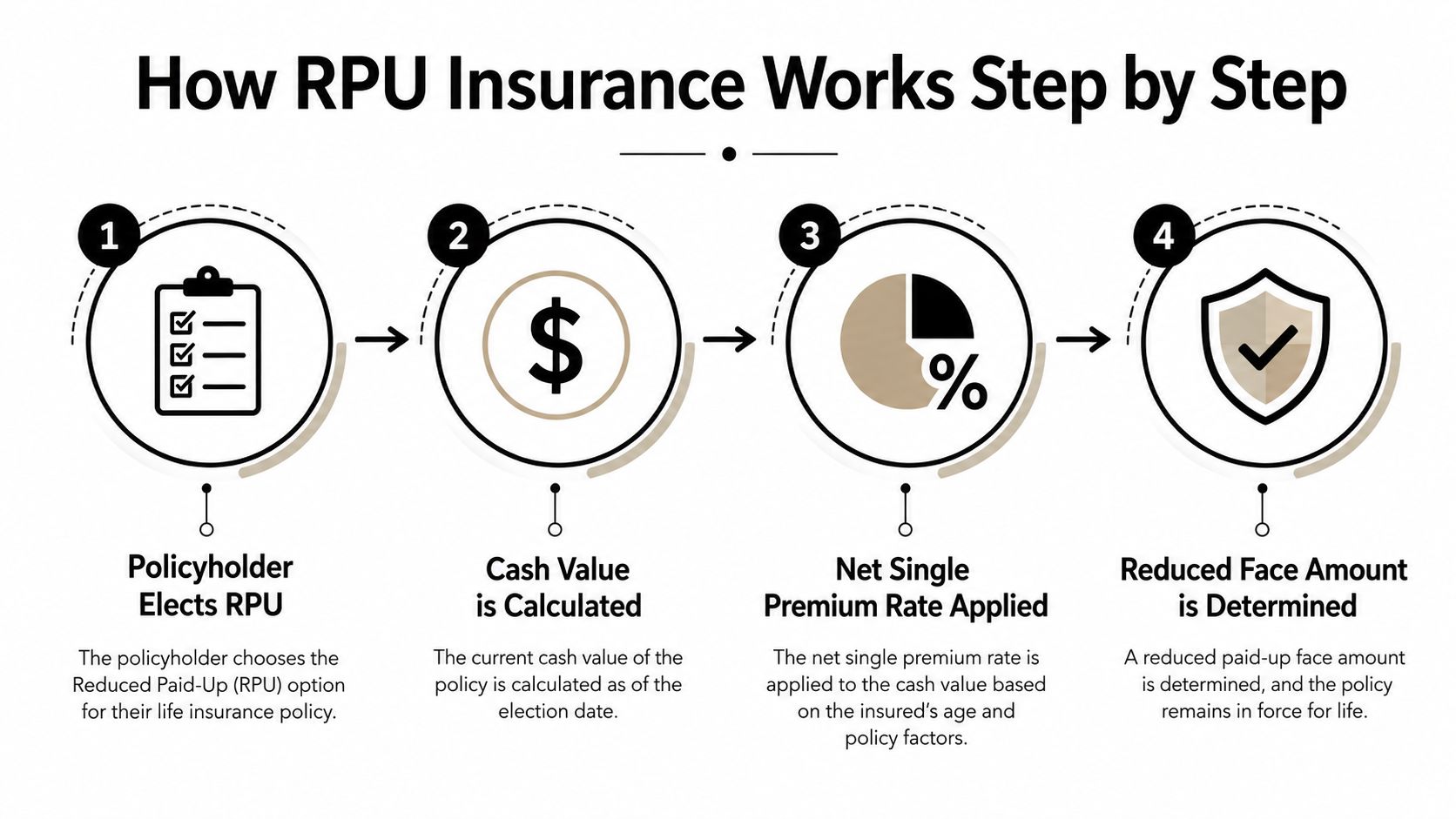
A policyholder usually reaches reduced paid up insurance after deciding the full premium is no longer the right fit, but the contract still has value worth preserving. The insurer then uses the policy's cash value, the insured person's attained age, and the plan's net single premium rate to calculate how much permanent death benefit that value can support. One common industry formula is New Death Benefit = (Current Cash Value ÷ Net Single Premium Rate for Current Age) × 1,000, as summarized in MoneyGeek's reduced paid-up guide.
The conversion process in plain language
The sequence is straightforward once you separate the policy's funding from its payout. The cash value already inside the contract is redirected to buy a smaller paid-up benefit, so future premiums stop and the policy stays in force at a reduced amount.
- You elect RPU. The request goes to your insurer, so no new life insurance application is needed.
- The insurer applies your cash value. That value functions like a single premium.
- Your age is used in the calculation. A higher attained age usually buys less coverage from the same amount.
- The face amount is reduced. The policy becomes fully paid up at the new level.
A simple example makes the trade-off easier to see. If a policy has $100,000 cash value and the net single premium rate is $400 per $1,000 of coverage, the reduced paid-up amount will be much lower than the original face value, which shows how cash value and age work together in the calculation. That is the same basic logic described in MoneyGeek's example discussion.
Other markets explain the same idea with a proportional formula. Edelweiss Life gives it as Reduced Sum Assured = Original Sum Assured × (Premiums Paid / Premiums Payable) in its Edelweiss Life glossary. In practical terms, the earlier you convert, the more coverage you usually keep. If you wait longer, there is less premium history left to convert into protection.
Short version: more cash value and more premium history usually mean more coverage survives when premiums stop.
For families and professionals sorting through policy paperwork, the handoff can also get messy if the insurer sends multiple versions of an illustration. Teams that need a cleaner paper trail can automate insurance documents with EDocGen, which helps organize forms, calculations, and review copies without losing track of the version that was approved.
When Reduced Paid Up Insurance Makes Sense
RPU becomes relevant when the original policy still has value, but the original premium no longer fits the household or business budget. Industry guidance connects it to income shock, retirement, or business change because whole life contracts are long-duration commitments and people often want to preserve some protection rather than lose it outright Aditya Birla Capital's reduced paid-up overview.
A recent college graduate might think about this after landing a lower-paying first job than expected. A new parent might see it after daycare or medical costs hit. A business professional might consider it after selling a company, changing roles, or stepping into a more volatile income stream.
Real-world situations that point toward RPU
- Income shock: If monthly cash flow has tightened, RPU can preserve some lifelong coverage without adding another bill.
- Retirement: If paychecks are gone and the policy is no longer affordable at the original level, a reduced paid-up election can keep a base level of protection intact.
- Business transition: If you've sold a company or changed from an owner-income structure to a salary, the policy may no longer match your financial reality.
- Major expense: A temporary expense spike can make it smart to preserve some coverage instead of forcing a lapse.
The decision usually comes down to one question, do you still want permanent protection, even if it's smaller? If the answer is yes, RPU may fit better than surrendering the policy or letting it lapse. If the answer is no, a different move may be cleaner.
Good fit test: choose RPU when keeping some guaranteed coverage matters more than keeping the original face amount.
That's especially true for people who don't want to re-enter the insurance market later at a higher age. The smaller benefit may still serve as a backstop for final expenses, family protection, or a business continuity need. The key is to make the choice while you're still thinking in terms of total household protection, not just this month's premium.
Pros and Cons of Choosing Reduced Paid Up Coverage
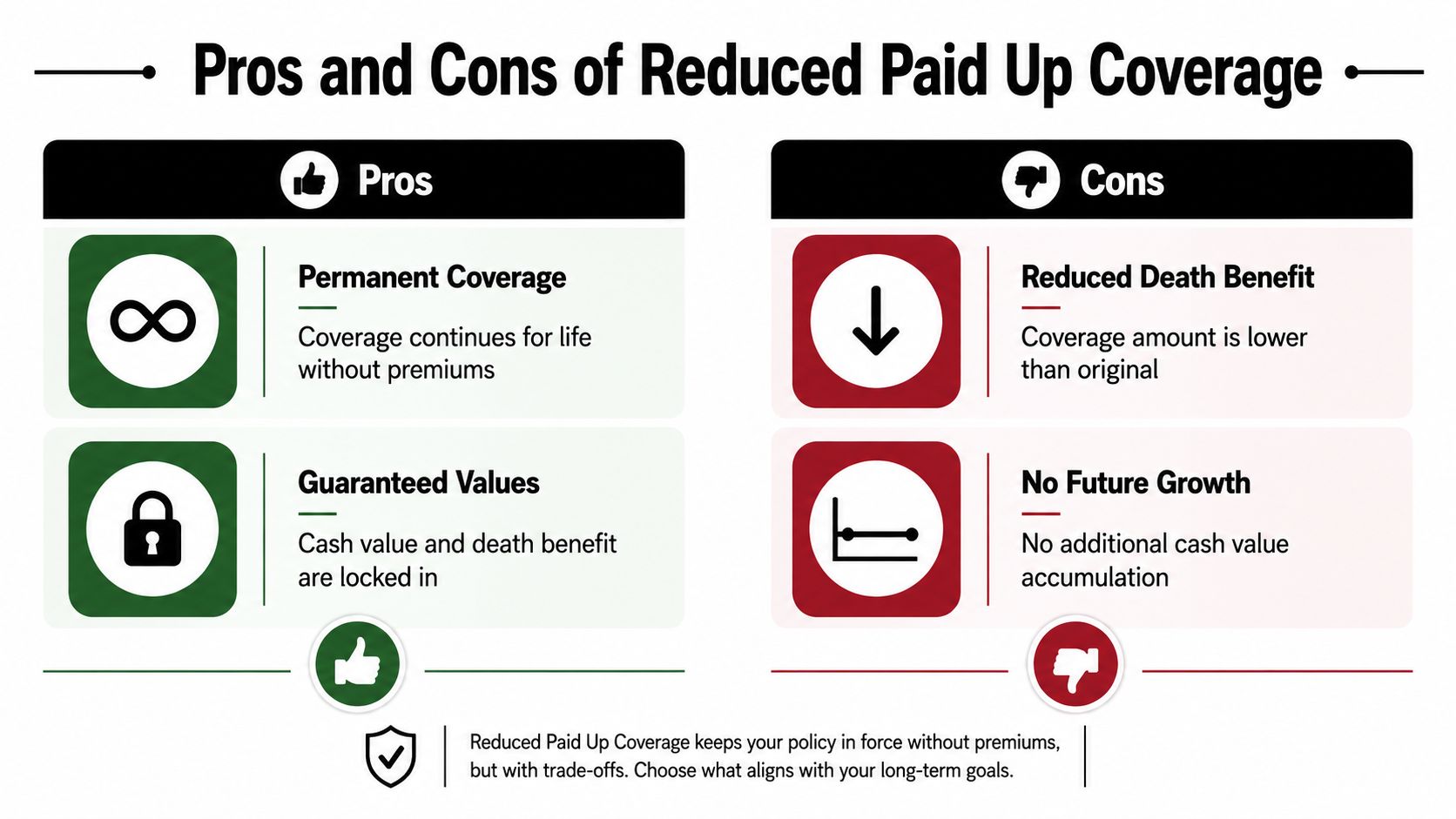
A reduced paid up election usually comes up at a turning point. A family may want to protect at least some lifelong coverage without keeping another premium in the budget, while a business owner may want to preserve a policy that still has value after a major income change. The appeal is straightforward, coverage continues for life with no future premiums. That can ease pressure when monthly expenses are already tight. The trade-off is just as direct, the death benefit drops, sometimes sharply, because the insurer is converting the policy's existing value into a smaller paid-up contract.
What you gain
- Permanent coverage remains: Your beneficiaries still have a death benefit in force for life.
- No more premiums: You stop the ongoing payment burden.
- Simplicity: The policy stays active without a new application process.
That mix can be useful when the policy's original face amount is no longer realistic, but keeping some protection still matters. For a young family, it may preserve a base layer for final expenses or income protection. For a professional, it may keep a policy in place after a job change, business sale, or shift to less predictable earnings.
What you give up
- Lower death benefit: The amount is reduced from the original face value.
- Less flexibility: Once elected, the decision is generally irrevocable, and the policy cannot be restored to the original terms, as noted in consumer guidance on the option YouTube consumer explanation.
- Opportunity cost: Money that might have supported another insurance strategy, or a policy loan, is no longer part of the original structure. If you were considering surrendering the policy instead, it also helps to understand what a surrender charge is, because that cost can affect the cash you walk away with.
That last point is where many comparisons become muddled. The key question is whether you want to trade future flexibility for certainty right now. If the answer is yes, RPU can be a disciplined move. If the answer is no, the premium relief may not justify the permanent reduction in coverage.
A reduced paid up policy can still provide a useful backstop, but it does not solve every cash problem. If your main concern is short-term affordability and you still want access to the original policy structure, compare RPU with the other choices before making a final decision.
Reduced Paid Up vs Other Policy Options
RPU is only one way to handle a policy that's no longer affordable. The right choice depends on whether you want lifetime coverage, temporary coverage, cash now, or flexibility. A policy loan, surrender, or extended term election can each solve a different problem, and they're not interchangeable.
| Option | Coverage Type | Premiums Required | Cash Access | Best For |
|---|---|---|---|---|
| Reduced Paid Up | Smaller permanent death benefit for life | No further premiums | No new premium payments, but coverage is reduced | People who want lifelong protection at a lower level |
| Extended Term Insurance | Original death benefit for a limited period | No further premiums | Uses cash value indirectly to fund temporary coverage | People who want to preserve the original face amount for a while |
| Policy Surrender | No coverage after surrender | No further premiums | Cash value is paid out, if available | People who need liquidity and no longer need insurance |
| Policy Loan | Original policy usually stays in force if loan terms are met | Premiums may still be due | Borrowing against cash value | People who want to keep coverage and preserve flexibility |
Where each option wins
Extended term is often the cleaner fit when you want the original death benefit to continue for a limited time. Coveredly's overview of extended term life insurance is useful for understanding that temporary protection angle. It's different from RPU because it preserves the original amount for a defined period rather than shrinking it for life.
Surrender is the most direct liquidity move. If the policy no longer makes sense as insurance, surrendering may give you cash value, but coverage ends. That's a hard stop, so it makes sense only when you don't need life insurance protection anymore.
Policy loans sit in a different category because they can leave the contract intact while you access money. That can be attractive for people who want more flexibility than RPU offers. The catch is that you're borrowing against your policy, not converting it into a smaller guaranteed contract.
Decision shortcut: if you still need lifelong protection, compare RPU with policy loans first. If you only need temporary protection, look at extended term. If you need cash and no coverage, surrender is the clearest exit.
For policyholders who are unsure, the smartest move is to compare the downside of smaller permanent coverage against the downside of losing coverage entirely. That's the choice underneath all the jargon.
Tax and Beneficiary Implications of RPU
The main tax advantage of life insurance usually stays intact with RPU. Beneficiaries generally receive the death benefit income-tax-free, which is one reason life insurance remains useful even when the policy is reduced. For a broader explanation of that treatment, see Coveredly's guide to whether life insurance proceeds are taxable.
What changes for beneficiaries
The biggest practical change is not tax, it's size. The payout is smaller because the policy itself is smaller. If you designed the original policy around income replacement, mortgage protection, or business continuity, the reduced amount may no longer line up with that original goal.
That matters in estate planning too. A beneficiary may still be protected, just not to the same degree. If a family depends on the policy to bridge several needs at once, the reduced amount may cover only one of them. That's why people should talk through the new benefit level before they elect RPU, not after.
A second issue is the policy record itself. If the contract had beneficiary updates, ownership changes, or other paperwork tied to the larger policy amount, those details should be reviewed alongside the conversion. For brokers and advisors, beneficiary designation eSignatures for brokers can be useful when beneficiary updates need to move quickly and cleanly.
A simple way to frame the impact
Think of RPU as preserving the structure of the policy, but on a smaller scale. The beneficiary still gets a death benefit, but the amount now reflects the cash value and age-based conversion mechanics instead of the original face amount. That's why the decision shouldn't be treated as a paperwork cleanup step.
Before you elect RPU, tell beneficiaries what the new coverage really means, not what the original policy once promised.
That conversation prevents surprises later. It also helps you decide whether the smaller benefit is enough to serve its intended purpose, or whether another option would be better.
Reduced Paid Up Insurance for Term Policyholders and Coveredly Customers
A term policyholder who wants lifetime protection often runs into a simple limit, term coverage does not convert into reduced paid up insurance on its own. RPU is tied to permanent insurance, because it depends on built-up cash value and a change inside the existing contract. Term life works differently, since it is meant to protect for a set period and then end.
What term policyholders should do instead
If you hold term life insurance and want coverage after the term ends, the first thing to check is whether your policy includes a conversion option to permanent insurance before the deadline passes. That review should happen early, because once the term is close to ending, your choices can narrow quickly. The point is to avoid reaching the end of the policy with no practical way to keep protection in place.
For digital-first customers who bought term coverage through Coveredly, timing matters even more. If your family needs or business responsibilities are changing, compare conversion options before the term ends so you can decide whether permanent coverage now fits better than waiting. A young family may need continued protection as mortgage, childcare, or income-planning needs grow. A business professional may need coverage that stays in place after a key role change, loan, or ownership shift.
A simple way to separate the options is this. Term insurance is built for lower cost and temporary protection. Permanent insurance is built for lifelong coverage and cash-value flexibility. Reduced paid up insurance belongs with the permanent side of that choice, because it keeps part of the policy in force without future premium payments.
If you are unsure which path fits, start with what you are trying to preserve. If you mainly need affordable protection for a defined period, term still fits that job. If you want some lifelong protection and fewer future premium obligations, the conversation should move toward a permanent policy instead.
Making Your Decision on Reduced Paid Up Insurance
Start with one question, can you still afford the original premium without straining the rest of your plan? If the answer is no, compare what you'd lose by reducing the policy against what you'd lose by surrendering it or letting it lapse. The key is to make the choice with your eyes open, because once RPU is elected, it's generally permanent.
A useful checklist is straightforward. Review your current cash value, ask for an illustration of the reduced benefit, compare that result with policy loans and extended term, and think about what your beneficiaries need. Then talk with an insurance professional who can show how the reduced coverage fits your broader household or business strategy.
For many young families, RPU makes sense when some protection is better than none. For many professionals, it makes sense when the policy still has value but the original premium no longer matches income reality. Either way, the right answer comes from balancing protection, flexibility, and affordability, not from chasing the smallest monthly payment.
Coveredly helps people compare life insurance choices without the confusion, whether you're keeping term coverage simple or deciding whether a permanent-policy move makes more sense. If you're weighing reduced paid up insurance against other ways to protect your family or business, visit Coveredly to see how flexible life insurance can fit your life.