
Most agents still sell term insurance like it's a shelf product. They open with price, toss out a few features, and hope the prospect reacts before attention drops. That approach misses how modern buyers decide. Term insurance works best when it's framed as a flexible, digital-first safety net for a very specific protection gap, not as a commodity quote.
The numbers back that up. Industry-facing lead benchmarks show term-life web leads converting at roughly 5 to 12 percent, while live transfers convert at 12 to 20 percent, with speed-to-contact identified as the #1 conversion factor in the cited guidance from LIMRA's sales workflow material (LIMRA). That means the edge isn't louder pitching, it's tighter segmentation, cleaner conversations, and faster follow-up.
For teams that want a practical benchmark on process and close-rate discipline, this boost life insurance close rates resource is a useful complement to a stronger workflow. And for buyers who prefer a modern digital path, the simplest framing is a policy that fits their life, not one that forces their life to fit the policy. That's why a simple, clear buying journey matters, especially for younger families and digitally comfortable households that want speed, clarity, and less friction. If you want to see what that looks like in practice, Coveredly's instant term life insurance model is a good reference point for the kind of experience buyers now expect.
Table of Contents
- Why Term Insurance Sales Need a Modern Playbook
- Identifying and Qualifying Your Best Term Insurance Prospects
- Needs-Based Framing and Consultative Sales Scripts
- Presenting Quotes and Navigating the Digital Application Flow
- Handling Objections and Closing With Confidence
- Follow-Up Cadence and Retention Tactics That Build Revenue
Why Term Insurance Sales Need a Modern Playbook
Term insurance still gets pitched like a low-involvement purchase, and that is exactly why so many conversations stall. The stronger way to sell it is as a protection decision tied to a real-life responsibility, mortgage, child care, debt, or business continuity. LIMRA's guidance points the same way, successful life-insurance firms match the channel to the market, keep improving the buying process, and use data analytics to sharpen segmentation and distribution strategy (LIMRA).
The market has changed faster than many scripts. Younger families, newly married couples, and digitally comfortable households do not want a lecture on policy features first. They want to know whether the coverage is clear, fast, and relevant to what they are trying to protect, and they will leave if the process feels slow or generic.
Practical rule: if the prospect does not see their own life problem in the first few minutes, you are probably shopping price instead of building intent.
The other blind spot is coverage gaps among people who are already in the market but still underinsured. Pacific Life Re's underserved-market research says low-income customers are less likely to have protection, while females, LGBTQ+ customers, and disabled customers are also less well served, and Deloitte describes the underserved market as people who have declined coverage, have inadequate coverage, or were never approached at all (Pacific Life Re). That is not a niche issue. It shows why broad, one-size-fits-all selling misses a large part of the market, especially when buyers expect a faster, more personal digital path.
The better sales motion is consultative. Start with the protection gap, then show how the policy closes it. That is a cleaner path than leading with term length, rider menus, or carrier branding. It also fits how modern buyers evaluate relevance, especially when they are comparing a policy against rent, childcare, student loans, or a new business commitment. For teams that want a tighter workflow, a digital-first route like instant term life insurance quotes can shorten the gap between interest and action, while tools that help boost life insurance close rates keep the conversation moving after the first call.
A simple shift helps. Treat every quote as a decision support tool, not the finish line. The agent who explains why the coverage matters earns the right to talk about the policy itself. The agent who starts with product specs usually ends up competing only on price.
Identifying and Qualifying Your Best Term Insurance Prospects
The fastest way to hurt a term sales team is to treat all leads as interchangeable. LIMRA's lead benchmark data makes the point clear, web leads and live transfers behave differently, and shared, delayed, or unverified leads materially depress close rates compared with exclusive, promptly contacted leads (LIMRA). Distribution fit matters because the buyer's urgency, digital comfort, and willingness to answer underwriting questions are not the same across segments.
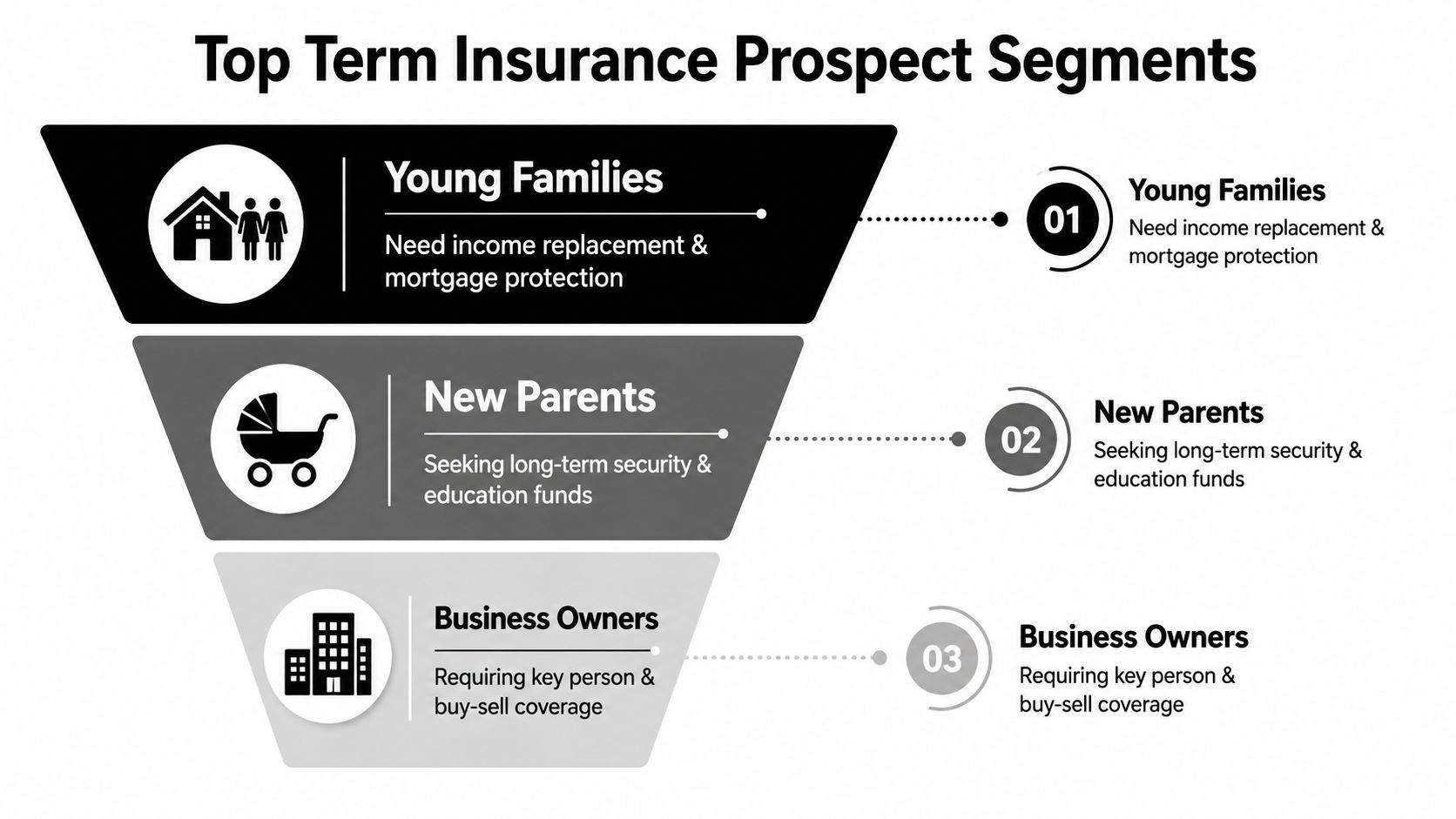
The three segments worth prioritizing
Young families usually buy because the math changed. A mortgage, daycare, and a single income disruption create a protection gap that's easy to explain if you keep the conversation grounded in monthly obligations.
Newly married couples are different. Their urgency comes from merged finances, shared rent or mortgage exposure, and the awkward but necessary question of who absorbs the cost if one partner disappears from the household budget. Business professionals and owners bring another layer, since term coverage can support income replacement, buy-sell planning, or key-person continuity.
Qualification shortcut: ask what changed, who depends on the income, and what would happen to the household or business if the insured weren't there for a year.
What to ask before you quote
Many agents waste time. They quote before they know whether the person is even a fit for the policy amount, the underwriting path, or the decision timeline. The first call should cover health fit, coverage intent, timeline, and the reason the prospect is looking now.
A simple first-call checklist can keep the team honest:
- Life event trigger: marriage, child, mortgage, business launch, or job change.
- Income dependency: who relies on the income and for what expenses.
- Current coverage: employer coverage, personal coverage, or both.
- Health and underwriting fit: enough detail to avoid late-stage surprises.
- Decision timing: today, this week, or tied to a specific payment date or life event.
For lead generation ideas that align with these segments, the creative lead generation tactics for agents resource offers useful context on matching outreach to the kind of buyer most likely to move quickly. And if you want a practical consumer-facing lens on coverage sizing, the how much term life insurance guide is a good example of the kind of question buyers are already asking before they ever speak to an agent.
The takeaway is simple. A better lead is not just a lead with a name, it's a lead with a clear trigger, an identifiable gap, and a channel that matches how that person wants to buy.
Needs-Based Framing and Consultative Sales Scripts
The strongest term sellers don't sound like clerks reading a quote. They sound like advisors who can name the risk before they offer a solution. Independent sales guidance says feature-led selling closes at about 10 to 20 percent, while problem-focused selling closes at 40 to 60 percent, with cost per client falling from roughly $2,000 to 5,000 to $150 to 500 in the cited comparison (MadLeadFlow). The point isn't that every team will reproduce those exact numbers. The point is that diagnosis beats product dumping.
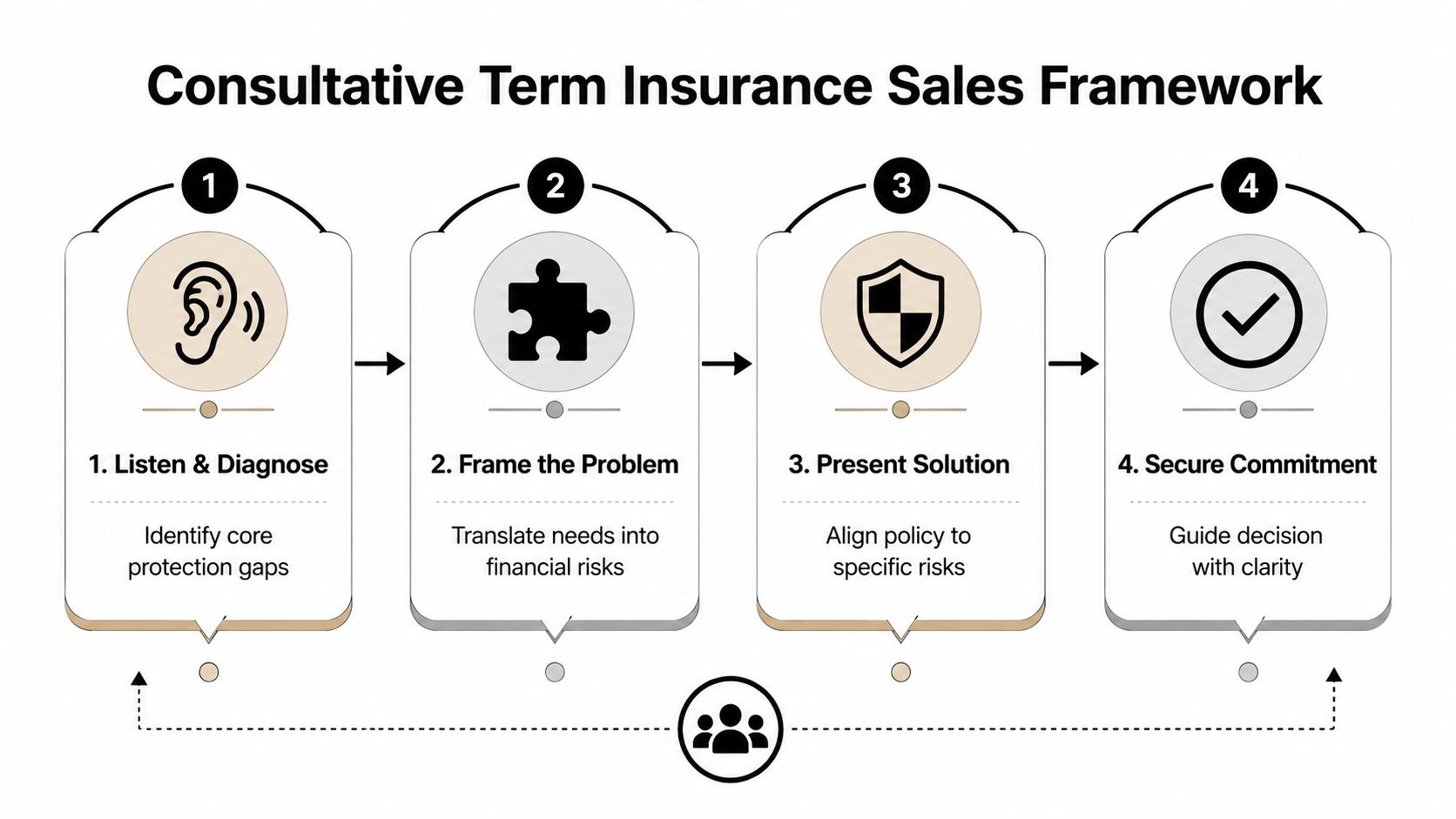
Start with the gap, not the quote
Ask what the prospect is trying to protect, then calculate the pressure points that would show up if income stopped. For a young family, that may be mortgage payments, daycare, and grocery flow. For a business owner, it may be payroll continuity or a partner's buyout obligation.
A clean opening sounds like this, “Before I quote anything, what's the biggest obligation you'd want this policy to cover if something happened to you?” That question forces the conversation out of product mode and into household economics.
Use language that people can actually budget against
Monthly premium alone can make a policy feel smaller than it is, while annual premium can clarify the total commitment. Present both. The prospect can usually process the monthly payment emotionally, but the annual figure helps them see the full cost in context.
Then connect the amount to the problem. If the family needs income replacement, name the target. If the concern is debt coverage, isolate the liabilities. If the buyer already has some protection, explain the shortfall in plain language instead of pretending existing coverage is irrelevant.
Best practice: don't answer the premium question until you've answered the need question. The sequence changes the conversation from shopping to planning.
Handle the “already insured” buyer differently
This is the underserved pocket many agents miss. A person can have group coverage and still be underprotected. The conversation should not be, “You need more insurance because everyone does.” It should be, “Your current coverage may cover part of the problem, but not the full gap tied to income, debt, or family obligations.”
That's especially effective with buyers who are technically insured but still vulnerable. It respects what they already have while showing the missing layer.
Keep the close anchored to a real deadline
A decision timeline works better than pressure. Tie the next step to a child's arrival, a mortgage closing, a wedding date, a business launch, or the next pay cycle. People move when the protection gap feels attached to a real event, not when an agent demands urgency for its own sake.
For teams that want to tighten the conversation itself, conversation analytics is worth studying because it turns vague “good calls” into observable behaviors. A useful resource on that front is AgentStack's guide to improving CX with analytics, which fits neatly with a coaching culture focused on how agents ask, listen, and redirect.
Presenting Quotes and Navigating the Digital Application Flow
A digital quote has to feel like a shortcut, not homework. Buyers don't mind underwriting questions when the experience is transparent and fast, but they do mind being bounced between forms, callbacks, and unclear next steps. Coveredly's digital-first model centers on up to $3 million in term coverage with no exams for most applicants, which is the kind of friction-reduction buyers notice immediately.
The most effective quote presentation starts with context. Instead of saying, “Here's the cheapest plan,” explain what the policy is solving and why the path is quick. A young couple buying coverage after a marriage or a first child wants to know whether the policy can be handled without weeks of back-and-forth. A business professional wants to know whether the process respects a workday.
If you're using a digital workflow, the quote should do three things at once. It should show the coverage amount, the premium, and the underwriting expectation in one clean flow. That reduces hesitation because the prospect can see the policy as a decision path, not a mystery.
What to say when underwriting comes up
Health questions scare people when they appear late. They feel less risky when the agent explains them early and plainly. Say what matters, why it matters, and what happens next if the answers fit the carrier's criteria.
That keeps the conversation moving. It also avoids the common mistake of acting surprised when underwriting affects pricing or eligibility. Agents who try to hide that part of the process usually create more drop-off, not less.
The application itself should be treated like a guided handoff, not a dead end. If the buyer is qualified, keep the energy focused on completion, identity verification, and any remaining health or coverage details. If the buyer needs a different amount, adjust it before the application stalls.
A clean quote-to-close rhythm looks like this:
- Confirm the protection goal.
- Show the coverage amount and premium together.
- Explain the no-exam or accelerated underwriting path in plain language.
- Finish the application while the motivation is still fresh.
For a live walk-through of digital term presentation, the embedded video below is a useful coaching aid for newer reps and a reminder for experienced ones that process clarity sells.
The buyer is also evaluating flexibility, not just speed. Marriage, a new child, or a business launch can change coverage needs quickly, so the policy should feel adaptable enough to fit life changes without turning the sales process into a maze. That's why a digital application can be a feature, not a hurdle, when it's explained as a faster route to the protection the buyer already wants.
If you want a straightforward example of a digital quote experience that keeps the buyer oriented, the instant online life insurance quotes flow is a practical reference point.
Handling Objections and Closing With Confidence
Objections are usually signals, not refusals. When someone says, “I need to think about it,” the issue is often uncertainty about the coverage amount, the timing, or whether the policy fits a real risk. The agent who argues usually loses momentum. The agent who clarifies usually earns the next question.
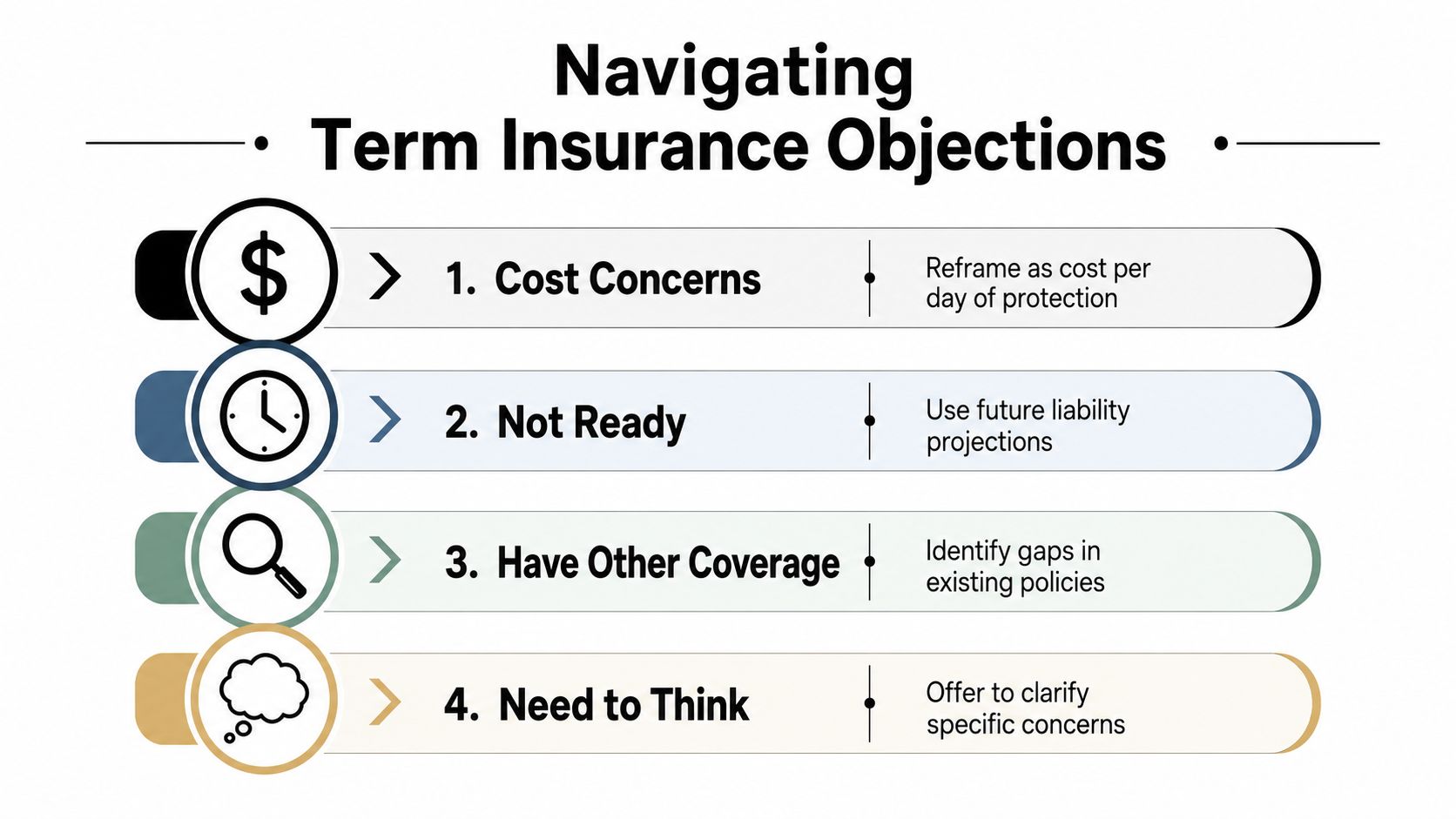
Cost and timing objections
“I'm too young” and “I'll do it later” both hide the same issue, the prospect doesn't feel the risk yet. The response shouldn't be dramatic. It should connect today's health and pricing advantage to tomorrow's obligations, especially if marriage, a child, or a mortgage is already in motion.
For cost objections, anchor the conversation in what the policy protects rather than the monthly outlay alone. If the buyer can see the gap, the premium becomes part of a larger household decision instead of an isolated expense. That's where monthly and annual framing helps again.
Existing coverage and indecision
When a prospect says, “I already have coverage through work,” acknowledge it. Then ask what happens if they change jobs, lose the benefit, or still have income replacement needs beyond the group plan. That keeps you out of a debate and back into gap analysis.
A calm response beats a clever one. The goal is to make the prospect feel understood before you make them feel persuaded.
For “I need to think about it,” use a specific next step. Ask what part needs more clarity, coverage amount, premium, underwriting, or timing. Most of the time, people want help sorting one unresolved issue, not a generic follow-up.
Close with a real timeline
Urgency works when it's attached to life, not pressure. The best close isn't a hard push, it's a clear decision window tied to a date the prospect already cares about. A wedding, a closing, a new baby, a business launch, or a paycheck date gives the conversation a reason to move.
The language can stay simple: “If this protects the gap we just talked through, do you want to move ahead before that next life event hits?” That keeps the close direct without sounding manipulative.
One more point matters for teams handling complex cases. If the prospect's need is strong but the fit isn't, you should say so. An honest redirect protects trust, and trust closes more future policies than a forced signature ever will.
Follow-Up Cadence and Retention Tactics That Build Revenue
The sale doesn't end at issue. It starts another revenue cycle, because a policy that gets understood, reviewed, and updated is far more likely to stay relevant. That matters when you're working leads with different contact patterns, since LIMRA's benchmark material says shared, delayed, or unverified leads depress close rates, while exclusive and promptly contacted leads perform better (LIMRA).
Build follow-up around the buyer's stage
A first-touch lead needs speed. A not-yet-ready prospect needs clarity and a specific reason to revisit. A newly issued policy needs confirmation that the coverage amount, beneficiary, and payment fit the client's real situation.
That's why a single blended close rate hides too much. Track conversion by cohort, not just by total volume. Separate web leads, live transfers, referrals, and re-engagement calls so you can see which channels deserve more time and which ones need a different script.
Use the post-sale touchpoints that actually matter
The best retention moves are practical, not noisy. A policy delivery call prevents confusion. A scheduled annual review catches changes in family size, debt, income, or employer benefits. A client newsletter keeps the relationship warm without turning every contact into a pitch.
- Policy delivery call: confirm details and coverage understanding.
- Annual review schedule: put life-change assessments on the calendar.
- Client newsletter opt-in: give value before asking for attention.
- Referral prompt: ask after a service milestone, not during the first close.
One more operational detail matters for producers who want repeatable revenue. Know the licensing boundaries before discussing policy transfers or settlements. Under the NAIC Producer Licensing Model Act, a person must not sell, solicit, or negotiate insurance without the proper license, and the model defines those activities specifically (NAIC). That keeps the team on the right side of the transaction while they focus on service and retention.
The lesson is straightforward. A disciplined pipeline, a clear follow-up rhythm, and a review process tied to life changes turn one policy into a longer client relationship. That's the revenue model that lasts.
Coveredly is built for buyers who want life insurance that's digital, affordable, and flexible, which fits the way term insurance should be sold today. If you're looking to align your sales motion with a faster, clearer buyer experience, visit Coveredly and see how a modern term workflow can support young families, newly married couples, and business professionals without adding friction.