A weekday morning can make financial risk feel very ordinary. One parent drops a toddler at daycare, the other checks the mortgage balance, and someone mentally adds the daycare bill, groceries, car payment, and next month's utility costs. Nothing about that routine suggests a crisis, yet the household depends on future income to keep it running.
Term life insurance benefits begin with protecting that routine. A term policy can pay a death benefit to named beneficiaries if the insured dies during the policy term, creating cash for housing, debts, childcare, education, and everyday living costs. The point isn't to make death financially positive. It's to preserve choices for the people left behind.
Table of Contents
- What Term Life Insurance Actually Does for Your Family
- How Term Life Insurance Works in Plain English
- The Core Financial Benefits That Make Term Life Stand Out
- Matching Coverage to Mortgages, Dependents, and Business Debts
- Convertibility, Renewability, and Riders That Add Flexibility
- Real-Life Scenarios Where the Death Benefit Changes Everything
- Common Misconceptions That Stop People From Buying
- Actionable Next Steps to Choose the Right Policy
What Term Life Insurance Actually Does for Your Family
Term life insurance works as a financial shock absorber during a defined period of vulnerability. That period might include early career years, a large mortgage, dependent children, or business debt. Instead of paying for lifelong coverage, you insure the years when your household has the most income to replace and the fewest resources to absorb a sudden loss.
The policyholder pays a fixed premium during the selected term. If the insured dies while coverage is active, the insurer pays the stated death benefit to the beneficiaries. Under current IRS rules, beneficiaries generally receive that benefit income tax-free, as explained in this term life insurance explainer.
That lump sum can help a surviving partner keep the mortgage current, pay off a car loan, replace lost earnings, and maintain childcare arrangements. It can also create time. A spouse may not have to sell the home immediately, take the first available job, or drain retirement accounts while grieving.
Why the protection gap matters
Ownership remains incomplete. The Insurance Information Institute's summary of the 2023 Insurance Barometer Study reports that 52% of respondents had some type of life insurance coverage, up from 50% in 2022, while 21% of owners said they didn't have enough coverage. Among insured households, 54% relied only on individual retail-market coverage, 26% relied exclusively on workplace coverage, and 20% had both.
Those figures help explain why personal term coverage often serves as a core protection layer, even when an employer offers group insurance. Workplace coverage may disappear after a job change, and its amount may not match the household's mortgage or income needs.
At the global level, life insurers paid $831 billion in claims worldwide in 2023, compared with $812 billion in 2022, according to the same III source. A term policy is therefore best understood as a balance-sheet tool. It turns manageable premiums into immediate liquidity when a covered death creates the largest financial need.
For household-planning ideas that include children and housing responsibilities, New American Funding borrower insights offers useful context. The practical question is simple: which future bills would become impossible if one income disappeared tomorrow?
How Term Life Insurance Works in Plain English
Think of term life insurance as renting financial protection for a chosen period. You pay the insurer to carry a specified risk for a set number of years. If the covered event occurs during that window, the insurer pays the agreed amount. If you outlive the policy, the contract usually ends without a death benefit, unless you use a renewal or conversion feature.
Four building blocks determine how the arrangement works.
- Premium: This is the amount you pay monthly or annually. A level-term policy keeps that premium fixed during the selected level period, provided you follow the contract.
- Death benefit: This is the amount paid if the insured dies while the policy is active. For example, a policy might promise a $500,000 benefit.
- Beneficiary: This is the person or organization receiving the proceeds. You can name a spouse, children through an appropriate trust arrangement, business partners, or another permitted beneficiary.
- Term length: This is the coverage window. Common level terms run from 10 to 30 years, as described by Guardian Life's explanation of how term insurance works.
What happens before and after approval
During underwriting, the insurer reviews information such as age, health, medical history, tobacco use, occupation, and lifestyle. Those details help determine whether the insurer will offer coverage and what premium it will charge.
Suppose you choose a 20-year policy with a fixed death benefit. Your family doesn't receive money because the policy reaches its final year. The benefit applies if the insured dies during those 20 years. If the insured survives, the policy ends unless its terms allow renewal or conversion.
| Term Length | Typical Life Stage | Premium Behavior |
|---|---|---|
| 10 years | Short debt or business obligation | Level during the selected term |
| 15 years | Mid-length family or mortgage need | Level during the selected term |
| 20 years | Young family and major earning years | Level during the selected term |
| 25 years | Long dependent or mortgage period | Level during the selected term |
| 30 years | Early mortgage and child-raising years | Level during the selected term |
The most important distinction is between the policy's term and your entire lifetime. Term insurance doesn't promise permanent protection. It provides focused protection for the years you choose.
The Core Financial Benefits That Make Term Life Stand Out
A young family may have a mortgage, childcare costs, and one income that carries much of the household budget. A new homeowner may also have little cash available for a large emergency. Term life insurance addresses that balance-sheet pressure by placing a defined death benefit beside the years of greatest financial exposure.
Lower-cost protection for a temporary risk
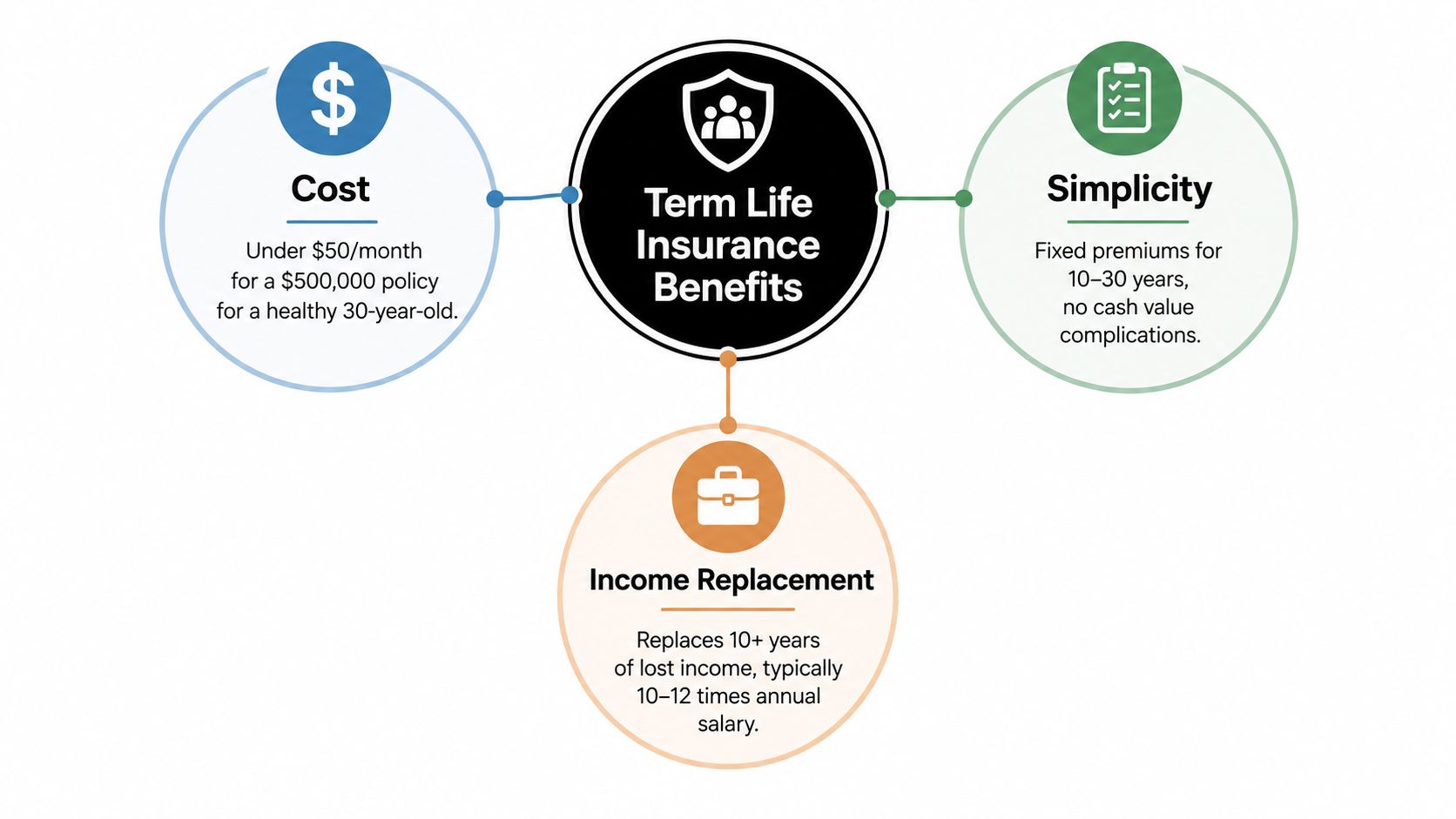
Term insurance generally costs less than permanent coverage because it protects a defined period and does not include a cash-value account. That structure can let a healthy 30-year-old seek several hundred thousand dollars of coverage for an amount comparable to an ordinary monthly subscription. The exact premium still depends on underwriting, policy design, and insurer pricing, so a quote matters more than a rule of thumb.
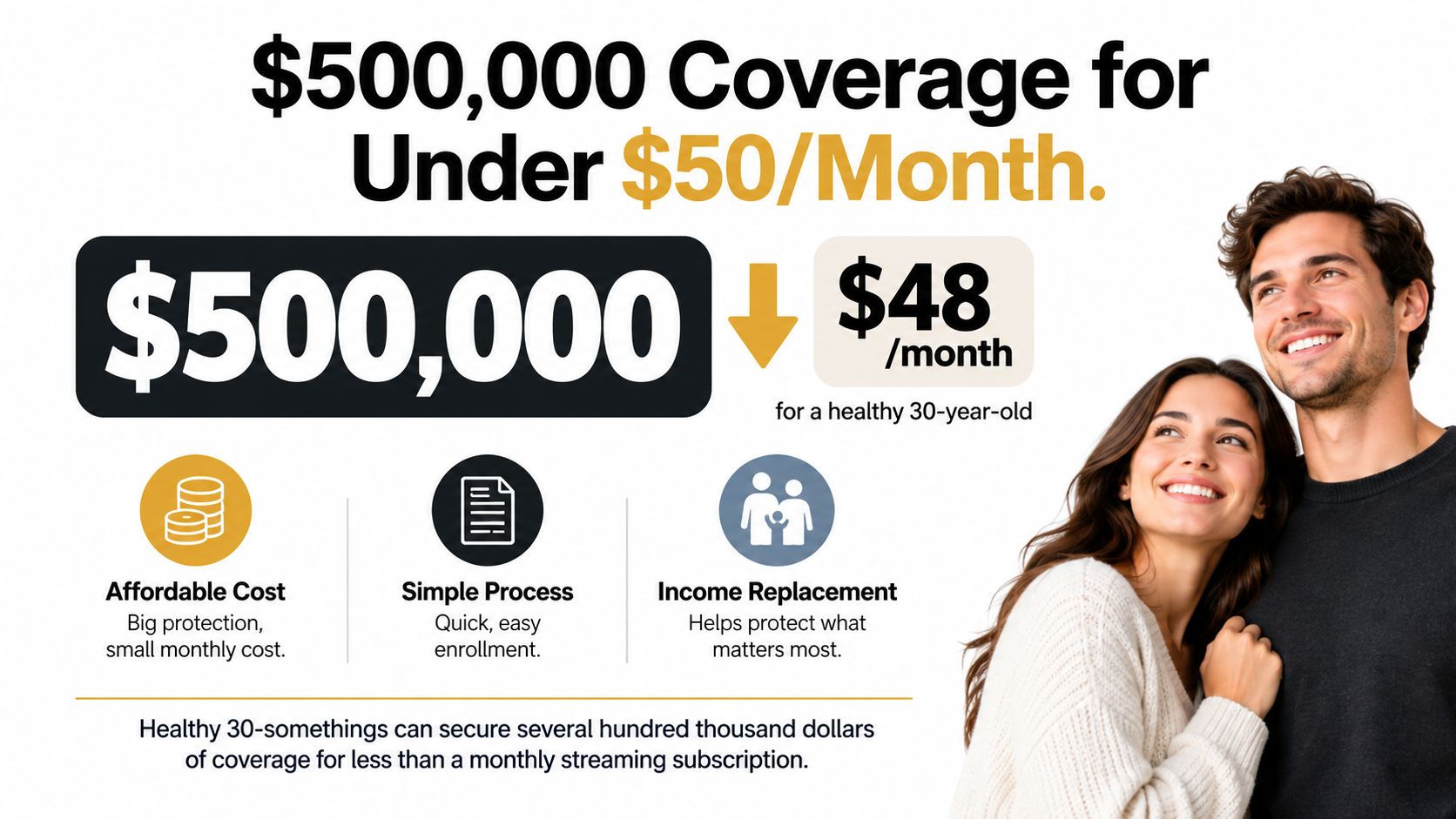
For a household with limited savings, the practical advantage is the size of the protection relative to the premium. A modest monthly payment can create a death benefit large enough to address a mortgage, replace earnings, and cover immediate expenses. The key is choosing enough coverage for the actual obligations, rather than stopping at the amount that feels easiest to afford.
Simplicity that keeps the job clear
A basic term policy has one primary job. It pays a stated death benefit if the insured dies during the stated period. There is no cash-value balance to monitor, investment menu to select, or surrender value to compare.
That design helps a first-time buyer separate protection from wealth building. Retirement accounts and other investments can support long-term accumulation, while term insurance addresses the household's financial loss if an income earner dies too soon.
For a broader discussion of how insurance may fit into a financial plan, see whether life insurance is an asset. The useful question is whether the death benefit would solve a specific balance-sheet problem, such as a loan, lost earnings, or near-term care costs.
Income replacement with a defined purpose
A $500,000 death benefit could replace $30,000 of annual income for more than 15 years, before accounting for investment returns, taxes, inflation, or changing household needs. It could also clear a $300,000 mortgage and leave a remaining cushion for childcare, education, and living expenses. These figures illustrate the planning logic, not a recommendation for every household.
Term insurance converts a relatively modest premium into a large payment when survivors may need liquidity most. That makes it especially useful during child-raising years, early homeownership, or any period when one death could leave a large gap between household income and fixed obligations.
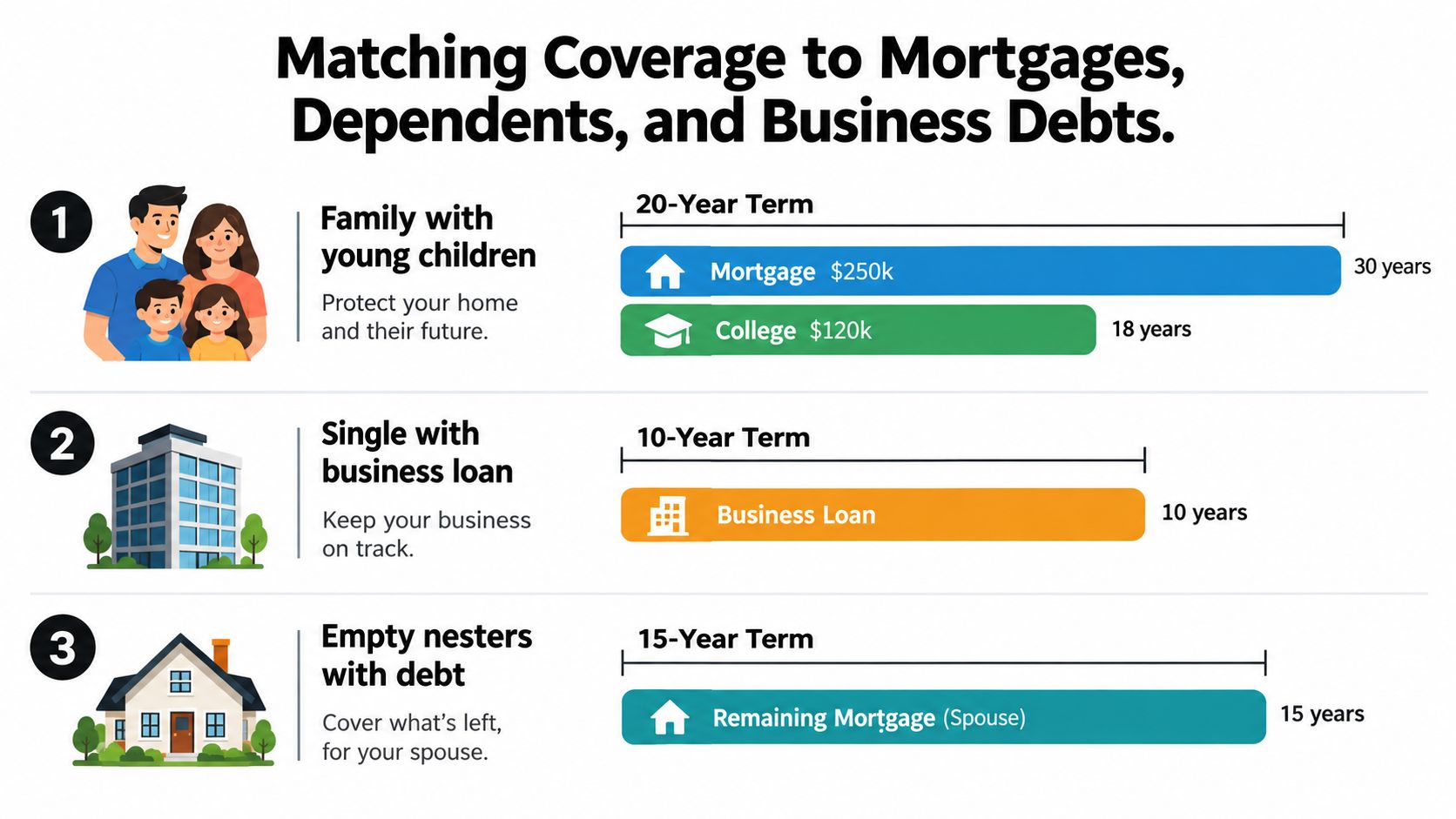
Matching Coverage to Mortgages, Dependents, and Business Debts
Choose a term by asking how long your household would remain financially exposed if you died today. The answer usually comes from the last major obligation, not from the cheapest available premium.
Families with young children
For parents, list the years until the youngest child becomes financially independent. Add income replacement, childcare, education funding, debt, and final expenses. A commonly used planning benchmark is 10 to 12 times annual income, but it should be treated as a starting point rather than an automatic answer.
A longevity mismatch can make a short policy look affordable but leave the family exposed later. One analysis using U.S. Social Security mortality data found that average death for policyholders can occur 17 to 20 years after coverage expires, according to MoneyGeek's analysis of outliving term life insurance. The lesson is to match the term to the risk window, not to the lowest quote.
Homeowners
Compare the proposed term with the mortgage amortization schedule. If the mortgage is scheduled to last longer than the policy, the surviving household could face a loan balance after coverage ends. A term that reaches the final payment, or extends slightly beyond it, may better align protection with the debt.
For help organizing the calculation, use this guide on how much life insurance you may need. Separate obligations that disappear at death from costs that would continue, then insure the remaining gap.
Business owners
A business policy can support a buy-sell agreement, help address an SBA loan guarantee, or fund the purchase of a deceased partner's ownership interest. The term should correspond with the loan horizon, planned exit, or period during which the business depends on a key person.
Child support can also affect the surviving household's cash-flow plan. A Texas family law firm's explanation of child support payments can provide relevant legal context, although insurance planning should be coordinated with qualified legal and financial professionals.
Consider a 35-year-old parent with a 30-year mortgage, two children, and $60,000 of annual income. A 25- or 30-year term with a death benefit between $600,000 and $750,000 could be evaluated to address mortgage debt, childcare, college funding, and a five-year household buffer. The final amount depends on the actual mortgage balance, savings, other coverage, and family goals.
Convertibility, Renewability, and Riders That Add Flexibility
A term policy's flexibility usually comes from three places: conversion, renewal, and riders. Each feature addresses a different uncertainty, so you shouldn't pay for all of them automatically.
Conversion preserves future insurability
A convertible term policy lets you switch some or all of the death benefit to permanent coverage during the conversion window, often without new evidence of insurability. That can matter if your health changes and a new application would be difficult or expensive.
Conversion windows vary by contract. For example, Guardian's convertible-term details describe windows that can end before the earlier of the level term period or attained age 70, with specific anniversary limits for certain terms. Read the policy rather than assuming conversion remains available forever.
Renewal extends protection, but at a price
Renewable term insurance can continue after the original level period. The insurer may allow continuation without new underwriting, but the premium generally rises as the insured gets older. Equitable's term policy information describes renewal premiums that increase with age and continued coverage without new underwriting under applicable policy terms.
Riders solve narrower problems
A waiver-of-premium rider may keep the policy active if the insured becomes totally disabled. An accelerated death benefit rider may allow access to part of the face amount for a qualifying terminal, chronic, or critical illness. A child rider can add coverage for dependents, while a return-of-premium rider may refund premiums at the end of the term in exchange for higher ongoing cost.
Review life insurance riders by asking what specific risk each one covers and what restrictions apply.
| Feature | What It Does | Typical Cost Impact |
|---|---|---|
| Convertibility | Changes term coverage to permanent insurance during an allowed window | May increase future premiums substantially |
| Renewability | Extends coverage after the level period | Premium usually rises with attained age |
| Waiver of premium | Keeps coverage active during qualifying disability | Adds a separate premium |
| Accelerated death benefit | Advances part of the death benefit for qualifying illness | May reduce the amount later paid to beneficiaries |
| Child rider | Adds coverage for dependent children | Adds a paid policy feature |
| Return of premium | May refund premiums at term end | Usually costs more during the term |
Real-Life Scenarios Where the Death Benefit Changes Everything
Numbers become easier to understand when attached to a household decision. These examples show how the mechanics can affect survivors.
A 38-year-old primary earner has two young children and a $420,000 30-year mortgage. After a fatal car accident, an $800,000 term policy pays the death benefit tax-free. The surviving spouse can clear the mortgage, cover ten years of childcare and living expenses, and continue retirement contributions.
Takeaway: Income replacement gives the surviving family time and housing stability.
A small-business co-owner dies while the company carries a $250,000 SBA loan and a co-signed commercial lease. The death benefit lets the remaining owner buy out the deceased partner's family, retire the loan, and maintain payroll while the business adjusts.
Takeaway: Business-owned coverage can protect both continuity and the deceased owner's heirs.
A 45-year-old single parent has two policy years remaining on a 20-year term. After a terminal-illness diagnosis, an accelerated death benefit rider advances $180,000, leaving $20,000 intact for her teenage son's college fund.
Takeaway: A rider can turn future protection into present medical and family support, subject to policy conditions.
A dual-income couple chooses a 15-year term that ends when their mortgage is paid off. Once the policy expires, they redirect the premium toward retirement savings.
Takeaway: A planned end date can be a feature when the underlying liability has also ended.
Actual claims depend on policy wording, exclusions, premiums being current, beneficiary designations, and the insurer's claim review. Zurich's 2025 retail protection claims report reported that 99.8% of life insurance claims were paid, totaling £228.6 million to nearly 3,400 beneficiaries, while terminal illness claims had a 90.6% payment rate. Claim type and contract language matter.
Common Misconceptions That Stop People From Buying
Term insurance creates confusion when buyers judge it like an investment account. It's better evaluated as temporary risk transfer.
| Common Misconception | Why People Believe It | How Term Life Actually Works |
|---|---|---|
| “It's wasted if I outlive it.” | No payment arrives at expiry | The policy protected a defined period of high exposure, even if no claim occurred |
| “Young families can't afford it.” | Life insurance feels like a major financial product | Term coverage is designed to provide focused protection without permanent-policy features |
| “The insurer will deny every claim.” | Claim decisions seem opaque | A valid claim can be paid when premiums are current and contract requirements are satisfied |
| “I need perfect health.” | Underwriting questions can feel intimidating | Available products and underwriting paths vary by applicant and insurer |
| “Buying now locks me in forever.” | Buyers overlook policy options | Convertible or renewable terms may preserve future choices, subject to contract rules |
Outliving the policy isn't evidence that the protection failed. If your children become independent, your mortgage disappears, and your savings can absorb remaining obligations, the original risk may no longer exist. The policy did its job during the years when those conditions were different.
Claims also aren't identical across policy types. The Zurich data above shows a clear difference between ordinary life claims and terminal illness claims, so read the definitions, waiting periods, exclusions, and rider language before relying on a feature.
Health doesn't have to be perfect, but answers must be accurate. Misrepresenting tobacco use, medical history, or hazardous activities can create problems during claim review. If standard underwriting doesn't work, compare available alternatives carefully rather than assuming every option has the same terms.
Actionable Next Steps to Choose the Right Policy
Start with the household balance sheet, not a premium quote.
- Estimate income replacement. Multiply the years your family would need support by gross earnings. Adjust for the income that would disappear, savings, existing employer coverage, and the surviving partner's earning capacity.
- Add obligations. Include the mortgage, student loans, business lines of credit, car debt, final expenses, childcare, and education funding.
- Choose the term. Cover the longest major obligation, ideally through the period when dependents become independent and the mortgage is paid.
- Compare durations. Request quotes for 10-, 20-, and 30-year terms. A shorter policy may cost less, but it can expire while your family still carries meaningful exposure.
- Review flexibility. Confirm conversion deadlines, renewal pricing, beneficiary rules, exclusions, and any riders before accepting the policy.
- Apply thoughtfully. Begin with a fully underwritten carrier when possible. Guaranteed-issue coverage may be relevant when health prevents approval elsewhere, but it can have different costs and limits.
Revisit coverage after marriage, a child's birth, a home purchase, a business launch, major debt changes, or an approaching policy end. If you're comparing online options, Coveredly provides online term life insurance, including up to $3 million of term coverage and no medical exams for most applicants, according to the publisher's product information. Compare its terms with other carriers rather than choosing based on convenience alone.
Coveredly can help you compare online term life insurance options while you work through the death benefit, term length, and beneficiary decisions discussed here. Visit Coveredly to review your coverage needs and begin comparing a policy that fits your household's current financial responsibilities.