You're standing in the driveway after closing on your first home. The mortgage papers are signed, your spouse is beside you, and your newborn is asleep in the car. Then the practical thought arrives: if your paycheck stopped tomorrow, how long could this household keep the house?
Many buy term life insurance only after that moment. They wait for marriage, a baby, a mortgage, or a new financial responsibility to make the risk feel real. That approach works, but it often means applying later, paying more, and hoping your health still earns a favorable underwriting class.
The better question isn't only, “When do I need life insurance?” It's when can I lock in the strongest price while I'm still young and healthy? For many buyers, that window opens before the traditional milestone. Term life insurance is usually cheapest when you're younger, and the policy can be selected to cover the years when other people depend on your income.
Table of Contents
- The Moment You Realize Someone Depends on Your Paycheck
- What Term Life Insurance Actually Solves
- Life Events That Make Coverage a No-Brainer
- Why Buying Early Beats Buying at the Right Time
- What Waiting Really Costs You in Dollars
- Matching the Term Length to the Obligation
- Two Real-World Buyers and How They Decided
- Your Next Steps to Get Covered This Week
The Moment You Realize Someone Depends on Your Paycheck
Closing day creates a specific kind of clarity. A single renter may have shrugged off life insurance because no one relied on their income. A newly married couple may have assumed two paychecks made the risk manageable. A new parent may have planned to compare policies after the sleepless weeks following the birth.
Then the mortgage begins, childcare becomes a real expense, and the household budget depends on one person continuing to earn. If that income disappears, the surviving family may need to replace earnings, keep making housing payments, cover childcare, and protect the child's future.
That's why the visible life event gets people moving. Marriage changes who shares the financial plan. A child creates a long dependency period. A home adds a debt that doesn't disappear just because a wage earner does. The need for coverage often becomes obvious overnight, even though the financial exposure has been building gradually.
Practical rule: Buy coverage before the person you love depends on your paycheck, not after the dependency becomes urgent.
The timing question matters because the cheapest and healthiest application window may arrive before the event itself. A healthy professional without children can often apply calmly, compare term lengths, and choose beneficiaries without the pressure of a newborn or a closing deadline. Once a family member depends on the income, delaying the application creates an uninsured gap.
Use a dedicated life insurance needs guide to estimate the amount before you apply. The goal isn't to buy a policy because a calendar says you should. It's to recognize that dependency begins as soon as someone's housing, care, or future depends on your earnings, and the strongest rate may be available before that dependency becomes visible.
What Term Life Insurance Actually Solves
Term life insurance is temporary income protection. You choose a death benefit and a fixed coverage period, commonly 10, 20, or 30 years, then pay a level premium during that term. If you die while the policy is active, the insurer pays the death benefit to your named beneficiaries, generally as a tax-free life insurance benefit under ordinary federal treatment.
The policy doesn't build cash value. That's a feature, not a defect, when your goal is to protect a defined financial period at a lower premium than permanent coverage. Whole life insurance is designed for lifelong protection and includes a cash-value component, while term insurance focuses on replacing income and paying obligations during the years your family needs protection most.
The contract prices your application day
An insurer evaluates your age, health, medical history, lifestyle, and other underwriting information when you apply. The resulting rate class determines the premium. A level-term policy then holds that premium steady for the selected duration, so the application date becomes a financial snapshot of your insurability.
That snapshot explains why waiting for the “right” milestone can be a mistake. You may be healthier today than you'll be after marriage, homeownership, parenthood, or a demanding period at work. A later application can still be approved, but it may receive a less favorable rate class or require more underwriting.
Match the benefit to the obligation
Term insurance can solve several connected problems:
- Income replacement: Gives beneficiaries money to replace earnings after a death.
- Debt payoff: Helps address a mortgage, business loan, or other obligation.
- Dependent support: Funds childcare, household services, and future needs.
- Business continuity: Provides capital for a buy-sell agreement or key-person exposure.
Financial-planning research describes term policies as commonly lasting 10 to 30 years, with lower premiums than permanent insurance because they don't include cash value. That structure makes term a practical fit when the need has an identifiable end, such as a mortgage payoff, a child reaching independence, or a business obligation ending. Read the financial-planning analysis of term and whole life insurance for additional context on that distinction.
Life Events That Make Coverage a No-Brainer
Some financial events turn life insurance from a nice-to-have into a necessary part of the household plan. You don't need every trigger to appear at once. One substantial obligation can justify a serious coverage conversation, and several obligations can compound the exposure.
Marriage and shared income
Marriage changes the financial consequence of an early death, especially when one spouse earns much more or one partner expects to reduce work for caregiving. A rough planning starting point for a marriage without dual incomes is 10 to 12 times combined salary, then adjusted for debts, savings, and future responsibilities.
That isn't a final quote or a universal formula. It's a way to prevent a couple from choosing a death benefit that covers funeral expenses but leaves the surviving spouse unable to maintain the household.
Children and adoption
A child creates years of care, housing, supervision, and education costs. The planning target in the brief is $250,000 to $500,000 per child, depending on income, childcare needs, existing assets, and the amount of support the family wants to preserve.
The surviving parent may need to buy childcare, reduce work hours, or handle responsibilities previously shared by two adults. A policy should account for those services, not only the wage shown on a tax return.
Mortgage and other debt
A mortgage can justify coverage equal to the outstanding balance, particularly when the surviving family wants the option to eliminate the payment. Student loans, car loans, and credit-card balances should be added according to the total owed.
A debt doesn't become less urgent because the borrower dies. The household still needs a funding source.
A stay-at-home spouse
A stay-at-home spouse may not receive a salary, but they provide childcare, transportation, meal preparation, household management, and other services. Replacing that work can require significant spending. A planning range of $300,000 to $500,000 can serve as a starting point for evaluating that exposure, then the couple should refine it around their actual household responsibilities.
Business ownership
Business owners have a separate risk. Key-person coverage may be sized at two to three times the executive's compensation, while buy-sell insurance should connect to the owner's share of the business valuation and the agreement's funding needs.
| Life Event | Suggested Coverage | Typical Term Length |
|---|---|---|
| Marriage without dual incomes | 10 to 12 times combined salary | 20 years |
| New child or adoption | $250,000 to $500,000 per child | 20 or 30 years |
| Mortgage | Outstanding loan balance | Remaining mortgage period |
| Other debts | Total owed | Until repayment |
| Stay-at-home spouse | $300,000 to $500,000 starting point | 20 years |
| Business need | 2 to 3 times executive compensation, or buy-sell obligation | Matches agreement |
These targets are planning anchors, not automatic recommendations. The decisive point is timing. As soon as one obligation creates meaningful financial exposure, waiting for another milestone leaves the first risk uninsured.
Why Buying Early Beats Buying at the Right Time
The advice to “wait until you need it” sounds sensible until you examine how underwriting works. Age and health affect the initial rate class, and both can change before the wedding, mortgage, or child arrives.
A healthy 25-year-old male could pay about $205 per year for a 20-year, $250,000 level-term policy, according to Investopedia's life insurance age guidance. A separate industry comparison cited by MoneyGeek places a healthy 37-year-old male at about $16 per month for the same face amount and term, compared with about $34 per month at age 47, an additional $216 per year. Those examples aren't your quote, but they show the direction clearly: the same protection can cost much more when purchased later.
Health drift is the hidden penalty
A new prescription, a diagnosis, weight change, or unfavorable lab result can affect underwriting. So can a family history that becomes more relevant as you age. Even if you never develop a serious condition, the insurer may place a later application in a different class.
Buying early also protects against an insurability problem. An unexpected diagnosis or serious accident can make coverage more expensive or harder to obtain. You can't predict those events, and you can't retroactively buy a preferred rate class after your health changes.
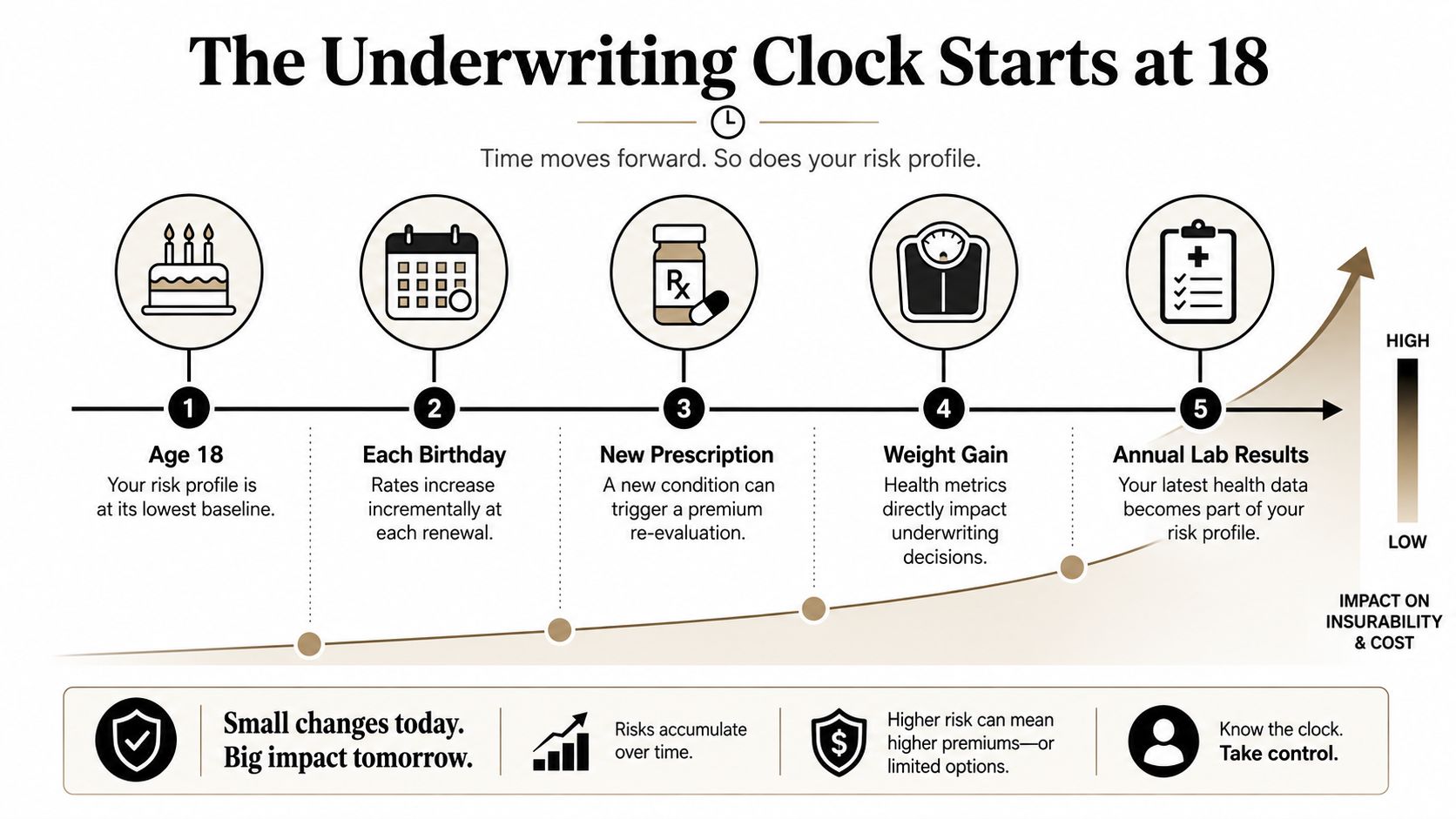
Young adults also tend to overestimate what term coverage costs. Research on insurance perceptions found that healthy adults ages 18 to 30 overestimated the premium for a $250,000, 20-year level-term policy by about 10 to 12 times, while the true median cost was about $192 per year. That finding, reported in the independent market research paper, supports a direct recommendation: get an actual quote before deciding coverage is unaffordable.
What Waiting Really Costs You in Dollars
Waiting has two separate costs. The first is the premium difference caused by age. The second is the possibility that a health change moves you into a less favorable underwriting class.
An industry rate illustration for a healthy male nonsmoker shows how a $500,000, 20-year level-term policy can become more expensive across age bands. The figures below are the requested illustrative ranges, not guaranteed quotes. Actual premiums vary by carrier, state, application details, and underwriting class.
| Age at Purchase | Preferred Plus (Est.) | Preferred (Est.) | Standard (Est.) |
|---|---|---|---|
| 25 | $20 to $25/month | $25 to $30/month | Varies by underwriting |
| 30 | $25 to $30/month | $30 to $35/month | Varies by underwriting |
| 35 | $30 to $40/month | $40 to $50/month | Varies by underwriting |
| 40 | $50 to $65/month | $65 to $80/month | Varies by underwriting |
| 45 | $85 to $110/month | $110 to $135/month | Varies by underwriting |
| 50 | $150 to $190/month | $190 to $230/month | Varies by underwriting |
The chart's directional lesson is more important than any single range. A buyer who waits from age 30 to age 40 can add roughly $15,000 to $20,000 in cumulative premiums over a 20-year term for identical coverage, based on the illustrative comparison provided. A health downgrade can widen the difference and may double the monthly cost in some cases.
For another view of age-based pricing, a published 2026 chart shows a preferred female applicant paying about $8.45 per month at age 30 for $250,000 of 10-year coverage, rising to $19.82 at age 50, $39.47 at age 60, and $107.69 at age 70. See the term life insurance rate chart by age for that illustration.
Compare actual quotes with a life insurance rates by age guide before assuming the price will fit your budget later. The cheapest moment is usually the healthiest moment you'll have, and postponement doesn't preserve today's rate.
Matching the Term Length to the Obligation
The right term ends after the last year your family needs the income, not after the first year a financial need appears. Choosing a short policy because the initial premium looks attractive can leave dependents exposed during the most expensive years of childcare, education, or debt repayment.
A 30-year term can fit a 30-year mortgage or a newborn whose support may continue through an anticipated college graduation around age 22 to 24. It gives a young parent a long period of level protection while the family's obligations develop.
A 20-year term often fits a young family from a child's birth through college when the parents are in their early 30s. It can also align with a business loan or buy-sell obligation expected to remain in place for a similar period.
Choose the ending date first
Start with the last year of the obligation. Ask when the mortgage should be paid, when children are expected to become financially independent, when a loan matures, or when retirement assets are intended to replace earned income.
Then add the obligations together and choose a term that reaches beyond the longest one. If the mortgage ends before childcare and education responsibilities, the children's dependency period should drive the term rather than the mortgage.
Shorter terms still have a place
A 15-year term can suit a parent in their mid-40s who needs coverage until retirement savings become sufficient. A 10-year term may fit a remaining SBA loan, a cosigned guarantee, or a child with a known shorter dependency window.
CBS News describes fixed policy lengths such as 10, 20, or 30 years, and explains that buyers commonly match the term to obligations such as children becoming independent or a mortgage being paid off. The guide to who should buy term life insurance provides that basic framework.
| Term Length | Best-Fit Obligation | Typical Buyer |
|---|---|---|
| 10 years | Short remaining loan or guarantee | Buyer with a defined near-term obligation |
| 15 years | Working years before retirement savings | Parent buying in the mid-40s |
| 20 years | Young-family income replacement or business loan | Parents in their early 30s |
| 30 years | Long mortgage or newborn's extended dependency | Young parent or first-time homeowner |
Don't choose the term based only on today's budget. Choose the period your family would struggle most to fund without your income.
Two Real-World Buyers and How They Decided
Consider a 29-year-old first-time parent earning $75,000, married, with a $280,000 mortgage and a newborn. The pregnancy-related application window had closed, but the parent's health profile remained strong. The household chose a 30-year, $500,000 policy at preferred rates to cover the mortgage, replace income, and preserve flexibility as the child grew.
“We didn't want to buy only enough to clear the mortgage. We wanted the surviving parent to have time to keep the home and raise the child without making immediate financial decisions.”
That buyer prioritized duration. The family had a long dependency horizon, and a 30-year level premium created a stable protection period instead of forcing a new application during a later life stage.
The second buyer was a 42-year-old small-business co-owner with two partners and a $600,000 buy-sell obligation. Retirement buyouts were expected to address the ownership transition, so the business didn't need lifelong coverage. The owners selected a 15-year term sized to fund the agreement until that transition.
“I didn't need a policy designed for every possible future. I needed the agreement funded until the point when our retirement plan took over.”
| Buyer Profile | Age & Income | Trigger Event | Coverage Amount | Term Length | Est. Monthly Premium |
|---|---|---|---|---|---|
| First-time parent | 29, $75,000 | Newborn and mortgage | $500,000 | 30 years | Quote-dependent |
| Business co-owner | 42, income not specified | $600,000 buy-sell obligation | $600,000 | 15 years | Quote-dependent |
These examples illustrate two sound decisions. The younger buyer locked in a long duration while healthy. The older buyer matched coverage tightly to a defined business obligation instead of paying for unnecessary years. Neither waited for every possible trigger.
Your Next Steps to Get Covered This Week
You don't need a perfect financial plan before starting. You need a defensible coverage amount, a term that reaches past the longest obligation, and accurate application information.
Day one and two, calculate the need
Start with income replacement. A planning rule of 10 to 12 times salary can create an initial estimate, then add outstanding debts and future obligations such as college costs. Subtract assets that would be available to beneficiaries, not money already committed to another goal.
Write the number down. A rough estimate is more useful than delaying while you search for precision.
Day three, compare identical quotes
Request quotes from at least three carriers for the same death benefit and term length. Comparing a 20-year policy from one insurer with a 30-year policy from another tells you almost nothing about price.
Look at the underwriting class, exclusions, conversion provisions, riders, and payment schedule. Price matters, but a low quote isn't useful if the policy doesn't match the obligation.
Day four through seven
- Apply accurately: Complete every health and lifestyle question accurately. Misrepresentations can jeopardize a claim or void the policy.
- Schedule the exam: If the insurer requires a paramedical exam, schedule it in the morning when blood pressure may read lower. Follow the examiner's preparation instructions.
- Review the contract: Examine the death benefit, term, exclusions, riders, premium, and beneficiary designations before accepting the policy.
- Name beneficiaries: Choose primary and contingent beneficiaries, then update them after marriage, divorce, a birth, adoption, or another major family change.
- Confirm activation: Coverage often takes effect 30 to 45 days after approval, so verify the effective date and first payment before assuming the protection is active.
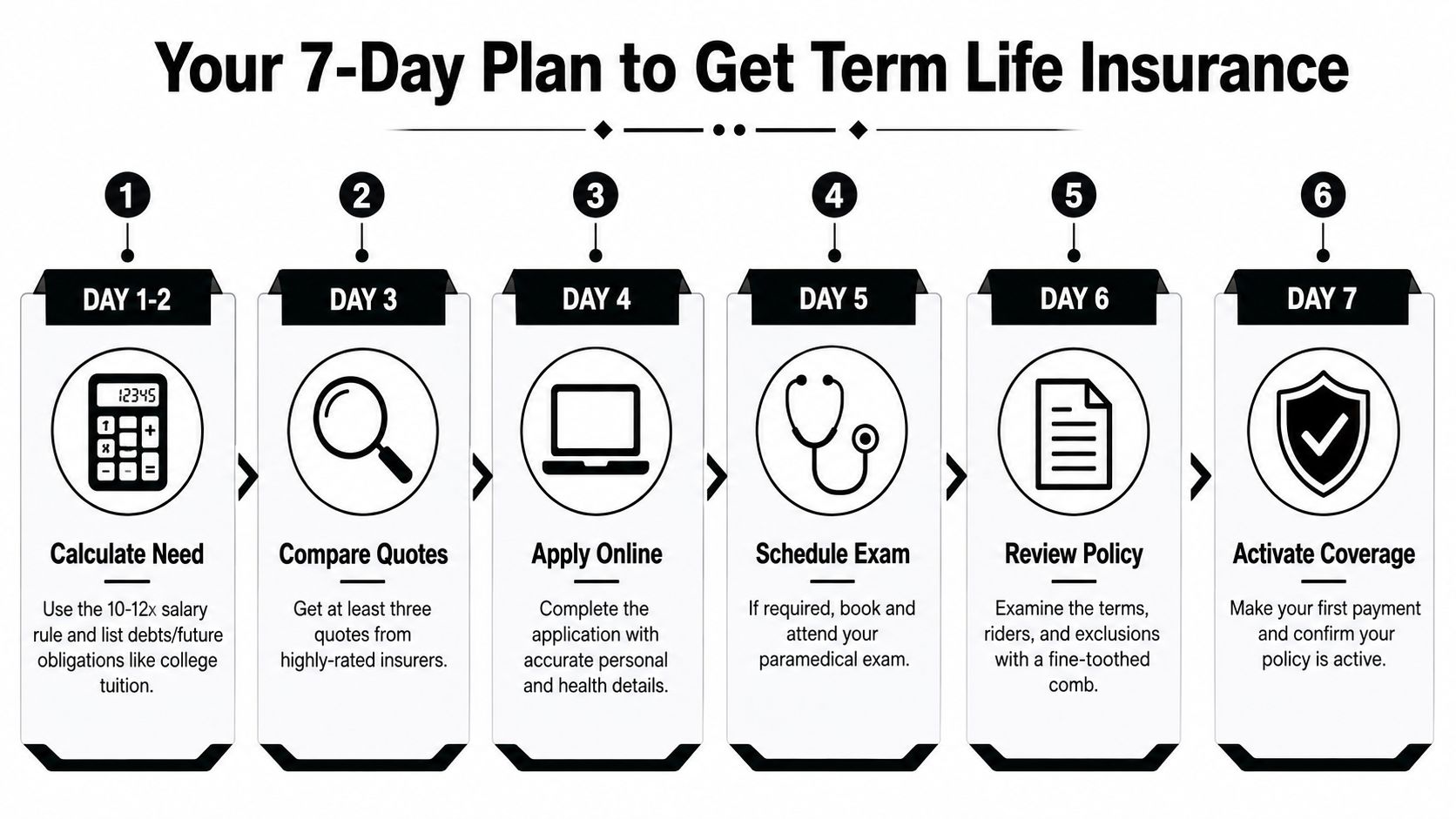
The application timeline can vary by insurer and underwriting requirements. Use this guide to how long life insurance takes to set expectations, but confirm the actual schedule with the carrier handling your application.
The direct recommendation is simple. If someone already depends on your income, apply now. If no one depends on it yet but you're young and healthy, get quotes now and consider locking in a rate before the next milestone changes your budget or underwriting profile.
Coveredly offers digital term life insurance options, including up to $3 million of coverage with no exams for most applicants. Visit Coveredly this week to compare a policy term and coverage amount that fit your current obligations, rather than waiting for the next life event to force the decision.