The advice you hear most often about term length goes like this: take the 10-year policy while money is tight, then reapply for something bigger once your income catches up. It sounds prudent. It's also the reason plenty of young families end up holding a policy that expires years before the mortgage does.
The cheaper premium isn't a saving. It's a delay, and the bill arrives at the worst possible moment, when you're a decade older, possibly less insurable, and still carrying the same obligations. A 10-year term and a 20-year term both pay a death benefit only if you die inside the chosen window, and neither builds cash value. What separates them is how long the insurer's promise lasts and what happens on the day it runs out.
So the useful question isn't which premium is lower this month. It's which obligation in your life ends last, and whether the policy you're buying is still in force on that date.
Table of Contents
- 10 vs 20 Year Term Side by Side
- Why 20-Year Term Costs More and How to Run the Break-Even
- Renewal and Conversion Rules That Shift the Real Cost
- Matching Term Length to Your Real Obligations
- How Much Coverage to Buy with Either Term
- Confirm Your Term Length Before You Apply
10 vs 20 Year Term Side by Side
A 10 vs 20 Year Term Life Insurance comparison only works when both products are scored on the same criteria, because these are the same instrument with a different expiry date. Term life is the most popular and affordable type of cover: a set period such as 20 years, pure protection, no investment component. Here's how the two lengths line up.
| Criterion | 10-Year Term | 20-Year Term |
|---|---|---|
| Coverage period | 10 years of level death benefit | 20 years of level death benefit |
| Starting premium | Lower than 20-year at the same face amount; exact figure depends on the quote | Higher; $221 a year at age 30 for $500,000 (male, healthy, nonsmoking) |
| Premium after expiry | Renewal at attained age, usually higher | Not applicable until year 20 |
| Cash value | None | None |
| Best fit | Obligations ending within about 10 years | Obligations lasting 15 to 20 years |
Read the first row first. Coverage period is the row everything else hangs from. A 10-year policy stops paying at the end of year 10; a 20-year policy keeps both the death benefit and the premium promise intact through year 20.
The premium row is where most buyers stop reading. The gap is smaller than the length difference suggests. As of January 2025, the average annual premium for a $500,000 20-year term policy was $221 for a healthy, nonsmoking 30-year-old man and $187 for a comparable woman, according to Guardian Life's term comparison using Covr Financial Technologies data. Divide that out and you're near the price of a monthly streaming bundle for a guarantee that runs two decades.
On the cash value row, both cells say none, and that's the design. Term buys protection, not savings. Whole life covers the insured for their entire life and includes a cash value component that grows over time, which is exactly why its premiums are significantly higher than term for the same face amount.
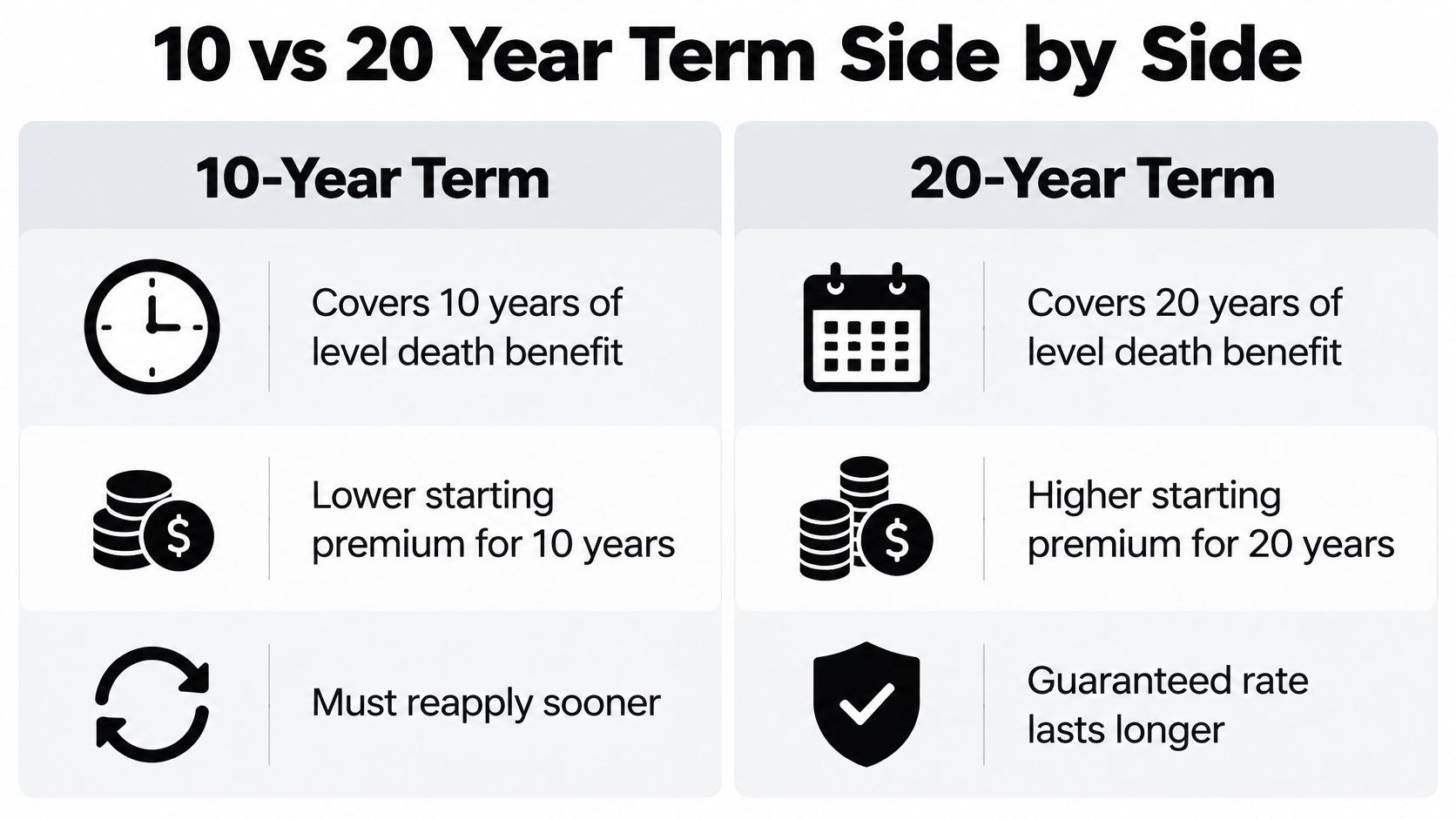
Then the best-fit row splits the market in two. Ten years suits an obligation with a visible end inside the decade. Twenty years suits what outlives a decade, and those are usually the expensive obligations: the mortgage, the childcare years, the income your household can't replace.
The rule the table implies: the 10-year term wins on the first invoice, and the 20-year term wins whenever the financial need outlasts the first decade.
Which row decides your choice? Not the premium row. The best-fit row does, and pinning it down takes arithmetic rather than instinct.
Why 20-Year Term Costs More and How to Run the Break-Even
A 20-year contract isn't a 10-year contract with a longer label. A 10-year policy asks an insurer to hold mortality risk for one decade. A 20-year policy asks it to carry that same risk through the years when the insured moves into their forties and fifties, and death rates climb with age. The extra premium buys two decades of fixed exposure instead of one.

What a Longer Guarantee Prices
Once a level-premium period ends, mortality rises steeply with each additional year of age, and the cost of insuring a life rises with it. The NAIC's life insurance guidance makes the consumer-facing version of the same point: renewed term coverage can cost more even when your health hasn't changed, because premiums generally rise when a term is renewed.
A 10-year policy gives you a level price for ten years. In year 11, the insurer prices you at your current age, and the original number is gone for good. That gap between the expiring rate and the renewal rate is exactly what the second decade of a 20-year premium was paying to avoid.
A Four-Step Break-Even You Can Run
The only fair comparison is total cost across the years you need cover. The sequence:
- Quote both terms on identical inputs. Same face amount, same age, same health class, same day. A 10-year quote at $750,000 against a 20-year quote at $500,000 tells you nothing.
- Multiply the 10-year premium by 10. That's the cost of the first decade, and it's the only part of the comparison that's a real quoted number.
- Estimate years 11 through 20 at the renewal age. Use the carrier's renewal schedule if the contract publishes one. Otherwise model a rate based on your age in a decade and treat the result as illustrative.
- Compare totals, then add a risk allowance. Ten times the 20-year premium against the 10-year total, plus something for the chance that replacement cover isn't available at any price because your health changed.
A couple who buy at 32 and need cover until their youngest child finishes full-time education at 52 face this directly. One 20-year policy covers the whole span at one rate. Two 10-year policies force a fresh underwriting decision at 42, priced on a body ten years older than the one quoted at 32.
Where the Totals Usually Land
Renewal pricing is the part buyers underestimate. Investopedia's term life explainer notes that renewal premiums are recalculated using the insured's age at renewal, with the practical example of someone who buys at 30 and renews at 40 paying more because pricing reflects the later age. The same source reports Guardian's finding that although a 10-year policy almost always costs less per month, two consecutive 10-year policies almost always cost more overall than a single 20-year policy.
That's the argument in one sentence: the break-even has to run across twenty years, not twelve months. Entry prices stay accessible either way, with many policies starting as low as $15 to $30 per month depending on age, health, and coverage amount. The inputs behind that number, from age and health class to term length and face amount, are laid out in this reference on how term life insurance premiums are set.
Choose the path with the lower total cost over the years you genuinely need coverage, not the lower first-year invoice.
A 20-year term also buys something the spreadsheet can't price: a hedge against becoming uninsurable. The 10-year route assumes you'll qualify for replacement cover at 42. Develop high blood pressure or diabetes in your thirties and that assumption collapses, and no monthly saving in years one through ten repairs it.
Renewal and Conversion Rules That Shift the Real Cost
Most buyers of a 10-year policy assume the simplest ending. Year 10 arrives, the policy stops, and life moves on. The contract usually gives you two other exits, and both change the arithmetic.
Renewable term lets you continue coverage past expiry without proving insurability again, as long as premiums are paid. The catch is that the renewal premium reflects your older attained age, so it typically lands well above what you were paying. Convertible term lets you exchange the policy for permanent coverage inside a stated conversion window, often with no new medical exam. The permanent policy's premiums are higher because they help fund a cash value account.
The Conversion Option Rarely Gets Used, and Still Matters
Independent actuarial research covering 2009 to 2023 term policies found that conversion activity at duration 10 was only about 4.9% by policy amount, while lapse rates peak around duration 10 and lower-face-amount policies lapse earliest. In plain terms, most 10-year buyers walk away rather than convert.
That low number is not an argument for skipping the feature. It's an argument about who the feature is for. For the majority, conversion is a line item they never touch. For the minority whose health deteriorates in year seven or nine, it's the only door left open, and the people who need it are precisely the people who can't buy replacement cover on the open market.
Comparisons also tend to gloss over a detail that matters: "convertible" doesn't mean every permanent product is available for the entire level-term period. Deadlines, age limits, eligible products and conversion pricing vary by contract. If your policy supports conversion, how life insurance policy conversion works is worth reading before you rely on it.
The Questions to Ask Before You Sign
Ask these five in writing, not on a call you'll half remember.
- The window: until what policy year or age can I convert?
- The menu: which permanent products are eligible?
- The underwriting: is proof of insurability waived, in full or in part?
- The price: how is the conversion premium determined at the point I exercise it?
- The renewal: what will year 11, 12 and 13 cost on this exact contract?
If I become uninsurable in year nine, exactly what can I convert into, and until what age?
That single question separates a real safety net from a brochure feature. Many carriers offer flexible underwriting options for people with pre-existing conditions, which widens the door but doesn't guarantee approval. Coveredly offers term life insurance, and permanent life insurance is optional depending on eligibility. Depending on the policy type, coverage can be adjusted or converted to permanent insurance.
For a healthy young professional, a 20-year term delivers a longer stretch of guaranteed insurability even if conversion never happens. A budget-constrained household can treat a 10-year policy as a starter layer, provided someone diaries a review well before expiry rather than assuming the market will be kind at 42.
Matching Term Length to Your Real Obligations
The decision principle fits in one line: choose the shortest term that fully covers your longest material obligation, not the cheapest premium on the page. The New York State Department of Financial Services confirms that term premiums are locked for the specified period, that longer guarantees cost more initially, and that no death benefit is payable if the insured survives the selected term.
That last point deserves emphasis, because it's where buyers get hurt. A 20-year policy and a 10-year policy both pay nothing if you outlive them. The difference is which one is still standing when the obligation you bought it for is still on the books.
The Obligation Table
| Obligation | Length of Need | Term to Consider |
|---|---|---|
| Mortgage with about 18 years left | About 18 years | 20-year term |
| Children dependent until independence | Typically 18 to 22 years | 20-year term |
| High-interest debt or business loan | 5 to 10 years | 10-year term |
| Income replacement until retirement | Depends on years to retirement | 20-year term if retirement is more than 10 years away |
| Newlyweds, no children, short mortgage | Under 10 years | 10-year term |
The New York guidance makes the same mapping in practice terms: a 20-year term can align with roughly 18 years remaining on a mortgage or the period through which children reach financial independence, while a 10-year term may better match shorter obligations such as business debt or a near-term income-replacement need.
Why the Cheaper Row Is the Riskier Row
Selecting 10 years solely because the monthly figure is lower creates coverage-gap risk at the exact moment replacement insurance may cost more or underwriting may be harder, because the applicant is older or less healthy. The obligation didn't shrink. Your ability to insure it did.
The opposite mistake costs money too. A 20-year term bought against a debt you'll clear in six years means paying for years of cover nobody needs. That's a smaller error than a gap, but it's still an error.
Life-stage timing complicates the picture for younger households. Among under-40 consumers, 63% report no immediate marriage plans and 84% report no immediate plans to have children, according to the Capgemini World Life Insurance Report 2026. If the children come later than the mortgage, sizing the term to today's budget rather than to the mortgage plus the expected dependency years leaves a gap at the far end.
Households with obligations split across countries face the same question with an extra wrinkle around residency and repatriation, and Expat Global Medical's guide to choosing expat life insurance works through how that changes the answer.
List every obligation, write the number of years until each one ends, and let the longest figure set your term. That single number resolves most of this decision.
How Much Coverage to Buy with Either Term
Term length decides when the policy stops. Face amount decides whether it was ever enough. Get the second wrong and the first doesn't matter.
The common guideline is 10 to 15 times annual income, and Coveredly helps tailor coverage to each situation rather than stopping at a multiplier. Run it on an illustrative household earning $80,000 a year and you land between $800,000 and $1.2 million, before you adjust for debts, childcare costs or a spouse's income.
That's a wide range, and the multiplier alone won't narrow it. Face amount drives most of the premium scale, so compare quotes at the same benchmark, the same age and the same health class. A $500,000 quote is a useful fixed point because it's the figure most published pricing uses, which makes carrier-to-carrier comparison honest.
Laddering as a Way Out of the Binary
You don't have to pick one term. Laddering pairs a 20-year policy sized to the mortgage with a smaller 10-year policy sized to short-term debt. Total coverage steps down as the debts get repaid, and the premium steps down with it.
Compare that with one large 20-year policy. The single policy costs more than the laddered mix, but it leaves fewer coverage gaps and fewer renewal decisions. Which is better depends on whether your obligations decline in a predictable line. A mortgage does. A child with unexpected needs might not.
The sizing trap that catches most households is omission. Build the number without the spouse's income, the unpaid household work they'd have to replace with paid help, and childcare, and you'll understate the need by a wide margin. A stay-at-home parent's contribution has a replacement cost, and insurers price the gap, not the sentiment.
Coverage can also be raised or lowered as life changes, without starting over. The application is 100% digital, most cases get instant approvals, and cover can be laddered up or down as financial needs shift. That flexibility is the argument for reviewing the number after a new child, a home purchase or a refinance, rather than treating the original face amount as permanent.
Bring three numbers to the quote step: annual income, total debt, and years of dependency. Our walkthrough of life insurance needs analysis shows how those three inputs convert into a face amount.
Confirm Your Term Length Before You Apply
The decision reduces to one question: does the obligation outlast the policy? Choose 20 years when your obligations run past year 10, when a health change would make replacement difficult, or when the household could not absorb a repriced policy at 42. Choose 10 years only when the need reliably ends inside the decade and the budget is tight, and put a review on the calendar eight to twelve months before expiry so the decision never happens under pressure.

Five Checks Before You Submit
- Let the longest obligation set the term. Work back through the obligation table and take the latest end date, not the average.
- Compare quotes on identical inputs. Same face amount, same health class, same day. Anything else is a marketing comparison.
- Get the exit terms in writing. The conversion window, the renewal premium at year 11, and whether underwriting is waived at conversion.
- Note how the premium resets after the first term. A level premium for ten years is a promise with an end date, and the price after that date is set by the carrier, not the calendar.
- Apply once the numbers agree. Coverage typically begins once the policy is approved and the first payment is processed, so the quote is the start of the process rather than the finish.
A changed health profile does not close off new coverage. Many carriers offer flexible underwriting options for people with pre-existing conditions, and Coveredly compares multiple carriers to find competitive pricing. What changes is the price and the health class you qualify for, which is why replacement risk belongs in the term decision now, not after the diagnosis.
A 10-year policy is a precise instrument, and it only works when the obligation it covers is equally precise. Households carrying a mortgage and young children rarely have that shape of need, which is why the cheaper premium so often turns out to be the more expensive path once renewal pricing is counted. Get quotes for the term that matches your longest obligation, and set the review date the day the policy is issued.
Coveredly offers term life insurance with a fully digital application and no medical exam for most policies up to $3M, so answer a few questions about your age, health, and the coverage you need to compare carrier pricing side by side. Start at Coveredly and quote the term that fits your longest obligation, not the one that fits this month's budget.