You're comparing mortgage statements after the kids are asleep, and the numbers point to a clear deadline. There are 15 years left on the mortgage, your children are still in elementary school, and the college fund you're building is aimed at tuition day roughly 15 years from now. A 20-year or 30-year policy might be the default recommendation, but it could protect obligations that will no longer exist.
15 year term life insurance can work as a precision tool. It's designed to cover a defined financial stretch, not every possible need for the rest of your life. The important question isn't, “How much coverage can I buy?” It's, “Which obligations still need protection, and when do they end?”
Table of Contents
- Why a 15 Year Term Might Be the Policy You Actually Need
- How 15 Year Term Life Insurance Actually Works
- What 15 Year Term Costs by Age and Health
- 15 Year Term Compared to 10, 20, and 30 Year Policies
- When a 15 Year Term Makes Sense and When It Falls Short
- Conversion and Renewal at the End of Year 15
- Is a 15 Year Term the Right Move for You
Why a 15 Year Term Might Be the Policy You Actually Need
A family with two children, a mortgage, and one primary income has several risks at once. If the breadwinner dies, the surviving spouse may need to replace income, keep the home, and continue saving for education. But those needs may not last forever. The mortgage could be paid off, the children could be financially independent, and retirement savings could be established by the same date.
That's where a 15-year policy can fit. The policy creates a temporary safety net that runs alongside a real obligation. If the insured dies during the term, the beneficiaries receive the death benefit and can use it for the mortgage, education, household expenses, or other priorities. If the obligation ends when the policy ends, the term has been sized to the liability rather than rounded up to a generic number.
The date matters more than the label
Start with a calendar, not a product brochure. Write down:
- Mortgage deadline: How long until the balance is scheduled to be repaid?
- Education timeline: How long might children depend on household income?
- Business debt: When is the loan or guarantee expected to end?
- Retirement transition: When should savings and other income sources carry more of the load?
A 15-year term has historically occupied a middle-duration niche. In one industry survey, it represented about 11% to 12% of level-premium term sales, compared with roughly 41% to 42% for 20-year term, 23% to 25% for 10-year term, and 14% to 15% for 30-year term. The survey treated 15-year term as a standard product category, which supports its role as an established middle option rather than an unusual policy design. (Milliman's term insurance executive summary)
By the end of this guide, you should be able to decide whether 15 years matches your liability, whether the premium fits your budget, how it compares with 10-year, 20-year, and 30-year coverage, and what you'll do when the level-premium period ends.
How 15 Year Term Life Insurance Actually Works
Think of term life insurance as renting a safety net for a defined period. You pay the insurer a premium, and the insurer promises to pay a death benefit if you die while the policy is active. With a 15-year policy, that agreement lasts for 15 years.
Four contract pieces
The premium is the amount you pay to keep the policy active. For a level-term policy, the insurer generally sets the price when you apply, then keeps it unchanged throughout the guaranteed period. Premiums reflect factors such as age, health, tobacco use, lifestyle, and habits. (Policygenius explains level premiums and pricing factors)
The term is the coverage window. Your policy remains in force as long as you pay the required premiums and follow the contract terms. The insurer doesn't build a cash account for you during that period.
The death benefit is the face amount paid to your named beneficiaries if you die during the covered term. They can generally use the money for income replacement, debt repayment, housing costs, education, or other needs.
The conversion rider is a policy provision that may allow you to exchange term coverage for permanent coverage under the insurer's rules. It can matter if your health changes and qualifying for a new policy becomes difficult.
For a more detailed explanation of the basic mechanics, see this guide to how term life insurance works.
What the policy doesn't do
A 15-year term policy typically doesn't create cash value, provide an investment account, or promise coverage for life. It's temporary protection. That simplicity is one reason term insurance can be useful for a mortgage or income-replacement deadline, but it also means you must plan for what happens after the term.
Underwriting determines your starting price. The insurer may review your medical history, age, sex, tobacco status, occupation, and other risk information. A healthier applicant may receive a more favorable rate, while tobacco use or significant health risks can raise the premium or affect eligibility.
What 15 Year Term Costs by Age and Health
A premium quote depends on the carrier, state, coverage amount, underwriting class, and personal risk profile. The available verified material provides public rate examples for healthy nonsmokers at other term lengths, but it doesn't provide a verified 15-year rate table broken down by age, tobacco status, health class, and both requested face amounts.
That means the responsible answer is to avoid filling in unsupported numbers. You can still understand the pricing pattern. A younger applicant generally pays less than an older applicant for the same coverage, and a smoker generally pays more than a nonsmoker. Health classifications such as Preferred Plus, Preferred, and Standard can also change the quote, with each step down commonly increasing the premium, although the exact increase depends on the insurer and the applicant.
What verified rate examples show
For a healthy 40-year-old nonsmoker, public examples show average annual premiums of about $201 for 10-year term, $321 for 20-year term, and $574 for 30-year term on a $500,000 policy. (Society of Actuaries product development publication)
Those figures don't establish a 15-year price, but they show why 15-year coverage is often considered a middle option. A 15-year quote would need to come from an actual carrier or broker comparison, not an invented midpoint.
The same actuarial research analyzed 10-year and 15-year premium-term products using monthly data from 95 companies and 804,242 unique policies. That scope demonstrates that 15-year term is a substantial product class for actuarial analysis, not merely a marketing phrase. (Milliman's actuarial research report)
A comparison table without fabricated quotes
| Age | Tobacco status | Health class | $250,000 face amount | $500,000 face amount |
|---|---|---|---|---|
| 30 | Nonsmoker | Preferred Plus, Preferred, or Standard | Request a carrier-specific quote | Request a carrier-specific quote |
| 30 | Smoker | Preferred Plus, Preferred, or Standard | Tobacco underwriting usually raises the quote | Tobacco underwriting usually raises the quote |
| 40 | Nonsmoker | Preferred Plus, Preferred, or Standard | Request a carrier-specific quote | Public examples for other terms show about $321 annually for 20-year term |
| 50 | Nonsmoker | Preferred Plus, Preferred, or Standard | Request a carrier-specific quote | Request a carrier-specific quote |
Doubling the face amount doesn't necessarily double the premium because insurers price the policy through their rate bands and underwriting rules. Still, a larger death benefit generally costs more.
For a broader explanation of the variables that affect a quote, read this guide to how much term life insurance costs. Treat online examples as starting points. Your actual quote can differ by carrier, state, health history, tobacco use, and the coverage amount you select.
15 Year Term Compared to 10, 20, and 30 Year Policies
A 10-year policy can cover a short bridge, such as the final years of a business loan. A 15-year policy fits a liability with a clearer but slightly less exact endpoint, such as a mortgage tail or a child's remaining years of financial dependence. A 20-year or 30-year policy may be better when debt, children, or income replacement needs will continue much longer.
The right comparison starts with the deadline, then considers the premium. A cheaper policy can create a gap if it expires while the mortgage or family obligation remains. A longer policy can cost more than necessary if the risk is scheduled to disappear earlier.
A practical side-by-side view
| Term length | Monthly premium | Total paid over level period | Age at expiration | Best-fit scenario |
|---|---|---|---|---|
| 10 years | Usually the lowest of these four options | Lowest total commitment among the four | Your current age plus 10 years | A short, certain obligation |
| 15 years | Usually more than 10-year term and less than longer terms | Middle-duration commitment | Your current age plus 15 years | A mortgage tail, school timeline, or business loan with a defined but imperfect deadline |
| 20 years | Usually more than 15-year term | Higher total commitment | Your current age plus 20 years | Dependents or debt that will continue further into the future |
| 30 years | Usually the highest of these four options | Longest total commitment | Your current age plus 30 years | A young family, a new long mortgage, or a need for maximum temporary protection |
For a healthy 40-year-old seeking $500,000 of coverage, verified public examples show about $201 annually for 10-year term, $321 annually for 20-year term, and $574 annually for 30-year term. The provided data does not include a verified 15-year figure, so that amount should not be estimated from the other terms. (Society of Actuaries product development publication)
The gap after expiration deserves attention. Renewal may be available, but the premium can rise sharply once the level-premium period ends, especially as the insured person gets older. That later cost can turn an apparently inexpensive short policy into a difficult choice if the original obligation has not disappeared.
Practical rule: Choose 10 years for a short, certain need, 15 years for a defined obligation with some timing flexibility, and 20 or 30 years when dependents or debt clearly extend further.
A 15-year policy works like a ruler placed against a financial deadline. If it reaches the endpoint, it avoids paying for years of protection you do not need. If it falls short, the family may face the same mortgage, education, or income risk the coverage was meant to address.
When a 15 Year Term Makes Sense and When It Falls Short
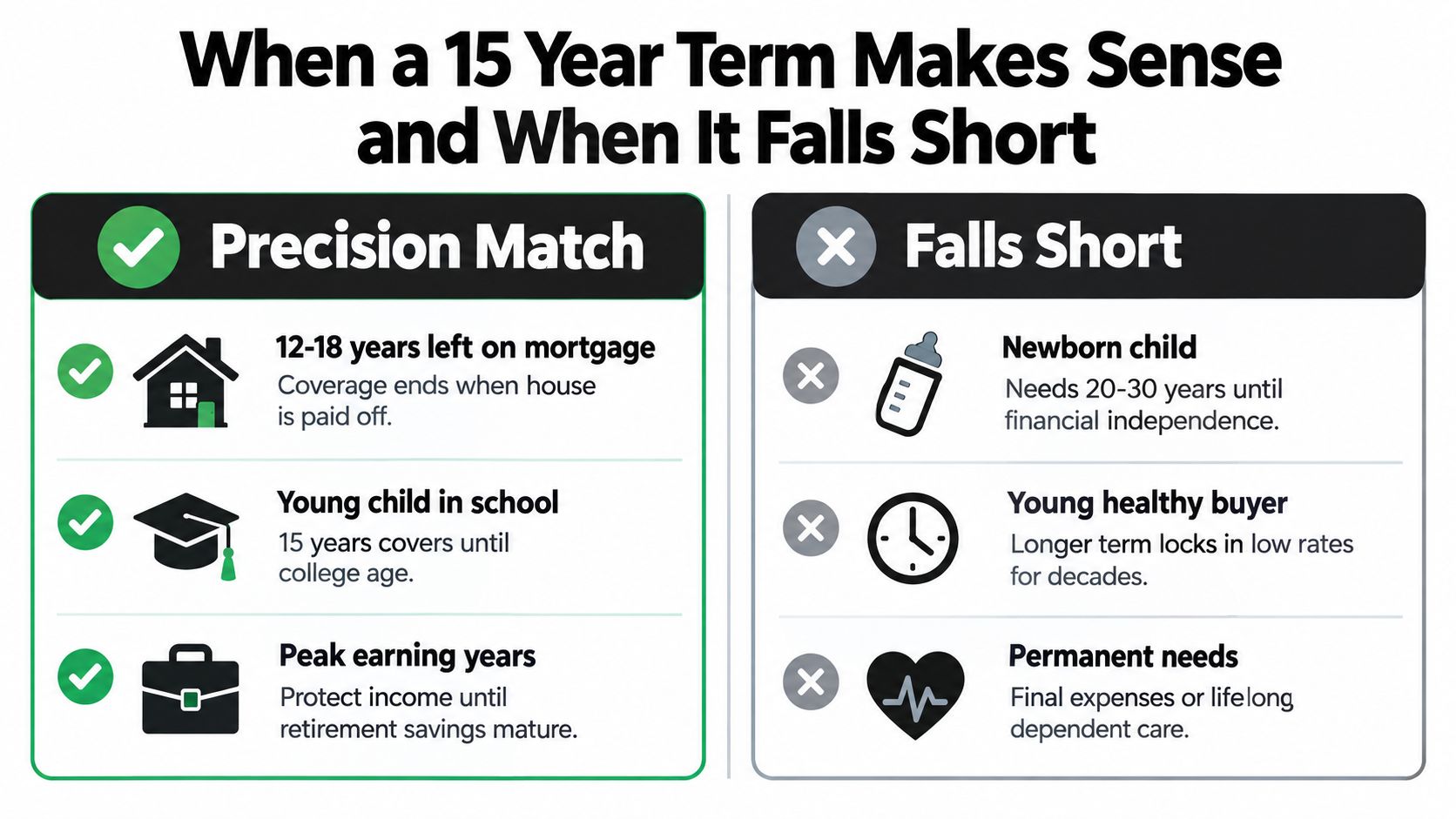
The strongest case for 15-year term insurance begins with a specific calendar marker. A homeowner with 12 to 18 years left on a mortgage can align coverage with the remaining repayment period. A parent with a school-age child can use the term to cover the years before education and income needs change. A business owner can protect a loan that should be repaid inside the same window.
Precision matches
Consider a couple with a 14-year mortgage and a six-year-old child. A 15-year policy could cover the mortgage tail and the years when the child still depends heavily on household income. The death benefit could remove the housing debt, replace income, or support education planning.
Other useful matches include:
- A business loan: Coverage can protect the surviving owner or family from a loan balance that's expected to clear during the term.
- Peak earning years: A breadwinner may need income protection until retirement savings and the spouse's resources can carry more of the household burden.
- A defined education horizon: A child already in school may need support through the remaining school years, even if a longer policy would extend beyond the practical need.
The U.S. coverage shortfall remains substantial. 75 million Americans have no coverage and 27 million are underinsured, according to the Guardian material provided for this topic. (Guardian's 15-year term life insurance overview)
Clear miss cases
Now compare that family with a couple carrying a 28-year mortgage and raising a toddler. Their financial obligations are likely to continue well after a 15-year policy ends. A 20-year or 30-year policy may better match the dependency period, especially if the household has limited savings.
A 15-year term can also fall short for someone with no defined debt deadline, a newborn who may need support for many years, or a family member who will require lifelong care. In those situations, short-term coverage may be only one layer of a broader plan.
The distinction is simple: 15-year term wins when the need has a specific end date. It's less suitable when the financial obligation is indefinite or extends beyond the policy's expiration.
The following video can help visual learners review the basic choices:
Conversion and Renewal at the End of Year 15
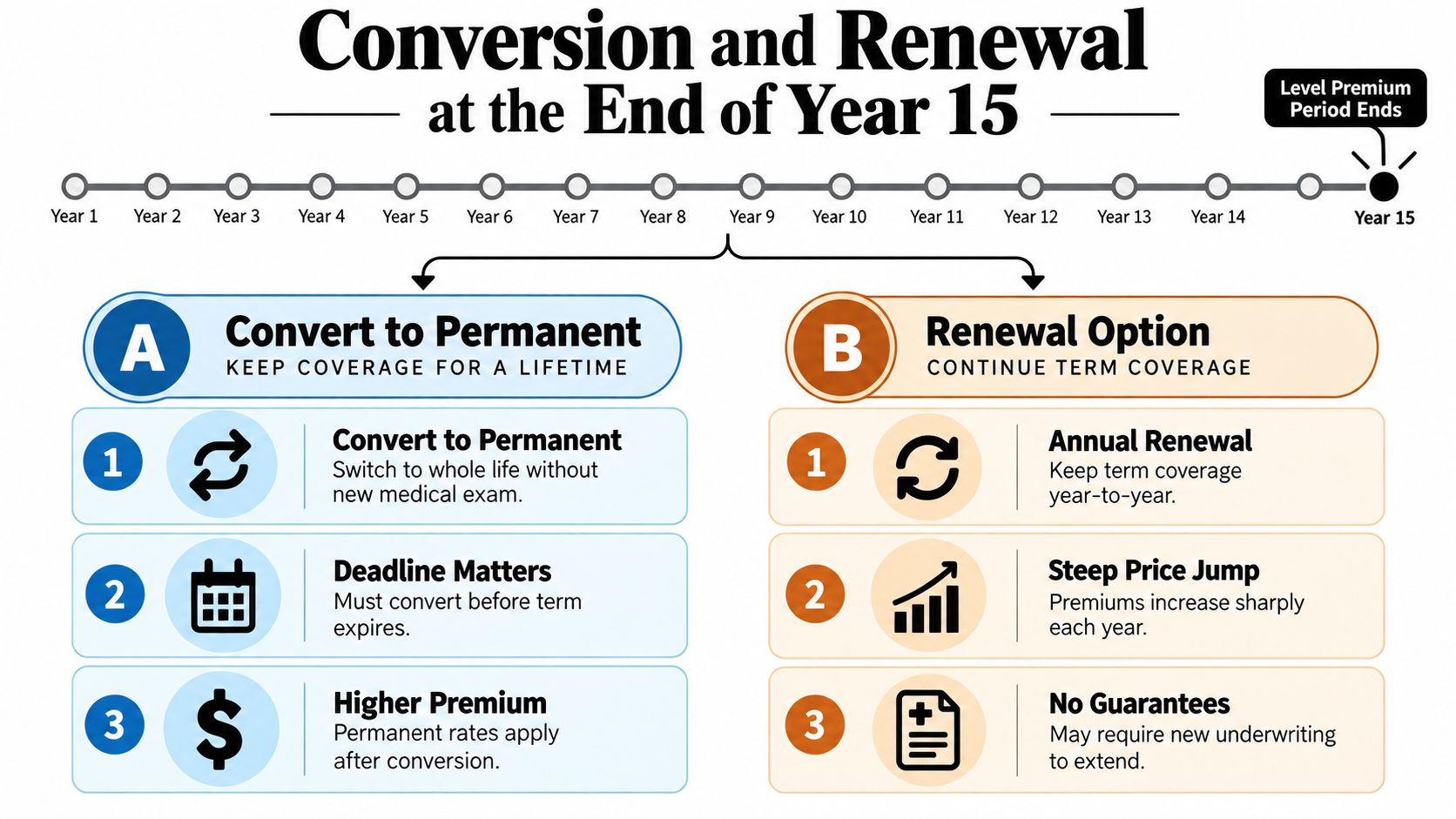
A 15-year level-term policy reaches a financial deadline when its guaranteed premium period ends. At that point, the coverage usually does not continue at the same price. You can keep it through renewal, replace it with a new policy, convert it to permanent insurance, or let it end.
Conversion without new medical underwriting
A conversion feature may let you change term coverage to a permanent policy without new medical underwriting. That option can preserve access to coverage after a serious health change, or when applying for a new policy would be difficult. The available products, deadlines, age limits, and costs depend on the insurer and contract.
Check the policy before the final year. Some contracts allow conversion only while the term remains active, while others limit which permanent products you can choose. This guide to life insurance policy conversion explains how the provision works when your needs change.
Renewal creates a premium cliff
Renewal can produce a sharp premium increase after the level period. The Society of Actuaries reported annual lapse assumptions for 15-year term rising from roughly 4% during the level-premium years to a median near 74% in the first post-level year, with cumulative lapse assumptions reaching about 83% by duration 20. It also reported post-level annual mortality multiples around 282% to 295%, reflecting the older insured population after the guaranteed period. (Society of Actuaries shock lapse survey)
Those figures show why renewal should be treated as a separate decision, not a routine continuation. The insurer may calculate the new cost using your age at renewal, and the resulting premium can make long-term renewal impractical. A policy that fit a mortgage, college countdown, or business loan at purchase may no longer fit once that obligation has nearly ended.
Start reviewing your options in year 13 or year 14:
- Check outstanding debts. Confirm whether the mortgage, business loan, or other deadline still remains.
- Review dependents. Decide whether anyone still depends on your income.
- Get a new term quote. Compare replacement coverage before the current policy expires, especially if your health has improved.
- Price conversion. Ask about permanent-policy costs, eligible products, and deadlines.
- Choose deliberately. Convert, replace, renew, or end coverage according to the remaining need.
The end of year 15 is a checkpoint. It marks the point where the original price guarantee ends, not an automatic renewal at the premium you have been paying.
Is a 15 Year Term the Right Move for You
Longer coverage isn't automatically better. A 30-year policy may be unnecessary when a mortgage has 14 years remaining, a child is already in high school, or a small business loan is scheduled to clear inside 15 years. Paying for decades of protection can make sense only if the financial need continues for decades.
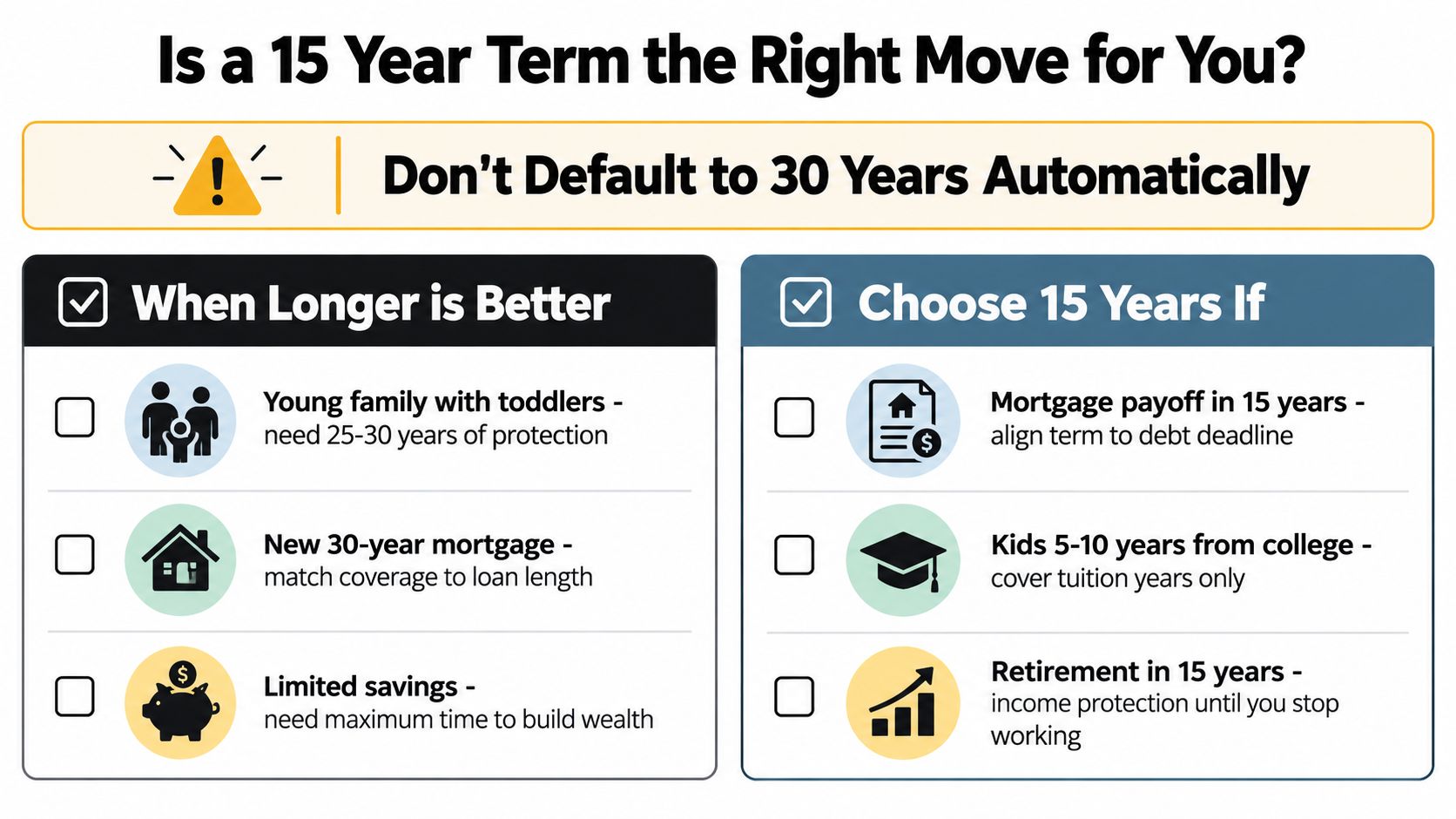
Use this decision checklist
Ask yourself:
- Coverage amount: Would the death benefit cover the debts, income gap, and family obligations you're protecting?
- Premium budget: Can you keep paying the premium for the full level period?
- End-of-term plan: Do you know whether you'll replace, convert, renew, or end coverage?
- Health rating: Could your current health make a future application more difficult?
- Family obligations: Will children, a spouse, a business partner, or another dependent still rely on you when the term ends?
A 15-year policy is often a reasonable match for a dated liability. It's less convincing when the buyer hopes the need will disappear without checking the calendar.
Three quick scenarios
A 42-year-old parent with a 12-year mortgage balance may find 15-year coverage closely aligned with the housing obligation, subject to the amount needed and the family's broader income needs.
A 35-year-old funding a newborn's college costs in 17 years has a timeline that exceeds 15 years. A 20-year term may better protect the full horizon, or a 15-year policy could be paired with another layer if the family understands the later gap.
A 50-year-old insuring a business loan should compare the loan's repayment schedule with the owner's remaining working years. If the debt ends inside 15 years, that term may fit. If the business depends on coverage beyond that date, a longer term or a permanent solution deserves attention.
Request quotes from at least three carriers, compare the same face amount and underwriting assumptions, and review the policy again around year 10. Don't wait until year 15 to discover that your debt, health, or family timeline has changed.
Coveredly offers online term life insurance, including term options for people considering a defined coverage period, with coverage of up to $3 million and a digital application path that requires no exam for most applicants. Compare your deadline, coverage amount, and end-of-term plan, then visit Coveredly to explore whether its application options fit your 15-year protection need.