You're probably here because life got more real lately. Maybe you bought a home, got married, had a child, or started thinking about what would happen if your income disappeared for the people who count on it.
Then you started looking up term life insurance rates and ran into the usual mess. One site shows a low monthly number. Another says to compare carriers. A third tells you no-exam coverage is faster. None of that really answers the question you have, which is simpler and more important: How do I compare term life insurance rates in a way that helps me choose well, not just choose cheap?
That's the right question. A smart term life insurance rates comparison isn't only about the first premium you see. It's about matching the policy to your timeline, your health profile, and your tolerance for paperwork and waiting. If you skip that framework, it's easy to save a little now and create a much bigger problem later.
Here's a practical way to think it through.
Table of Contents
- Why Comparing Term Life Insurance Is More Than Finding the Lowest Price
- Understanding What Drives Your Term Life Insurance Rate
- A Clear Methodology for Term Rate Comparison
- The No-Exam Versus Traditional Exam Trade-Off
- Common Pitfalls When Comparing Insurance Quotes
- Actionable Tips to Secure the Best Possible Rate
- Frequently Asked Questions About Rate Comparisons
Why Comparing Term Life Insurance Is More Than Finding the Lowest Price
A low premium can be a good sign. It is not the whole story.
When people shop for term life insurance, they often compare only one line item: monthly cost. That's understandable. If one policy is cheaper than another, it feels like an easy win. But term life insurance is a time-based product. The central consideration isn't just what it costs today; it's whether the policy stays in place for the years your family would need it.
That matters most for young professionals with long financial runways. A new mortgage, small children, private student loans, a spouse who depends on your income, or a business loan can all last much longer than the shortest, cheapest policy.
Cheap isn't always aligned
A 10-year term might look attractive because it keeps the payment lower. But if your main goal is protecting a 20- or 30-year obligation, that choice can leave you shopping again later, when you're older and underwriting is less forgiving.
Practical rule: Compare policies based on the problem you're solving, not the teaser premium.
There's also a process issue. Two policies with similar coverage amounts can differ because the insurers use different underwriting paths, ask different health questions, or require different levels of evidence. So a proper term life insurance rates comparison has three layers:
- Price today: What's the premium for the coverage you want?
- Fit over time: Does the term length match your real financial obligations?
- Friction to get approved: Are you willing to complete a medical exam, or do you value a faster digital process more?
Think like a buyer, not a bargain hunter
The best comparison starts with your life. If your partner would need income replacement for years, or your kids are young, a slightly higher premium for a longer term can be the more responsible choice. If you only need short protection for a temporary debt or a bridge period, a shorter term may fit perfectly.
The point isn't to spend more. It's to avoid buying the wrong product just because the first number looked good.
Understanding What Drives Your Term Life Insurance Rate
Insurance pricing feels mysterious until you break it into pieces. Once you know the inputs, quotes become easier to read and easier to compare.

The biggest pricing inputs
The first driver is age. Term life gets more expensive as you get older because the insurer is pricing more risk into the same coverage period.
For a standardized benchmark, a healthy, nonsmoking 30-year-old woman can expect about $23 per month for a 20-year, $500,000 term policy, while a comparable man pays about $29 per month. By age 50, that same policy rises to about $78 per month for a woman, which is 239% higher than the age-30 price, according to Policygenius term life insurance rate data.
The second driver is sex, which is built into many insurers' underwriting classes. That's why a man and woman with similar age and health can receive different quotes.
Third is health and medical history. Insurers look at current conditions, prescriptions, past diagnoses, and sometimes family history. If you want a plain-English overview of how insurers review this information, this underwriting guide from Coveredly is a useful starting point.
How to compare quotes fairly
The fourth and fifth drivers are the easiest to miss because they look like product settings, not risk factors: coverage amount and term length. If one quote is for a 20-year term and another is for a 30-year term, you're not comparing the same thing. If one is fully underwritten and another uses a simplified process, you may also be comparing different pricing assumptions.
Use this quick checklist before you judge any quote:
- Match the death benefit: Compare the same coverage amount across insurers.
- Match the term: A 20-year quote and a 30-year quote answer different needs.
- Match the applicant profile: Use the same smoking status, age, and health information each time.
- Check the underwriting style: Traditional exam, accelerated underwriting, and no-exam paths can price differently.
A useful quote is a normalized quote. Same person, same coverage, same term, same disclosures.
Once you do that, the quote spread starts to make sense. Without that discipline, term life insurance rates comparison turns into noise.
A Clear Methodology for Term Rate Comparison
A good comparison process starts before you request a single quote. If you don't define what you need first, the cheapest option will keep pulling your attention even when it doesn't fit.
Start with need, not price
Use this simple sequence:
- Choose the purpose of coverage. Are you covering income replacement, a mortgage, childcare years, or a business obligation?
- Choose the amount. Pick one death benefit and keep it constant while comparing.
- Choose the term based on your timeline. If your biggest obligations stretch out for decades, compare longer terms seriously.
- Then compare premiums and underwriting paths.
This sounds obvious, but most bad decisions happen because shoppers reverse the order. They start with a low monthly payment and then try to justify it.
The data shows how much term length changes cost. NerdWallet reports average annual nonsmoker premiums of $201, $321, and $574 for men for 10-year, 20-year, and 30-year term policies, versus $175, $278, and $451 for women. For smokers, the same ladder rises to $895, $1,464, and $2,475 for men and $720, $1,157, and $1,750 for women, based on NerdWallet's average life insurance rate tables. That same dataset indicates smoking can push 20-year premiums to roughly 4 to 5 times nonsmoker levels.
Sample 2026 Monthly Term Life Insurance Rates ($500,000 Coverage)
Below is a simple benchmark table built from the verified monthly examples available in the research brief. Treat it as a reference point, not a personalized quote.
| Applicant Age | Gender | 20-Year Term | 30-Year Term |
|---|---|---|---|
| 30 | Woman | about $23/month | Higher than the 20-year term |
| 30 | Man | about $29/month | Higher than the 20-year term |
| 50 | Woman | about $78/month | Higher than the 20-year term |
If you want to start gathering side-by-side pricing efficiently, instant online life insurance quotes through Coveredly show how a modern digital quote flow can simplify the shopping step.
How to use the table without fooling yourself
The table makes one point very clear. Age changes the baseline fast. The annual averages from NerdWallet make a second point just as clearly. Longer terms cost meaningfully more because they lock in coverage for more years.
That doesn't mean you should automatically buy the shortest term. It means you should ask whether the extra cost today buys protection you'll still need later.
A strong methodology compares these trade-offs side by side:
- Shorter term
- Lower starting premium
- Higher risk of needing to buy again later
- Longer term
- Higher starting premium
- Better alignment with long obligations
- Exam-based path
- More friction
- May reward very healthy applicants
- No-exam or accelerated path
- Faster and simpler
- May involve a convenience trade-off in pricing
That's how you turn rate shopping into a decision, not a guessing game.
The No-Exam Versus Traditional Exam Trade-Off
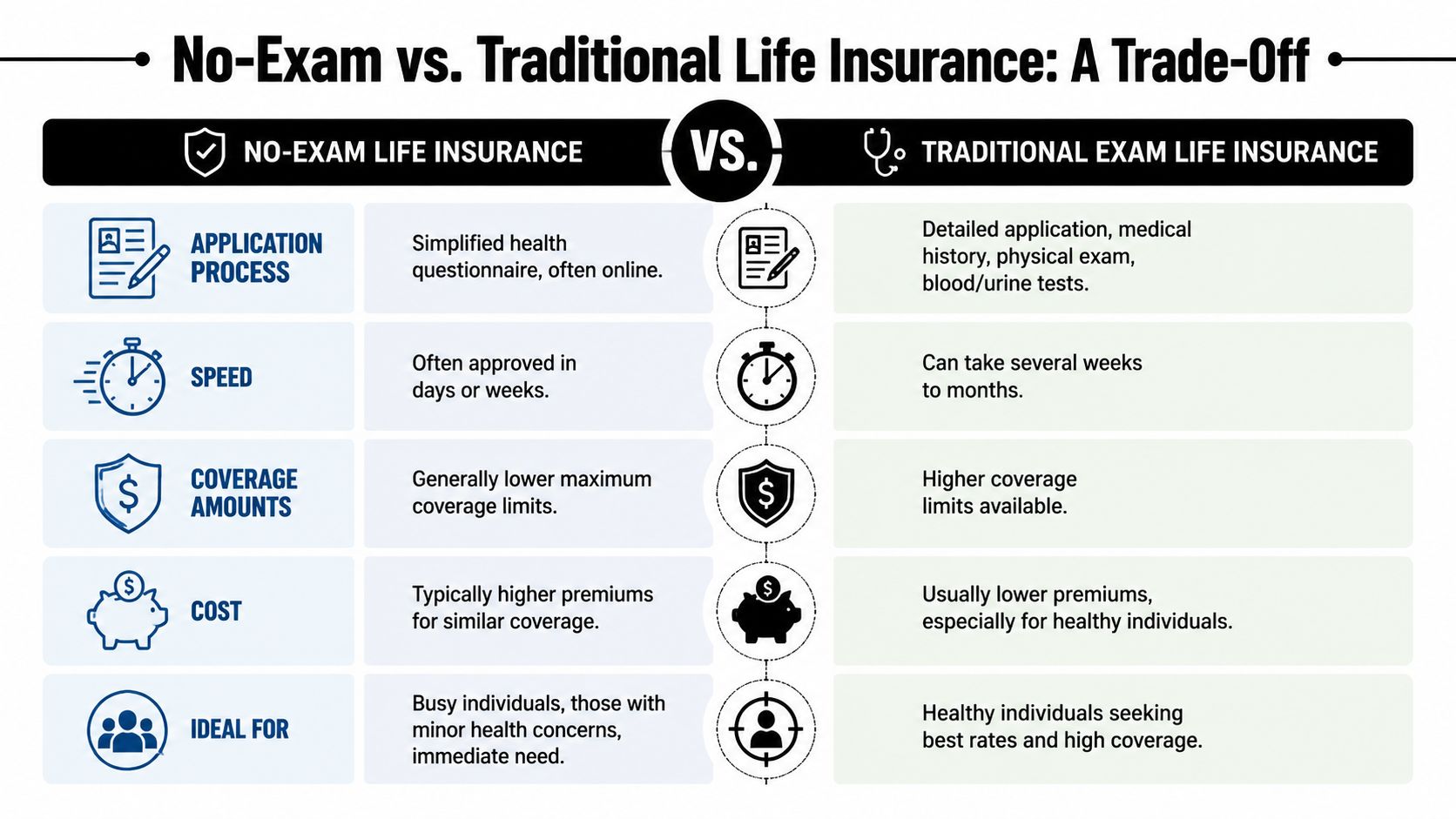
The biggest blind spot in most term life insurance rates comparison articles is underwriting style. Buyers see “no exam” and think only about convenience. Buyers see “traditional exam” and think only about hassle. Neither view is complete.
What convenience changes
Public comparison pages often note that quoting workflows, health questions, and medical requirements affect the buying process, but they rarely give a clear, data-backed way to quantify the trade-off between convenience and price. That gap is especially relevant for busy applicants who want fast digital coverage, as noted in Progressive's term life comparison overview.
In plain terms, the trade-off works like this:
- Traditional exam underwriting
- More medical detail
- More waiting
- Better fit for shoppers who want every chance at the lowest possible rate
- No-exam or accelerated underwriting
- Less friction
- Faster process
- Better fit for people who value speed, privacy, or simplicity
Here's a helpful explainer on the process itself:
Who each path fits best
If you're healthy, patient, and comfortable scheduling an exam, the traditional route may be worth considering because it gives the insurer more detailed evidence. If you're juggling work, kids, travel, or a time-sensitive coverage need, the faster path may be worth the trade.
Speed has value. So does pricing precision. Your best option depends on which one matters more in your situation.
Use cases make this clearer:
- Busy young parent: You may care more about getting coverage in force quickly than optimizing every dollar of premium.
- Very healthy applicant with time: You may prefer the traditional route if you want to compete for the best possible underwriting class.
- Applicant who dislikes medical exams: A simplified path may reduce enough friction that you complete the purchase instead of delaying it.
If you want to explore that faster option directly, no-exam term life insurance through Coveredly shows what a digital-first path can look like.
The mistake is assuming one path is always superior. It isn't. The right question is whether convenience today is worth the possible pricing difference for your profile and timeline.
Common Pitfalls When Comparing Insurance Quotes
Some quote comparisons fail before the application even starts. Not because the shopper is careless, but because the online experience nudges people toward the easiest number to understand.

Cheap can become expensive
The biggest mistake is term length mismatch. Many buyers choose the lowest premium without checking whether the coverage lasts as long as the financial problem they're trying to solve.
Neutral guidance on term policies notes that coverage typically lasts 10 to 30 years, premiums stay level during the term, and coverage ends when the term expires. If protection is still needed after that point, a new policy is usually more expensive because the insured is older, according to Aflac's comparison guidance on term policies.
That creates a practical risk. If you buy a short policy to protect a long obligation, you may save money now and hand your future self a much harder shopping problem.
The wrong term length doesn't usually feel wrong on day one. It shows up later, when you still need coverage and the easy rate is gone.
Mistakes that weaken your comparison
A few other errors show up all the time:
- Comparing unequal quotes: One quote includes a longer term, different underwriting path, or different coverage amount.
- Ignoring policy features: A very low premium may look less attractive if the policy lacks features you care about, such as conversion options.
- Leaving out honesty: If your application doesn't match your actual history, the problem isn't just underwriting friction. It can create claim problems later.
- Treating all insurers as identical: Price matters, but so does how the policy fits your needs and how comfortable you are with the application process.
A stronger buying process looks like this:
- Decide your ideal term first.
- Compare equal quotes only.
- Review the underwriting style.
- Check the features that matter to you.
- Submit accurate information the first time.
That sequence protects you from the most expensive kind of mistake: buying a policy that was cheap to start and costly to outgrow.
Actionable Tips to Secure the Best Possible Rate
You can't control every underwriting outcome, but you can improve the odds of getting a better result. Most of the advantage comes from timing, preparation, and disciplined comparison.

What you can do before applying
Start earlier than feels necessary. Term life usually gets easier and less expensive when you're younger and healthier, so delaying the decision rarely improves the math.
Then tighten up what you can control:
- Your smoking status: If tobacco use applies to you, this is one of the biggest pricing variables.
- Your medical follow-through: Keep prescriptions current and chronic conditions managed.
- Your application timing: Don't apply casually if you know your health picture is in the middle of changing.
What to do while shopping quotes
Treat quote shopping like a clean comparison exercise, not a browsing session.
- Keep your inputs consistent: Same age, same coverage amount, same term, same disclosures.
- Decide whether speed matters: If convenience is a priority, compare no-exam and traditional routes as separate categories.
- Choose a term that matches your timeline: Protect the years your family is financially exposed, not just the years that produce the lowest monthly bill.
- Read the details: A policy is more than the headline premium.
- Be accurate on every answer: Accuracy protects both approval and future claims.
Buy coverage for the years that matter most, then optimize price inside that decision.
A practical way to think about this is to rank your priorities before you apply. Put these in order:
- How long you need protection
- How much coverage you need
- How fast you want the policy in force
- How much underwriting friction you'll tolerate
- What monthly premium fits comfortably in your budget
That ranking helps you avoid the common trap of letting a single low quote make the entire decision for you.
Frequently Asked Questions About Rate Comparisons
Will my term life insurance rate go up over time
If you buy a level term policy, the premium is generally designed to stay level during the term. The issue isn't usually a rate increase during the active term. The issue is what happens if the term ends and you still need coverage. That's why term selection matters so much during a term life insurance rates comparison.
Do riders affect a rate comparison
Yes. Riders can change the premium, so don't compare a policy with add-ons against a stripped-down version and assume the base pricing is equivalent. If you want a clean comparison, line up the same core policy design first, then evaluate riders separately based on need.
Is it better to get quotes online or through an agent
It depends on how you like to make decisions. Online quotes are fast and convenient. An agent can add context, especially if your health history is more complex or you want help thinking through term length and underwriting options. Many modern platforms combine both experiences by giving you digital speed with guidance when you need it.
Is the shortest term the best value
Not automatically. A short term often has the lowest starting premium, but value depends on whether the coverage lasts through your years of financial responsibility. A cheaper policy can be poor value if it expires while your family still depends on your income.
Should healthy people always choose the medical exam route
Not always. Healthy applicants may want to explore it, but the best choice still depends on schedule, comfort level, and how much you value speed. Some people would rather accept a possible convenience trade-off than spend weeks completing a longer process.
If you want a simpler way to shop for coverage, Coveredly offers digital life insurance designed for busy people who want flexibility. It's a practical place to explore term life options, including no-exam coverage for many applicants, without turning the process into another major project.