You're probably here because life is getting real. Maybe you just bought a home, had a baby, got married, or realized other people now depend on your income. You know term life insurance matters. But if you smoke, even occasionally, the first question often isn't “How much coverage do I need?” It's “Can I even afford this?”
That concern is reasonable. Many people assume they'll either get denied or get quoted a rate that makes the whole idea feel pointless. Neither assumption is always true. Smokers can get coverage. The bigger challenge is understanding how insurers look at tobacco use, what kind of policy makes sense right now, and what steps can help lower your cost later.
This guide is built for that exact situation. It gives you a plain-English view of term life insurance for smokers, explains where the higher premiums come from, and walks through a practical path from buying coverage today to possibly earning non-smoker rates in the future.
Table of Contents
- Securing Your Family's Future as a Smoker
- Why Smoking Changes the Life Insurance Equation
- The Financial Impact of Smoking on Premiums
- Navigating Your Policy Options as a Smoker
- Strategies for Securing Affordable Coverage Now
- The Quitter's Roadmap to Cheaper Premiums
- Protecting Your Future Is Within Reach
Securing Your Family's Future as a Smoker
A lot of people put off life insurance for a simple reason. They're afraid of the answer.
You might be a young parent running the household budget at the kitchen table, looking at mortgage payments, daycare, groceries, and everything else. You know a term policy could protect your family if something happened to you. But if you smoke, it's easy to assume the premium will be too high, or that the insurer will treat you like you've done something wrong.
That's not how to think about it.
Life insurance companies don't make a moral judgment. They make a pricing decision. That distinction matters because pricing can be managed. You may not love the rate you get today, but you still have options. You can choose the right policy type, compare carriers, avoid costly application mistakes, and if you quit, you may be able to ask for better rates later.
The best life insurance policy is often the one that gets your family protected now, even if it isn't your perfect long-term rate.
That mindset helps people move forward. Instead of waiting for some ideal moment, they secure coverage that fits today's reality and create a plan to improve it later.
For many families, term coverage is the most practical place to start. It's built to protect your income during the years when other people rely on it most, such as while kids are young, debts are large, or savings are still growing. If you smoke, the process may involve extra questions and a higher price, but it's still a path you can take.
The key is understanding the system well enough to work with it instead of feeling boxed in by it.
Why Smoking Changes the Life Insurance Equation
Insurance pricing makes more sense once you understand underwriting. That's the process insurers use to decide how risky an applicant looks on paper.
How underwriting works in plain language
Think about car insurance. A driver with a clean record usually gets a better rate than a driver with recent speeding tickets. The company isn't trying to punish anyone. It's estimating the chance of a claim.
Life insurance works the same way. Smoking changes how insurers estimate health risk over time. According to Bandhan Life's explanation of smoker risk in term insurance, smokers are classified as higher-risk policyholders because tobacco use significantly increases the probability of chronic conditions like lung cancer and heart disease, which directly reduce life expectancy. That increased claim probability results in premiums that are 1.5 to 3 times higher than those for non-smokers.
If you've never applied before, it helps to read a plain-language overview of how life insurance underwriting works before comparing quotes. The process feels less intimidating when you know what the insurer is trying to measure.
What usually counts as smoking
Many applicants get tripped up. They hear “smoker” and think only of daily cigarette use. Insurers usually cast a wider net.
Depending on the insurer, tobacco or nicotine use may include more than cigarettes. A company may ask about:
- Cigarettes and cigars because both can affect your classification
- Chewing tobacco or similar products because underwriting usually looks at tobacco use broadly
- Vaping or e-cigarettes because nicotine use can still matter
- Nicotine replacement products such as patches or gum, if the insurer's rules treat nicotine use as part of smoker classification
The exact treatment differs by company, so the safest move is full disclosure. If an application asks whether you've used tobacco or nicotine, answer it directly and consistently.
Practical rule: Don't guess what “counts.” Let the insurer define it, and answer based on the wording in the application.
That honesty protects your family, too. If your application doesn't match your medical records or test results, the issue isn't just price. It can create claim problems later. Clear answers at the start are part of good financial planning, not just good paperwork.
The Financial Impact of Smoking on Premiums
Price is where this becomes real.
What the price difference looks like in real life
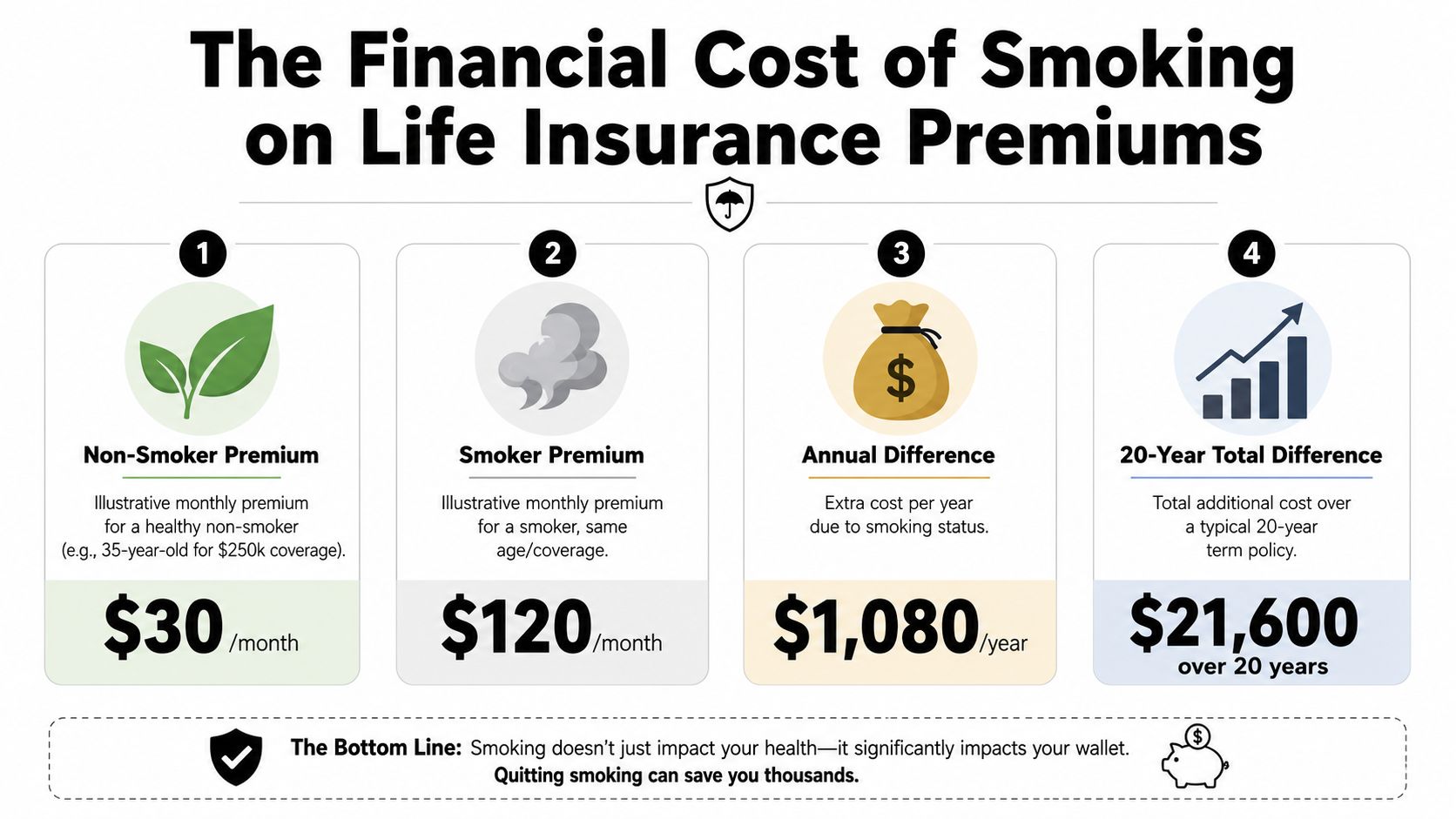
According to Policygenius data on smoker life insurance rates, smokers pay an average of 286% more than non-smokers for the same term life insurance policy. That's a huge gap, but percentages can still feel abstract, so it helps to look at a concrete example.
For a 30-year-old female buying a $500,000, 20-year term policy, the monthly premium is about $65.75 for a smoker versus $22.98 for a non-smoker, based on the same source. Over the full 20-year term, that adds up to $10,200 in extra cost tied to smoking status alone.
That difference matters because life insurance is usually a long commitment. A premium that seems manageable month to month can become a major budget item over time. If you're deciding whether to buy now, those long-run costs deserve as much attention as the monthly number.
Here's that same example in a simple comparison:
| Applicant | Coverage | Term | Monthly premium |
|---|---|---|---|
| Smoker | $500,000 | 20 years | $65.75 |
| Non-smoker | $500,000 | 20 years | $22.98 |
Why age makes the gap feel even bigger
The smoker penalty doesn't stay flat as you get older. In the verified data, a 50-year-old male smoker pays $351.50 per month, while a non-smoker of the same age pays $102.50. That's a 243% increase, drawn from the same Policygenius smoker rate examples.
The lesson isn't “panic and buy anything.” It's more practical than that. If you know you need coverage, waiting can stack two expensive things on top of each other: age and smoking status.
A smoker in their 30s may dislike the quote. A smoker in their 50s may be dealing with a very different affordability problem.
That's why timing matters. Even if quitting is part of your future plan, many families still decide it makes sense to lock in coverage now rather than leave a spouse, partner, or children unprotected while they wait for a better rate class.
Navigating Your Policy Options as a Smoker
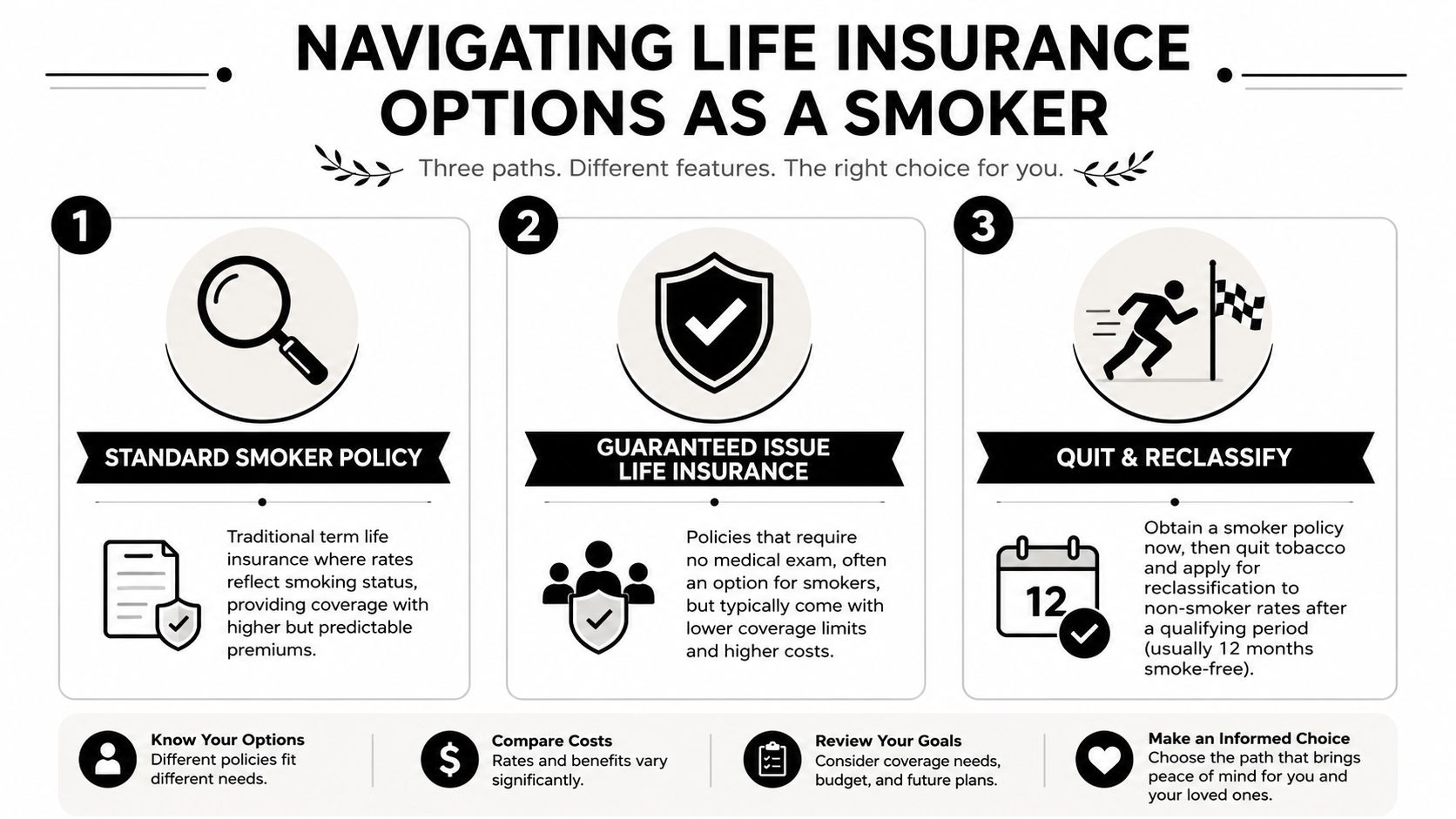
Smokers don't have just one route into life insurance. They usually have several, and each one trades off price, convenience, and coverage amount differently.
A side-by-side view of your main paths
| Policy path | What it usually involves | Main upside | Main trade-off |
|---|---|---|---|
| Fully underwritten term policy | Detailed application and possibly medical review | Often the best chance at larger coverage and better pricing for your risk class | More steps and more scrutiny |
| Simplified issue term policy | Fewer health hurdles, often no medical exam | Faster and easier for busy applicants | Cost can be higher than fully underwritten coverage |
| Guaranteed issue policy | Little to no health screening | Useful when other options are limited | Lower coverage and less favorable pricing structure |
If you want a faster application process, some shoppers look at no-medical-exam term life insurance options. That kind of policy can make sense when convenience matters, though it's still important to compare the price against a fully underwritten option.
When each option tends to fit best
A fully underwritten policy often works best for smokers who are otherwise in reasonably good health and want substantial coverage. If your blood pressure, weight, and medical history are stable, a deeper underwriting process can sometimes work in your favor because the insurer sees the whole picture instead of making a broad assumption from limited information.
A simplified issue policy can suit someone who wants to move quickly. Maybe you've got a new baby, a new mortgage, or a demanding job, and you want coverage in place without a long process. You may pay for that convenience, but the ease can be worth it when speed matters.
A guaranteed issue policy is usually more of a fallback than a first choice. It can help applicants who have major health concerns or trouble qualifying elsewhere. The catch is important. Verified data from Aflac's guide to life insurance for smokers and tobacco users notes that guaranteed issue policies for heavy or long-term smokers often include 2-year full-death-benefit waiting periods. That detail gets missed a lot, and it changes how useful the policy is for immediate protection.
- If your priority is maximum protection: fully underwritten term often deserves the first look.
- If your priority is speed and less friction: simplified issue may feel more realistic.
- If your health history limits other choices: guaranteed issue may still be better than going uninsured, but read the waiting-period language carefully.
The best choice depends on your real-life constraint. For one person, that's budget. For another, it's time. For someone else, it's qualifying at all.
Strategies for Securing Affordable Coverage Now
If you need coverage now, don't wait for perfect timing. Shop strategically.

A practical checklist for shopping smarter
Start with comparison shopping. Rates for smokers can vary noticeably from one insurer to another, so the first quote you see shouldn't become your final answer. According to MoneyGeek's 2026 comparison of smoker life insurance rates, State Farm offers the cheapest average monthly rate for smokers at $29 for men and $26 for women for a 10-year, $250,000 term policy.
That doesn't mean State Farm will be cheapest for every person. It does mean shopping around can uncover meaningful savings.
Use this checklist as you compare:
- Get multiple quotes: Don't assume one insurer's smoker rate reflects the whole market.
- Be consistent on applications: If one quote says you use cigars occasionally and another says you never use tobacco, you won't get a clean comparison.
- Ask about policy length: A shorter term can reduce cost if your budget is tight and your main goal is getting protection in force.
- Look beyond smoking status: If your weight, blood pressure, or medications have improved, that broader health picture can still matter.
Some insurers are simply a better fit for smokers than others. Shopping is not optional. It's part of the strategy.
How to balance cost with real protection
Cheap coverage isn't the same as useful coverage.
A very small policy may fit the monthly budget, but it might not do much for your family if the primary need is income replacement, debt payoff, or childcare support. A better approach is to find the most affordable policy that still covers the responsibilities you'd leave behind.
Two questions usually help:
What must this policy accomplish right away?
Mortgage support, funeral costs, income replacement, and child-related expenses are common starting points.What can I improve over time?
You might buy a manageable term policy now, improve your health profile, and revisit your rate later.
That combination often works better than an all-or-nothing mindset. Good-enough protection today can be far more valuable than waiting for a lower premium that may not arrive soon enough to help your family.
The Quitter's Roadmap to Cheaper Premiums
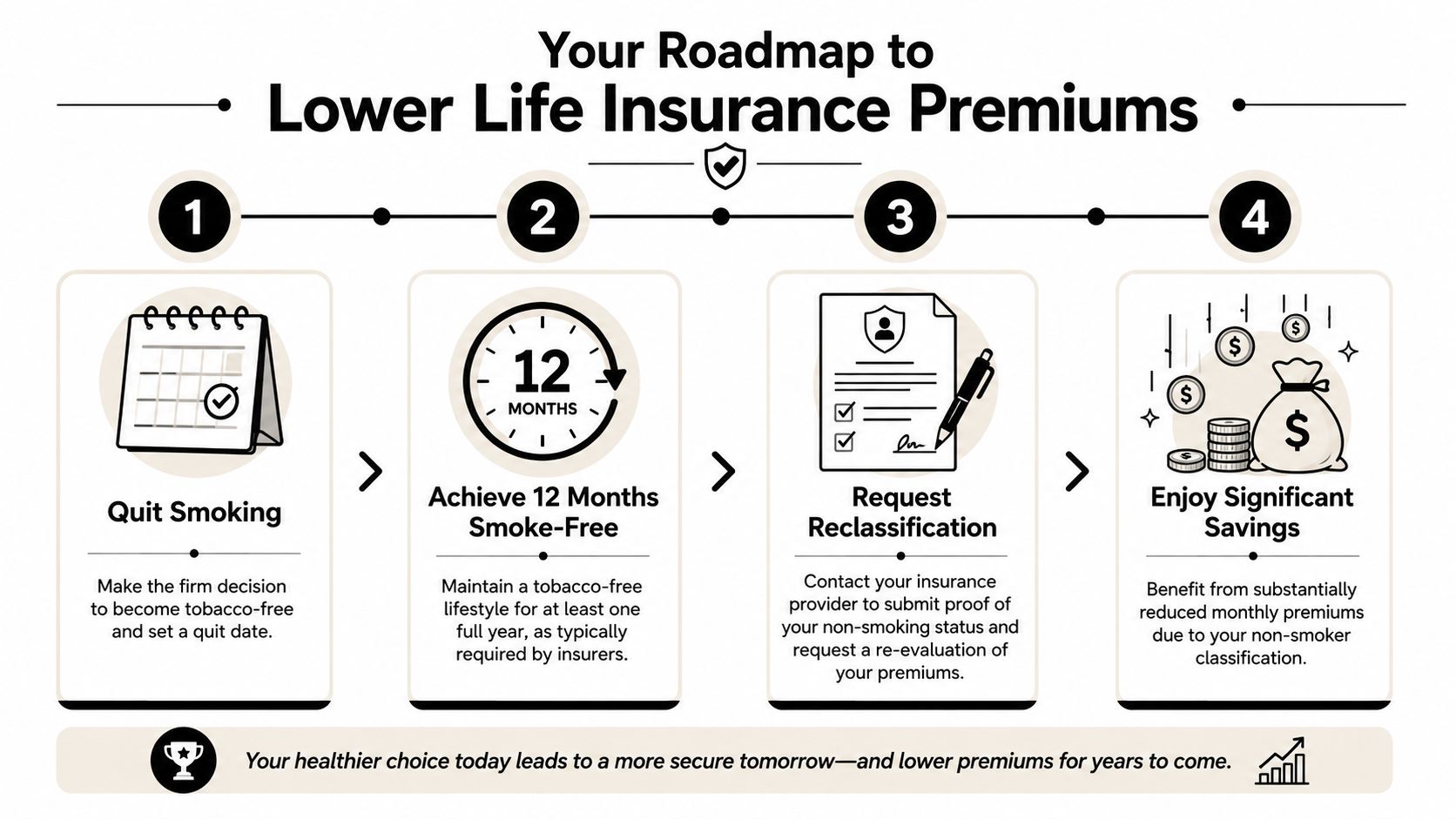
Buying a smoker-rate policy now doesn't mean you're locked into that classification forever. Many insurers allow former smokers to seek a better rate after a sustained period without tobacco or nicotine.
The basic timeline most insurers use
According to Mutual of Omaha's guidance for former smokers seeking lower rates, former smokers can qualify for non-smoker rates after being completely tobacco-free for at least 12 months. The same source says quitting can cut premiums by over 66%.
That's the headline people usually hear. The part they miss is the process.
A practical roadmap looks like this:
Quit fully, not partly
Insurers generally want complete tobacco-free status, not reduced use.Keep records and be ready to verify
If the insurer asks for evidence of abstinence, you want a clear and consistent history.Ask about reconsideration or re-entry
Some insurers let you apply to have an existing policy re-rated after you've remained nicotine-free for the required period.Prepare for medical review
Depending on the insurer, that may include updated health questions or testing. If you want a better sense of what screening can involve, read this plain-language guide to a blood test for life insurance.
Quitting helps twice. It can improve your health, and it can create a path to lower premiums.
The overlooked detail about age and reconsideration
This is the nuance most articles skip. The 12-month mark is important, but it isn't a magic reset button.
Verified data notes that rate recovery depends on age, and older quitters may still pay more than comparable non-smokers even after the same abstinence period. In the Aflac-backed underserved angle from the verified data, a 50-year-old former smoker still pays $351.50 versus $102.50 for a non-smoker equivalent, a 3.4x gap, while the gap for a younger applicant is smaller.
That can feel discouraging at first, but it's better to know the truth going in. Reconsideration is real. It just isn't always linear.
- Younger quitters may see faster relative improvement
- Older quitters may still benefit, but not match non-smoker pricing right away
- Insurer rules differ, so ask how reclassification works before you buy
If you're choosing a policy today, one useful question is simple: If I quit, what is your reconsideration process? That answer can matter almost as much as the starting premium.
Protecting Your Future Is Within Reach
If you smoke, term life insurance may cost more. This is a fact. But it's not the end of the conversation.
A workable plan usually has two parts. First, get the best coverage you can responsibly afford now so the people who depend on you aren't left exposed. Second, if quitting is part of your future, choose a path that gives you a real shot at better rates later through reconsideration or a new policy application.
That's a much healthier way to think about term life insurance for smokers. Not as a yes-or-no question, but as a decision with stages.
You don't need to be perfect to protect your family. You don't need to wait until every habit, lab result, and budget line is ideal. You need a clear understanding of your options, honest applications, and a plan that fits your life as it is today.
For newly married couples, young families, and busy professionals, that protection can bring a lot of peace of mind. It means a mortgage payment is still manageable. It means a partner has breathing room. It means children have financial support while life adjusts.
That's worth acting on.
If you want a simple way to explore term life insurance online, Coveredly offers flexible coverage designed to fit modern life, including up to $3mm of term life insurance with no exams for most applicants. It's a practical place to compare your options and see what coverage could look like for your situation.