You're probably here because an application asked for a paramedical exam and your brain went straight to worst-case scenarios. That reaction is normal. For many young parents, newly married couples, and busy professionals, a blood test for life insurance sounds less like paperwork and more like a judgment on your health.
It helps to reframe it. This exam is usually a pricing tool, not a pass-or-fail event. Consider it similar to a lender checking your credit before approving a mortgage. The insurer wants a reliable snapshot so it can place you in the right pricing bucket for your level of risk.
The confusing part is that most guides stop at “they check your blood.” They rarely explain how the numbers on that lab report can shift you from one rate class to another. That's where people get blindsided. A result that looks minor on paper can affect what you pay for years.
This guide breaks it down in plain English, with pictures, relevant keywords, and clear examples so you can understand what the test measures, how to prepare, and how those results can affect your premium.
Table of Contents
- Your Guide to the Life Insurance Medical Exam
- Why Insurers Use Blood Tests for Risk Assessment
- Key Biomarkers Underwriters Analyze in Your Blood
- How Blood Test Results Determine Your Rate Class
- A Practical Checklist for Your Exam Day
- Skipping the Needle: Alternatives to the Blood Test
- Taking Control of Your Life Insurance Journey
Your Guide to the Life Insurance Medical Exam
If an insurer says you need a medical exam, that usually means a short appointment with a nurse or paramedical professional who collects basic health information. The blood draw is only one part of it. The purpose is straightforward. The company wants objective data to support the answers on your application and help set your premium.
That can feel invasive, especially if you're juggling work, kids, or a packed schedule. But the process is usually routine and predictable. Once you understand what's being measured and why, it becomes much easier to approach calmly.
A blood test for life insurance isn't designed to “catch” you. It's meant to show where you fit in the insurer's risk system. If you want a broader overview of what happens during the appointment, this guide to the life insurance medical exam process is a helpful starting point.
A useful way to think about it is this: the exam helps the insurer price your family's financial safety net with more precision.
A common question isn't “Will they draw blood?” It's “What do those results mean for my monthly cost?” That's the part worth understanding before the appointment happens.
Why Insurers Use Blood Tests for Risk Assessment
Insurance works by grouping people with similar levels of risk. In car insurance, a clean driving record usually earns a better price than a history of accidents. In life insurance, blood work helps fill that same role. It gives underwriters a standardized way to compare applicants using measurable health markers instead of guesswork.

According to Fidelity Life's explanation of understanding life insurance blood tests, a life insurance blood test is a routine medical screening conducted during the application process to analyze health markers such as cholesterol, glucose, and nicotine metabolites so insurers can use specific numerical thresholds to place applicants into rate classes.
That last part matters most. Rate classes are how insurers translate lab results into premiums. They don't just note that cholesterol or glucose is “high” or “low.” They compare those readings against internal underwriting thresholds and decide whether you qualify for a more favorable class or a more expensive one.
Why insurers prefer objective data
A questionnaire can tell an insurer what you know about your health. A blood panel can reveal patterns you may not know about yet, or details that need confirmation. That's especially important for conditions that can progress unnoticed, such as blood sugar issues or nicotine use.
This system also protects healthier applicants from subsidizing higher-risk applicants too heavily. Without objective screening, insurers would have to price more policies conservatively. That would make coverage less fair for people whose lab work supports a lower-risk profile.
What underwriters are trying to sort out
Underwriters generally use blood testing to answer a few basic questions:
- Metabolic risk: Are blood sugar markers pointing to a possible diabetes concern?
- Cardiovascular risk: Do cholesterol and triglyceride readings suggest increased heart risk?
- Lifestyle risk: Is there biochemical evidence of nicotine or other substances?
- Organ function: Do liver or kidney markers suggest a condition that needs closer review?
This isn't personal. It's a pricing method built around measurable evidence.
Once you see the test that way, the process feels less mysterious. The next step is understanding which biomarkers carry the most weight.
Key Biomarkers Underwriters Analyze in Your Blood
A lab report can feel like reading a dashboard in a language you never learned. The good news is that underwriters are usually looking for a small set of patterns, and each marker answers a fairly simple question about risk.
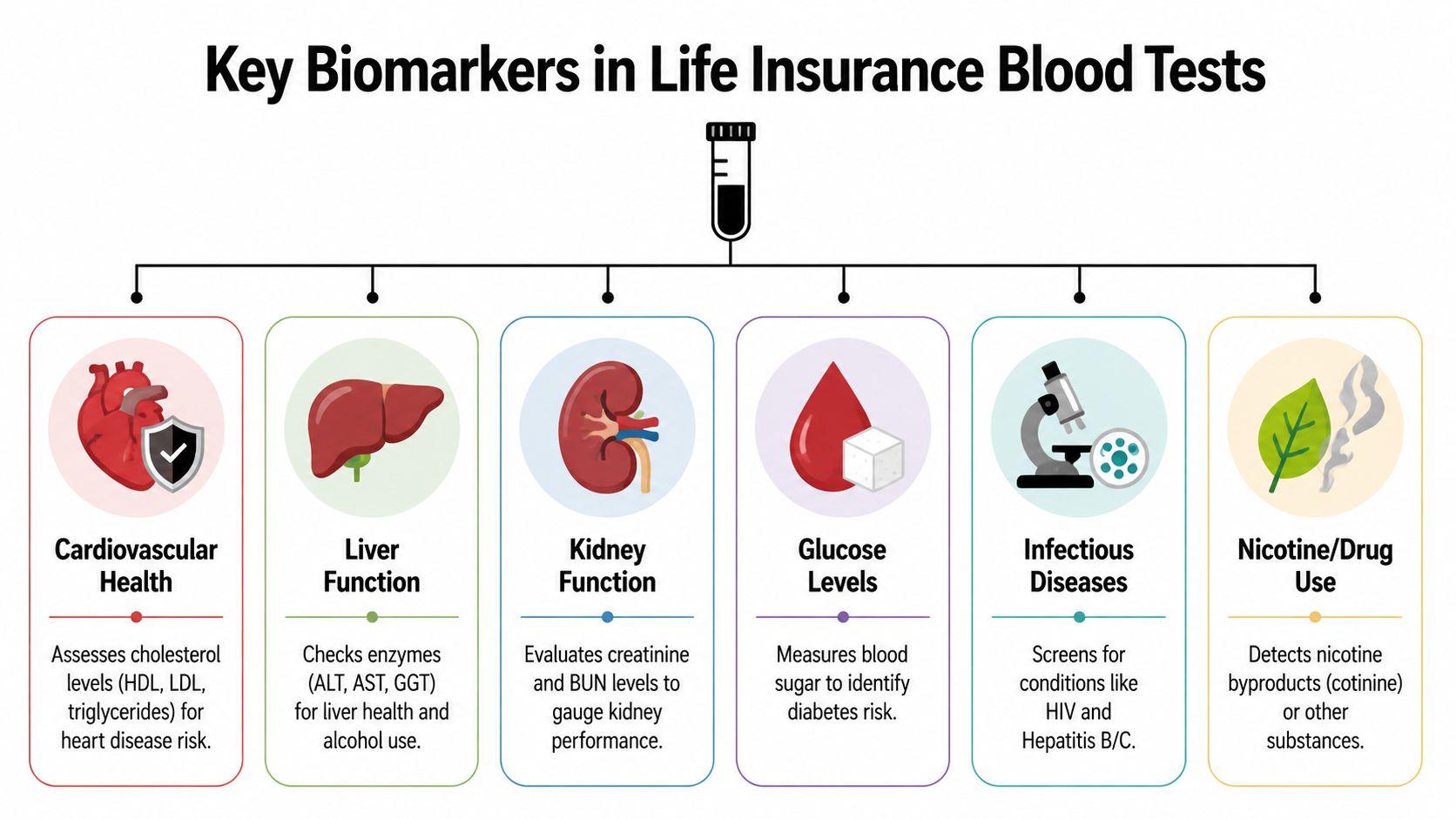
The easiest way to make sense of the panel is to sort biomarkers into three buckets: blood sugar, heart health, and signs of nicotine or organ stress. Underwriters use those numbers the way a lender uses credit inputs. A few key readings can move you toward a lower-cost class or a higher-cost one.
Heart and metabolic markers
Glucose, HbA1c, cholesterol, and triglycerides usually get the most attention because they connect closely to long-term health risk and premium math.
Glucose is a single-moment reading. It shows what your blood sugar looks like that day. That matters, but it has limits because stress, illness, or recent food can affect it.
HbA1c gives the underwriter a three-month replay of blood sugar. That makes it one of the clearest markers for possible diabetes or poor glucose control. If your fasting glucose is borderline but your HbA1c is comfortably normal, that can support a better view of your overall risk. If HbA1c crosses a diabetic threshold, pricing often changes more sharply because the result suggests a pattern, not a one-day spike.
That distinction matters for families comparing quotes. A one-point change on a lab report does not always affect your premium, but crossing a company cutoff often does. Underwriters are not reacting to the name of the test alone. They are comparing your number with a pricing threshold.
Cholesterol and triglycerides work in a similar way. Total cholesterol is only one piece of the picture, yet very high readings can push an application out of the best rate classes. Triglycerides also matter because higher levels can strengthen the case that cardiovascular or metabolic risk is higher than average.
If you want context on how carriers turn these lab readings into pricing tiers, Coveredly's guide to life insurance underwriting and rate classes explains the broader process.
Some insurers also review Fructosamine. This marker reflects shorter-term blood sugar control than HbA1c, which can help clarify whether an unusual glucose result looks temporary or part of a broader pattern.
Liver kidney and lifestyle indicators
Other biomarkers answer a different question. They help the insurer check whether there may be hidden issues that deserve closer review.
ALT, AST, and bilirubin are common liver markers. Results outside the normal range do not automatically mean a serious disease, but they can raise follow-up questions about alcohol use, medication effects, fatty liver, hepatitis, or temporary inflammation.
Creatinine and GFR help assess kidney function. If those numbers suggest reduced filtration, the insurer may view the application as higher risk because kidney problems can be linked with several chronic conditions.
Then there is cotinine, one of the most important pricing markers on the entire panel. Cotinine is a nicotine byproduct, so it can show recent nicotine exposure even if the product was vaping, chewing tobacco, or nicotine pouches rather than cigarettes. For underwriting, that matters because tobacco and non-tobacco pricing are often far apart. A positive nicotine marker can shift an applicant into a much more expensive class.
Some panels may also detect certain recreational drugs. In that situation, the issue is not just the chemical result. The insurer may also view it as evidence of ongoing risk behavior, which can lead to steeper pricing or a decline.
Common Life Insurance Blood Test Biomarkers
| Biomarker | What It Measures | Why It Matters to Insurers |
|---|---|---|
| HbA1c | Average blood sugar over about 3 months | Helps identify diabetes risk and can directly affect rate class |
| Glucose | Current blood sugar level | Supports metabolic risk assessment |
| Cholesterol | Blood lipids linked to heart health | Helps estimate cardiovascular risk |
| Triglycerides | A type of blood fat | Higher levels can trigger less favorable pricing |
| Cotinine | Nicotine byproduct | Used to classify tobacco versus non-tobacco status |
| 3-hydroxycotinine | Nicotine metabolite | Confirms recent nicotine exposure |
| ALT and AST | Liver enzyme activity | Can flag liver stress or temporary inflammation |
| Bilirubin | Liver function marker | May point to liver-related concerns |
| Creatinine | Kidney function marker | Helps identify renal issues |
| GFR | Kidney filtration estimate | Supports kidney health review |
| LDH and CK | Tissue and muscle stress markers | Can suggest organ inflammation or sub-clinical cardiac concerns |
| Fructosamine | Shorter-term blood sugar control | Can help confirm borderline glucose patterns |
A helpful way to read this table is to ask one simple question: which numbers can change the insurer's view of future risk enough to move your rate class? That is the primary purpose of the blood test. It is less like a doctor visit and more like measuring the strength of the financial safety net the insurer is being asked to provide.
How Blood Test Results Determine Your Rate Class
Most applicants talk about “passing” the blood test for life insurance, but that's not really how underwriting works. You don't usually pass or fail in the way you would on a school exam. You land somewhere on a pricing ladder.
There is no simple pass or fail
Insurers use rate classes such as Preferred, Standard, and Substandard or table-rated categories. The names vary by company, but the idea stays the same. Cleaner lab results can support a better class. Less favorable results can move you into a more expensive one.
That's why the blood test matters so much financially. A 2024 NAIC report indicates that blood biomarkers are the single largest determinant for premium deviations. Verified underwriting data also notes that thresholds such as Triglycerides above 200 mg/dL or HbA1c above 6.5% can mathematically trigger substandard or table-rated premiums that can double costs, moving an applicant from a Preferred class to a Substandard class.
If you want a deeper look at how companies sort applicants into these categories, this overview of life insurance underwriting explains the broader process.
The key shift is simple: your lab report doesn't answer “approved or denied” first. It often answers “which price tier fits this risk?”
How thresholds can move your premium
Think of rate classes like lanes on a highway. Everyone is headed toward coverage, but not everyone pays the same toll.
A person with blood work that stays within favorable underwriting ranges may qualify for a top or near-top class. Another person with high triglycerides, diabetic-range HbA1c, or nicotine metabolites may still get approved, but at a noticeably higher premium. The insurer is not making a moral judgment. It's matching price to measured risk.
Here's where people often get confused. A result can be medically manageable and still be insurance-relevant. For example, an applicant may feel fine and function normally but still test into a less favorable class because the underwriting model weighs that biomarker heavily.
A few common outcomes look like this:
- Favorable readings: These may support a better class and lower premium.
- Borderline readings: These may lead to extra review, additional requirements, or a middle-tier class.
- Threshold-crossing readings: These can push the application into substandard pricing even if the applicant has no symptoms.
- High-risk substance findings: These can lead to exclusions or a denial depending on the insurer's rules.
This is why understanding the direct link between lab values and pricing matters so much. The blood test for life insurance is not just a medical formality. It's one of the clearest points where health data turns into premium math.
A Practical Checklist for Your Exam Day
Good preparation isn't about gaming the exam. It's about making sure the results reflect your normal baseline instead of a distorted one. Small choices in the day before the appointment can influence readings in ways that matter to underwriting.

The day before your exam
Western & Southern's guidance on preparing for a life insurance blood test says applicants should fast for 8 to 12 hours, stay hydrated, and avoid strenuous exercise for 24 hours before the appointment because exercise can temporarily raise white blood cell counts and liver enzymes like AST and ALT.
That advice matters because temporary changes can make a healthy person look riskier than they really are. The goal is accuracy.
Use this checklist:
- Hydrate steadily: Water can make the blood draw easier and helps avoid a stressful, difficult sample collection.
- Skip intense workouts: A hard session can temporarily alter lab markers the underwriter may review closely.
- Keep meals simple before the fast begins: Once your fasting window starts, avoid food and sugary drinks.
- Avoid trying anything unusual: Don't add supplements, cleanses, or last-minute “health hacks” right before the test.
The morning of the appointment
Morning exams often work best because fasting is easier overnight. If your appointment is early, you can usually sleep through most of the fasting window and show up with fewer chances for accidental mistakes.
A few simple habits can help:
- Bring identification and paperwork: It keeps the appointment smooth and reduces stress.
- Wear clothing with easy arm access: A short-sleeve or loose-sleeve top makes the draw easier.
- Answer questions consistently: The exam results and your application should align.
- Stay calm: Anxiety won't define your outcome, but a steady routine helps the experience go better.
You're not trying to look healthier than you are. You're trying to avoid artificial noise in the results.
One more point gets overlooked. Fasting is often recommended for accuracy, but verified guidance also notes that fasting can artificially increase blood lipids in some individuals. If a result comes back unexpectedly unfavorable, it may be worth asking how the insurer handles follow-up review or future retesting.
Skipping the Needle: Alternatives to the Blood Test
Not everyone wants a nurse visit, a blood draw, and a longer underwriting timeline. If speed and convenience matter most, there are policies designed to skip the exam entirely.

How no-exam options work
The two main alternatives are Simplified Issue and Guaranteed Issue coverage. Verified insurer guidance states that Simplified Issue policies bypass the blood test and use a health questionnaire for approval in days, while Guaranteed Issue policies require no health questions for certain age groups. That same guidance notes these options can carry premiums that are 20% to 50% higher than traditional policies because the insurer is taking on more unknown risk, according to Banner Life's summary of what to expect during a term life insurance medical exam.
A more detailed look at simplified issue life insurance can help if you're comparing speed against cost.
Here's a simple side-by-side view:
| Option | Main upside | Main trade-off |
|---|---|---|
| Traditional underwritten policy | More detailed pricing based on lab data | Slower process and blood draw required |
| Simplified Issue | Faster approval and no exam | Higher premium than fully underwritten coverage in many cases |
| Guaranteed Issue | No exam and no health questions for eligible ages | Higher cost and more limited fit for many buyers |
A quick video can also help make the difference easier to visualize.
When the trade-off makes sense
No-exam coverage can be a strong fit if you need to move fast, dislike medical testing, or want a simpler application path. For some applicants, paying more for convenience is worth it. For others, especially people confident in their health profile, traditional underwriting may still offer the better value.
The right choice depends on what matters most to you:
- Speed: No-exam options usually win.
- Pricing precision: Traditional underwriting usually gives insurers more data to work with.
- Comfort level: Some applicants strongly prefer avoiding blood work.
- Health uncertainty: If you're concerned about what blood work may show, a no-exam route may feel less stressful, though not always less expensive.
This isn't a one-size-fits-all decision. It's a trade-off between friction and price.
Taking Control of Your Life Insurance Journey
Once you understand how a blood test for life insurance works, the process becomes much less intimidating. The exam is usually a tool for placing you into a rate class, not a mysterious hurdle. Specific biomarkers can affect pricing in very concrete ways, which is why preparation and clear expectations matter.
You also have options. Some applicants benefit from traditional underwriting because detailed lab data may support a better rate. Others prefer a no-exam path because convenience and speed matter more than perfect pricing.
The best move is the one that fits your life now and protects the people who depend on you. When you understand the trade-offs, you can choose confidently instead of reacting under pressure.
If you're ready to compare exam and no-exam coverage in one place, Coveredly offers a simple digital way to explore life insurance that fits your schedule, your budget, and the kind of protection your family needs.