You just bought a home, or maybe there's a baby on the way, and the question lands all at once. If something happened to you this month, would your family have enough time to keep the lights on, pay the mortgage, and avoid a financial scramble? That's where instant term life insurance gets attention, because it promises a fast path to coverage when waiting weeks feels unrealistic.
The appeal is easy to understand. Term insurance is the main entry point for many households, and in 2023, 39.5% of new individual life policies purchased were term insurance, representing 3.8 million policies and $1.4 trillion in total face amount issued, or 71.9% of the individual life face amount issued (ACLI Fact Book). At the same time, digital instant issue is growing into a major distribution model, not a niche workaround.
Table of Contents
- What Instant Term Life Insurance Means
- How Accelerated Underwriting Replaces the Medical Exam
- Instant Term Life Insurance Versus Traditional Term Policies
- Eligibility Requirements and Coverage Limits
- The Application Process From Start to Coverage
- Common Misconceptions About Instant Approval
- Deciding If Instant Term Life Insurance Fits Your Situation
What Instant Term Life Insurance Means
A couple closes on their first house and starts asking the same question a lot of new homeowners ask. They do not want to spend weeks gathering paperwork, but they also do not want to leave their family exposed while they sort out insurance later. Instant term life insurance is built for that moment, a term policy that uses digital underwriting to deliver a fast decision, often without a medical exam.

What “instant” really covers
The word instant can be misleading. It usually means the insurer can make a decision quickly, not that every part of the policy is finished the moment you submit the application. In other words, the approval may arrive fast, while the actual coverage start date still depends on the carrier's process and the applicant's final status.
That gap between approval and coverage matters in the world. A newly married couple may want protection before a wedding trip. A parent may want coverage before the next mortgage payment comes due. A freelancer may want a process that feels closer to an online purchase than a paper chase. Instant issue marketing often highlights the speed, but it can hide the part that matters most, when the policy becomes active and what still has to happen before that point.
Practical rule: instant usually describes the underwriting experience, not your financial protection clock.
The difference is easier to see if you compare it to a store receipt. Getting a confirmation email does not mean the package is already in your hands. With life insurance, a quick approval does not always mean immediate coverage, so buyers still need to check when the contract starts and whether anything else is required first.
That is also why eligibility questions matter so much. Instant-issue products often work best for applicants whose health, prescription history, driving record, and other data fit the carrier's narrow rules. People with more complicated medical histories, gaps in records, or income patterns that do not fit standard screens may still qualify for coverage, but they may be steered into a slower process. For that reason, the promise of speed can feel very different for self-employed applicants, older buyers, and people in groups that are often left out of polished marketing.
The wider market shows why these products keep getting attention. Term life remains the main entry point for many first-time buyers, and instant issue policies give them a faster way to get quotes, answer questions, and understand whether they fit the carrier's rules without starting with a medical appointment. If you want a plain-language overview of how simplified issue policies fit into that picture, see simplified issue life insurance.
A broader underwriting example helps explain the same idea. In other lending and insurance settings, such as underwriting for self-employed borrowers, reviewers often rely on documents and records rather than a face-to-face exam. Instant term life insurance uses a similar logic, then applies it to life coverage so the insurer can decide faster without treating every applicant the same way.
How Accelerated Underwriting Replaces the Medical Exam
Think of traditional life insurance underwriting like a full physical checkup. The insurer may want labs, a nurse visit, and a deeper medical file before making a decision. Accelerated underwriting swaps that in-person exam for a data-driven review, more like a background check on your health than a clinic appointment.
What the insurer checks instead
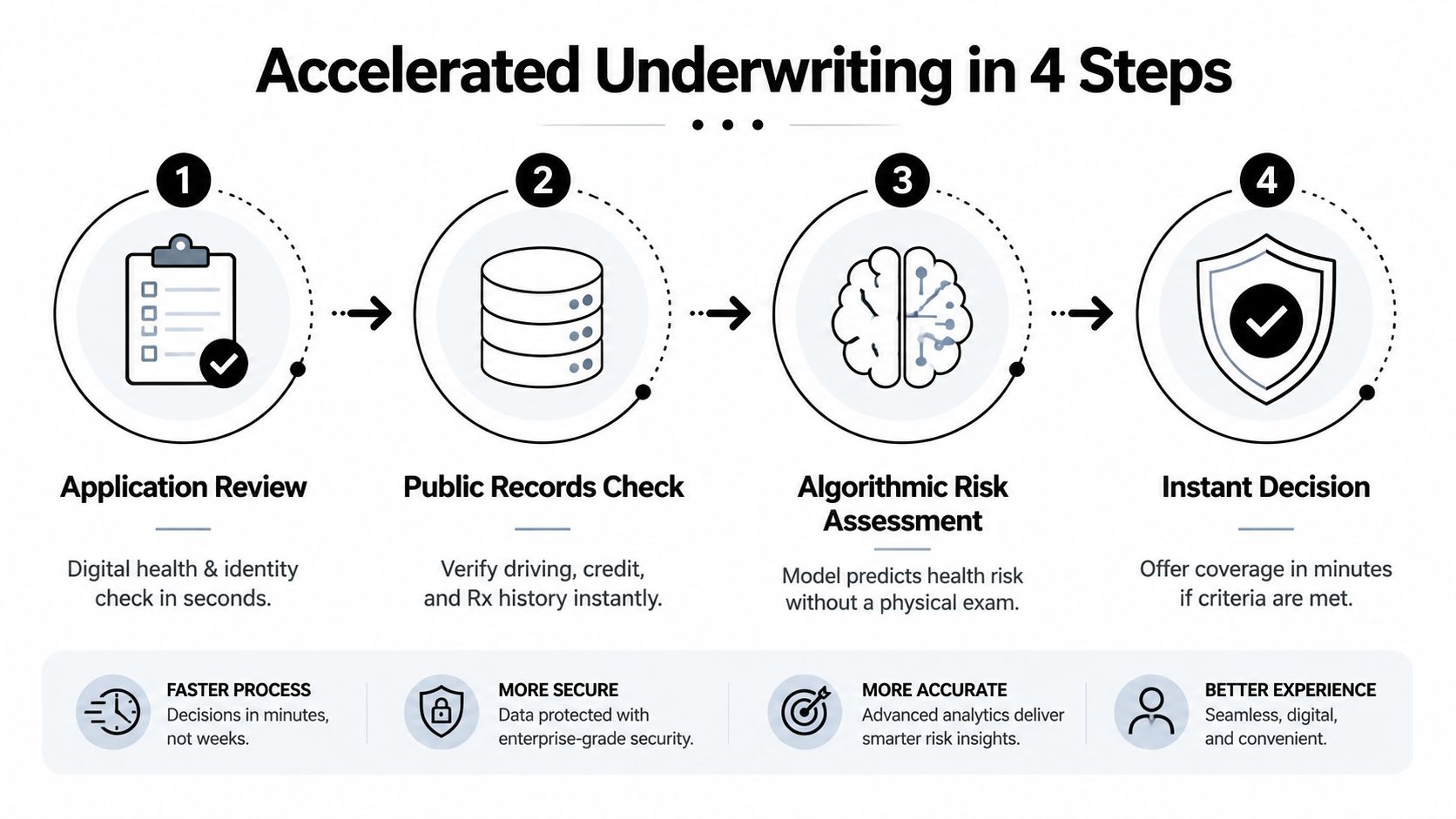
Instead of bloodwork or a paramedical exam, carriers may use prescription histories, MIB records, motor vehicle reports, and sometimes soft-credit or financial data to score risk (NerdWallet). Applicants still answer health questions, so this is not a one-click mystery box. The insurer is still asking whether your profile looks close enough to its instant-issue rules to offer coverage quickly.
The process becomes easier to understand in steps:
- Application review. You enter your personal details and answer health questions online.
- Public records check. The insurer checks records tied to medications, driving, and other risk signals.
- Algorithmic risk assessment. The carrier's model weighs the data and decides whether you fit the instant-issue lane.
- Decision. If you meet the criteria, the insurer can offer a fast approval, often in minutes to 48 hours (NerdWallet).
The speed comes from replacing physical evidence with digital evidence, not from skipping underwriting altogether.
That helps explain why the process feels similar to other fast financial applications. A useful comparison is the way some underwriting for self-employed borrowers works in mortgage lending, where lenders may lean on alternate documents and data when a standard payroll trail isn't the whole story. Life insurance uses a different set of records, but the logic is familiar, fewer in-person steps, more automated verification.
For a more detailed view of the broader no-exam pathway, it can also help to compare this with simplified issue life insurance. The important takeaway is simple. Accelerated underwriting shortens the route, but it still has checkpoints.
Instant Term Life Insurance Versus Traditional Term Policies
A close call can become obvious when the policy is tied to a deadline. If a buyer needs coverage before a mortgage closing, a new dependent arrives, or travel plans make waiting uncomfortable, instant term life insurance may fit better than a slower traditional application. The trade-off is still there. Faster approval usually means the insurer is working with less medical detail, so the price for a healthy applicant can be higher than a fully underwritten policy (MoneyGeek).
That extra cost is not always a drawback. It can be the reasonable price of getting protection in place quickly, especially when delay would leave a gap. If time is less pressing and the main goal is the lowest possible premium, the traditional route usually deserves a closer look.
Side by side
A quick comparison on the Compare Xpert page helps show why the fastest option is not automatically the best one.
| Feature | Instant Term Life | Traditional Term Life |
|---|---|---|
| Approval speed | Fast, often minutes to 48 hours | Slower, often requires more time |
| Medical exam | Usually skipped | Usually required |
| Pricing for healthy applicants | Often about 10% to 20% higher per dollar of coverage (MoneyGeek) | Usually lower for the same profile |
| Underwriting depth | Uses digital data and questionnaires | Uses deeper clinical data |
| Best fit | People who need speed and simplicity | People who can wait for a lower price |
| Coverage design | Often standardized | Often more flexible |
The price gap matters most when a buyer can compare quotes side by side. Someone with a clean health profile and no deadline may see little reason to skip the exam if the traditional policy saves meaningful money over time. The picture changes when timing matters more than squeezing out the lowest premium.
Rule of thumb: choose instant when urgency is the primary constraint, not just curiosity or convenience.
For readers comparing no-exam products more broadly, it helps to look at no-exam term life insurance as a category rather than a single product. Instant issue is one version of that approach, but speed, price, and underwriting can still vary a lot from one policy to another.
Eligibility Requirements and Coverage Limits
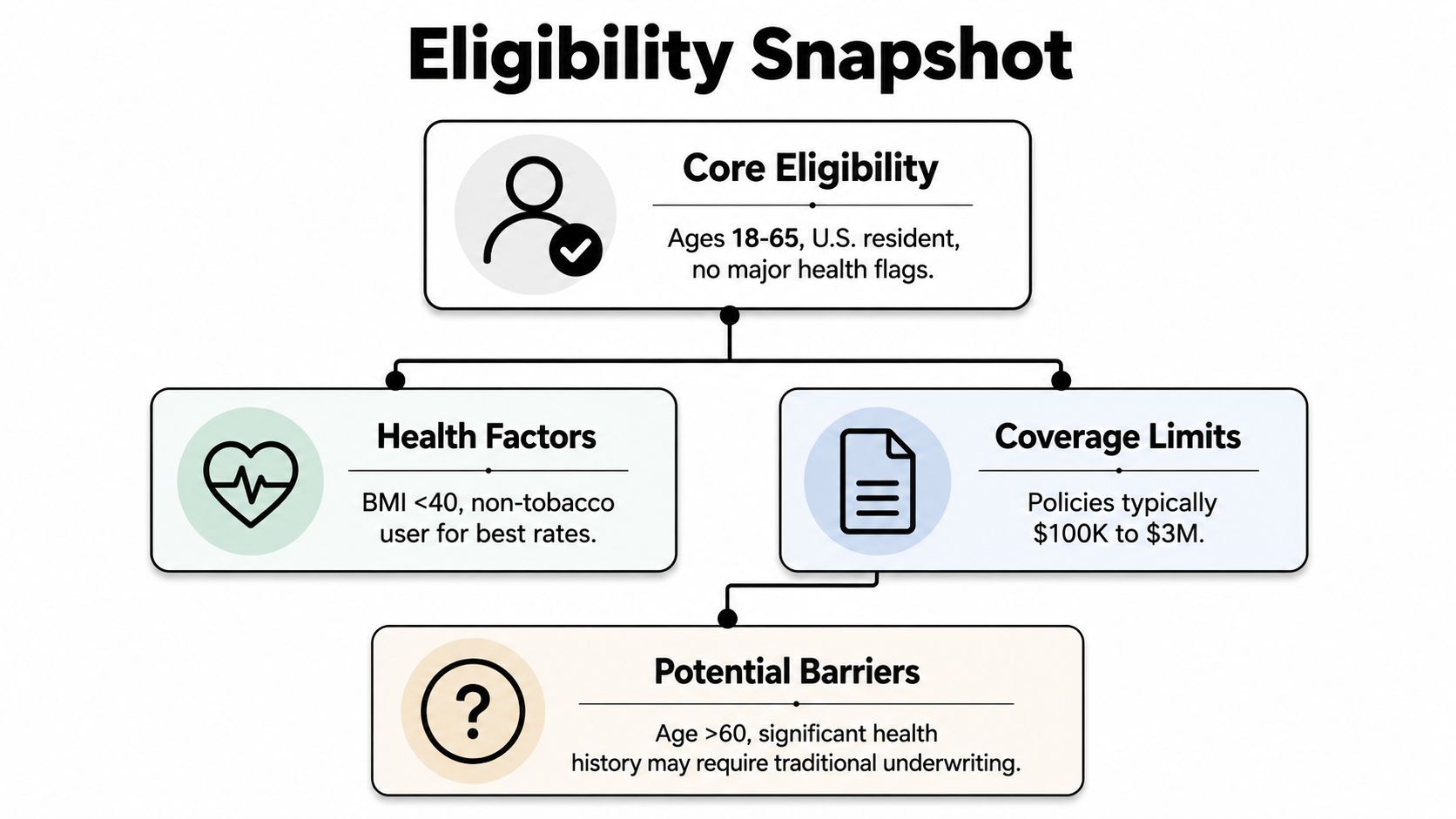
Instant term life insurance is not built for everyone, and that's where many marketing pages get fuzzy. Most products target generally healthy adults in roughly the 18 to 60 range, with some carriers extending to 65 and some limiting certain term lengths to younger applicants (Instant Term brochure). That means the product is designed around a specific kind of buyer, someone whose age and health profile fit a simplified risk model.
Who tends to fit best
The fastest approvals usually go to applicants with straightforward profiles. That often means fewer serious medical flags, stable records, and information that aligns cleanly with the carrier's automated rules. Some carriers narrow term lengths as age rises, which is why a 10-year or 20-year option may be easier to access than a longer term for some older applicants (Instant Term brochure).
Coverage limits matter just as much as age. Many instant-issue policies cap face amounts around $500,000 to $1 million, while some simplified no-exam policies go higher (Stanley Insurance Group). A carrier brochure also notes that total Ameritas life insurance in force plus applied-for coverage may not exceed $5 million. That doesn't mean everyone can get that much instantly, but it shows how carriers use limits to keep the approval process manageable.
Eligibility isn't only about the rulebook. It's also about who gets left out. Deloitte describes underserved life-insurance consumers as people who have declined to buy, have inadequate coverage, or haven't been approached effectively, and it points to the need for more personalized education and targeted outreach (Deloitte). Pacific Life's 2024 report also finds that customers reporting a disability or illness are 17% less likely to have any protection cover, and that low-income, female, LGBTQ+, and disabled customers are among the most underserved groups (Deloitte summary of protection-gap research).
That's the deeper issue. For many families, the barrier isn't just speed. It's whether the product feels fair, whether the price fits, and whether they trust a digital decision to reflect their real situation. Instant issue works best when those concerns are low, and it works worst when the applicant already feels boxed out by the system.
The Application Process From Start to Coverage
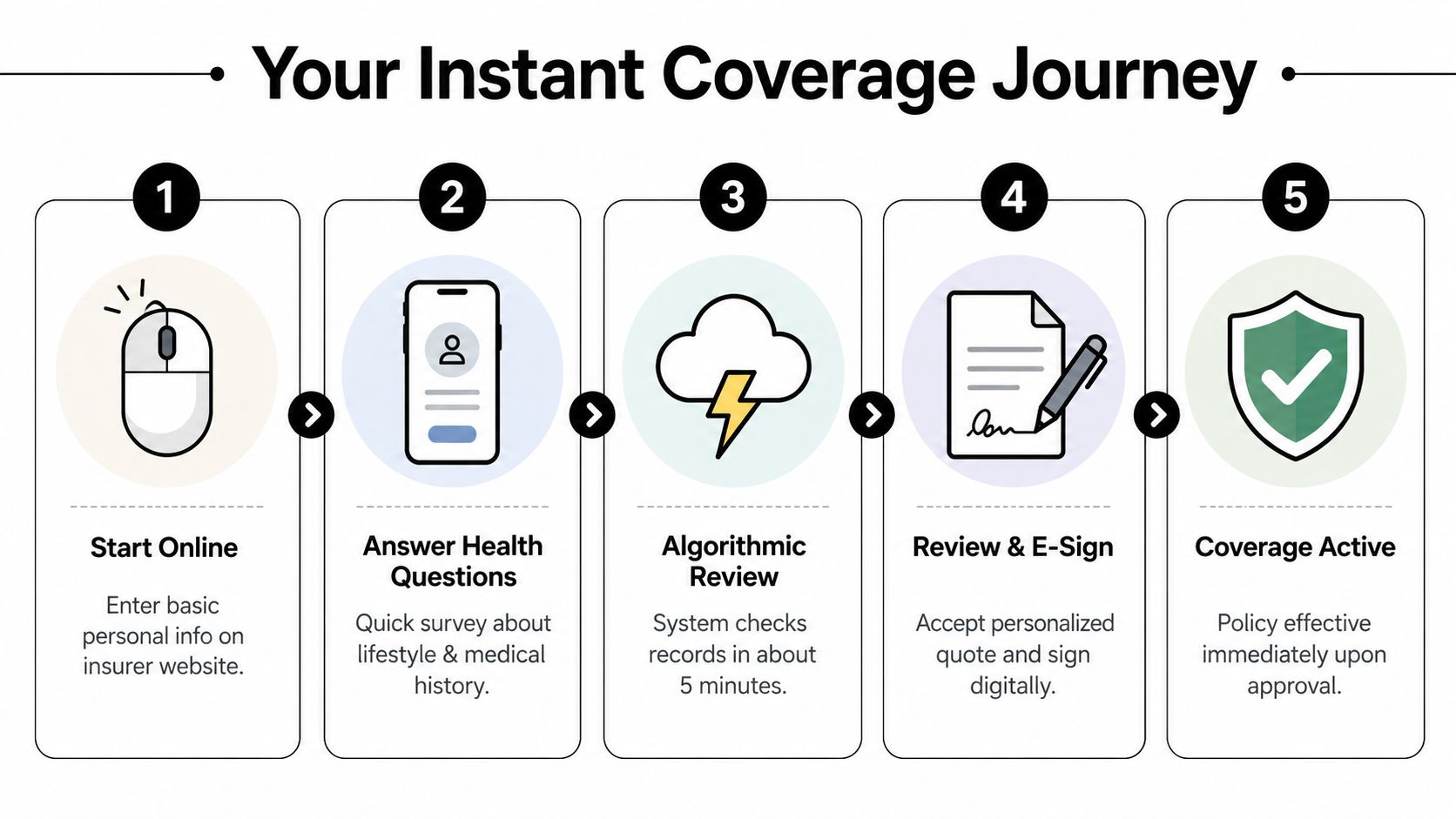
A person can complete an instant term life application while sitting at a kitchen table, but the form still asks real underwriting questions. You'll usually enter name, date of birth, address, Social Security number, beneficiary information, payment details, health history, family history, and driving history. Some insurers also ask about height, weight, citizenship, past denials, smoking status, and major medical conditions before they issue a policy (Choice Mutual).
Three clocks that buyers confuse
The main source of confusion is that fast approval, final paperwork, and real protection do not happen at the same moment. Those are three different clocks.
- Decision speed. The insurer may tell you quickly whether you're approved.
- Issue speed. The policy documents still need to be finalized.
- Coverage-effective date. Protection starts only after payment and final issuance steps are complete (Kitces).
That last step is the one many buyers miss. A quick approval can feel like the job is done, but the policy may still be sitting in the gap between approval and activation. If you need coverage tied to a time-sensitive event, such as a home purchase or a new baby, that gap matters more than the speed of the decision itself. For a plain-English explanation of how underwriting works behind the scenes, see this underwriting overview.
What the timeline usually feels like
The online application often feels more like a guided form than a long interview. You answer the health questions, the insurer checks its data sources, and the decision comes back quickly. If the policy is approved, you review the offer, sign electronically, and pay the first premium.
That sounds simple because it is, but only after you know what each step means. Some applicants are surprised that a fast digital process can still leave them waiting for final issuance, especially if the carrier needs to confirm details from health or driving records. The key question is straightforward. Has the carrier told me exactly when coverage starts, or only when approval happens?
If the answer is unclear, keep asking until it isn't. That is the difference between feeling insured and being insured.
Common Misconceptions About Instant Approval
The biggest myth is that instant approval means instant coverage. It often doesn't. A carrier can return a decision in minutes and still require payment and final issuance before the policy becomes active (Kitces). That gap trips people up because the word “instant” sounds final, but insurance always has a last mile.
Another myth is that no-exam means no underwriting. That's not true either. Applicants still answer health-related questions, and carriers still rely on prescription history, MIB records, and motor vehicle reports to make the call (NerdWallet). The process is lighter, not empty.
What buyers should verify
Before you assume the policy is live, check three things.
- Approval date. When did the insurer say yes?
- Issue date. When did the policy paperwork get finalized?
- Effective date. When does coverage begin?
If those answers don't match, don't guess. Ask the carrier or agent to show the timing in writing.
The third myth is that instant policies are always too expensive. The better way to say it is that they often cost more for healthy applicants, usually about 10% to 20% more per dollar of coverage than a comparable traditional policy (MoneyGeek). For some buyers, that premium is worth it because speed solves the problem. For others, the cheaper traditional route makes more sense because time isn't pressing.
Approval is a checkpoint, not the finish line.
Once you understand that, the product becomes much easier to judge. Instant term life insurance isn't a trick, and it isn't magic. It's a faster underwriting path with real trade-offs, and the buyer who understands those trade-offs usually makes the better decision.
Deciding If Instant Term Life Insurance Fits Your Situation
If you're a young family, a business professional, or newly married, the decision often comes down to timing and tolerance. Do you need coverage quickly for a specific life event? Are you generally healthy enough to fit an accelerated process? Can you accept a higher premium for speed, knowing healthy applicants often pay about 10% to 20% more per dollar of coverage (MoneyGeek)?
The coverage amount matters too. If your family needs a large policy and the instant route tops out before you get there, traditional underwriting may be the better fit. If your main goal is to secure meaningful protection quickly, a simplified policy can be a smart bridge while you sort out longer-term planning.
A simple decision check
- Choose instant term life insurance if speed matters, your profile is straightforward, and the coverage limit fits your needs.
- Choose traditional term life insurance if you want the lowest price and can wait for a fuller underwriting process.
- Pause and compare if you're unsure whether the policy starts when approved or only after final issuance.
That last point is the one worth circling twice. A policy that feels quick but doesn't start when you expect can leave a dangerous gap. The right choice is the one that protects your family on the timeline you need, not the one that just sounds fastest in a headline.
If you want a clearer way to compare instant term life insurance with other options, Coveredly makes that process simpler with digital life insurance built for real-life timelines. Visit Coveredly to see how fast no-exam coverage can fit your situation, and to explore whether a simple term policy makes sense for your family today.