
Getting life insurance can take anywhere from minutes to 8 weeks, depending on the underwriting path. No-exam digital options often deliver coverage in 24 to 48 hours, while traditional fully underwritten policies typically take 4 to 6 weeks.
You're probably asking because something changed. A baby is on the way, you've bought a home, or your new spouse depends on your income. You don't need a vague answer like “it depends.” You need to know whether your family can be protected this week, whether you'll need a medical exam, and how much coverage you can realistically secure quickly.
The answer comes down to three separate clocks: how long the application takes, how long underwriting takes, and when the policy becomes effective. Those clocks often overlap, but they aren't the same. A clean digital application may move through all three in a day, while a traditional case can wait on medical records, lab work, and manual review.
Table of Contents
- Why Insurance Timelines Vary So Much
- Digital vs Traditional Life Insurance Timelines
- The Three Stages of Getting Life Insurance
- What Speeds Up or Slows Down Your Approval
- The Speed vs Coverage Trade-Off You Should Know
- How to Get Life Insurance Faster
- Choosing the Right Path for Your Situation
Why Insurance Timelines Vary So Much
A newly married professional may need coverage before signing a mortgage. A young parent may want protection before the next pediatric appointment. In both situations, the instinct is to search for the fastest policy available and buy immediately. That's understandable, but speed alone doesn't tell you whether the policy is adequate or when protection begins.
The practical answer to how long does it take to get insurance is a range from minutes to more than eight weeks. Traditional life insurance commonly takes 4 to 6 weeks, and fully underwritten policies are often described as taking 3 to 8 weeks from application to issue. Accelerated and no-exam paths can move in 24 to 48 hours, while some instant-issue products can produce a decision in minutes. These ranges are documented in consumer guidance from NerdWallet's life insurance application overview and industry reporting from Gen Re's 2024 underwriting survey.
One question, three timelines
The first clock is the application. You provide identity details, beneficiaries, financial information, and health history. An online form may be completed during a short break, but a complicated or incomplete application creates follow-up work.
The second clock is underwriting. The insurer checks the information, evaluates risk, and decides whether it needs an exam, lab work, physician records, prescription data, or other evidence. Gen Re found that accelerated underwriting workflows averaged 5 days, compared with 23 days for full underwriting, an 18-business-day gap. Read more about how life insurance underwriting works.
The third clock is coverage start. Approval doesn't always mean protection has begun. You may still need to review documents, sign the policy, pay the initial premium, and confirm the effective date. Ask the insurer directly, “When does my coverage start?” Don't assume the approval email answers that question.
Practical rule: Choose the underwriting lane based on the coverage your family needs, not simply the shortest advertised application time.
Digital vs Traditional Life Insurance Timelines
Digital-first life insurance and traditional underwriting solve the same problem through very different workflows. Traditional underwriting often relies on a medical exam, fluid collection, physician records, and manual review. Accelerated underwriting uses the applicant's disclosures alongside third-party evidence and automated decisioning, which can remove the slowest evidence-collection steps for eligible applicants.
The difference is substantial. Gen Re's 2024 survey found average accelerated underwriting time of 5 days, versus 23 days for full underwriting, as reported in its survey of individual life insurers. Consumer guidance also describes traditional applications as taking several weeks, while no-exam options may produce decisions in minutes or within a few days.
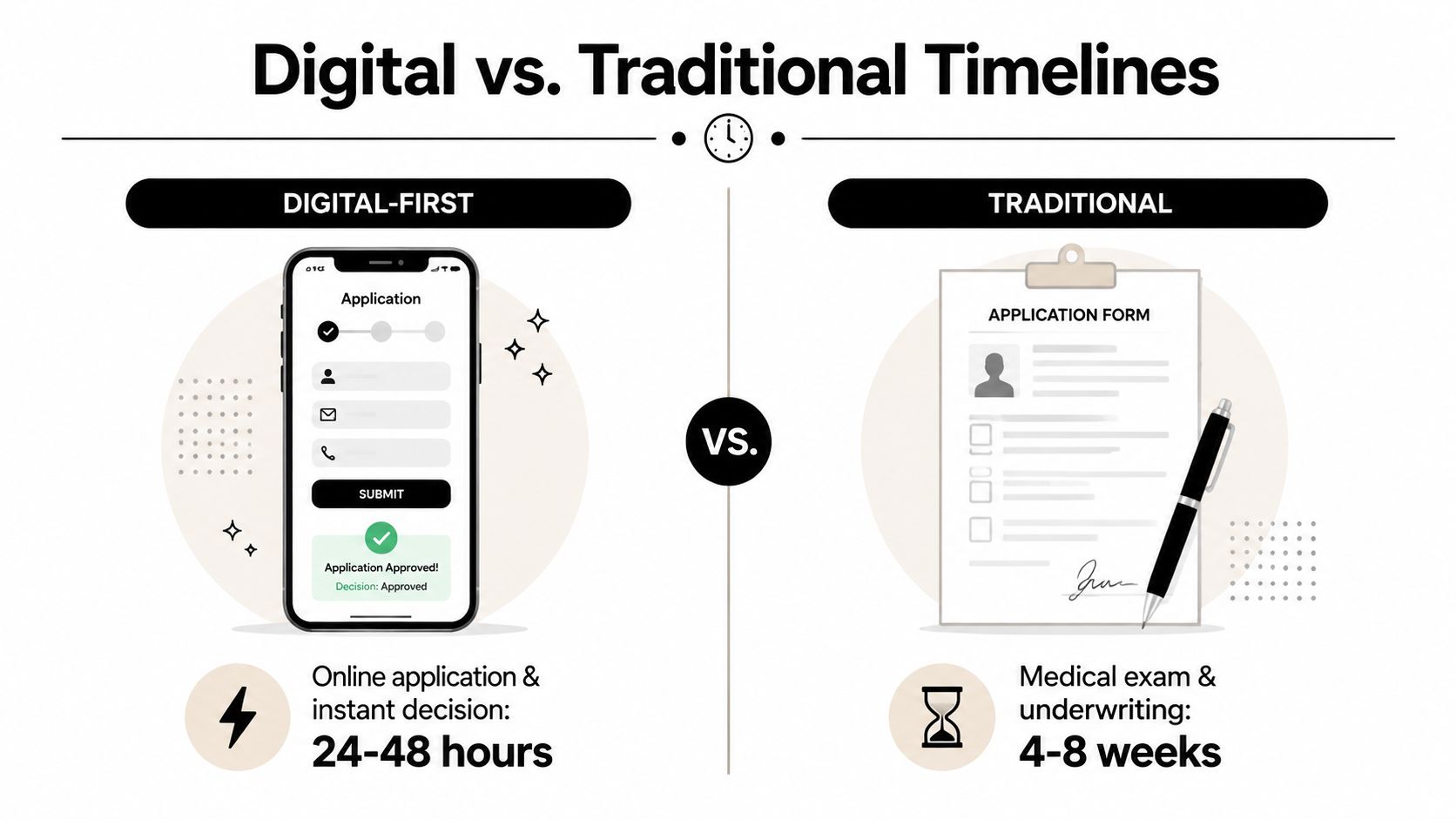
Life Insurance Timeline Comparison
| Stage | Traditional Underwriting | Digital No-Exam |
|---|---|---|
| Application | Online or agent-assisted form, followed by evidence requests | Online application and automated data checks |
| Underwriting | Medical exam, labs, records, and manual review may be required | Health questions and third-party data may support an accelerated decision |
| Typical decision window | Commonly 4 to 6 weeks, with some cases taking 3 to 8 weeks | Often 24 to 48 hours, with some instant decisions taking minutes |
| Coverage start | After approval, policy delivery, signature, payment, and effective-date confirmation | May begin after approval and required policy steps are completed |
| Coverage limits | Often suitable for larger or more complex needs | Limits vary by product, insurer, age, health, and eligibility |
A digital route is usually the sensible first stop for a younger, healthier applicant seeking straightforward term coverage. It cuts out unnecessary waiting when the insurer can verify risk electronically. You can compare instant online life insurance quotes before deciding whether the faster lane offers enough protection.
Traditional underwriting still has a role. If you need a large amount of coverage, have a complicated medical history, or don't qualify for accelerated underwriting, a full review may offer more appropriate options even though it takes longer.
The Three Stages of Getting Life Insurance
Most applicants think in terms of one event, approval. In practice, the process has three stages, and each one can stop the clock.
Stage one, the application
You submit personal details, financial information, beneficiary choices, and health answers. An online application can be completed quickly when you have the information ready. An agent-led process may take longer because documents and follow-up questions move between several people.
Accuracy matters more than speed. A rushed answer that conflicts with prescription records or medical history can trigger questions and send the case into manual review. Give complete answers the first time, even if the truth makes the application feel less convenient.
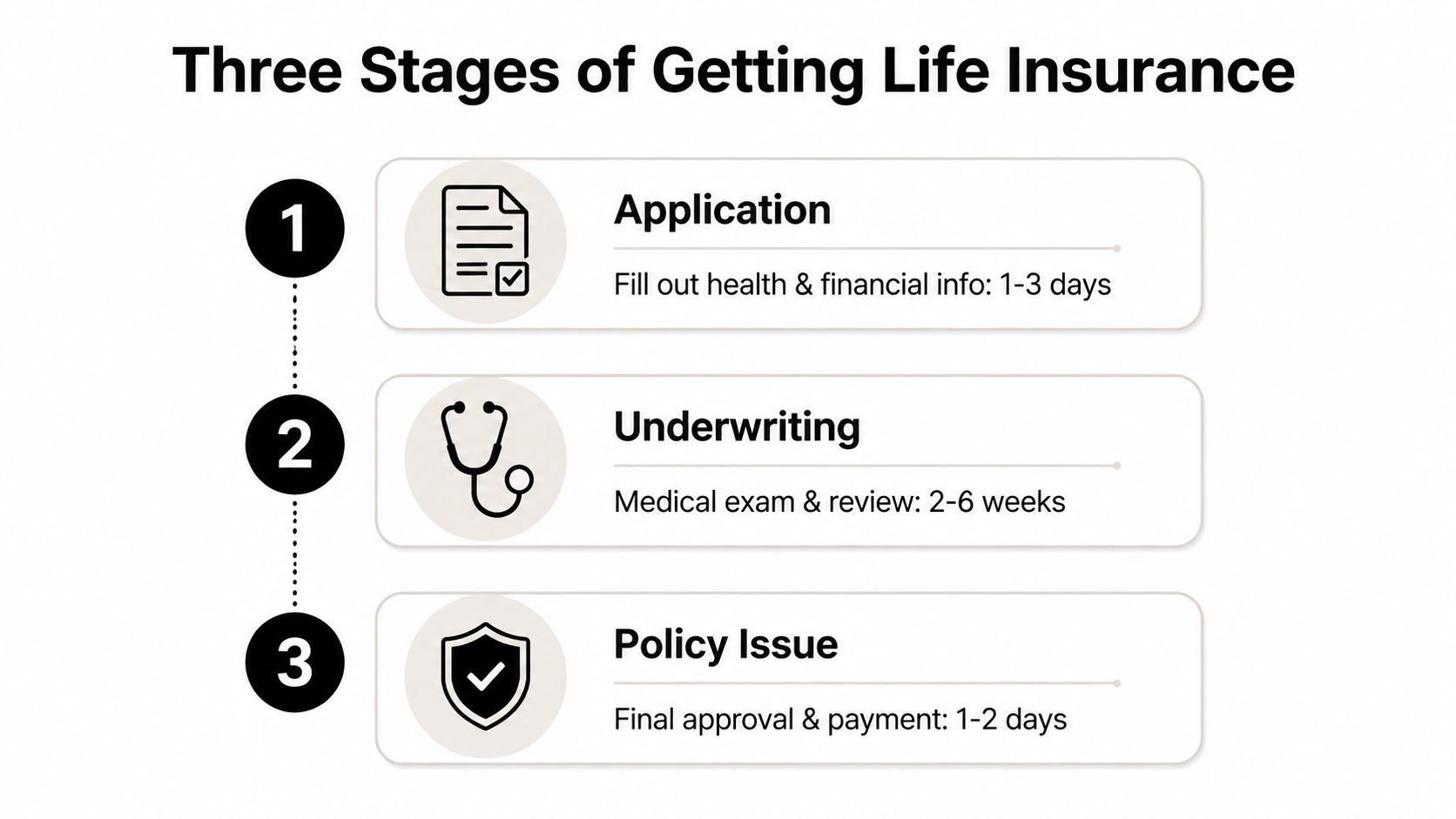
Stage two, underwriting
Underwriters assess the risk behind your application. Depending on the program, the insurer may use prescription history, motor vehicle information, MIB data, electronic health records, disclosures, and medical evidence. Traditional cases can slow down when a doctor's office takes time to provide records or when the insurer requests additional lab work.
The insurer may approve the application as submitted, offer different terms, request more information, or decline it. Accelerated underwriting is designed to make that evaluation faster, but eligibility rules still determine who can use it.
For a plain-language guide to comparing policy types and application choices, Life Cover Plans helps you compare life while you review your options.
Stage three, policy issue and coverage start
After underwriting, the insurer finalizes the policy. You'll typically review the offer, sign the required documents, make the initial payment, and confirm the effective date. That date is the point that matters to your family, not merely the moment an underwriting screen says “approved.”
Use this guide to getting a life insurance policy to keep the application, underwriting, and policy-issue steps separate in your planning.
This short video gives a visual explanation of the process:
What Speeds Up or Slows Down Your Approval
The fastest applications share two traits: the applicant fits the insurer's accelerated-underwriting rules, and the information arrives complete and consistent. Younger, healthier applicants are more likely to qualify for no-exam or accelerated paths, especially when their coverage request fits the insurer's limits.
The slowest cases usually involve evidence collection. The application itself may be straightforward, but the insurer can't finish its decision until it receives medical records, lab results, prescription information, or clarification about a health condition.

The variables you can influence
- Complete every field: Missing addresses, medications, diagnoses, or beneficiary details create avoidable follow-up.
- Keep answers consistent: The insurer compares your disclosures with external records. Explain discrepancies before they become a reason for delay.
- Respond promptly: If the carrier asks for a document or clarification, answer quickly and keep the case moving.
- Match the request to the lane: A very large coverage request or complex history may require full underwriting rather than accelerated review.
- Prepare medical information: Know your doctors, diagnoses, medications, and approximate treatment dates before you begin.
The variables you can't control include the carrier's technology, the responsiveness of medical providers, and the complexity of your records. Higher face amounts tend to trigger more evidence requests and deeper review, as described in NAIC materials on accelerated underwriting.
If the insurer needs permission to access records or lab information, read the authorization carefully and complete it without delay. Applicants who want to understand the process can review how to authorize your blood test before the request arrives.
The Speed vs Coverage Trade-Off You Should Know
The fastest policy isn't automatically the right policy. A guaranteed-issue product may avoid health questions and move quickly, but it can provide less protection and cost more for the amount insured. Simplified-issue and no-exam products also vary widely, so you have to examine the face amount, exclusions, premiums, and eligibility rules rather than accepting “instant” as a complete answer.
No-exam doesn't mean no underwriting. Many no-exam policies still use health questionnaires, prescription data, medical records, and other checks. Guaranteed issue is different because the insurer doesn't use medical questions to decide whether you qualify for medical reasons, but that convenience generally comes with tighter limits or less favorable pricing.
Some no-exam products offer coverage from $40,000 to $3 million, depending on the carrier and product type, according to Ethos' no-medical-exam life insurance guide. Policygenius' comparison of no-exam life insurance also explains that some applicants may qualify for as much as $3 million, while simplified and guaranteed-issue options can offer substantially less.
The right question isn't “How fast can I get a policy?” It's “How much protection can I put in force quickly, and what would make the insurer slow my case down?”
For a young family, a small instant policy may not replace income, cover a mortgage, and fund childcare. If accelerated underwriting can provide the amount you need, it deserves serious consideration. If it can't, accept the longer traditional process instead of buying inadequate coverage simply because it starts sooner.
How to Get Life Insurance Faster
You can't control every underwriting decision, but you can remove the delays caused by poor preparation. Use this checklist before you start.
- Apply online: A digital-first application avoids much of the paper and phone exchange that slows traditional processing.
- Gather your information: Have your Social Security number, beneficiary details, addresses, medication list, doctor information, and basic health history available.
- Answer completely: Don't guess, omit, or minimize. Inconsistent answers can create follow-up questions and manual review.
- Choose an appropriate amount: If your request falls outside accelerated eligibility, the insurer may route you into full underwriting.
- Watch your inbox and phone: A fast response to an underwriter's question keeps a straightforward case from sitting idle.
- Review the effective date: Confirm when coverage starts after approval, payment, and policy delivery.
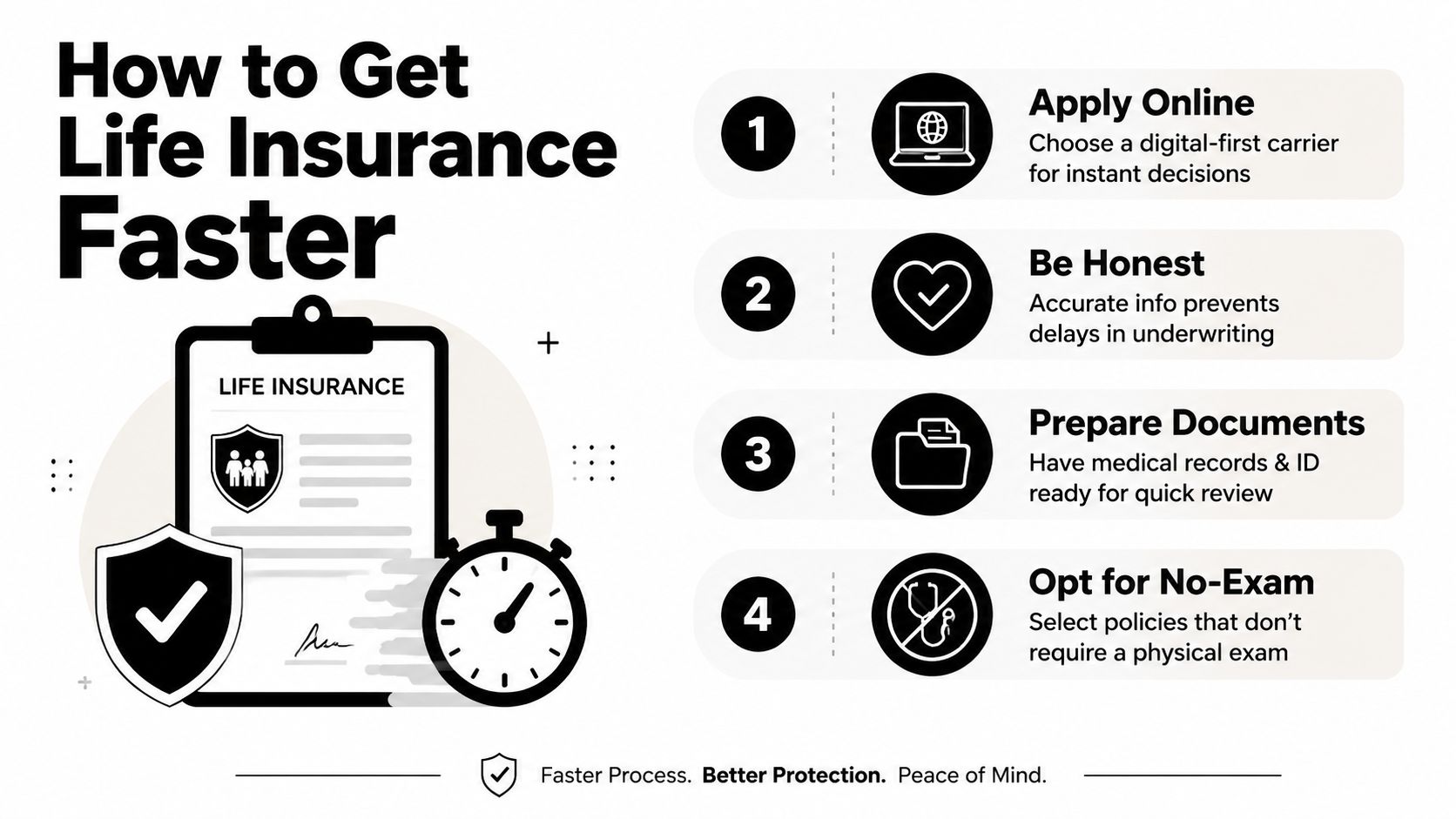
Applying while you're younger and healthier can improve your odds of fitting an accelerated path and can also support more favorable premiums. That doesn't mean you should delay coverage while waiting for the perfect moment. If your family depends on your income, start the process now and let the insurer tell you which lane fits.
Choosing the Right Path for Your Situation
A young family that needs protection before a new baby arrives should start with an online no-exam option, provided the available coverage amount meets the household's real need. Expect a decision in days when the applicant qualifies, but verify the policy's effective date before treating the protection as active.
A business professional replacing income should compare the required coverage amount with accelerated limits. If the amount is moderate and the health profile is straightforward, accelerated underwriting can be practical. If the request is unusually large or the financial review is complex, traditional underwriting may be the better route.
A newly married couple should avoid choosing a policy solely because it can be approved instantly. First calculate what would happen to housing costs, debts, and shared expenses if one income disappeared. Then select the fastest underwriting path that can provide enough coverage, whether that means no-exam digital underwriting or a full medical review.
For most healthy applicants, digital underwriting offers a useful combination of convenience, speed, and meaningful term coverage. It's not a universal shortcut, though. Complex health histories and very high coverage needs can push an application into a longer review, and that's a normal part of responsible risk assessment.
The fastest way to learn your personal timeline is to begin an application with accurate information. You'll quickly discover whether you qualify for an accelerated decision or need to prepare for traditional underwriting.
Coveredly offers online term life insurance with up to $3 million in coverage without exams for most applicants, subject to eligibility and underwriting. Visit Coveredly today to start the application and find out how quickly your family's coverage can take effect.