For a healthy 30-year-old non-smoker, $500,000 of 20-year term life insurance commonly costs about $23 to $30 per month. The same coverage scales steeply with age, health, smoking status, and the type of policy you choose.
You may be looking at a mortgage statement, daycare bills, and a spouse or partner who depends on your income, wondering whether half a million dollars would protect the people you love. The answer depends on what that money must do after your death, how long your family would need support, and whether you choose affordable term coverage or lifelong permanent insurance.
This guide explains how 500000 life insurance works, what the policy can cover, why quotes vary, when no-exam underwriting may be available, and how to decide whether $500,000 is enough for your household.
Table of Contents
- Why $500,000 in Life Insurance Has Become the Standard Benchmark
- What $500,000 of Life Insurance Actually Covers
- Is $500,000 Enough for Your Family or Income
- Real Premium Costs for $500,000 of Term Life Insurance
- Term Life vs Whole Life and Other Coverage Alternatives
- How No-Exam Underwriting Works for a $500,000 Policy
- Step-by-Step Process to Buy $500,000 Life Insurance
- Final Checklist and Key Takeaways Before You Apply
Why $500,000 in Life Insurance Has Become the Standard Benchmark
A 32-year-old parent might reach the decision after an ordinary financial moment. The mortgage still has years left, a toddler needs childcare, and the household depends on two incomes to keep everything running. If one income disappears, the surviving partner may need to pay the mortgage, take time away from work, and fund daily expenses at the same time.
That's why $500,000 has become a practical reference point. It's large enough to address a major debt and provide income support, but it can remain accessible as a term policy for younger applicants in favorable health classes. Industry commentary places $500,000 near a commonly selected protection level in some markets, while U.S. term-policy averages can be lower, closer to roughly $300,000 or around $150,000 depending on the dataset and definition used. Worldmetrics' term life insurance statistics describes the market context behind this benchmark.

Why the round number feels practical
A half-million-dollar death benefit can sit between basic final-expense protection and the much larger amount a high-income household may need for long-term income replacement. A young family might use it to eliminate a mortgage, support childcare, and create time for the surviving spouse to adjust financially.
The 20-year term also fits a common family planning window. A buyer may want coverage while children are dependent, while a mortgage is outstanding, or while a partner is building earning capacity. The correct term isn't automatically 20 years, but that duration often aligns with major temporary obligations.
Digital underwriting has reinforced the benchmark. Some online carriers make $500,000 a natural ceiling or tier for simplified applications, especially for applicants with favorable health and financial profiles. In the UK, healthy applicants under 50 can usually obtain up to around £500,000 through questionnaire-only underwriting, although insurers may request medical information above that threshold or for older applicants. Life Pro's explanation of no-medical life insurance gives an example of Legal & General requesting a medical or GP report from applicants over 40 when cover exceeds £500,000.
Planning insight: A standard coverage amount is a starting point, not proof that the amount matches your family's needs.
Life insurance also belongs in a broader family continuity plan. Resources such as Family Folder's legacy planning guide can help you think beyond the policy itself, including beneficiaries, important documents, and instructions your family may need.
What $500,000 of Life Insurance Actually Covers
A $500,000 term policy pays a lump-sum death benefit to the beneficiaries if the insured person dies while the policy remains active. The beneficiaries usually control how to use the money, rather than receiving a fixed spending schedule from the insurer.
Consider a household with a $250,000 mortgage balance, $40,000 in final debts and funeral costs, and a goal of replacing $60,000 of annual income for 10 years. Add $50,000 for a child's college fund, and the planned uses total $940,000. That budget is larger than the policy, which immediately shows why $500,000 can provide meaningful protection without covering every long-term goal.
Because the requested allocation exceeds the death benefit, the family would need to prioritize. Paying the mortgage and final costs would use $290,000, leaving $210,000. That remainder could replace part of the lost income, support childcare, or fund education. A surviving spouse might choose to keep the mortgage and use more of the benefit for income, depending on interest rates, employment, savings, and family priorities.
A sample allocation
The table below shows the full requested budget and the share each item would represent if the household had $500,000 available.
| Expense Category | Estimated Amount | Share of $500,000 |
|---|---|---|
| Mortgage payoff | $250,000 | 50% |
| Final debts and funeral costs | $40,000 | 8% |
| Income replacement for 10 years | $600,000 | 120% |
| Child's college fund | $50,000 | 10% |
| Total planned needs | $940,000 | 188% |
The percentages in the table are allocation comparisons, not a claim that the policy can pay more than $500,000. The example demonstrates the central budgeting problem: one death benefit may need to serve several purposes at once.
A term policy generally doesn't create cash value. Its value comes from the protection it provides during the selected term. Beneficiaries can use the payout for a mortgage, medical bills, childcare, emergency reserves, education, or a career pause, subject to their own financial decisions and the policy's terms.
Is $500,000 Enough for Your Family or Income
A $500,000 policy can look substantial until you compare it with the income it needs to replace. Guardian presents a common starting rule of multiplying annual income by 10, and its example connects a $50,000 salary with $500,000 of coverage. The same guidance suggests adding roughly $100,000 to $150,000 per child for college costs. Guardian's term life insurance rate guidance explains that income-multiple approach.
That rule is useful for a first estimate, but it can understate the need for a household with a long support horizon. Some families consider 20 times income as a more ambitious income-replacement target. A separate industry example shows how a $41,000 income benchmark could leave a $320,000 gap against a 20-times target even when the person already owns $500,000 of coverage. AAFMAA's discussion of whether $500,000 is enough illustrates why the round number doesn't automatically fit every family.
Two households, two answers
A teacher earning $55,000 reaches $550,000 under the 10-times method. A $500,000 policy is close to that basic income benchmark before considering debt, children, education, or existing savings.
A software engineer earning $160,000 reaches $3.2 million under a 20-times approach. In that situation, $500,000 might still help with immediate expenses, but it would replace only a limited portion of the household's expected income support.
The DIME method, which considers debt, income, mortgage, and education, can produce a more individualized answer. It asks you to total the obligations your family would face, estimate how long income should be replaced, and subtract assets or existing coverage that could help.
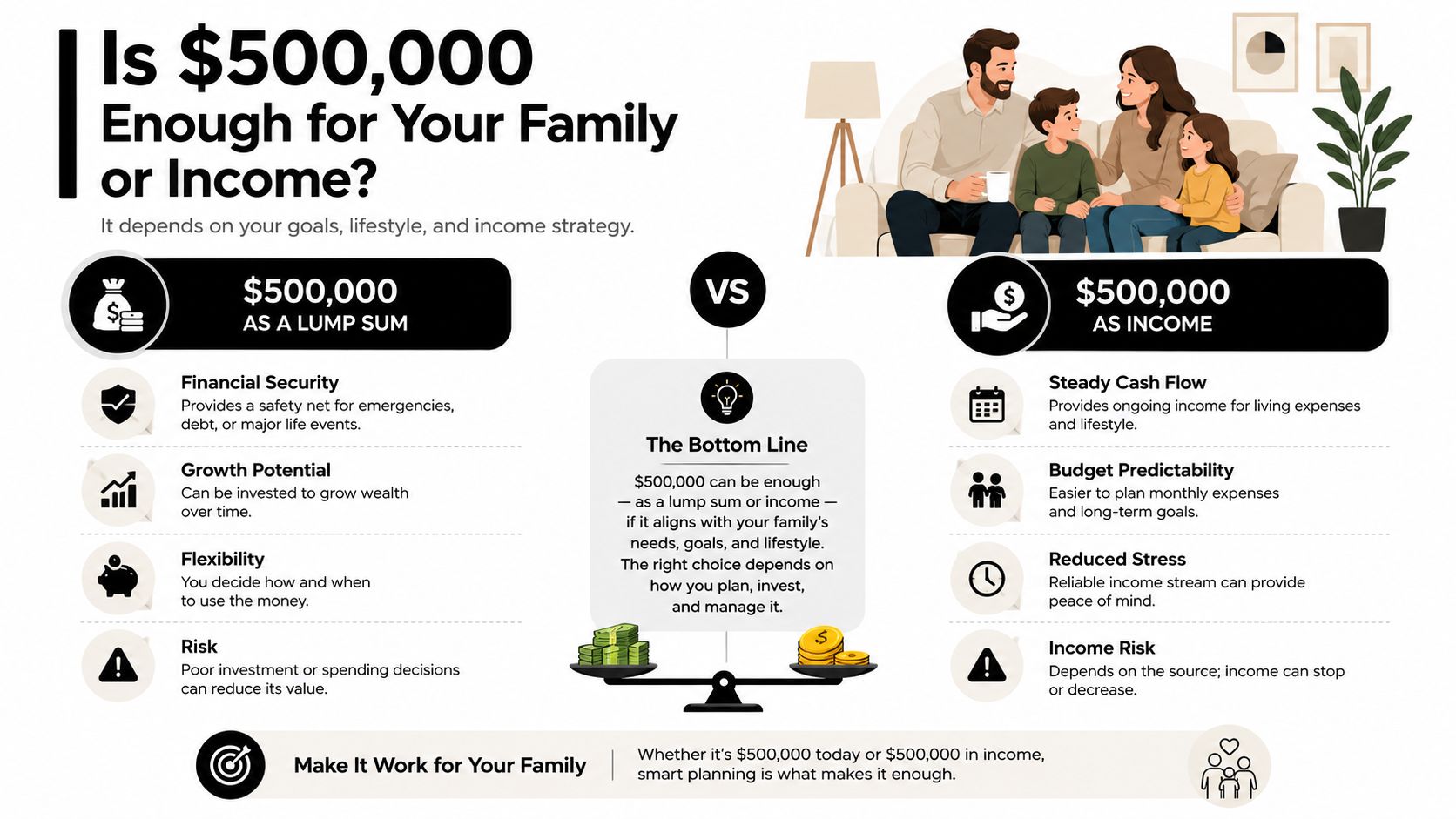
Your age, dependents, mortgage, savings, career path, and whether your household has one income or two all affect the target. A useful life insurance needs guide can help organize those figures, but no calculator replaces a careful look at your actual obligations.
Real Premium Costs for $500,000 of Term Life Insurance
For a healthy 30-year-old non-smoker, published quote analyses commonly place a 20-year, $500,000 term policy in the low-$20s to around $30 per month. One table lists approximately $22.98 per month for a 30-year-old woman and $29.32 for a 30-year-old man. Policygenius life insurance rates provides that comparison and shows how rates rise with age.
A separate industry analysis places a healthy 40-year-old non-smoker at roughly $47 per month for a woman and $59 for a man for the same 20-year term. Another dataset reports different assumptions for the same age and coverage, which is a useful reminder that carrier mix, underwriting class, location, and application details can materially change a quote. MoneyGeek's term life insurance cost data discusses that variation.
A grounded comparison
The table uses only the clearly published benchmark figures available for the stated ages and terms. It doesn't fill unverified cells with invented estimates.
| Age | Sex | 10-Year Term | 20-Year Term | 30-Year Term |
|---|---|---|---|---|
| 30 | Woman | Not stated in verified data | About $23 | Not stated in verified data |
| 30 | Man | Not stated in verified data | About $30 | Not stated in verified data |
| 40 | Woman | Not stated in verified data | About $47 | Not stated in verified data |
| 40 | Man | Not stated in verified data | About $59 | Not stated in verified data |
| 50 | Woman | Not stated in verified data | About $78 | Not stated in verified data |
| 50 | Man | Not stated in verified data | About $268 | Not stated in verified data |
The age-50 figures come from the independent rate table cited above. Other published tables show different assumptions, so treat these as reference points, not guarantees.
Age matters because insurers price the probability of death during the policy term. Tobacco use, health history, build, occupation, and selected term can move an applicant into a different underwriting class. The difference between term and permanent coverage can be even larger. Ethos' $500,000 policy cost discussion describes healthy younger applicants paying roughly $23 to $30 monthly for term coverage while whole life for the same face amount can cost roughly $400 monthly or more.
Quote warning: A “starting at” price usually reflects an unusually favorable applicant profile. Your application, not the headline rate, determines the offer.
For a broader explanation of the variables behind a term quote, review this term life insurance cost guide.
Term Life vs Whole Life and Other Coverage Alternatives
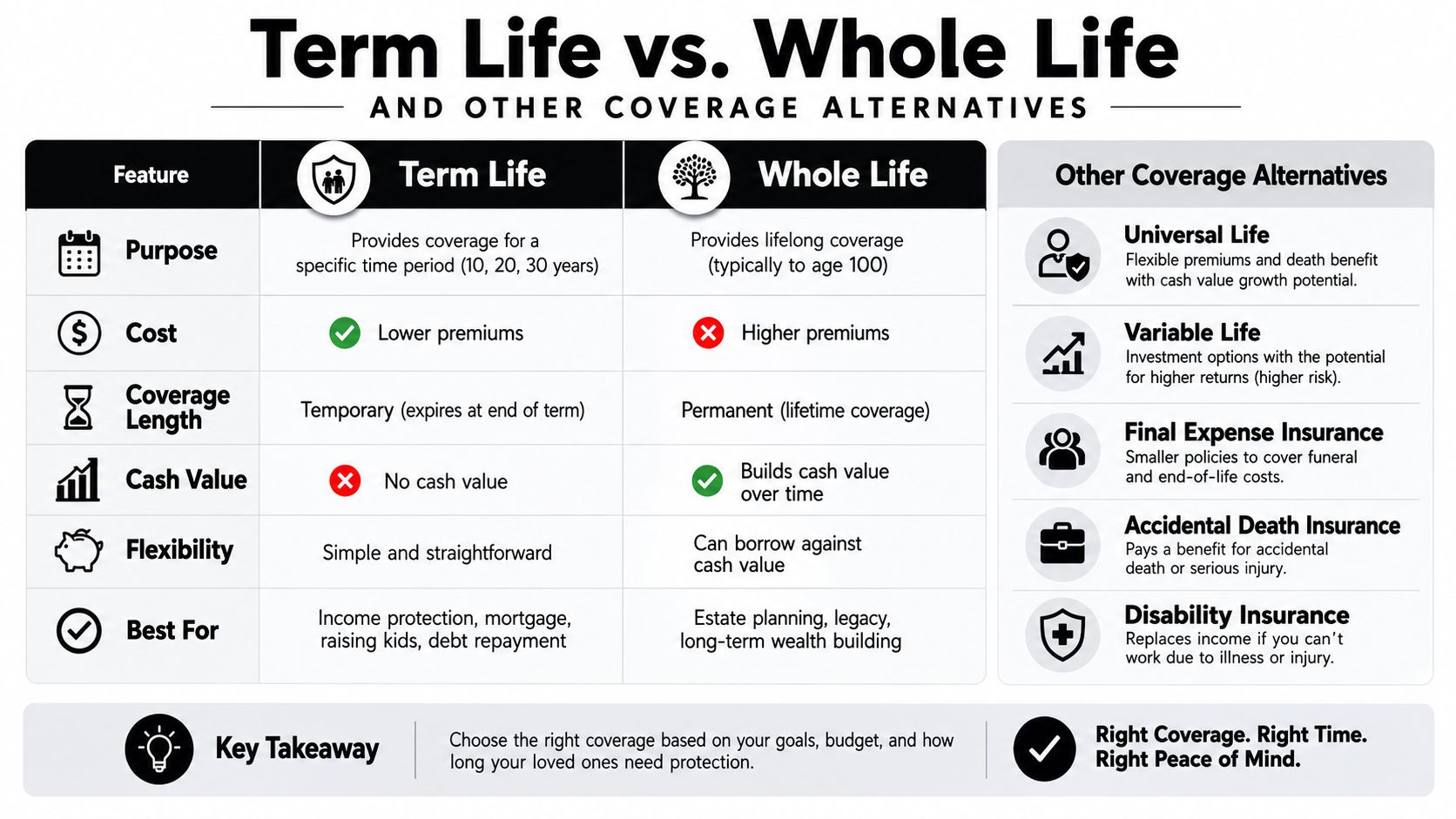
The main choice isn't whether to buy $500,000. It's whether you need temporary income protection, lifelong coverage, or a smaller policy designed for final expenses.
Term life keeps the structure straightforward. You pay premiums for a selected period, such as 10, 20, or 30 years, and the policy pays the death benefit if you die during that period. It generally doesn't build cash value, and coverage ends when the term ends unless the contract offers renewal or conversion options.
Whole life and universal life are permanent policies designed to last for life and may build cash value. The trade-off is a substantially higher premium. Verified pricing commentary places a $500,000 whole life policy at roughly $400 per month or more in some examples, while a healthy younger applicant may find comparable term coverage in the low-$20s to around $30 monthly. The exact premium depends on age, sex, health, insurer, policy design, and funding assumptions.
Matching the product to the need
| Coverage Type | Main Purpose | Typical Trade-off |
|---|---|---|
| Term life | Income replacement, debt payoff, family protection during working years | Coverage lasts for a defined term |
| Whole life | Lifelong death benefit plus cash value features | Higher premiums and more complex policy design |
| Universal life | Permanent coverage with flexible premiums or cash value features | Performance and policy funding require close attention |
| Final expense insurance | Smaller end-of-life costs | Usually not designed to replace a working income |
| Indexed universal life | Permanent coverage with cash value linked partly to an index | Requires careful review of caps, charges, and assumptions |
Final expense policies are intended for limited end-of-life costs rather than a mortgage and years of income replacement. Indexed universal life can provide permanent coverage and cash value exposure tied to market indexes, but it isn't the same as directly investing in an index.
Use term life when the financial risk is temporary and your priority is a larger death benefit within a manageable budget. Consider permanent insurance only when lifelong coverage or cash value features serve a specific, understood purpose.
How No-Exam Underwriting Works for a $500,000 Policy
No-exam life insurance doesn't mean no underwriting. Instead of requiring a paramedical exam and blood draw, an insurer may evaluate the application using a detailed health questionnaire, prescription history, industry databases, electronic records, and other verification sources.
The process usually begins with questions about diagnoses, medications, tobacco use, activities, and family medical history. The carrier then checks available information and decides whether it can approve the application through accelerated underwriting or whether it needs traditional evidence.

Who may qualify
Healthy applicants within an insurer's eligible age range may receive a no-exam decision, particularly when the requested amount fits the carrier's simplified underwriting limits. Some insurers set a $500,000 ceiling, while others allow more for selected applicants. The UK market source cited earlier says healthy applicants under 50 can usually obtain around £500,000 through questionnaire-only underwriting, while older applicants or larger applications may trigger a GP report or nurse exam.
Recent cardiac events, cancer history, complex medical conditions, hazardous occupations, or inconsistent application answers can lead to additional requirements or a decline. No-exam convenience doesn't guarantee approval or the lowest premium.
No-exam term life insurance information can help you compare the process with fully underwritten coverage. Coveredly is one comparison platform that presents online term insurance options, including no-exam possibilities, so applicants can review available routes before submitting an application.
Accuracy matters: Prescription checks and database searches don't replace honest answers. An incomplete or inaccurate application can create problems during claims review.
Step-by-Step Process to Buy $500,000 Life Insurance
Start with your household numbers. Write down annual income, mortgage balance, other debts, childcare costs, education goals, savings, employer coverage, and the number of years your family would need support. This turns a vague search for “cheap life insurance” into a coverage decision tied to a real financial obligation.
1. Set the target and term
Choose a preliminary death benefit, then test it against both the income-multiple method and a DIME-style calculation. Select a term that lasts through the longest major obligation, rather than choosing a duration only because it has the lowest initial quote.
2. Compare carriers and underwriting paths
Run quotes across at least three insurers. Compare the same face amount and term, then look at health-class assumptions, conversion rights, renewal pricing, exclusions, financial strength information, and whether the quote requires an exam.
A no-exam application may be faster, but traditional underwriting can be appropriate when the carrier needs more medical detail or when an applicant wants access to a different pricing class. Don't assume the first online estimate is final.
3. Complete the application carefully
The application asks about health, medications, lifestyle, occupation, finances, and beneficiaries. Have physician and prescription details available, and answer every question consistently. If an exam is required, schedule it promptly and follow the instructions for any requested testing.
Medical record retrieval and attending physician statement orders can create delays. A fully underwritten application may take longer than an accelerated decision because the insurer has to gather and assess additional evidence.
4. Review, sign, and activate
After approval, read the issued contract rather than relying only on the original quote. Confirm the death benefit, term, premium, beneficiary designations, riders, exclusions, payment frequency, and conversion provisions. Sign electronically where available, then set up EFT or annual billing so the policy doesn't lapse.
The free-look period gives you time to cancel after delivery under the contract's rules. Keep the policy with your estate documents and tell your beneficiaries where to find it.
Final Checklist and Key Takeaways Before You Apply
Before requesting a quote, collect the figures that determine whether $500,000 is enough:
- Income: Record the amount your household would need to replace and the number of years support should continue.
- Debt: Include the mortgage balance, loans, credit obligations, and any debt your family would inherit or need to settle.
- Dependents: Consider childcare, support for a nonworking partner, and the age of each child.
- Education: Decide whether the death benefit should contribute to future education costs.
- Assets: Count savings, investments, existing individual policies, and employer coverage, but don't assume employer coverage will last forever.
- Term: Match the policy duration to the longest major obligation, often a 20-year or 30-year planning period.
- Beneficiaries: Name primary and contingent beneficiaries, then review the designations after marriage, divorce, births, or other major changes.
Use the income rule as a quick screen, not a final answer. A healthy 30-year-old non-smoker may find a $500,000, 20-year term policy for about $23 to $30 monthly, while older applicants can face substantially higher premiums as age and underwriting risk change. The earlier pricing examples show why waiting can make the same coverage more expensive.
Compare at least three quotes, and distinguish a no-exam convenience offer from a fully underwritten quote. Review the policy contract, payment schedule, conversion provisions, and beneficiary details before accepting coverage.
Life insurance is one part of a larger financial safety plan. For a broader perspective on protecting household finances, AmbitionCFO's risk management guide offers useful context for identifying and managing financial exposures.
The best day to buy was yesterday. The second best is today, while your age, health, income, and family obligations are still the facts an insurer can evaluate.
Coveredly offers online term life insurance quotes, including coverage amounts up to $3 million and no-exam options for many applicants. Visit Coveredly to compare a $500,000 policy with other coverage amounts and start an application that fits your family's needs.