A graded death benefit is a whole-life design where the insurer pays less than the full face amount if the insured dies during the first two to three policy years, then steps up to 100% coverage afterward. During the waiting period, beneficiaries may receive premiums plus interest or a scheduled percentage of the face amount, while accidental death is often covered in full from the first day.
That difference matters when a family is counting on a policy to pay funeral bills, settle small debts, or leave money behind. The policy may be permanent and the premiums may stay level, but “approved” doesn't always mean “fully covered immediately.” Understanding the exact year-one, year-two, and post-waiting-period payout can prevent a painful surprise during an already difficult claim.
Table of Contents
- Why Graded Death Benefits Exist
- How a Graded Death Benefit Actually Works
- The Two and Three Year Payout Schedule
- Accidental Death Versus Natural Death During the Wait
- Graded Compared With Level and Simplified Issue Coverage
- Two Real World Claim Scenarios
- Pros Cons and the Break Even Question
- Choosing the Right Policy for Your Situation
Why Graded Death Benefits Exist
Maria is 67, a former smoker with well-controlled diabetes. She wants a $15,000 whole life policy to help her family pay funeral costs. Her first application goes through traditional underwriting, which asks for blood work, an EKG, and a recent physician statement. Her agent privately warns that the carrier may decline her or assign a heavily rated classification.
Maria still needs coverage. Rather than ending the search, the agent discusses a graded death benefit policy that doesn't require lab work. Maria accepts that the full benefit may not be available immediately because guaranteed access comes with a different payout design.
That trade-off fills a gap between people who need permanent insurance and people who can qualify for fully underwritten coverage. An insurer that accepts applicants with more serious health histories faces greater early mortality risk. A reduced natural-death benefit during the opening period helps the carrier manage that risk, while the applicant gets a path to coverage that may not involve a medical exam.
The central trade-off: graded coverage can solve an eligibility problem, but it may create an early payout problem.
Final expense insurance is the most common setting for this design. These policies are intended to help with end-of-life costs rather than replace a working person's income or fund a large estate. Face amounts commonly fall between $5,000 and $25,000, a range described in industry guidance on graded death benefit life insurance.
The rest of the decision comes down to contract details. Beneficiaries need to know what happens in year one, what changes in year two, whether an accidental death receives different treatment, and when the policy reaches its full face amount. Buyers also need to compare that design with level-benefit and simplified-issue coverage before choosing the easiest application.
How a Graded Death Benefit Actually Works
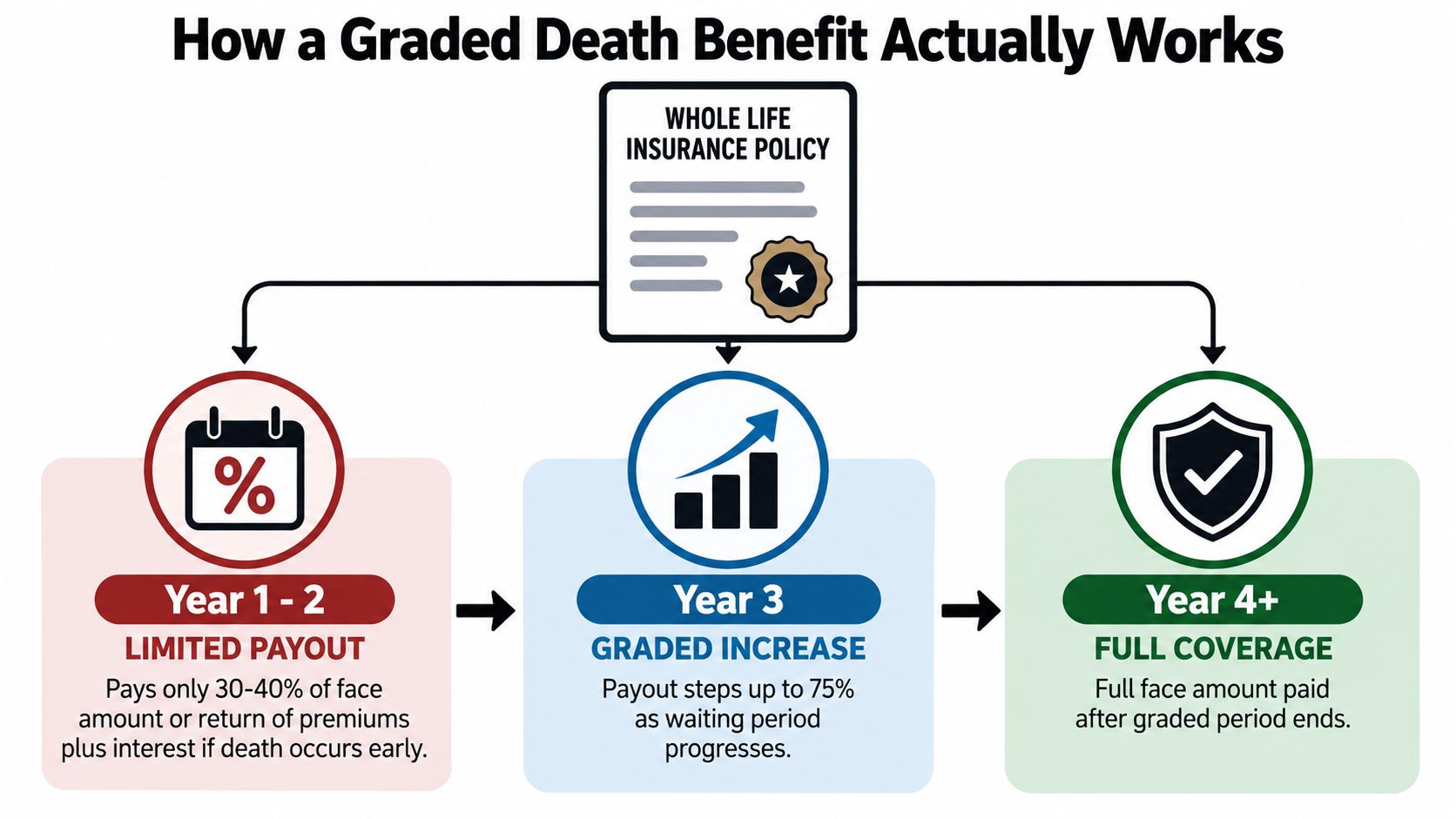
Think of the policy as a staircase. A level-benefit policy places the beneficiary at the top step from the first day. A graded death benefit starts lower, climbs during the opening period, and reaches the full landing after the contract's waiting period.
In plain language, the insurer pays only part of the face amount, or returns premiums with interest, if the insured dies from natural causes during the first two or three policy years. After that period ends, the policy generally pays 100% of the face amount for covered causes of death. The Insurance Compact recognizes graded-benefit individual whole-life designs with a reduced early benefit and a later full benefit, as described in its adopted graded-benefit standard.
Why the insurer limits the early payout
Many graded policies are designed for applicants who may have difficulty passing conventional underwriting. Depending on the carrier, that can include people with Type 2 diabetes, heart disease, or a recent cancer diagnosis. The insurer may skip a medical exam, and some guaranteed-issue products ask few or no health questions beyond eligibility exclusions.
The carrier takes on more uncertainty by accepting those applicants. The reduced early payout, sometimes called a modified death benefit, is the contractual protection against that uncertainty. It isn't a cancellation of coverage. It's a different benefit formula during the first part of the policy.
What the policy still provides
Graded coverage is generally a form of whole life insurance, not temporary term insurance. Premiums are designed to remain level for life, and the contract doesn't expire because the insured reaches a certain age, as long as required premiums are paid. The policy may also accumulate cash value, including during the graded period, although the amount and borrowing terms depend on the contract.
The product is commonly aimed at applicants roughly ages 50 to 80, particularly those declined elsewhere, seeking permanent protection, and needing a smaller amount for final expenses. Those characteristics don't guarantee that a graded policy is the right choice. They identify the problem the product is built to address.
A useful legal history shows that this structure isn't merely a sales label. Missouri rules in force by 1974 required graded policies to meet disclosure and payout standards, including limits on how long benefits could remain reduced and minimum early-benefit thresholds for certain issue ages. The rule also addressed accidental death benefits and a 30-day free-look refund notice, illustrating the regulatory focus on timing and consumer protection. You can review the historical requirements in the Missouri graded death benefit regulation.
The Two and Three Year Payout Schedule
There isn't one universal payout formula. The policy contract controls the result, and two designs appear frequently.
A return-of-premium schedule may pay the total premiums received, plus interest, if a natural-cause death occurs during the early period. One example described in industry material uses 110% of premiums for deaths within the first two policy years, followed by the full face amount after the waiting period. A stepped schedule instead pays a portion of the face amount that rises as the policy ages. Published examples include 30% in year one, 70% in year two, and 100% from year three onward. These examples come from graded life insurance payout explanations and shouldn't be treated as a promise for every carrier.
Reading the policy by policy year
The contract normally assigns the claim to the policy year in which death occurs:
- Year one: The first 12 months use the year-one benefit formula.
- Year two: Months 13 through 24 use the year-two formula.
- After the waiting period: The full face amount becomes payable under the policy terms.
Consider a hypothetical contract with a $10,000 face amount and a $50 monthly premium. If the contract returns premiums plus 10% interest, the basic premium total after 12 months is $600. With that interest assumption, the year-one calculation is about $660, not $10,000. The same simplified calculation produces about $1,320 after 24 months before applying the contract's exact interest and claim rules. A natural death in year three would qualify for the full $10,000 if the graded period had ended.
| Policy Year | Return-of-Premium Schedule | Stepped Percentage Schedule | Fully Graded After Wait |
|---|---|---|---|
| Year 1 | Premiums paid plus contract interest | About 30% of face amount in one published example | Not yet applicable |
| Year 2 | Premiums paid plus contract interest | About 70% of face amount in one published example | Not yet applicable |
| Year 3 and later | Full face amount after the waiting period | 100% of face amount | 100% of face amount |
A schedule stated in the policy is part of the contract. The carrier can't casually replace it after issue, but other provisions can affect the final claim, including unpaid premiums, policy loans, exclusions, and the definition of accidental death.
When comparing quotes, request the benefit schedule page, then line up each policy year. A 30/70 design and a return-of-premium design can produce materially different claim amounts for the same face amount. Minnesota provides one regulatory benchmark by requiring a graded amount to be at least four times the first-year premium in the statute's definition, as shown in the Minnesota graded benefit statute.
Accidental Death Versus Natural Death During the Wait
The most important distinction in a graded policy is often the cause of death. During the waiting period, many contracts pay the full face amount for accidental death, while a natural death from illness may receive premiums plus interest or a reduced percentage of the face amount. The exact language matters more than the marketing summary.
The reason is straightforward. The graded design protects the insurer against early natural deaths associated with the health risks it accepted. An accident is treated differently under many contracts because it isn't the mortality risk the reduced natural-cause schedule was primarily designed to address. Sources explaining this distinction include graded death benefit claim rules.
Suppose the policy has a $10,000 face amount and the insured dies in year one. Under an accidental-death provision, the beneficiary may receive the full $10,000. If the same insured dies from natural causes and the contract returns premiums with interest, a hypothetical payout could be about $10,400, assuming the contract's premium total and interest calculation produce that result. That example isn't a universal quote. The beneficiary must use the policy's actual formula.
| Policy Year | Accidental Death Payout | Natural Death Payout |
|---|---|---|
| Year 1 | Often the full face amount, subject to exclusions | Reduced amount, such as premiums plus interest or a percentage of face amount |
| Year 2 | Often the full face amount, subject to exclusions | The contract's next graded amount |
| After the graded period | Full face amount under the policy | Full face amount under the policy |
Clauses beneficiaries should verify
“Accidental” has a contract definition. Exclusions may address suicide during the applicable exclusion period, drug overdose, self-inflicted injuries, or risky activities. Don't assume that an unexpected death automatically qualifies.
Beneficiaries should also review contestability language, claim documentation rules, and any notice period. Some policies refer to a 30-day contestability window, while others use different provisions, so the contract and state law control. For a plain-language explanation of accidental death coverage and its limits, review this guide to AD&D coverage.
The difference can determine whether a family receives enough to pay the intended bill or only recovers part of the money paid into the policy. That's why a beneficiary should see the full schedule and exclusions before the policy is purchased, not after a claim begins.
Graded Compared With Level and Simplified Issue Coverage
A graded policy isn't only way to avoid a medical exam. The comparison is among underwriting intensity, early coverage, and price.
A level-benefit whole life policy pays the full face amount from day one, but the insurer usually asks for more medical information and may request a paramedical exam, laboratory work, and records. Simplified-issue whole life sits between the two. It typically uses a health questionnaire without a medical exam and can provide full coverage immediately if the applicant qualifies. Coveredly's guide to simplified-issue life insurance explains that middle ground in more detail.
| Feature | Graded Death Benefit | Simplified Issue | Level Death Benefit |
|---|---|---|---|
| Early natural-death payout | Reduced during the graded period | Full benefit if approved | Full benefit if approved |
| Medical exam | Often not required | Usually not required | May be required |
| Health questions | Few or limited, depending on carrier | A short series of health questions | Detailed medical underwriting |
| Premium structure | Typically level for life | Typically level for life | Typically level for life |
| Permanent coverage | Commonly whole life | Commonly whole life | Commonly whole life |
| Typical applicant | Someone who may be declined elsewhere | Someone with manageable health history | Someone able to qualify through fuller underwriting |
The more underwriting information an insurer receives, the more precisely it can price the risk. Removing the waiting period often means accepting more health information, paying a different premium, or both. A graded policy can be valuable when an applicant has been declined or can't complete an exam, but it shouldn't be the automatic choice for someone who might qualify for immediate full coverage.
Beneficiary planning also matters. Life insurance proceeds commonly pass directly to a named beneficiary, but estate and probate questions can complicate administration. Executors handling a Texas estate may find this life insurance proceeds guide for executors useful when organizing documents and understanding how beneficiary designations fit into the process.
If an applicant can pass simplified issue, that option will often provide a better balance than graded coverage. If the applicant qualifies for fully underwritten level coverage, the immediate benefit and potentially lower cost can make the additional underwriting effort worthwhile.
Two Real World Claim Scenarios
A claim becomes easier to understand when you follow the paperwork rather than just the sales illustration. These examples assume premiums were paid, the policy stayed in force, and the contract's exclusions and definitions support the stated result.
Scenario one, an accidental death in year one
A 67-year-old retired teacher buys a $15,000 graded policy. Six months after the policy takes effect, she dies in a car accident. Her beneficiary contacts the insurer and submits the claim form, a certified death certificate, and identification showing the beneficiary's identity.
The insurer reviews the cause of death and confirms that the event meets the policy's accidental-death definition. The carrier also confirms that the policy was active and that the relevant contestability requirements don't prevent payment. Under a common graded design, the beneficiary receives the full $15,000 face amount, even though the death occurred during the first policy year.
The family still has to follow the carrier's process. Missing documentation can delay review, and “accident” isn't whatever the family believes it means. The beneficiary should request the policy's accidental-death clause if the claims representative asks for additional records.
Scenario two, a natural death after the wait
Use the same policyholder and policy, but change the event. She survives into year three and dies from a heart attack. The beneficiary again submits the death certificate, claim form, and identification. Because the graded period has ended, the insurer pays the full $15,000 face amount, subject to the contract.
If the policyholder had an outstanding policy loan, the carrier would subtract that balance and any applicable interest from the amount paid. The remaining proceeds go directly to the named beneficiary under the policy's designation. The claim can feel less like a financial transaction and more like the final piece of a promise made years earlier, which is why accurate beneficiary records matter.
Insurers' timelines vary by company and claim complexity. A straightforward claim may be processed in roughly 30 days in the example described here, but families should ask the carrier what documents it needs and when payment can be expected rather than treating that timeline as guaranteed.
Pros Cons and the Break Even Question
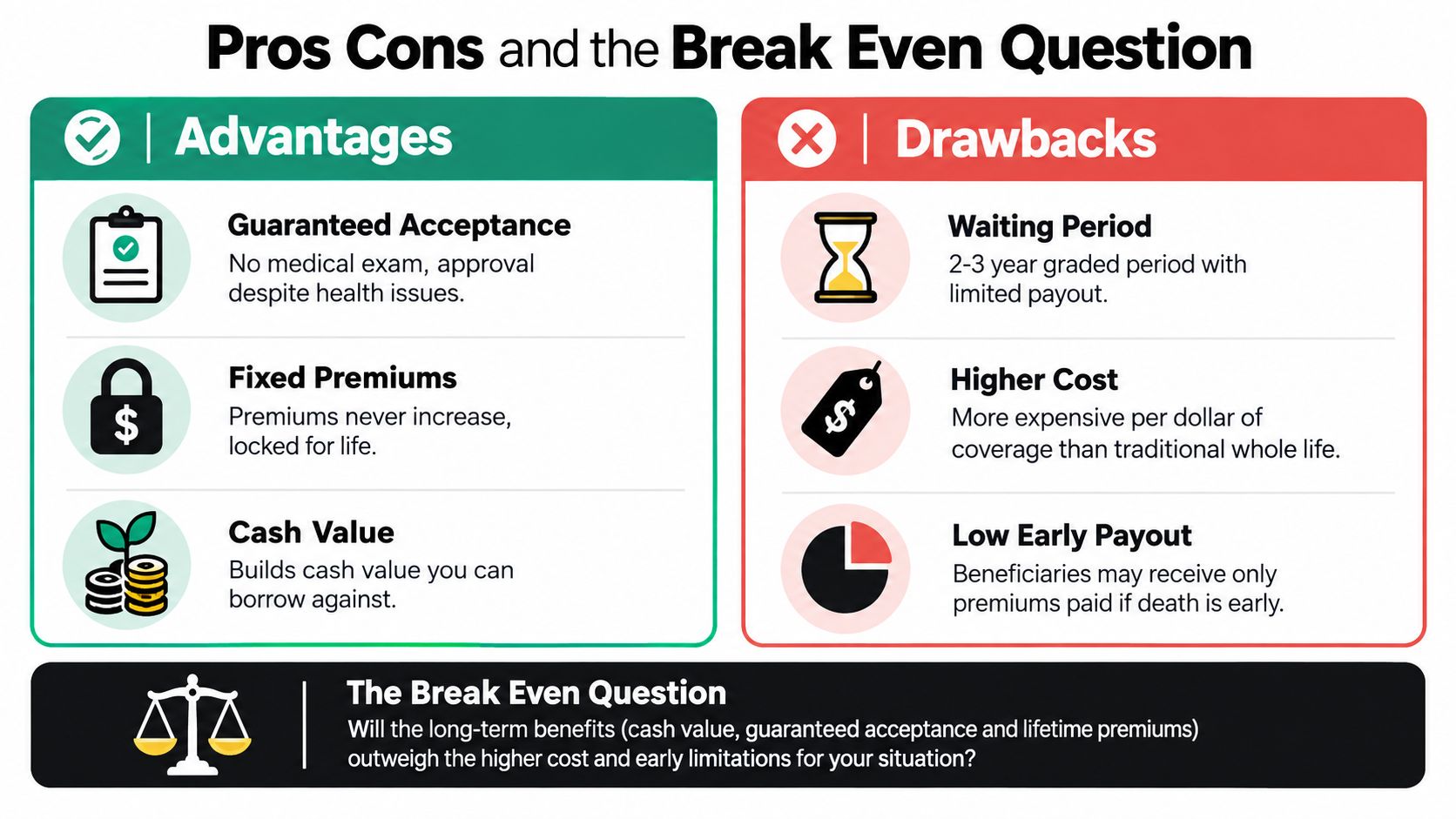
A graded death benefit solves a specific problem: getting permanent coverage when traditional underwriting may not be available. The applicant may avoid a medical exam, keep premiums level, and establish a benefit for final expenses. Some policies also build cash value that the owner may access through a policy loan, subject to the contract's terms.
The drawbacks are just as concrete. The natural-death payout may be limited during the opening two or three years, premiums can cost more per dollar of coverage than fully underwritten whole life, and an early claim may return less than the family expected. The policy isn't automatically poor value, but the buyer must value access and permanence enough to accept the early limitation.
The break-even question
The common question is, “How many years of premiums must I pay before the convenience is worth the extra cost?” There isn't one honest answer without comparing actual quotes. The result depends on age, health, face amount, premium, payout formula, cash value, and the level-benefit alternative available to the same applicant.
Use this process:
- Request two quotes: Ask for a graded policy and a level or simplified-issue policy with comparable coverage.
- Record the premiums: Multiply each premium by the same projected ownership period.
- Compare early claims: Note what each beneficiary receives for natural death in each graded year.
- Test the need: Decide whether the family could handle the reduced payout during the waiting period.
- Review the long term: Compare total premiums, face amount, cash value, and exclusions rather than focusing only on the first payment.
A practical rule: If you can qualify for immediate full coverage at a reasonable price, don't pay for guaranteed access you don't need.
A healthier applicant may discover that simplified issue or fully underwritten level coverage provides stronger protection from day one. Someone with serious health conditions may decide that a smaller guaranteed benefit is better than having no permanent policy at all. The break-even point is therefore personal. It isn't a universal number that can be calculated from the product name alone.
Choosing the Right Policy for Your Situation
Start with eligibility, then examine the payout. A graded death benefit can be sensible for an applicant with a serious pre-existing condition who has already been declined or can't complete traditional underwriting. In that situation, guaranteed access may matter more than maximizing the first-year natural-death benefit.
A borderline applicant should try simplified issue before accepting a graded design. A short health questionnaire may reveal that the applicant qualifies for full coverage from day one without lab work. Compare that option directly rather than assuming a no-exam policy must have a waiting period.
A relatively healthy buyer should ask whether convenience is worth the reduced early benefit and potentially higher cost. If fuller underwriting is available, a level-benefit whole life policy may provide the cleaner contract. If the household needs substantial protection on a limited budget, term life may deserve comparison because it can address income replacement differently from a small final expense policy.
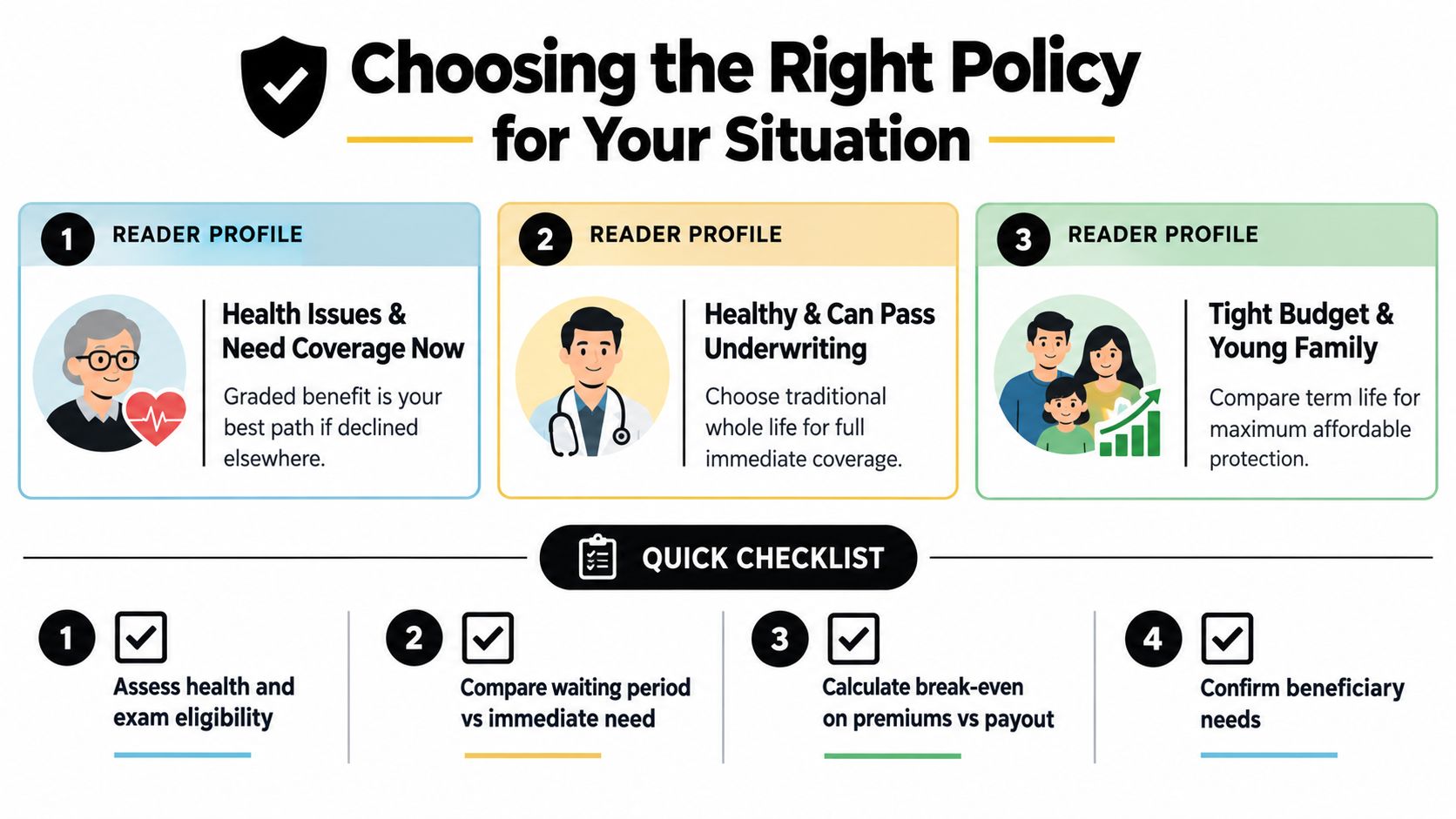
Before signing, ask the agent these questions:
- Payout schedule: What exactly does the beneficiary receive in each policy year?
- Accidental death: Is the full face amount payable for an accident during the graded period, and what exclusions apply?
- Premium rating: Is the quoted premium fixed, and what rating class or underwriting basis applies?
- Policy type: Is this whole life or term insurance, and does it build cash value?
- Beneficiary administration: Which documents will the beneficiary need to file a claim?
If you need coverage without a waiting period, compare alternatives such as no-waiting-period life insurance before choosing a graded policy. The direction is simple: choose level or term coverage when your health and budget make it workable, and choose graded coverage when guaranteed acceptance is the deciding factor.
Coveredly offers online life insurance options, including term coverage with no exam for most applicants, so you can compare immediate-coverage possibilities alongside a graded death benefit policy. Visit Coveredly to review available options and see which coverage structure fits your family's needs.