A young couple can build a responsible budget, keep an emergency fund, and still discover an uncomfortable weakness: if one paycheck disappeared tomorrow, their savings might cover only a short stretch of rent, food, childcare, and debt payments. That realization often arrives after a wedding, a new home, or the birth of a child, when another person's financial security depends on income that used to support only one adult.
An income replacement policy turns that risk into a measurable plan. It doesn't replace a person, and it can't remove grief. It creates financial time, so a surviving partner can make careful decisions instead of accepting the first available job, selling assets quickly, or abandoning long-term goals under pressure. The calculation becomes clearer when you focus on the household obligations that would remain, the costs that would disappear, and the resources already available.
Table of Contents
- Why Your Family Needs an Income Replacement Policy
- Defining the Income Replacement Approach
- Calculating Your Exact Coverage Requirement
- Adjusting for Disappearing Liabilities and Assets
- Factoring Inflation and Long-Term Payouts
- Choosing the Right Product for Income Replacement
- Your Action Plan for Securing Coverage
Why Your Family Needs an Income Replacement Policy
Consider a newly married couple moving into their first home. One partner earns most of the household income, while the other handles a larger share of childcare and expects to return to work later. Their bank balance looks reassuring during an ordinary month, but after accounting for the mortgage, groceries, utilities, insurance, and debt, it wouldn't support the household for long without the primary paycheck.
That's the situation an income replacement policy addresses. The death benefit provides money that can replace the economic value of the deceased person's work, whether the surviving spouse uses it for monthly expenses, debt repayment, childcare, housing, or education. The purpose isn't to predict every future cost perfectly. It's to give the family enough room to adjust without turning a death into an immediate financial emergency.

The policy buys time
A surviving partner may need time to grieve, arrange childcare, manage legal matters, and decide whether to change jobs or move. Children may still need years of daily care and future education funding. A policy can create a financial buffer for those decisions instead of forcing them into a rushed timetable.
The right amount isn't automatically the largest amount an insurer will approve. It's the amount that supports the household's remaining responsibilities after accounting for savings, other income, debts, and expenses that would no longer exist.
Practical rule: Treat life insurance as a plan for the people who remain, not as a price tag on the person who dies.
Financial wellness habits help too. A resource such as FloosYo financial wellness tips can help households organize cash flow, savings, and broader money decisions before they calculate insurance. Better records make the coverage decision more realistic because you're working from actual household commitments rather than a rough guess.
Defining the Income Replacement Approach
Retirement planners use a replacement rate to estimate how much of a worker's pre-retirement income a benefit stream should replace. Pew describes the measure as a way to judge whether people can maintain their standard of living after work ends, and research from the U.S. Social Security Administration found a median total replacement ratio of 0.733, or 73.3%, in the first or second year of retirement among the households studied. The same research found wide variation, with one-fourth of households at 1.013 or higher and another one-fourth at 0.480 or lower. These figures appear in the Pew fact sheet on replacement income.
That range explains why a flat promise to replace “your salary” can mislead. Households have different taxes, savings, housing costs, family structures, and public benefits. A surviving family may not need the deceased person's entire gross paycheck, but it may need more than a simple percentage suggests if a mortgage, childcare, or debt remains.
Start with the replacement rate
Retirement-planning literature has often clustered around a 70% to 80% replacement target. A U.S. Government Accountability Office review found recommendations ranging from 43% to 476%, with most recommendations between 70% and 85% and a median recommended target of 77%. The GAO retirement-income review documents that variation.
For life insurance, use that idea as a starting lens rather than a final answer. If a household earns $100,000 and aims to replace 70%, the target income need is about $70,000 per year for the selected period, as described in the GAO-based planning framework. The death benefit still has to account for how that annual need will be funded, whether through investments, scheduled withdrawals, debt reduction, or a combination.
Gross and net are different calculations
A gross replacement rate compares pre-tax income with post-event income. A net replacement rate compares disposable income after taxes and transfers. The distinction matters because replacing a percentage of gross salary may overstate or understate what the household actually needs.
The Congressional Budget Office explains that there's no universal target. Household composition, income, mortgage status, and expected public benefits all affect the required ratio, as outlined in its analysis of retirement income replacement rates at the Congressional Budget Office.
For a family budget, ask practical questions:
- Which taxes and payroll deductions would change?
- Which personal expenses belonged mainly to the deceased worker?
- Would retirement contributions stop, continue, or be redirected?
- Would childcare, commuting, or household-support costs rise?
- What income would the survivor receive from work or public benefits?
The goal isn't to replace a pay stub. It's to preserve the household's essential spending and future choices.
Calculating Your Exact Coverage Requirement
A salary multiplier gives you a quick estimate. One widely used approach suggests buying life insurance equal to 8 to 10 times annual salary. U.S. Bank gives the example that a $100,000 salary could translate to roughly $1,000,000 in coverage, with adjustments for debts, dependents, and long-term goals in its guide to how much life insurance you may need.
That shortcut can be useful when you're starting from zero, but it treats every dollar of income as if it has the same purpose. A household with substantial savings and no mortgage may need less. A family with young children, large debts, and one primary earner may need more. The multiplier is a baseline, not a diagnosis.
Use DIME to separate the obligations
The DIME method organizes the calculation into Debt, Income, Mortgage, and Education. MoneySuperMarket describes the framework in its guide to life-insurance needs.
- Debt: Add personal loans, credit-card balances, and other obligations that shouldn't pass to the surviving household.
- Income: Estimate the years of lost earnings the policy should replace. This is the ongoing support component, not the same thing as a one-time debt payoff.
- Mortgage: Decide whether the surviving family should pay off the mortgage or receive enough support to keep making payments.
- Education: Estimate the future education funding you want the policy to provide.
Then subtract resources that are genuinely available for those needs. Existing savings, other life insurance, survivor income, and investments may reduce the additional death benefit required.
| Calculation Method | How It Works | Best For |
|---|---|---|
| Salary multiple | Multiplies annual salary by a broad coverage factor | A fast first estimate |
| DIME method | Separates debt, lost income, mortgage, and education costs | Families with multiple obligations |
| Liability-adjusted model | Starts with DIME, then subtracts usable assets and costs that disappear | Households seeking a tailored target |
A useful worksheet might look like this:
Coverage need = debt + income replacement + mortgage + education − usable assets and other income.
The formula is simple. The judgment lies in deciding which expenses truly remain and which assets the survivor could realistically use without undermining another goal. For a second perspective on the calculation, compare your worksheet with this guide to how much life insurance you may need.
The important question isn't “How much did I earn?” It's “Which costs and responsibilities would remain if I died?”
Adjusting for Disappearing Liabilities and Assets
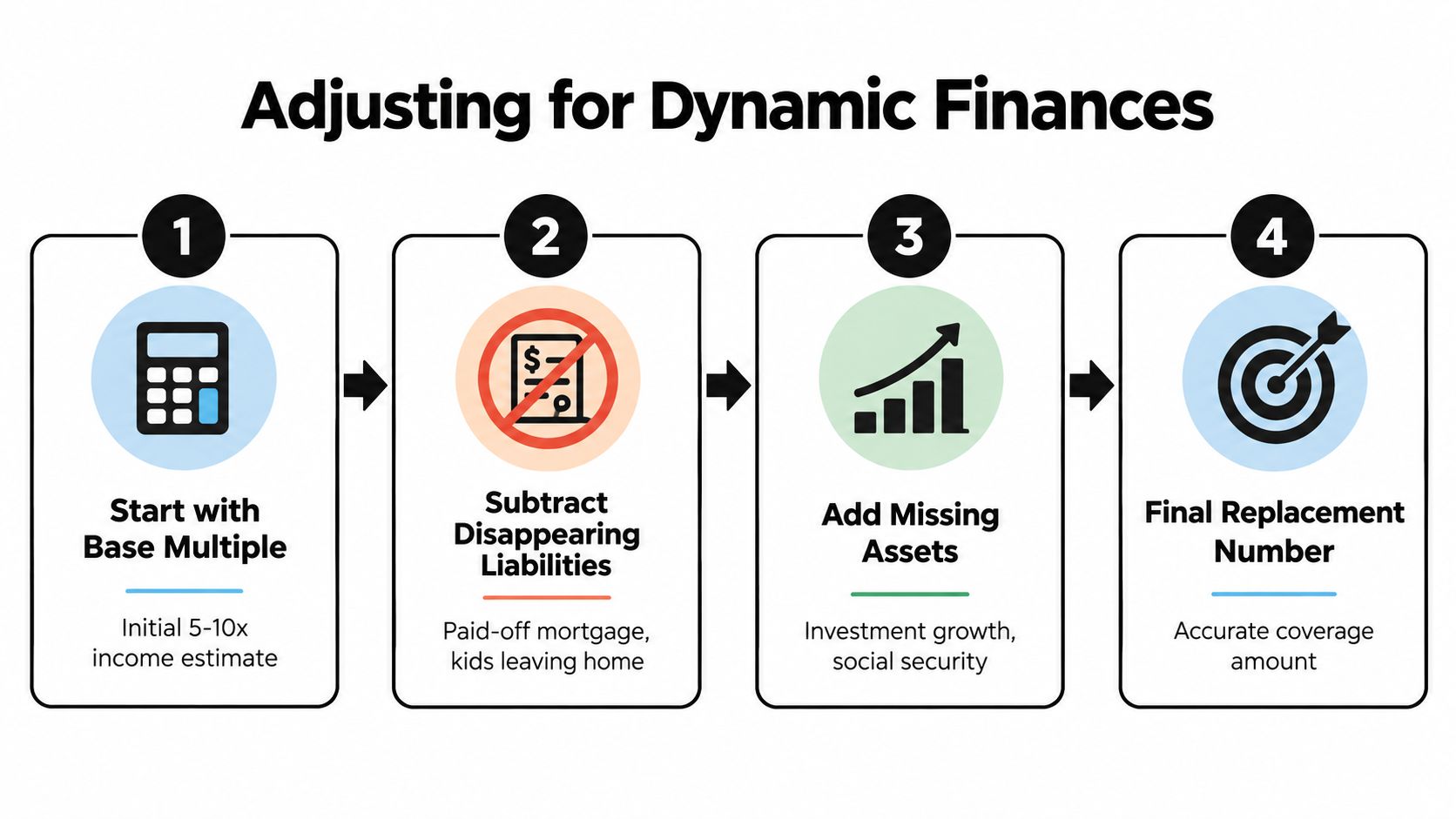
A flat coverage multiple assumes the household's financial picture stays frozen. Real life doesn't work that way. A mortgage balance falls, children become independent, debts are repaid, savings grow, and a surviving spouse may qualify for other income.
That means an income replacement policy should be connected to a liability curve. The largest need often appears while children are young, housing debt is substantial, and the household has had limited time to build assets. The required amount can decline as those obligations shrink.
Subtract what the family already has
Begin with the total need from your DIME worksheet. Then review resources one at a time:
- Savings: Include cash and investments that the survivor could use without creating a new emergency.
- Existing coverage: Subtract life insurance already in force, including individual and employer-provided policies, after confirming the coverage terms.
- Survivor income: Consider reliable survivor benefits or the surviving partner's earnings, but don't assume every benefit will continue indefinitely.
- Paid-down debt: Reduce the mortgage and debt figures as balances decline.
- Future assets: Treat expected investment growth cautiously. It may support the plan, but it shouldn't replace coverage the family needs today.
The adjustment works in both directions. Existing resources can lower the policy amount, while a survivor's need for childcare, household help, or career interruption can raise it. A nonworking spouse also contributes economic value, even without a salary, because replacing childcare and domestic work can require substantial spending.
Match coverage to changing obligations
A 30-year-old newlywed with a new mortgage and plans for children may reasonably need substantial protection now. By the time that person reaches their fifties, the mortgage may be smaller, children may be financially independent, and retirement savings may cover more of the household's needs.
That doesn't mean coverage should disappear automatically. It means the amount and duration should reflect the purpose. Some families use a longer level term policy for core protection and review the amount as obligations change. Others consider a decreasing structure for liabilities expected to fall over time. The mechanics of a decreasing policy are outlined in this guide to decreasing term life insurance.
Review the policy when the household changes, not only when the premium statement arrives.
An annual review can check beneficiaries, employer coverage, debt balances, savings, and the number of years remaining in the income-replacement period. The objective is alignment, not constant buying and canceling.
Factoring Inflation and Long-Term Payouts
A death benefit is usually paid as a lump sum, while household expenses arrive month after month. That difference matters. A surviving spouse may need to invest the benefit, reserve money for near-term bills, and create withdrawals that support the family over the intended period.
Inflation adds another layer. The same dollar amount may buy less in the future, so a policy designed to replace income over many years must consider whether the annual withdrawals will stay level or rise with living costs. The policy amount should also reflect whether the survivor plans to preserve principal for children or spend the benefit over the replacement period.

Turn a lump sum into a household paycheck
Suppose the family's plan calls for regular withdrawals rather than an immediate mortgage payoff. The survivor and their adviser would need to consider:
- the annual amount required for essential spending;
- how long withdrawals should last;
- whether withdrawals should increase as costs rise;
- taxes on investment income and withdrawals;
- investment risk and the survivor's comfort with market changes;
- money reserved for education or other one-time goals.
A larger benefit may provide more flexibility, but it also needs a clear management plan. A smaller benefit may work if the survivor has dependable earnings, substantial assets, or a lower spending requirement. The correct target depends on the interaction between the money received and the responsibilities it must fund.
A financial planner can model several payout paths, such as level withdrawals, rising withdrawals, and an approach that pays off debt first. This is more useful than treating a large round number as automatically sufficient.
The following video can help families think about the connection between coverage, financial growth, and long-term planning:
Avoid presenting investment returns as guaranteed. Inflation, fees, taxes, and market losses can change the outcome, so the insurance calculation should use cautious assumptions and include a review process. The policy's job is to create a durable pool of money. The survivor's job, with appropriate advice, is to turn that pool into spending that lasts.
Choosing the Right Product for Income Replacement
For pure income replacement, term life insurance usually matches the problem more directly than permanent insurance. The need often has a defined horizon, such as the years when children depend on the household's earnings or when a mortgage and other obligations remain. Term insurance provides a death benefit for a selected period, which can align the protection with that temporary liability.
Permanent or whole life insurance can provide lifelong coverage and may include cash value, but those features serve goals beyond replacing a paycheck during a family's highest-risk years. If the main objective is a large death benefit during a defined working-life period, allocating money toward features you don't need can complicate the design and compete with savings, debt repayment, or retirement contributions.
Compare the main choices
| Product | Primary structure | Potential fit |
|---|---|---|
| Term life | Death benefit for a selected period | Income replacement, mortgage protection, and dependent support |
| Permanent life | Lifelong insurance with cash-value features | Estate, legacy, or permanent coverage objectives |
| Employer coverage | Coverage connected to employment | A supplemental layer, not automatically a complete household plan |
Digital applications can make term coverage easier to explore, but convenience doesn't remove the need for accurate financial information. Health history, occupation, coverage duration, beneficiaries, and policy exclusions still matter. A no-exam application may be available for many applicants, while others may need additional underwriting.
Match the term to the liability
A policy term should reflect the years when the family would struggle most without the insured income. A longer term can protect against an extended period of dependency. A shorter term may fit a narrower obligation, such as a mortgage or education goal, but it can leave a gap if the family's responsibilities last longer than expected.
Coveredly offers online term life insurance, with coverage of up to $3 million and no medical exams for most applicants, according to the publisher's product information. Families comparing employer and public-sector benefits can also use this guide to compare federal life insurance options before deciding how much private coverage they need.
Read the benefits of term life insurance alongside your own budget and liability worksheet. The right product is the one whose coverage amount, duration, underwriting requirements, and cost support the actual household plan.
Your Action Plan for Securing Coverage
Start with an inventory, not an application. Gather your income records, mortgage statement, debt balances, savings accounts, investment statements, education goals, existing policies, and beneficiary information. If you're married, complete the exercise together so both partners understand what the policy is meant to accomplish.
Use this checklist:
- Audit workplace coverage: Confirm the death benefit, eligibility, cost, and whether the policy remains available if you change employers.
- Build the DIME estimate: Separate debt, years of income to replace, mortgage needs, and education funding.
- Subtract usable resources: Account for savings, other insurance, survivor income, and assets the survivor can realistically access.
- Identify disappearing costs: Remove expenses tied mainly to the deceased person, but add likely childcare, household support, or career-transition costs.
- Choose the duration: Align the term with the years of financial dependence rather than choosing a period by habit.
- Review beneficiaries: Confirm the people and trusts listed on every policy, especially after marriage, divorce, or the birth of a child.
- Revisit the calculation: Update the plan after major changes in income, debt, housing, children, or savings.
Employer coverage can be helpful, but it may not equal the household's full replacement need and may not follow you to a new job. A separate policy can give the family more control over the amount and duration of protection.
You don't need perfect forecasting. You need a documented estimate, a product that fits the obligation, and a review habit that keeps the coverage connected to real life.
Coveredly offers online term life insurance, including up to $3 million in coverage with no medical exams for most applicants, which can help families address an income replacement need through a separate policy. Review your calculated liabilities and visit Coveredly to explore coverage that fits your family's financial plan.