A healthy 30-year-old typically pays around $18 to $30 per month for a 20-year, $500,000 term life policy in 2026. That monthly price can rise sharply with age, health class, smoking status, term length, and the amount of coverage you choose.
The headline number is useful, but it can also mislead. A quote for one healthy 30-year-old doesn't predict what another applicant of the same age will pay. Insurers assess the risk differently, and the final premium reflects more than age alone.
Table of Contents
- What the Average Term Life Insurance Cost Looks Like in 2026
- The Four Biggest Factors That Drive Your Premium
- How Age Reshapes the Term Life Insurance Average Cost
- Choosing the Right Term Length for Your Budget
- Health, Gender, and Lifestyle Adjustments to Your Quote
- How to Compare Term Life Insurance Quotes Like a Pro
- Smart Ways to Lower Your Term Life Insurance Average Cost
What the Average Term Life Insurance Cost Looks Like in 2026
A healthy 30-year-old non-smoker buying $500,000 of 20-year term coverage may see a monthly premium near the entry-level range of $18 to $30, or approximately $215 to $360 per year, based on 2025 and 2026 term life pricing data. Women generally appear toward the lower end of comparable rate ranges, while men often appear toward the higher end.
That price is low because term life insurance works more like renting protection than buying an asset. You pay for a defined period, such as 10, 20, or 30 years. If you die during that period, the insurer pays the death benefit to your beneficiaries. Unlike whole life insurance, term coverage doesn't normally include a cash-value account that you build over time.
Your premium usually stays level throughout the selected term. That makes a level-premium policy easier to budget for, especially when you're covering a mortgage, replacing income, or protecting children who depend on you.
The lowest published tier generally goes to applicants in excellent health. A typical buyer may receive a higher quote after the insurer reviews medical history, blood pressure, height and weight, family history, occupation, hobbies, and tobacco use. The $25 monthly figure is a starting point, not a universal price.
2026 term life average monthly premiums at a glance
The following benchmarks come from the same market snapshot cited above. They illustrate how age and coverage amount interact for healthy applicants.
| Applicant profile | Age | Health class | Estimated monthly premium |
|---|---|---|---|
| Healthy applicant, $500,000 coverage | 30 | Strong health class | About $18 to $30 |
| Healthy applicant, $1 million coverage | 30 | Strong health class | About $29 |
| Healthy applicant, $500,000 coverage | 40 | Strong health class | About $25 |
| Healthy applicant, $1 million coverage | 40 | Strong health class | About $42 |
| Healthy applicant, $500,000 coverage | 50 | Strong health class | About $60 |
| Healthy applicant, $1 million coverage | 50 | Strong health class | About $109 |
| Healthy applicant, $500,000 coverage | 60 | Strong health class | About $156 |
A policy's face amount, term, and underwriting class can move the quote far from the initial average. The next four factors explain why.
The Four Biggest Factors That Drive Your Premium
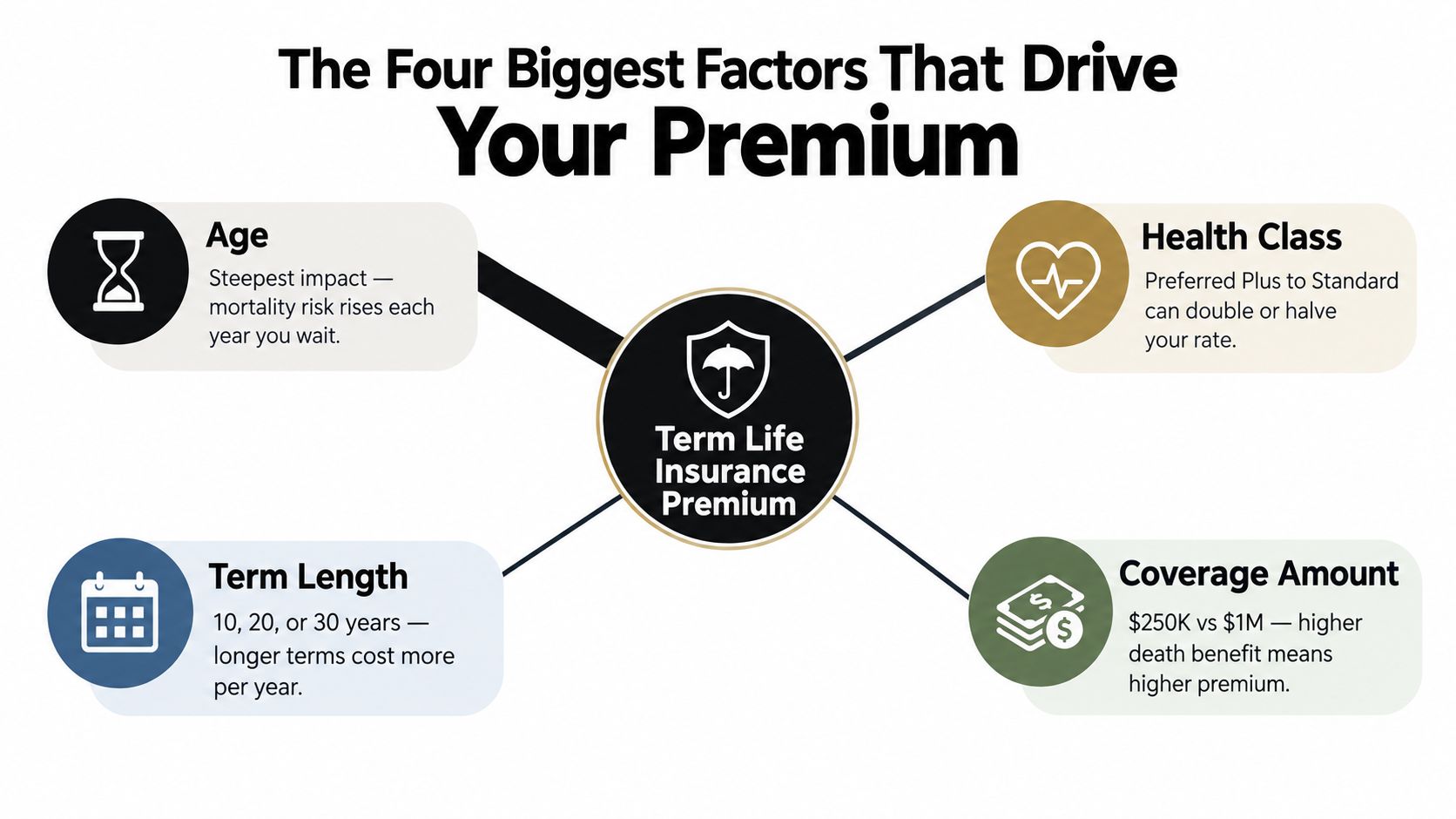
A term life quote reflects four connected inputs: your age, health class, term length, and coverage amount. Each one changes the insurer's estimate of how likely a claim is during the policy period. That is why two applicants of the same age can receive very different quotes.
Age
Age is usually the strongest pricing lever. A younger applicant gives the insurer more expected time to collect premiums before a possible claim. An older applicant has a shorter expected claim-free period and a greater chance of dying during the selected term. The price curve therefore tends to rise more sharply in later underwriting bands, as described in term life pricing guidance from Fidelity.
Health class
Insurers sort applicants into risk categories, often ranging from preferred plus to preferred and standard. These categories work like grades based on medical and lifestyle evidence. Someone with well-controlled conditions and favorable medical results may receive a better grade than an applicant with recent diagnoses, unmanaged conditions, or other risks.
That classification can change the quote while age, coverage amount, and term stay the same. Two 40-year-old applicants can therefore receive very different offers because the insurer evaluates their expected claim risk differently.
Term length
A longer term protects your family for more years. It also gives the insurer more time during which a claim could occur, so the premium generally rises as the term expands. Rate tables show the basic pattern: a 10-year term costs less than a 20-year term, while a 30-year term costs more for the same applicant and coverage. The term comparison is reflected in Insure.com's comparison of term life rates.
Coverage amount
The death benefit is the amount paid to your beneficiaries. Raising it usually raises the premium, though the increase may not match the benefit increase exactly. Insurers also account for fixed policy expenses, so doubling coverage does not always double the price. MoneyGeek's 2026 analysis shows clear differences between $500,000 and $1 million policies for applicants of the same age.
Practical rule: Compare quotes only after matching age, health class, term length, and coverage amount. Otherwise, the cheaper quote may simply provide less protection or end sooner.
How Age Reshapes the Term Life Insurance Average Cost
The age effect becomes clearer when you compare the same product across different life stages. A healthy 30-year-old male may pay about $29.32 per month for $500,000 of 20-year coverage, while a comparable 40-year-old male may pay about $42.94. At age 60, the same benchmark rises to about $268.04 per month, according to Guardian's 2025 term life rate table.
The increase isn't a small annual surcharge. Insurers are pricing a changing probability of a claim during the policy period. As applicants move into older age bands, the expected time available to collect premiums becomes shorter and the risk within the term becomes greater.
Average term life cost by age
The verified rate tables don't provide a separate preferred quote for every requested five-year interval. The table below uses the available age benchmarks for a 20-year, $500,000 policy and keeps the comparison focused on published figures.
| Age | Monthly premium, preferred benchmark | Annual cost | Versus age 30 baseline |
|---|---|---|---|
| 30 | About $18 to $30 | About $215 to $360 | Baseline |
| 40 | About $25 to $42 | About $300 to $504 | Higher |
| 50 | About $60 to $109 | About $720 to $1,308 | Materially higher |
| 60 | About $156 to $268 | About $1,872 to $3,216 | Several times higher |
The broader rate ranges by age and gender show the same pattern. For men, average annual premiums move from roughly $220 to $332 at ages 30 to 40 to approximately $817 to $2,361 at ages 50 to 60. For women, the corresponding ranges move from about $183 to $281 to roughly $641 to $1,656, according to the verified age-sensitivity benchmarks.
That change resembles a daily coffee budget turning into a much larger recurring expense, not because one cup suddenly became extravagant, but because the purchase has been delayed into a more expensive pricing band. Waiting can also expose you to new health issues that make underwriting less favorable.
If you're comparing age-specific premiums, life insurance rates by age can provide another way to organize the decision. The central lesson remains simple: applying while you're young and healthy is usually the most powerful cost lever available.
Choosing the Right Term Length for Your Budget
The right term length depends on the obligation you want the policy to cover. A policy that ends before your children become financially independent, or before a major debt is paid, can create a coverage gap. A lower starting premium does not help if protection expires while your family still depends on your income.
Published rate tables for a healthy 40-year-old non-smoker show how term length changes cost. For $500,000 of coverage, the average annual rate is about $201 for a 10-year term, $321 for a 20-year term, and $574 for a 30-year term for men. For women, the corresponding averages are about $175, $278, and $451, as shown in the term-length rate comparison. The longer term costs more because the insurer agrees to cover a larger span of future years, when age and health may increase the chance of a claim.
Matching a term to your responsibilities
| Term length | Healthy 35-year-old male | Healthy 35-year-old female | Best for |
|---|---|---|---|
| 10 years | Varies by carrier and underwriting | Varies by carrier and underwriting | Short obligations or a mortgage nearing payoff |
| 20 years | Varies by carrier and underwriting | Varies by carrier and underwriting | Family income replacement and debt reduction |
| 30 years | Varies by carrier and underwriting | Varies by carrier and underwriting | Young children and long-horizon liabilities |
A 10-year policy can fit a mortgage or other obligation that is close to ending. It can also provide temporary protection while a household adjusts its financial plan.
A 20-year term often matches the years when parents are raising children, reducing debt, and replacing income if one spouse dies. A 30-year term may suit a family with very young children or a mortgage extending far into the future.
Two applicants the same age can still receive different quotes, because health class, tobacco use, coverage amount, and insurer underwriting affect the final premium. Term length is another separate choice. Compare the price with the years your dependents need the death benefit, rather than choosing only the shortest option. This guide to how long a life insurance term should last can help connect the term to specific financial obligations.
Health, Gender, and Lifestyle Adjustments to Your Quote
Two applicants can be the same age and request the same coverage amount yet receive very different premiums. Age sets the starting point, but underwriting determines where each applicant lands. A preferred health class may produce a lower rate than a standard class, while tobacco use can widen the difference substantially.
A published benchmark makes the age effect easier to see. A healthy 40-year-old man buying $500,000 of 20-year coverage may pay about $470 per year, compared with about $299 per year for a 25-year-old man buying the same coverage, according to Insure.com's age and gender rate table. These figures are reference points, not personal quotes. A same-age applicant with different health or lifestyle details could receive a very different offer.
What underwriters review
Underwriting works like a risk screen. The insurer reviews several pieces of information before assigning a class:
- Medical history: Recent diagnoses, treatment, and how well a condition is controlled can affect the assessment.
- Nicotine use: Smokers generally pay more because the insurer assigns greater mortality risk.
- Lifestyle: Skydiving, hazardous hobbies, and high-risk work may lead to additional questions or a higher rate.
- Driving record: Serious violations can signal added risk and affect the offer.
- Build and vital signs: Height, weight, blood pressure, and other medical results may influence classification.
A controlled medical condition may receive a more favorable assessment than an untreated one. The details matter, so answer every application question accurately. Misstating tobacco use or medical history can create problems during claim review.
How gender enters the estimate
Published rate tables generally show lower premiums for women than for men of the same age and coverage profile because insurers price different mortality expectations. The gap depends on the carrier, health class, tobacco use, and other underwriting details. Gender alone cannot predict a personal quote.
| Applicant profile | Male monthly premium | Female monthly premium |
|---|---|---|
| Healthy non-smoker, preferred class | Carrier-specific | Carrier-specific |
| Healthy non-smoker, standard class | Higher than preferred | Higher than preferred |
| Smoker | Substantially higher | Substantially higher |
The table shows the direction of pricing differences, not fixed paired premiums. “Standard” describes the insurer's estimate of risk under its rules. It is not a judgment about an applicant's character, and another carrier may classify the same person differently.
How to Compare Term Life Insurance Quotes Like a Pro
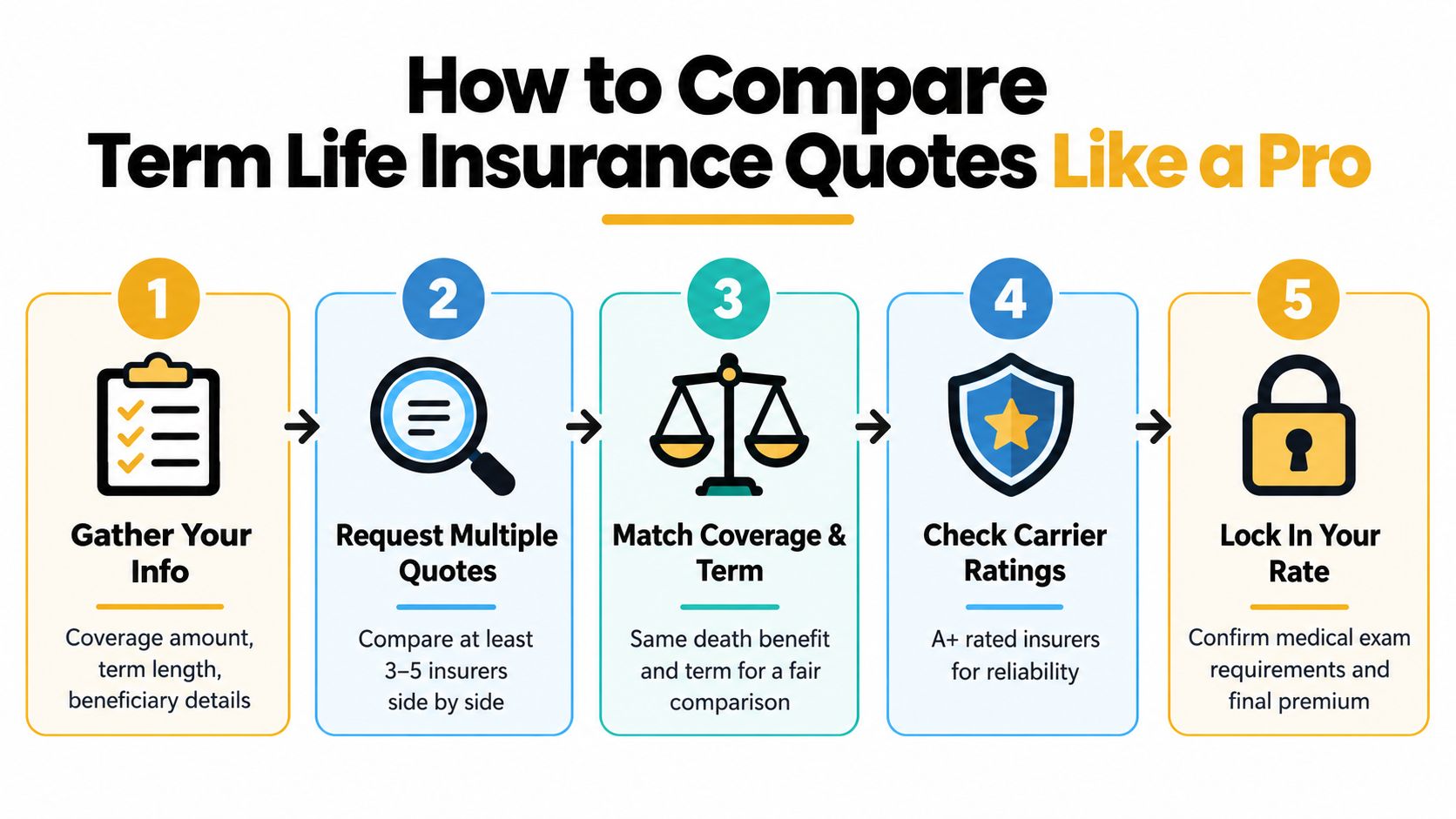
Start by making every quote answer the same question. Decide the coverage amount, term length, beneficiary information, and basic health details before you request offers. If one carrier quotes $500,000 for 20 years and another quotes a different amount or term, you aren't comparing prices, you're comparing different products.
Use a consistent quote checklist
- Confirm the rating class. Ask whether the quote assumes preferred plus, preferred, standard, or another class.
- Verify the rate period. Confirm that the premium is level and guaranteed for the selected term.
- Ask about medical requirements. A fully underwritten policy may require an exam, while simplified-issue and no-exam products use less medical information.
- Review policy features. Check conversion rights, renewability, exclusions, and any riders included in the quote.
- Check the carrier. Look for financial-strength information, licensing, and clear policy documentation.
No-exam coverage can reduce friction, but convenience may come with a higher price because the insurer has less medical information. The verified data confirms that no-exam products and health classes can produce meaningful differences, but it doesn't support a universal premium surcharge for every applicant.
Ask each carrier the same questions in the same order. Consistency makes the quote differences easier to interpret.
If your needs include complex ownership, business succession, or estate planning, a resource on HNWI insurance tax strategies may help you identify questions for a qualified tax or financial professional. That type of planning is separate from choosing an affordable family protection policy, but ownership and beneficiary decisions can affect the broader strategy.
You can also use a term life insurance rate comparison to organize offers around identical coverage parameters. Treat any online estimate as an indication, not a final underwriting decision.
Smart Ways to Lower Your Term Life Insurance Average Cost
The largest savings opportunity usually comes before you submit an application. If you know your family needs coverage, applying earlier can help you lock in an age-based rate before a later application enters a more expensive underwriting band.
Buy enough coverage for the obligation, not an arbitrary round number. The DIME method, which considers debt, income, mortgage, and education, can help you estimate a reasonable death benefit. A human-life-value approach can provide another framework. The right amount depends on what your household would need to replace, not on a slogan about buying a particular multiple of income.
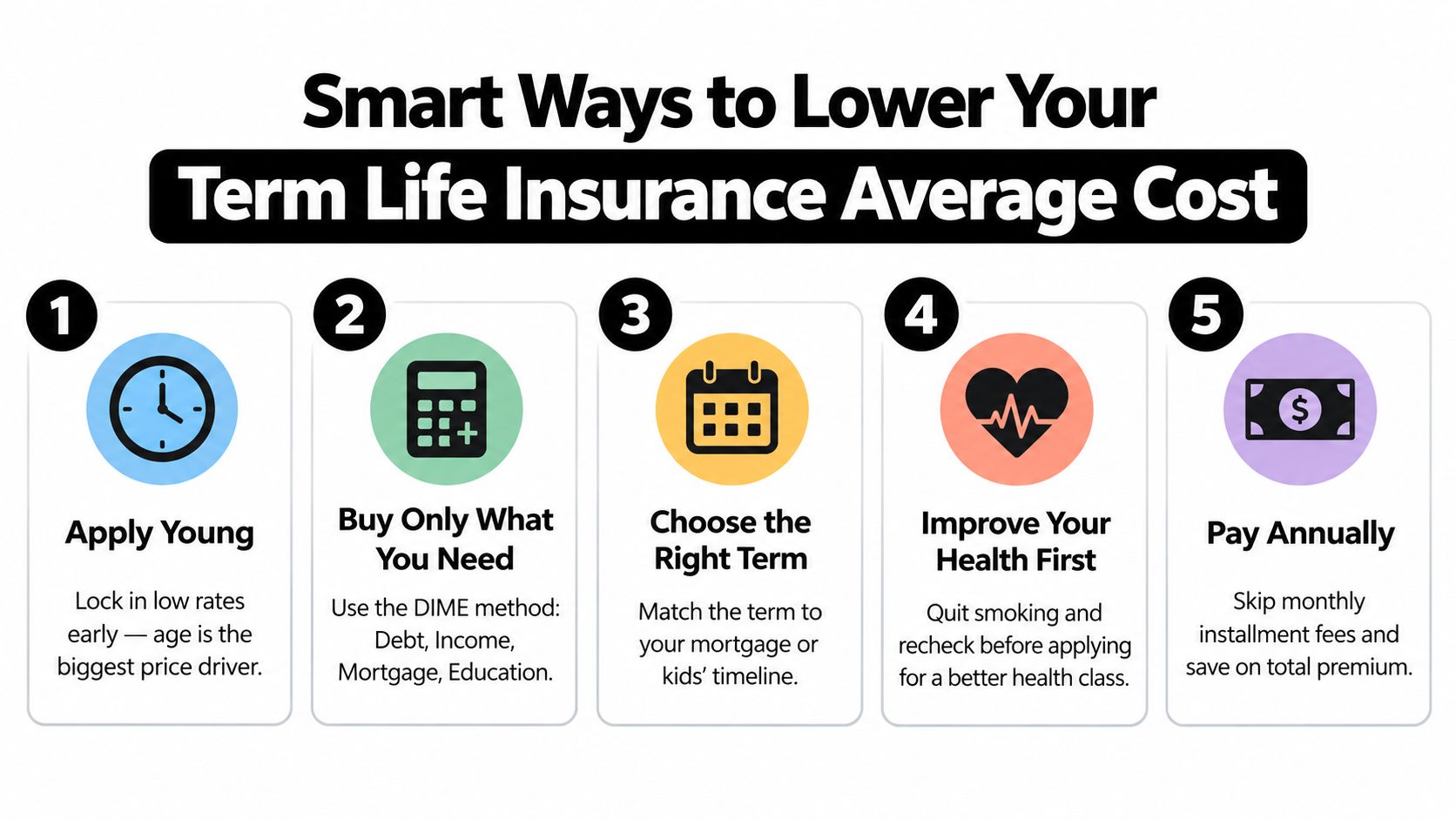
Other practical choices include:
- Choose level premiums: A level term policy makes the payment predictable during the selected term.
- Consider annual payment: Ask whether paying annually avoids installment charges compared with monthly billing.
- Improve your health profile: Managing blood pressure, reaching a healthier weight, and ending nicotine use may support a better underwriting class.
- Use employer coverage carefully: Group insurance can act as a temporary layer, but review what happens if you leave the employer.
- Work with an independent broker: A broker who represents multiple carriers can help identify which underwriting rules fit your profile.
No-exam coverage can be useful when speed or convenience matters, but the verified data doesn't establish one universal extra-cost percentage. Compare the final premium against a fully underwritten offer before choosing convenience.
Watch the video below for another visual explanation of ways to evaluate life insurance costs.
Prioritize your decisions in this order:
- Apply when coverage becomes necessary.
- Set the death benefit around real obligations.
- Choose a term that lasts through those obligations.
- Compare health-class assumptions and carrier rules.
- Balance exam-free convenience against the final premium.
Coveredly helps shoppers review online term life insurance options, including coverage of up to $3 million with no exams for most applicants. Visit Coveredly to compare a policy structure that matches your coverage amount, term length, and family protection needs.