You've just bought a home, or maybe you're staring at a mortgage statement while your kid's school forms sit beside it on the kitchen table. In moments like that, life insurance stops feeling abstract. A key question isn't only whether you need coverage, it's how long life insurance term should last so the protection properly fits the life you're building.
A term policy is easiest to understand when you treat it like a timeline, not a product label. You're mapping coverage to the years when your family would feel the biggest financial hit if something happened to you. That's the idea behind choosing a term that matches your mortgage, your children's dependency years, or the point where your income replacement need fades.
If you're also thinking about legacy planning, a helpful starting point is Secure your family's legacy with Family Folder, because the best insurance choice usually sits inside a wider family protection plan.
Table of Contents
- Matching Your Protection to Your Timeline
- What Is a Life Insurance Term
- How to Choose the Right Term Length for You
- A Closer Look at Common Term Lengths
- What Happens When Your Term Ends
- Choose Your Term with Confidence on Coveredly
Matching Your Protection to Your Timeline
A young couple closes on their first home and feels the relief of finally having a place to call their own. Then the practical questions start. What happens if one income disappears before the mortgage does, or before the kids are grown and self-supporting?
That's where term life insurance makes sense. The decision is less about picking a random number like 10, 20, or 30, and more about deciding how long your family needs a financial backstop. A term policy exists for a specific period, then it ends when that period ends, which makes timing the primary issue, not just the monthly premium.
Practical rule: choose coverage for the latest date among your biggest obligations, not the earliest one you can afford.
That way of thinking is especially useful for families with overlapping deadlines. A mortgage may run for decades, children may need support well into early adulthood, and retirement may be the point where income replacement finally becomes less urgent. A term that ends too soon can leave a gap exactly when the household still needs protection.
For families trying to think through that larger picture, the best move is to line up insurance with the life chapter you're protecting. The right answer usually feels obvious once you write the dates down on paper. The challenge is that the common approach involves starting with the policy term and working backward, when they should be starting with the obligation timeline first.
What Is a Life Insurance Term
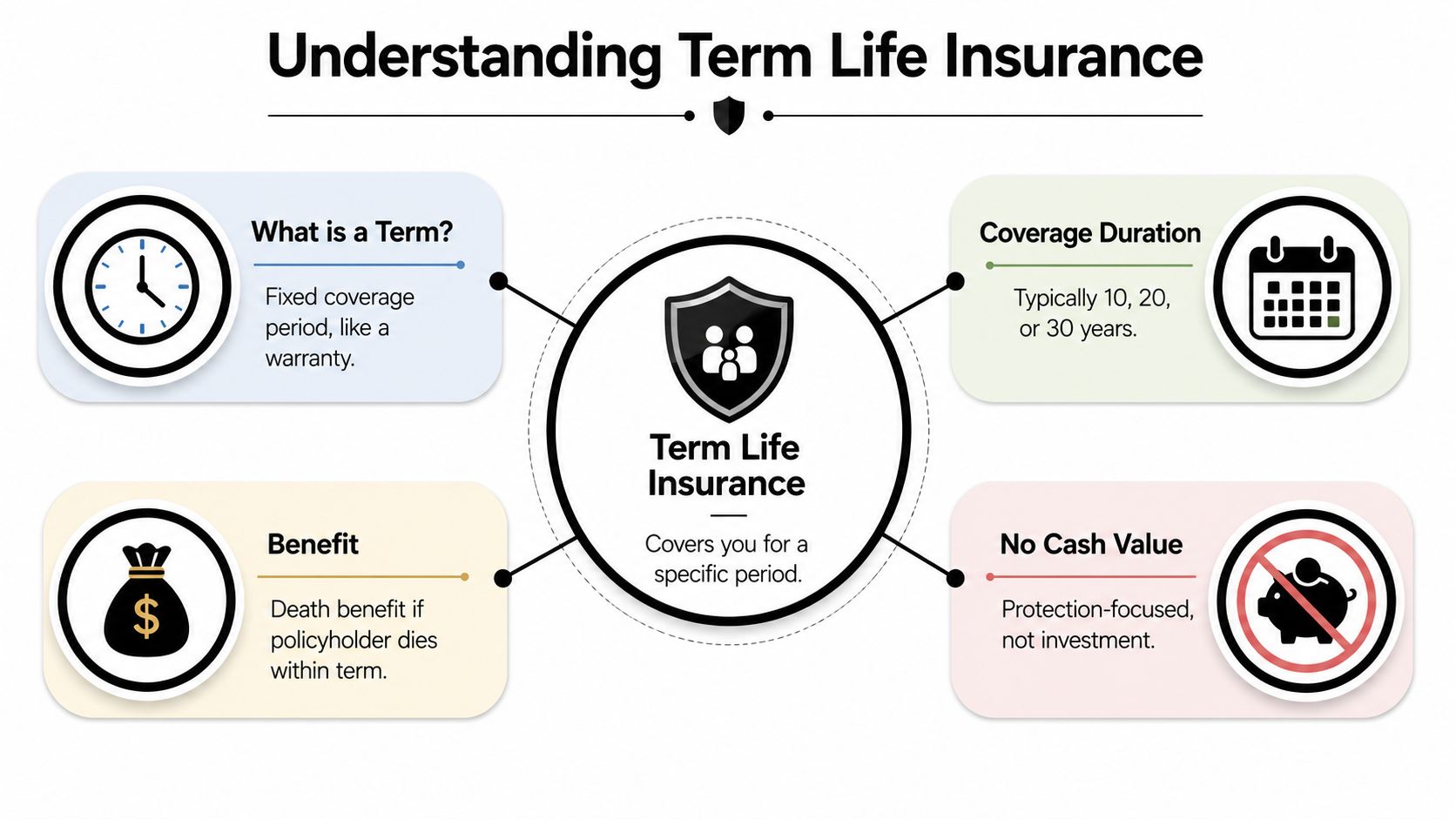
A life insurance term is the fixed period your policy stays active. It functions as a warranty on financial protection. If the covered event happens during the warranty period, the insurer pays the death benefit. If the term ends first, the coverage stops.
That temporary design is the whole point. Term life is built for people who need protection during a specific window, not for life. The most common lengths are 10, 15, 20, 25, and 30 years, and some insurers also offer shorter or longer options, including one-year coverage or terms up to 40 years (Guardian Life).
If you want a plain-English overview of the structure, the internal guide on what is a term life insurance policy is a useful companion. It reinforces the core idea that the policy is designed around a set period, not an open-ended promise.
For many households, the key mental shift is to stop asking, “How long does this product last?” and start asking, “How long do my family's biggest obligations last?” That's why advisers often tie term length to three milestones, the mortgage being paid off, the youngest child reaching about 21, or the insured reaching retirement age (Guardian Life). The term itself is just the container. The primary decision is what you're trying to cover inside it.
One detail people miss is that term insurance usually doesn't build cash value. That means the policy is about protection, not investment. You're paying for a death benefit during a set window, not a savings account attached to the contract.
The simplest way to explain term life is this, it protects a specific chapter of your life, then it ends when that chapter does.
For readers dealing with family or guardianship questions, the Texas-focused resource on understanding life insurance under Texas guardianship can be worth a look, since beneficiary and decision-making issues can become part of the planning conversation.
How to Choose the Right Term Length for You

Start with the longest financial obligation in your life. That might be a mortgage, it might be the years before your children are financially independent, or it might be the period you need income replacement until retirement. The cleanest rule is to make the policy last at least as long as the last major responsibility you'd want covered.
That approach lines up with the practical view that the term length should match the duration of liabilities, not a generic age target (Allstate). Mortgage amortization, child-dependence years, and business debt service each create a different horizon, so one family may need a shorter term while another needs a much longer one.
Here's a simple way:
- Mortgage: If the loan stretches farther than your current policy, the house may still need protection after the coverage ends.
- Children: If your kids would still depend on your income for housing, schooling, or daily costs, the policy should last through that period.
- Income replacement: If your salary is the reason your household stays stable, coverage should reach the point where retirement or assets reduce that risk.
- Business debt: If you've personally guaranteed loans, the policy should stay in force until those obligations are gone.
This is why many households don't fit neatly into a single default term. A shorter policy may look cheaper on paper, but if it expires before your obligations do, the savings can disappear the moment your family still needs protection. A longer term costs more, yet it reduces the chance that you'll outlive the policy while still carrying debt or dependents.
Here's the practical logic. If your youngest child is still years away from independence and your mortgage is even longer, the longer timeline usually wins. If your house will be paid off before your children are grown, then the children's timeline matters more. The term should follow the latest date, because that's the point at which your family would be most exposed.
Don't choose the shortest policy you can afford. Choose the one that still protects the household when the biggest bill or responsibility is still on the books.
A Closer Look at Common Term Lengths
The market has clearly leaned longer in many cases. In 2025, more than 1 in 3 new term policy applicants chose 30-year terms, a sign that buyers often want protection that runs through mortgages and child-rearing years (GITNUX). That doesn't mean 30 years is right for everyone, but it does show how common longer planning horizons have become.
If you're comparing options, it helps to sort them by purpose instead of by price alone. A shorter term can be a fit for a temporary debt, while a longer one works better when your family's dependence period is still unfolding. The term length should feel like a match for the obligation, not a guess.
A helpful resource for that comparison is 30-year term life insurance, especially if you're trying to understand why a longer policy can make sense for younger families.
| Term Length | Best For | Key Pro | Key Con |
|---|---|---|---|
| 10 years | Short, specific obligations | Usually the most focused fit for temporary needs | Can end before a family's bigger responsibilities are done |
| 20 years | Mid-stage family protection | Often bridges a meaningful stretch of child-raising and debt payoff | May still stop before retirement or a long mortgage is finished |
| 30 years | Long mortgages and extended child-rearing years | Better aligned with longer household timelines | Costs more because the insurer covers you longer |
A 10-year term works best when the need is narrow and predictable. Maybe you're covering a business debt that has a clear end date, or you already know a mortgage will be gone well before the next decade ends. It's the lean option, but it's only useful if the obligation really is short.
A 20-year term is the classic middle ground. Many families use it as a bridge between early parenthood and the years when children are grown. It also lines up well when a mortgage and household responsibilities are spread across the same general window.
A 30-year term fits the reader who wants fewer moving parts. If your mortgage is long, your kids are young, or your income matters until late career years, the longer coverage window can feel more natural. It's not a luxury choice, it's a timeline choice.
What Happens When Your Term Ends
A lot of people assume term life just runs until the end and that's the whole story. The issue is what happens if you still need coverage after the policy ends. That's where the planning risk shows up, especially for younger families whose responsibilities often last longer than a 10- or 20-year contract (MoneyGeek).
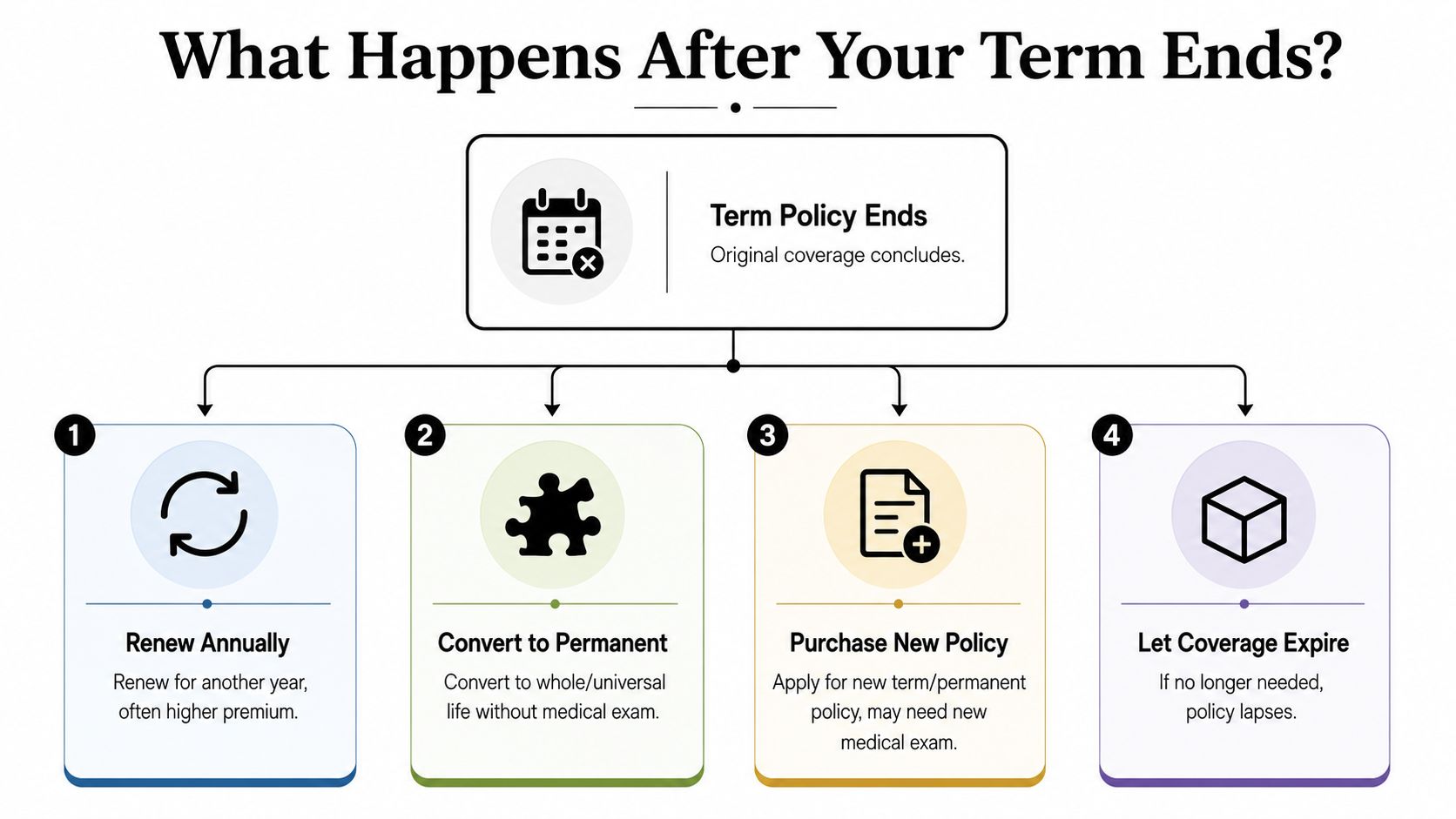
Some policies include renewability and convertibility. Texas consumer guidance explains that renewability lets you extend term coverage for additional terms without a medical exam, while convertibility lets you exchange term coverage for permanent coverage without a medical exam or health questions (Texas Department of Insurance). Those features matter because health can change over time, and getting new coverage later isn't always simple.
If you want a practical explainer on this stage of the process, the guide on what happens when term life insurance expires gives a straightforward breakdown of the choices people face when a policy reaches its end.
The main options are easy to remember:
- Renew the policy: This can keep protection going, but renewal usually comes at a higher price because the insurer is pricing you at an older age.
- Convert the policy: This can move you into permanent coverage without the medical questions that often appear with a new application.
- Apply for new coverage: This can work if your health and budget still support it.
- Let it end: This makes sense only if you no longer need the protection.
The risk for many families is not the first policy term itself, it's the gap that appears later. A couple may buy term insurance in their 30s and assume they'll be finished by the time the policy ends. Then life changes, children arrive later, a mortgage lasts longer, or retirement gets pushed out. That's why renewal and conversion aren't minor footnotes. They're part of the original decision.
If your responsibilities are likely to outlast the policy, the exit options matter almost as much as the starting term.
Choose Your Term with Confidence on Coveredly
The right answer to how long life insurance term should last is usually simple once you stop thinking in product terms and start thinking in timelines. Match the policy to the longest obligation. That could be the mortgage, the years your children depend on you, or the point where your income replacement need finally drops.
That framework keeps you from underbuying coverage just because the premium looks appealing today. It also keeps you from overpaying for a term that runs longer than any real obligation in your life. The best policy is the one that protects the most important years without leaving you exposed later.
For many modern families, flexibility matters too. Some policies include renewability and convertibility, and Texas consumer guidance notes that both features can help when life changes after the policy is issued, because renewability can extend coverage without a medical exam and convertibility can move you into permanent coverage without medical questions (Texas Department of Insurance).

If you're ready to turn the timeline into real coverage, use Coveredly to compare options and see how a term can fit the years you're protecting. A few minutes of planning now can help your family avoid a costly gap later.
A CTA for Coveredly.