You're sitting at the kitchen table with your fiancé, or holding a newborn while doing mental arithmetic. The mortgage is real, childcare is expensive, and one income may not be enough to keep the household running if something happens to either of you. So you search for free online life insurance quotes, hoping a number on a screen will settle the question.
It won't. A quote is useful, fast, and often the right place to begin, but it's an estimate based on the information you provide. It isn't a binding offer, an approval, or a policy. The important work starts when you test the assumptions behind that number and follow the application through underwriting.
Table of Contents
- Why a Free Online Quote Is Just the Starting Point
- What to Gather Before You Request a Quote
- How Online Quote Engines Actually Calculate a Number
- Hidden Costs and Assumptions to Watch For
- Comparing Quotes the Right Way
- From Approved Quote to Active Policy
- Smart Next Steps and Common Questions
Why a Free Online Quote Is Just the Starting Point
A free online life insurance quote gives you a preliminary price for a selected coverage amount and term. The engine usually relies on information such as your age, health answers, nicotine use, location, and desired benefit. If those answers are incomplete, optimistic, or inaccurate, the estimate can change after the insurer verifies your application.
That distinction matters most when your family is making a serious financial decision. A low estimate may assume excellent health, non-smoker status, a particular underwriting class, and a policy structure you haven't fully examined. Treat it as a planning figure, not a promise.
Online buying is becoming a normal starting point for this decision. LIMRA's 2024 Insurance Barometer shows that 32% of U.S. consumers preferred purchasing life insurance online in 2023, up from 31% the year before, while in-person preference fell from 33% to 29%. Online became the leading preference, but that doesn't mean shoppers no longer need licensed guidance or human review.
What the number can and can't tell you
The estimate can help you decide whether a coverage amount appears affordable. It can also help you compare term lengths and identify whether you need to speak with an advisor before applying. It can't confirm the final underwriting class, policy exclusions, approval terms, or effective date.
Most actual purchases still involve more than clicking a quote button. People research online, ask questions, submit an application, respond to verification requests, and review a contract. Younger households are especially likely to start digitally, which makes a clear quote-to-policy explanation more valuable than a flashy price widget.
If you're buying a home or trying to protect a new household, a practical overview of basic life insurance for homebuyers can help you connect the coverage decision to your mortgage and family responsibilities. Start with the risk your family would face, then use the quote to price a sensible solution.
What to Gather Before You Request a Quote
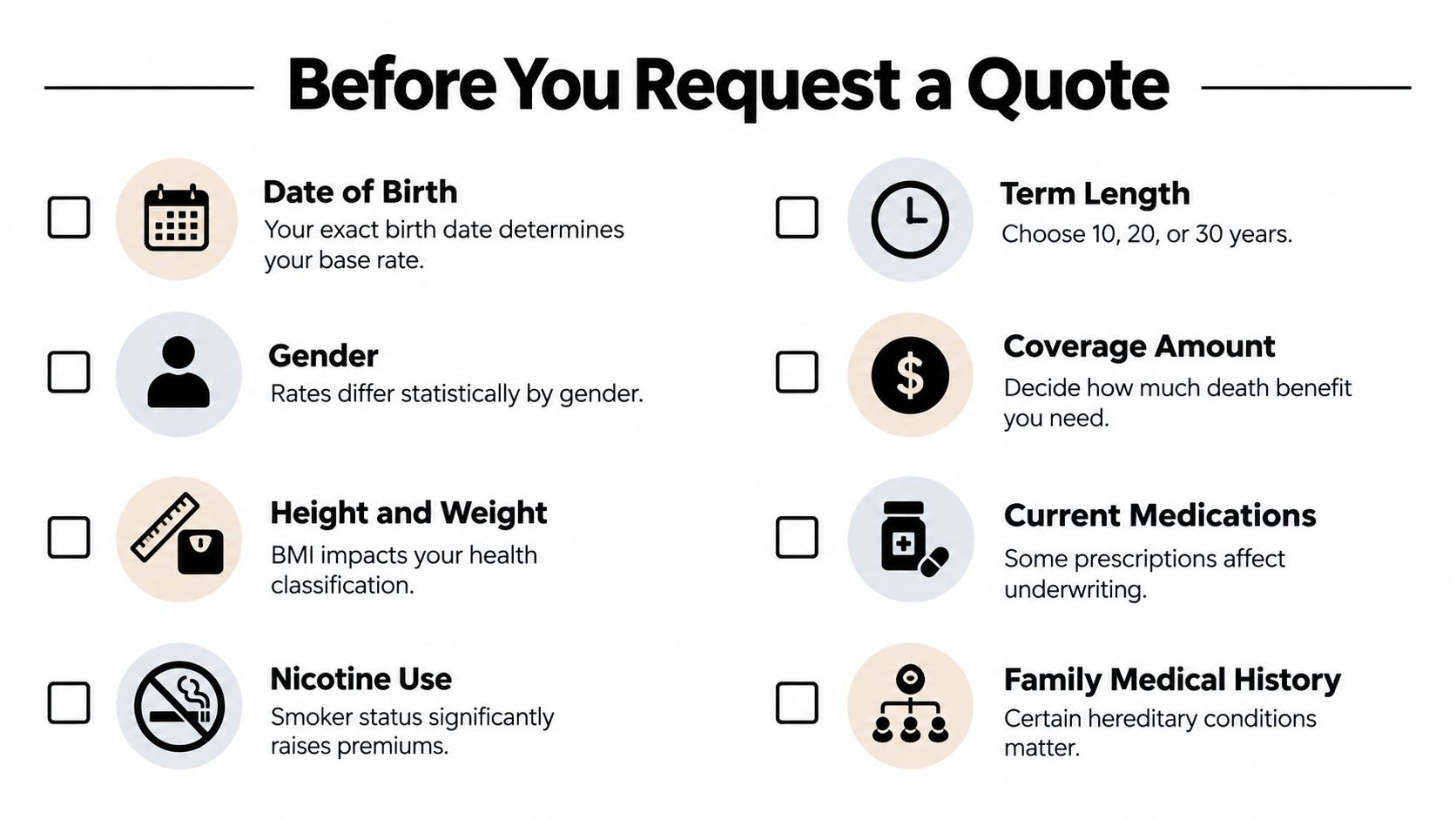
A realistic quote begins with accurate inputs. Pull the information together before opening several quote forms, because changing answers from one application to another makes comparisons unreliable and can create problems during underwriting.
Start with the personal details most quote engines request:
- Date of birth: Use the exact date shown on your identification.
- Gender: Enter the option requested by the insurer and check how the carrier defines its underwriting categories.
- Height and weight: Use current figures rather than a convenient estimate.
- Nicotine use: Include cigarettes, vaping, chewing tobacco, and other products when the application asks.
- State of residence: Licensing, products, and availability depend on where you live.
- Health information: Have diagnoses, surgeries, hospital stays, current medications, and family medical history nearby.
Do the needs analysis before the price comparison
Next, work out the financial problem the policy needs to solve. List mortgage and other debts, income that would need replacing, education goals, final expenses, childcare or household services, liquid savings, employer coverage, and any individual policies already in force.
The basic calculation is straightforward. Add the obligations your dependents couldn't easily handle, then subtract liquid assets and existing coverage. The result is a starting point for the death benefit. Choose a term that matches the period when someone relies on your income or services, rather than automatically accepting the default term shown by a quote form.
A family protection plan guide can help you think through responsibilities beyond salary replacement, especially if one partner provides unpaid childcare or household work. Save your assumptions in a simple worksheet, then use the same figures for every quote.
For an additional explanation of the application process, review how to get a life insurance quote. Don't guess on medical questions. If you aren't sure whether a past diagnosis or prescription matters, ask the insurer or a licensed professional before submitting.
How Online Quote Engines Actually Calculate a Number
An online quote engine isn't judging your entire financial life. It's mapping a defined set of inputs to a preliminary risk price. The main variables are age, gender, health, nicotine use, term length, and coverage amount.
Age affects the expected cost of covering you during the selected term. Health and nicotine use influence the likelihood of an earlier claim. A longer term gives the insurer exposure for more years, while a larger death benefit increases the amount the carrier may have to pay. Each input matters, but the combination matters more than any single answer.
Underwriting class drives the final difference
Two people the same age can receive very different prices because the insurer places them in different underwriting classes. The class reflects the carrier's assessment of health, lifestyle, medical history, prescriptions, driving record, occupation, and other relevant information.
That assessment may happen through traditional underwriting, an exam, or an accelerated process. A no-exam pathway doesn't mean no underwriting. The carrier may review application answers and obtain prescription, motor-vehicle, or medical information. If the verified information differs from the assumptions behind the estimate, the insurer can change the price, request more information, postpone approval, or decline the application.
Millennial households show stronger online-shopping behavior than U.S. adults overall. LIMRA reports that 30% seriously shop for individual life insurance, 26% evaluate quotes, and 18% purchase individual coverage, compared with 19%, 16%, and 10% among adults overall. That behavior makes a transparent digital process important, especially for people who want to research independently before speaking with an advisor.
Practical rule: Save the exact answers, coverage amount, term, and assumptions used to generate every quote. Otherwise, you may compare different products while thinking you're comparing prices.
For a deeper look at the risk review behind the estimate, read about underwriting life insurance. The quote is only useful if you understand which parts are confirmed and which parts remain conditional.
Hidden Costs and Assumptions to Watch For
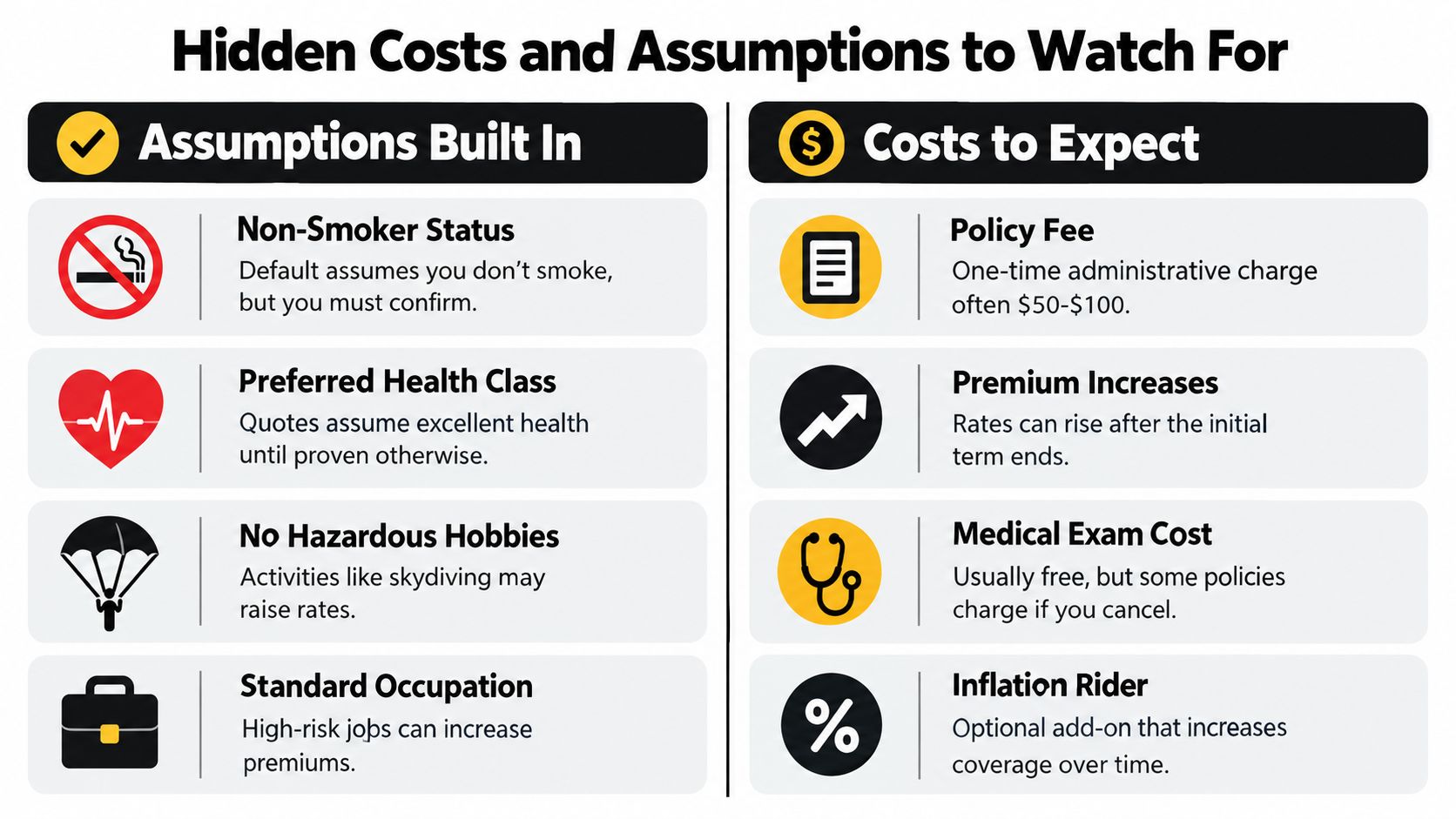
A free quote can look accurate while resting on assumptions you never confirmed. The form may classify you as a non-smoker, preferred-risk applicant, or buyer of a basic policy without riders. If any assumption is wrong, the attractive estimate can change during underwriting.
Many younger adults do not understand how underwriting affects eligibility or price. That gap creates predictable disappointment. Someone sees a low estimate, skips the explanation, then feels misled when the insurer requests records or offers different terms.
Assumptions that deserve a direct question
Ask which underwriting class the estimate uses. Confirm whether nicotine includes vaping, and ask how the insurer treats hazardous hobbies, aviation, overseas travel, or high-risk work. Verify whether the premium stays level for the entire selected term or changes after an introductory period.
“No medical exam” usually means no physical exam, not no underwriting. The insurer may still verify prescriptions, application answers, driving records, or medical information. LIMRA reports that more than half of consumers would be interested in life insurance issued through accelerated underwriting, while 92% researched life insurance online in 2025, up from 71% in 2015. Faster processing can reduce friction, but it does not guarantee approval or preserve the initial estimate.
Review the policy fee, payment schedule, renewal rates, conversion rights, exclusions, and riders. Ask whether an application inquiry affects credit or future insurability, and request a clear explanation of any soft inquiry. If the estimate changes, insist on the specific reason. The insurer should identify what changed and which verified fact produced the new offer. That answer matters more than the original headline price.
Comparing Quotes the Right Way
Put quotes side by side only after making them comparable. A lower headline premium can reflect a smaller death benefit, shorter term, different payment mode, weaker conversion rights, or a more optimistic underwriting assumption.
Use a one-page comparison sheet. Record the carrier, face amount, term, underwriting class, payment schedule, riders, exclusions, renewal structure, conversion privilege, and financial-strength information. Then identify which details are guaranteed and which remain subject to approval.
| Criterion | Why It Matters | What to Check |
|---|---|---|
| Face amount | A cheaper benefit may leave your dependents exposed | Use the same death benefit |
| Term length | Shorter coverage can reduce the initial price but end before the need does | Match the dependency period |
| Underwriting class | The assumed class can make estimates look artificially different | Confirm whether it is preliminary or approved |
| Payment mode | Payment frequency can affect the total cost and cash flow | Compare the same schedule |
| Renewal terms | Post-level premiums may be materially different from the opening price | Review the renewal schedule |
| Conversion rights | Conversion can matter if your health changes later | Check eligible products and deadlines |
| Riders and exclusions | Extra benefits and limitations change what the policy actually provides | Compare the same rider set |
| Carrier strength | A policy is a long-term promise from an insurer | Review financial-strength ratings |
The term life insurance rate comparison guide can help you organize the comparison. Don't choose based on the first number that feels affordable. Choose the policy that solves the right problem with terms you understand.
The National Association of Insurance Commissioners advises applicants to test whether premiums remain affordable if they increase, answer every application question completely and accurately, and confirm that the insurer and agent are licensed in the relevant state. It also recommends checking financial-strength ratings and avoiding replacement of an existing policy until you've thoroughly compared both contracts.
From Approved Quote to Active Policy
After selecting a quote, you complete a formal application. That usually means confirming identity, answering detailed health and lifestyle questions, signing electronically, naming beneficiaries, and authorizing the insurer to verify relevant information. Read every answer before submitting. A casual mistake can produce re-underwriting, delays, claim disputes, or rescission risk.
Accelerated underwriting may rely on prescription history, motor-vehicle information, medical records, consumer data, and the answers in your application. Some applicants receive a decision without an exam. Others trigger follow-up questions, a records request, or an exam because the insurer needs more evidence.
The payment and delivery steps matter
An approval isn't always the same as active coverage. Ask when the policy becomes effective, whether temporary coverage applies, and what event binds the contract. In many workflows, the insurer requires the first premium payment before coverage is placed in force, but the policy documents control. Don't assume the date shown on a quote is the start date.
When the contract arrives, review the insured person, owner, beneficiaries, face amount, term, premium, exclusions, riders, conversion rights, and effective date. Keep the complete policy somewhere your partner can access. If the issued premium is higher than the estimate, stop and compare the reason, not just the amount.
LIMRA reports that approximately 100 million U.S. consumers say they need life insurance, while 66% of prospects who say they need individual coverage report not buying because they believe it is too expensive or have other financial priorities. A careful online process can make the decision easier, but it can't replace the responsibility to finish the application and understand the contract.
Smart Next Steps and Common Questions
A sound purchase comes down to three decisions: how much coverage your dependents need, how long they need it, and which carrier you trust to deliver the stated benefits. Revisit those decisions after marriage, a birth, a home purchase, a major income change, or a change in existing employer coverage.
What if the approved premium is higher?
Ask the insurer exactly which fact changed the offer. If the new price is unaffordable, compare a smaller benefit or different term, but don't hide health information to force the estimate back down. Accuracy is more important than preserving a preliminary number.
Should spouses apply together?
Usually, each spouse needs an individual needs analysis and application because underwriting evaluates each person's risk separately. Coordinate the coverage amounts and beneficiaries, but don't assume one partner's quote or health classification applies to the other.
How is a quote different from an application?
A quote is an estimate based on stated information. An application is a formal request for coverage that authorizes verification and underwriting. Only the approved policy explains the final premium, exclusions, benefits, and effective date.
Get the quote, but keep moving. Gather accurate information, calculate the financial need, compare like-for-like policies, answer the application truthfully, and read the issued contract before treating the job as finished.
Coveredly offers online term life insurance quotes with personalized rates available in minutes, including no-exam options for many applicants and coverage of up to $3 million. Visit Coveredly to start with a quote, then review the assumptions and approval steps before choosing your policy.