It's Tuesday night. The laundry is half-done, one kid is stalling at bedtime, and you're trying to figure out what a 20-year term policy might cost before you forget again. That's how you start. Not with a spreadsheet. Not with a deep love of underwriting. Just a quick search for how to get a quote and a hope that the answer will be simple.
Here's the blunt truth. A life insurance quote is rarely just a price lookup. It's the front end of a risk review, and the quality of what you enter determines whether the number on your screen is useful or fiction.
Table of Contents
- What Getting a Life Insurance Quote Really Means
- Information You Need Before You Request a Quote
- How a No-Exam Online Quote Flow Works
- Realistic Timelines From Quote to Decision
- Tips to Get an Accurate and Competitive Quote
- Common Obstacles and How to Get Past Them
What Getting a Life Insurance Quote Really Means
You type in your age, pick a 20-year term, and get a low monthly number in under five minutes. Good. Now the part that matters starts.
A life insurance quote is not a price tag you can count on yet. It is a pricing estimate based on the risk class the insurer believes you fit, using the answers you gave and the underwriting method that carrier uses. If the quote tool treats the process like a lead form, it misses the point. A useful quote process should help you make two decisions first: how much coverage to ask for, and what kind of no-exam review is likely to be used to price you.
The quote on screen versus the offer you can actually buy
There are two quotes in play.
- Illustrative quote: Built from your self-reported answers
- Underwritten offer: Updated after the carrier checks outside information such as prescription history, medical records, and MIB data
The second one is the one. According to Policygenius' explanation of life insurance underwriting, carriers may issue a same-day decision in some accelerated cases, while traditional underwriting can take weeks because the insurer still has to verify what you entered.
That gap between the screen price and the buyable offer is where shoppers get burned. They compare a handful of teaser rates, assume the cheapest one wins, then find out one carrier uses accelerated underwriting, another uses simplified issue, and a third still wants records or an exam. Those are not small process details. They affect both price and your odds of approval.
Practical rule: Do not ask, “What's the cheapest quote?” Ask, “What coverage amount makes sense for my situation, and how is this carrier going to underwrite me?”
A good quote helps you decide, not just submit
A weak quote form collects contact info and spits out a number. A good one helps you pressure-test the decision.
It should clarify whether you are pricing:
- The right coverage amount, not a random round number
- The right term length, based on how long the financial risk lasts
- The right no-exam path, whether that is accelerated underwriting, simplified issue, or instant decision screening
- A realistic starting price, not a fantasy rate that falls apart during review
That is the job of a quote.
If you only compare monthly premiums, you miss the bigger problem. A slightly higher quote from a carrier whose underwriting fits your health history is often the better buy than a lower teaser quote from a carrier likely to re-rate you later.
If you want the paperwork side to stay organized once you choose a policy, an insurance eSignature free plan can help keep signatures and forms moving without the usual print-scan-email mess.
Information You Need Before You Request a Quote
Open a quote tool without your facts straight, and you get a price that looks useful but is built on guesses. That is how people waste time, pick the wrong coverage amount, and end up surprised when the insurer prices the application differently.
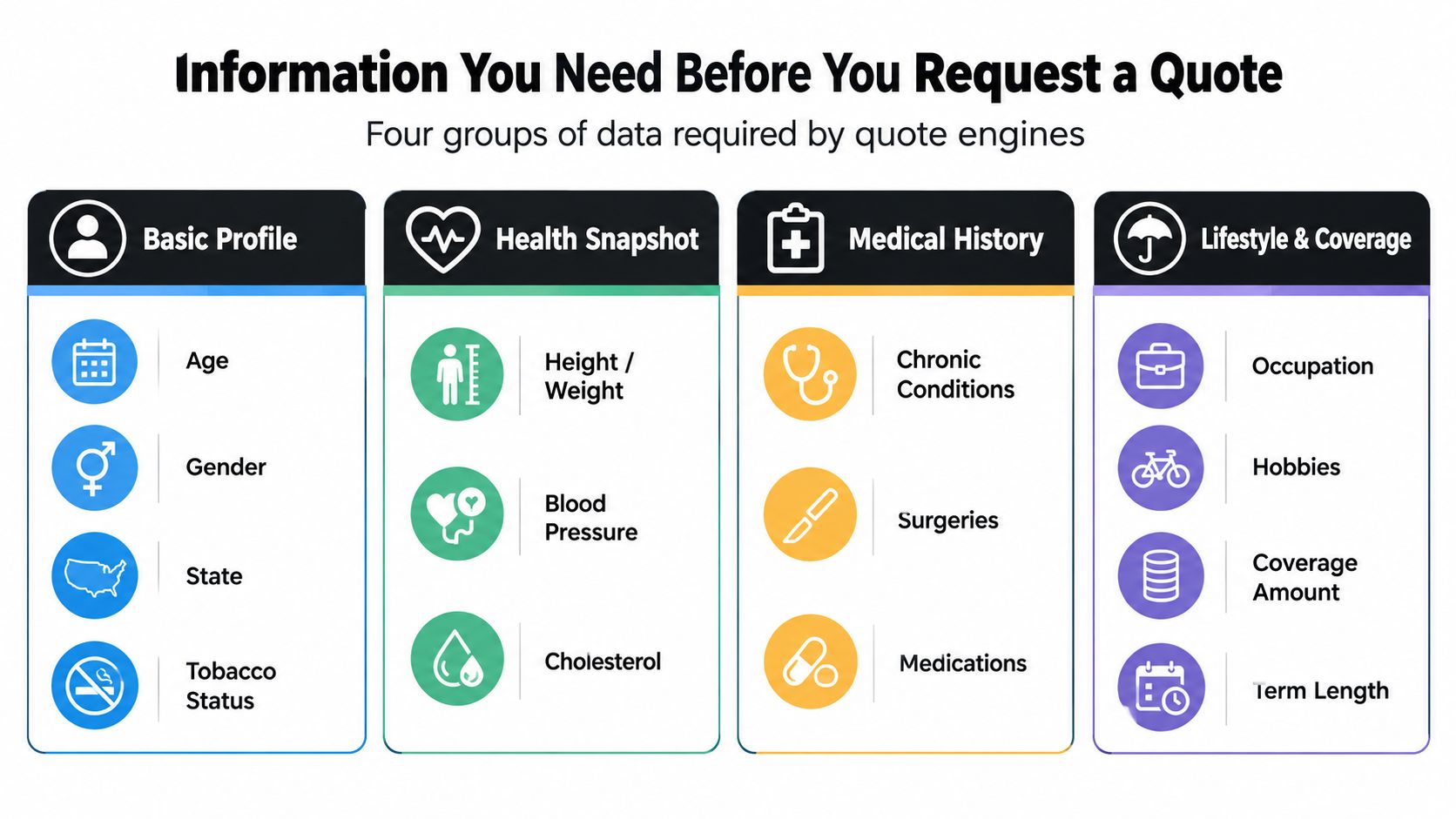
A quote is only as good as the inputs. Before you request one, get clear on two things: what you are asking the policy to do, and what an insurer is likely to find when it checks your records.
Basic profile details
Every quote starts with a small set of facts that affect price right away:
- Age
- Gender
- State
- Tobacco status
These questions are doing real work. A five-year age difference can change pricing. State matters because products and rates vary by location. Tobacco answers matter even more. If you used nicotine recently and mark yourself as a non-user, expect the quote to fall apart once underwriting reviews prescription history or other records.
Be exact. “Social smoking” and “occasional vaping” still count in many cases.
Health snapshot and medical history
Accuracy matters most here. Be precise.
You'll usually need:
- Height and weight
- Major diagnoses
- Surgeries or hospitalizations
- Current prescriptions
Do not rely on memory if you take regular medication or have seen multiple doctors in the last few years. Pull your pharmacy list. Check the dosage. Confirm the reason for each prescription. Small mistakes create bigger problems than people expect, especially in no-exam underwriting where electronic records do a lot of the checking.
A recent visit summary helps. So does a plain-English list of conditions, treatment dates, and follow-up status. If a condition is controlled, say that clearly and answer consistently.
Lifestyle and coverage inputs
This is the part many applicants underestimate. It is also where the quote stops being a lead form and starts becoming a decision tool.
You may be asked about:
- Occupation
- Hobbies
- Recent DUIs or moving violations
- Coverage amount
- Term length
- Beneficiary structure
Occupation and hobbies can affect eligibility or price. Driving history can do the same. Say it upfront. Hidden risk does not stay hidden.
Coverage amount and term length matter just as much. Do not default to a round number because it sounds normal. Ask for enough coverage to replace income, cover debts, and protect the period when someone depends on you financially. Then match the term to that risk window. A 10-year term for a family that needs protection for 20 years is cheap for the wrong reason.
If you want to see how these fields typically carry from quote questions into the actual forms, this guide to an online life insurance application gives a useful look at the process.
What to prepare before opening a quote tool
Use this checklist before you start:
- Medication list ready: Names, dosages, and why you take them.
- Doctor history handy: Major conditions, surgeries, and follow-up dates.
- Lifestyle answers decided: Tobacco, cannabis, hazardous hobbies, and driving issues.
- Coverage target picked: A rough amount based on debts, income replacement, and how long the financial obligation lasts.
- Term length chosen: Long enough to cover the actual risk period.
- Underwriting expectation in mind: Whether your history is likely to fit accelerated underwriting, simplified issue, or a path that triggers more review.
That last point saves a lot of frustration. If you have a clean history, stable build, and straightforward prescriptions, a no-exam quote may hold up well. If you have recent health changes, complex medications, or a spotty driving record, expect more questions and price accordingly.
A clean quote starts before the first click.
How a No-Exam Online Quote Flow Works
You see a low monthly price, assume you're done, and then the review starts. That is how people waste time comparing quotes that were never built on the same underwriting path.
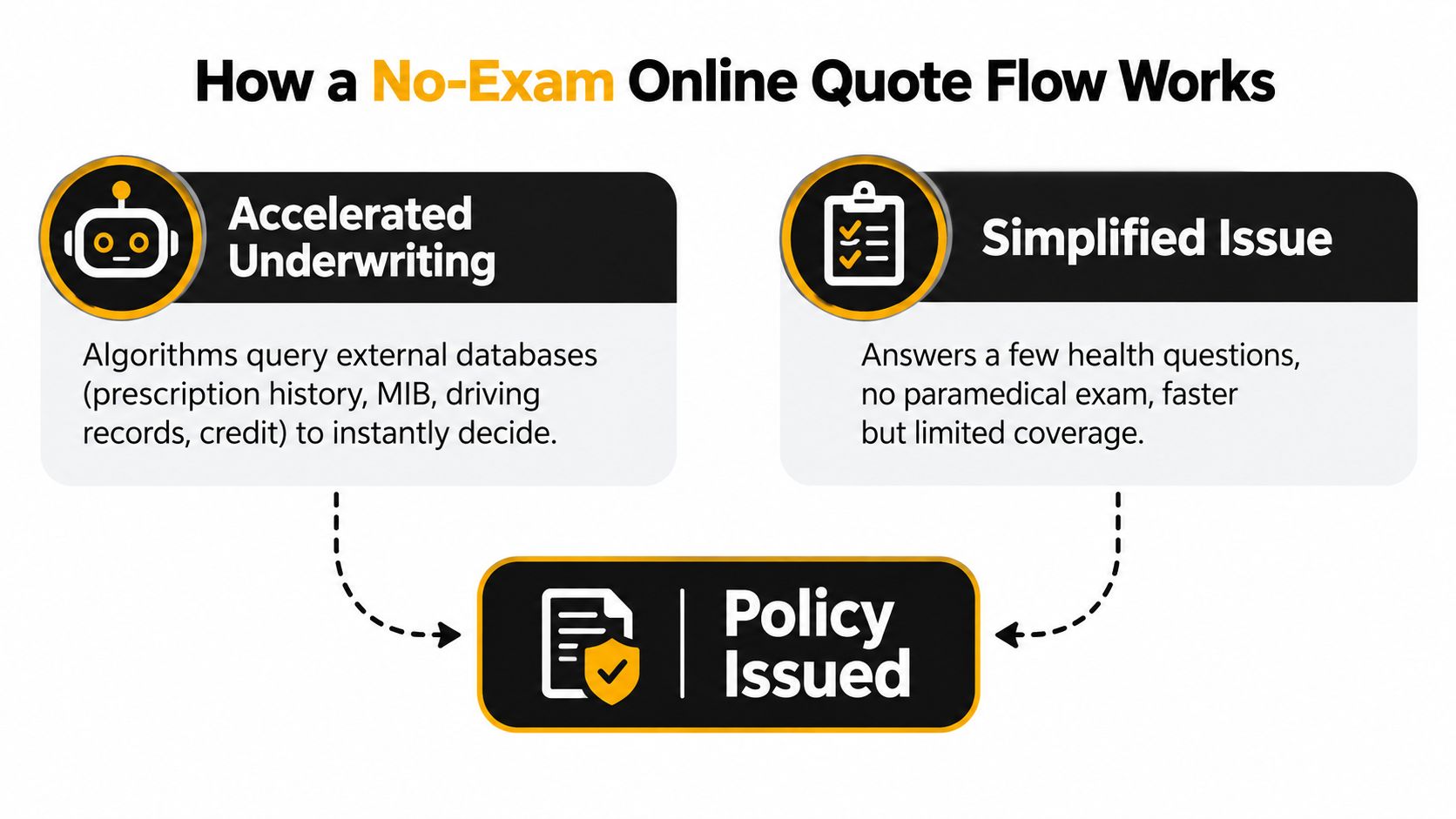
A no-exam quote flow is a screening and pricing process. The carrier skips the nurse visit, not the risk review. It still has to decide two things: whether the coverage amount you asked for fits its rules, and whether your profile qualifies for a faster underwriting track or a more restrictive one.
The two quote paths that matter
Shoppers mix these up all the time, and it leads to bad comparisons.
Accelerated underwriting usually gives the better outcome if your history is clean enough to pass electronic checks. The insurer reviews items like prescription history, motor vehicle records, MIB data, and sometimes electronic health records. Reviews.com explains that accelerated no-exam coverage can return very fast decisions and may price close to fully underwritten policies for healthier applicants in its no-exam life insurance overview.
Simplified issue is a different product lane. It asks fewer questions, but that convenience often comes with tighter face amounts, stricter knockouts, or higher prices. If a quote looks fast but oddly expensive, this is usually why.
The label “no exam” does not tell you which path you're in. Ask anyway.
What the online flow is actually doing
A normal no-exam quote flow usually works like this:
- You enter age, sex, state, tobacco status, coverage amount, and term.
- The tool shows an estimated price range or a carrier lineup.
- You answer a health questionnaire with more detail than the first screen suggested.
- You authorize electronic record checks.
- The carrier matches your answers against outside data.
- The system either keeps you in accelerated underwriting, moves you to simplified issue, or kicks the file to human review.
- You get a firm offer, a revised price, more questions, or a decline.
That middle step is the part people underestimate. The quote tool is not just collecting contact info. It is sorting you into an underwriting lane.
Coverage amount matters here too. Ask for more coverage than the carrier is comfortable issuing through accelerated underwriting, and the quote may still display, but the case can slow down or reprice once the deeper review starts. Ask for too little just to keep the price low, and you solve the wrong problem. A good quote flow helps you choose an amount that fits your actual need and a product lane that can realistically deliver it.
Some carriers automate almost all of this. Others route anything inconsistent to an underwriter. A prescription that does not match your application answer, an old DUI, or a recent specialist visit is enough to change the path.
Before you trust a no-exam price, ask: Is this accelerated underwriting, simplified issue, or a quote that still needs manual review?
If you want a clearer sense of which products usually fall into each bucket, this guide to no-exam term life insurance options is a useful comparison point.
Realistic Timelines From Quote to Decision
You get a price in three minutes, assume you're basically done, and then hear nothing for days. That is the part that throws people.
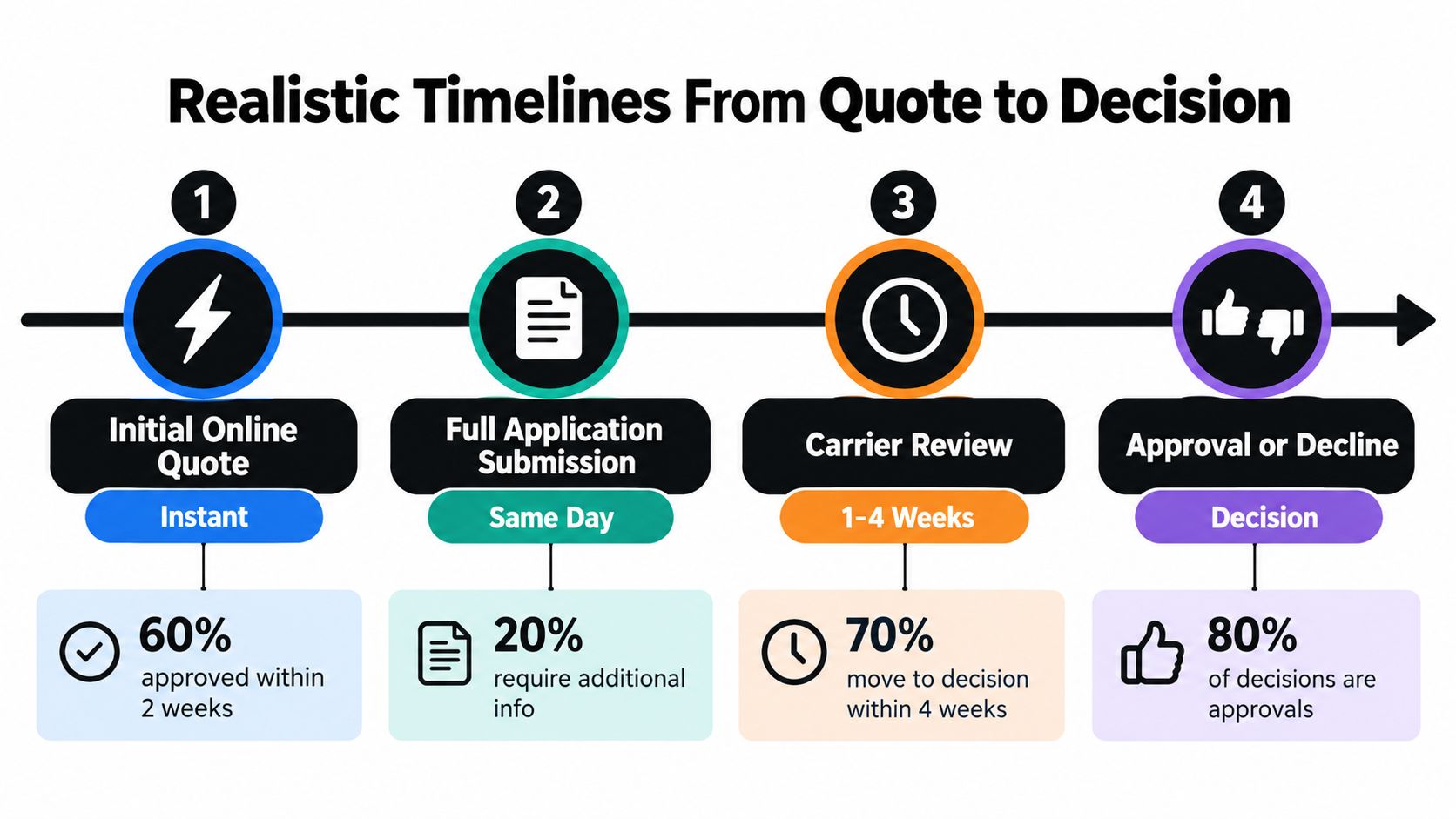
A quote is a pricing signal. A decision is an underwriting outcome. Treating those as the same step is how applicants misread timing, compare the wrong offers, and get frustrated when the "instant" quote turns into a waiting game.
The four checkpoints that actually control timing
Every case has four points where time gets won or lost:
- Initial online quote
- Full application submission
- Underwriting review
- Policy issuance
The first checkpoint is usually fast. The third one decides the timeline.
The Society of Actuaries found that only 43% of life insurance quote tools connect the quote result directly to an online application in its research on quote tool conversion. That gap matters because a fast quote means very little if the buyer then has to restart, wait for a callback, or repeat the same answers in a second system.
What realistic timing looks like
Clean accelerated cases can come back the same day. Cases that stay in simplified issue or need manual review take longer. Full underwriting can stretch into weeks, especially if the carrier orders records or questions something in your history, as noted earlier by Policygenius.
Coverage amount affects timing too. Ask for an amount that fits the carrier's faster no-exam lane, and you have a real shot at a quick decision. Ask for more than that lane usually supports, and the file often gets kicked into a slower review path even if the original quote looked fine.
That is why I tell people to judge quote speed and decision speed separately.
The application itself may only take part of an hour. The waiting starts after submission, when the carrier checks prescription history, medical records, motor vehicle reports, and consistency across your answers. If anything conflicts, the clock resets.
If you want speed, submit early on a weekday and answer follow-up requests the same day.
For a fuller timeline after you apply, this guide on how long it takes to get life insurance breaks down where delays usually happen and which cases move fastest.
Tips to Get an Accurate and Competitive Quote
Shopping for life insurance isn't about collecting the most quotes. It's about getting a quote you can buy at roughly the price shown.
Start with coverage amount, not premium
Beginning backward is risky. Asking, “What can I get for this monthly budget?” is how people end up underinsured.
Start with your obligations:
- Income replacement
- Mortgage payoff
- Childcare
- Education funding
- Final expenses
A rough rule of thumb is often framed around replacing many years of income, but I don't like stopping there. A needs-based number is better because it forces you to decide what the policy is supposed to do. If your spouse needs the house covered and your kids need a few years of support, price that reality, not a random round number.
Tell the truth about lifestyle details
Applicants obsess over blood pressure and ignore the stuff that blows up quotes later.
Be clean and accurate on:
- Nicotine use
- Cannabis use
- Driving history
- Risky hobbies
- Occupation hazards
If you smoke occasionally, say so. If you stopped recently, say that too. Carriers don't reward creative storytelling.
The broader application burden is one reason people quit. According to the Financial Times market announcement summarizing actuarial findings, 79% of applicants cited required effort as the leading reason for abandoning the process, and 63% cited the time required through that application-friction summary. The fix is simple. Give fewer but better answers. Don't restart three times with three different stories.
Compare like with like
If you compare a simplified-issue policy against an accelerated-underwriting policy and only look at the monthly premium, you're not making a fair comparison.
Use this checklist.
| Variable to Match | Why It Matters | What to Confirm |
|---|---|---|
| Term length | A 15-year and 20-year policy won't price the same | Match the exact number of years |
| Death benefit amount | Small differences change premiums and underwriting bands | Confirm the same coverage amount |
| Underwriting type | No-exam products can price very differently | Check whether it's accelerated or simplified issue |
| Rate class assumption | Preferred and standard rates are not interchangeable | Ask what health class the quote assumes |
| Riders and features | Extra benefits can raise cost | Verify whether riders are included |
| Payment structure | Some teaser pricing hides later changes | Confirm the premium is level for the full term |
One more thing. Don't blast applications across a pile of carriers in one sitting. Quote shopping is smart. Messy shopping creates confusion.
If you want one tool-based way to compare options without bouncing from site to site, Coveredly offers a multi-carrier online quote path built around no-exam term life. That's useful when you want to compare structures, not just chase the lowest first number.
Common Obstacles and How to Get Past Them
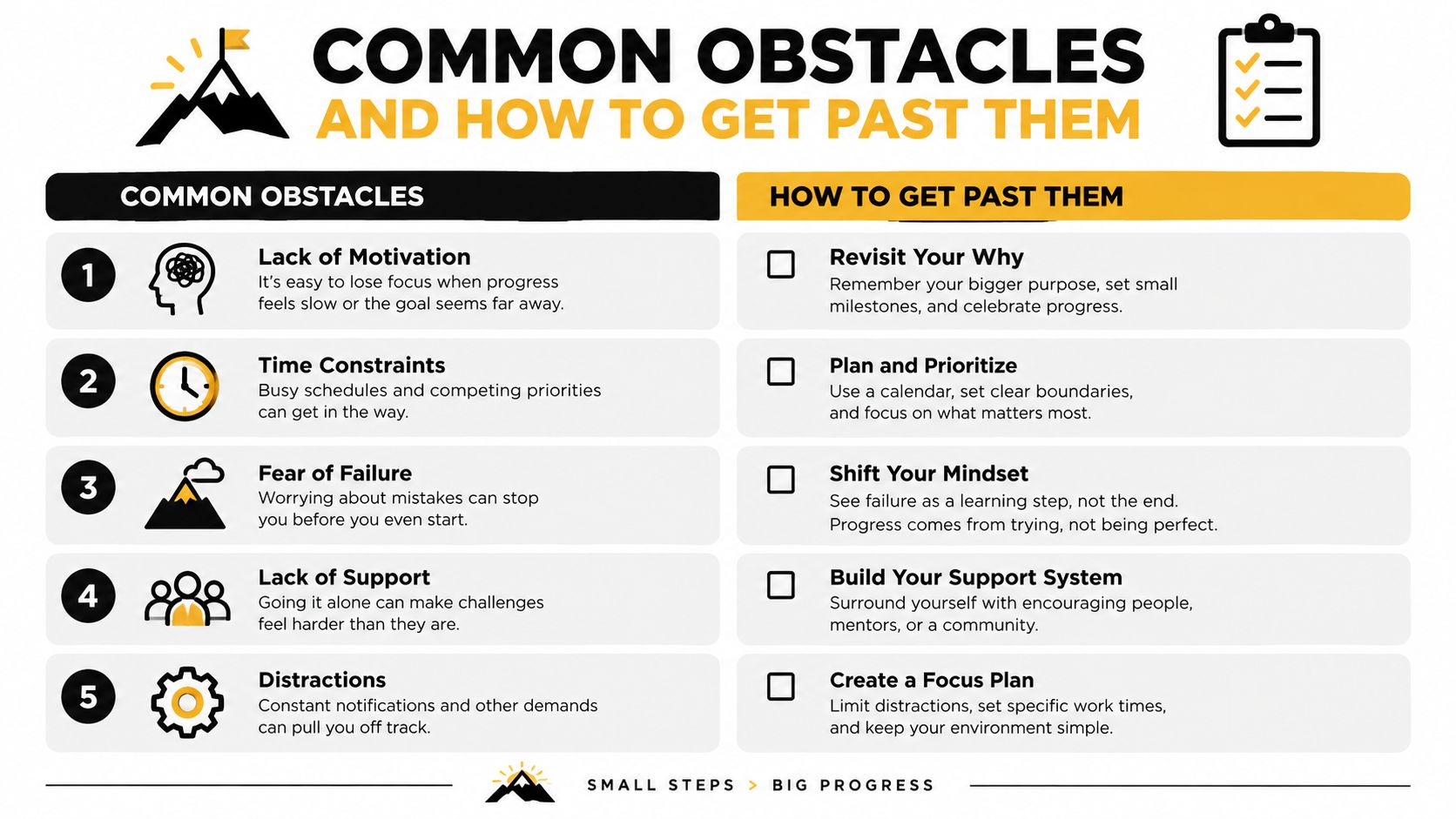
The biggest problem in this market isn't lack of quotes. It's dead-end quotes. People see a price, start an application, and then the case stalls, gets revised, or dies.
The friction points that actually kill applications
Corporate Insight reported that many quote journeys remain incomplete and that insurers still rely heavily on manual or semi-manual quoting, with data-entry redundancy consuming 60% to 70% of quoting time in broker workflows in its analysis of life insurance quote tools. That explains why some quote experiences feel polished until you try to move forward.
Here are the common problems I see most:
- Silent declines: Ask for the reason in writing. If one carrier says no, that doesn't mean all of them will.
- MIB surprises: If a prior application is showing up incorrectly, request your disclosure and dispute errors.
- Prescription mismatches: Pharmacy printouts help clear up dosage changes, prescriber changes, and bad records.
- Recent medical events: Many applicants need time. After treatment or surgery, eligibility often improves later.
- Duplicate submissions: Using different emails, phones, or application details creates avoidable underwriting mess.
How to keep the case moving
Don't assume the system is doing a great job of remembering what you already sent. Document everything yourself.
Use these safeguards:
- Keep one contact identity across every quote and application.
- Save every underwriting request and every item you send back.
- Avoid simultaneous submissions all over the market unless you have a clear plan.
- Respond fast when a carrier asks for clarification.
- Reapply later if timing was the issue, not the product.
Some declines aren't “never.” They're “not yet.”
If you're trying to figure out how to get a quote and turn it into coverage, that mindset helps. A stalled case usually needs better documentation, better carrier fit, or better timing. It rarely needs more random clicking.
If you want a cleaner path than juggling disconnected quote forms, Coveredly lets you get an online life insurance quote, compare no-exam term options, and apply digitally. If you're serious about getting a quote that holds up in underwriting, it's worth starting with a platform built for that full process instead of stopping at the first teaser rate.