It's 9 p.m. The kids are finally asleep, the mortgage paperwork is still on the table, and you're comparing a thin workplace policy with a term quote on your phone. A few years ago that same worry usually waited for an agent appointment and a stack of forms. Life insurance digital transformation is the industry's attempt to meet you in that moment without skipping the risk work that used to happen on paper.
Speed isn't free. Someone still has to read the health facts, price the risk, and stand behind a claim years later. The useful questions, before you tap apply, sit in the back office rather than on the landing page.
Table of Contents
- What Digital Transformation Means in Life Insurance
- The Technology Stack Behind Digital Life Insurance
- How Automated Underwriting Replaces the Medical Exam
- Business Models Driving the Shift to Digital
- Industry Impacts on Costs, Operations and Speed
- What Consumers Gain From Digital Life Insurance
- Future Trends and How to Choose a Digital Policy
What Digital Transformation Means in Life Insurance
A family of three can start a term application from the couch after bedtime. You type a birth date, pick a coverage amount, and answer a short health screen. The older path was slower on purpose: a paper form, a kitchen-table visit, then a medical exam booked weeks out.
Life insurance digital transformation means digital stops being one sales channel and becomes the way a policy is sold, underwritten, serviced, and paid. A paper road atlas and a navigation app share a destination. The route, the live data, and the speed don't. The death benefit is still the destination. What changed is how the insurer gets there, and who absorbs the cost when a shortcut is wrong.

Three parts of the same trip
Front end: quotes, mobile applications, portals, and claim status, which is the only layer most buyers see.
Back office: identity checks, underwriting rules, policy records, billing, and claims.
Connecting data: medical and financial facts, models, and software links so staff don't retype the same answers.
McKinsey reported that 54% of surveyed European consumers preferred direct or digital channels in 2020, compared with 38% before the crisis. More than 90% of new business in China had traditionally been generated face to face. Young families who research coverage on a phone first now expect quotes, applications, and later changes to work the same way, without a branch visit.
The same analysis estimated that digitally enabled customer interactions could reduce customer-acquisition costs by as much as 50%, generate 5-10% of new premiums, and reduce customer churn by up to 30%. Those savings appear only when issuance and service keep up with the click. Carriers that want a practical picture of what actually moved can study digital transformation case studies in insurance rather than a feature list.
A polished phone screen doesn't underwrite the risk. The systems behind it do.
If the back office still runs on overnight batches and mailed files, the app is a prettier waiting room. That's the part worth unpacking before you share medical history.
The Technology Stack Behind Digital Life Insurance
A digital policy moves through layers, not a single app. Read the stack from the top down. Each row is a handoff. If a middle row is missing, the rows above it can't stay fast.
| Layer | Technology | What It Replaces | What the Buyer Notices |
|---|---|---|---|
| Acquisition | Online quotes and mobile application with prefilled data | Paper forms and agent visits | Quote and application completed on a phone |
| Identity and intake | Electronic identity checks and e-signature | Notarized or mailed paperwork | Signing and verification from home |
| Data retrieval | OCR and natural-language processing for documents | Manual reading of medical and financial records | Fewer document requests and faster decisions |
| Risk assessment | Rules engine with predictive models | Blanket medical exam for every applicant | Many applicants skip the exam |
| Policy administration | Cloud core systems connected through APIs | Batch processing and manual rekeying | Quicker issuance and online policy changes |
| Servicing and advice | Portals, chatbots and recommendation engines | Phone calls and annual paper statements | Self-service changes and timely reminders |
| Claims | Digital claim intake and document upload | Mailed claim forms | Faster filing and visible claim status |
How a case actually moves
Acquisition starts with an online quote and a mobile application that prefills what the carrier already knows, so you aren't copying a paper kit by hand.
Identity and intake checks who you are and captures an e-signature at home, instead of a notarized packet in the mail.
Data retrieval uses optical character recognition and natural-language processing to read records that clerks used to sort page by page.
Risk assessment runs a rules engine beside predictive models. That pairing is what lets some telemedical and no-exam policies exist at all.
Policy administration sits on cloud core systems joined by APIs, so issuance and later changes don't wait for a nightly batch.
Servicing uses portals, chatbots, and reminders for address changes, beneficiary updates, and payment questions.
Claims takes a digital filing and uploaded documents, with a status you can see.
Connection beats any single tool. A glossy application bolted to a legacy batch system still forces rekeying, and rekeying is where days disappear. Straight-through handling only pays off when the decision can be executed without someone typing it again, which is the point of straight-through processing in insurance.
How to read the table before you apply
Ask which middle layers the provider can show: document reading, the rules engine, and an API-connected policy record. If those answers stay vague, expect slow decisions and repeated document requests, no matter how clean the quote screen looks.
How Automated Underwriting Replaces the Medical Exam
A traditional file asked for a long questionnaire, medical-record orders, lab work, and a person reading all of it. A digital file prefills known facts and sends low-risk cases down a faster route. The exam didn't vanish for everyone. It became one path among several.
Two jobs have to stay separate. Extraction pulls facts out of documents. Adjudication decides what those facts mean for price and eligibility. Mixing them is how a fast system becomes a black box.
Swiss Re describes systems that combine optical character recognition, natural-language processing, and large language models to ingest structured and unstructured applicant information, normalize it into common metrics, and present it on an underwriter dashboard. Digital data, automation, and predictive analytics can shorten and reduce the invasiveness of risk assessment while improving risk selection and pricing. A sound build keeps an auditable raw-data layer, stores normalized features with provenance, applies versioned rules or models, and writes a complete decision log.
A worked split
Say a 34-year-old non-smoker applies for a moderate term amount and the data sources agree. That file can clear on an instant path. An applicant with a recent diagnosis doesn't get the same shortcut. The case goes to an underwriter, who may request physician statements before offering, rating, or declining.
Evidence often includes prescription histories, motor vehicle records, credit-based insurance scores, and shared industry databases. A human steps in when model confidence is low, data is incomplete, or a risk threshold is crossed. Production controls should include calibration testing, drift monitoring, and bias analysis across protected or proxy segments, so speed doesn't shift who gets covered.
| Underwriting Path | When It Applies | Evidence Used | Applicant Action |
|---|---|---|---|
| Instant decision | Moderate term amounts with clean data matches and low-risk profile | Prefilled application and data-source checks | Answer questions and consent to checks |
| Accelerated review | Minor data gaps or somewhat higher amounts | Additional database and record checks | Confirm details and upload any requested document |
| Telemedical or paramedical exam | Higher amounts, risk flags or age-based requirements | Phone or in-home exam, lab tests and selected medical records | Schedule the visit and authorize records |
| Underwriter referral | Conflicting data or unusual medical history | Full file reviewed by a human underwriter | Supply physician statements or clarifications |
| Decline or rated offer | Risk outside underwriting guidelines | Full file and written explanation | Review the reasons and ask about appeal or alternatives |
Before you start, write down an accurate health history, a current medication list, and the names of treating physicians. Those three items prevent most of the back-and-forth. If you want a closer look at how carriers sort these paths, see life insurance underwriting.
Prepare the health facts yourself. Don't let a rushed screen answer become the official record.
Business Models Driving the Shift to Digital
Buyers are already purchasing coverage online. Swiss Re found that more than 40% of consumers in advanced markets and 50% in emerging markets had bought insurance online. Inside the companies, the picture is thinner. Only 10% of firms were able to implement end-to-end machine-intelligence systems, while 80% lacked data clean and curated enough for the most productive applications. That's why two sites that look alike can run on completely different economics.
Each model answers two questions. Who owns the customer relationship, and who carries the underwriting risk if the fast decision is wrong?
| Business Model | How It Earns | Main Strength | Main Risk |
|---|---|---|---|
| Direct-to-consumer online carrier | Sells term policies straight to buyers | Lower distribution cost and clear pricing | Must build brand trust without agents |
| Insurtech partner model | Technology firm runs the front end while a licensed insurer underwrites | Faster product launch and shared technology cost | Depends on partner and raises data ownership questions |
| Embedded distribution | Coverage offered inside a lender, employer or retailer journey | Reaches buyers at life events | Narrow product choice and possible conflicts of interest |
| Hybrid digital and advisor | Digital quote and enrollment with human backup | Stronger trust at complex decisions | Higher servicing cost per policy |
| Platform or managing general agent | Sources and manages coverage across several carriers | Choice of carriers in one place | Commission structure must be disclosed clearly |
A direct-to-consumer carrier, including online issuers such as Coveredly alongside older direct writers, sells term straight to the buyer and keeps the relationship. An insurtech partner runs the screen while a licensed insurer holds the risk, which speeds a launch and muddies who owns your data. Embedded coverage shows up inside a mortgage, payroll, or checkout flow, which is convenient and often narrow. A hybrid keeps a person available when the decision gets hard, at a higher cost per policy. A platform or managing general agent shops several carriers, so the commission has to be visible.
LIMRA identified middle-income Americans, households earning $50,000 to $149,999, as the largest opportunity, with four in ten of them, about 50 million adults, acknowledging a coverage gap. Many of those households lean on a workplace policy alone, so the model behind a "free quote" changes what they can buy. Check who issues the contract, who stores the data, and who pays the claim. A plain map of the direct path is in this note on direct-to-consumer life insurance.
Industry Impacts on Costs, Operations and Speed
An isolated pilot that drafts emails or summarizes one file doesn't redesign the business. A domain-level change rewires a whole journey, from the first identity check through the claim.
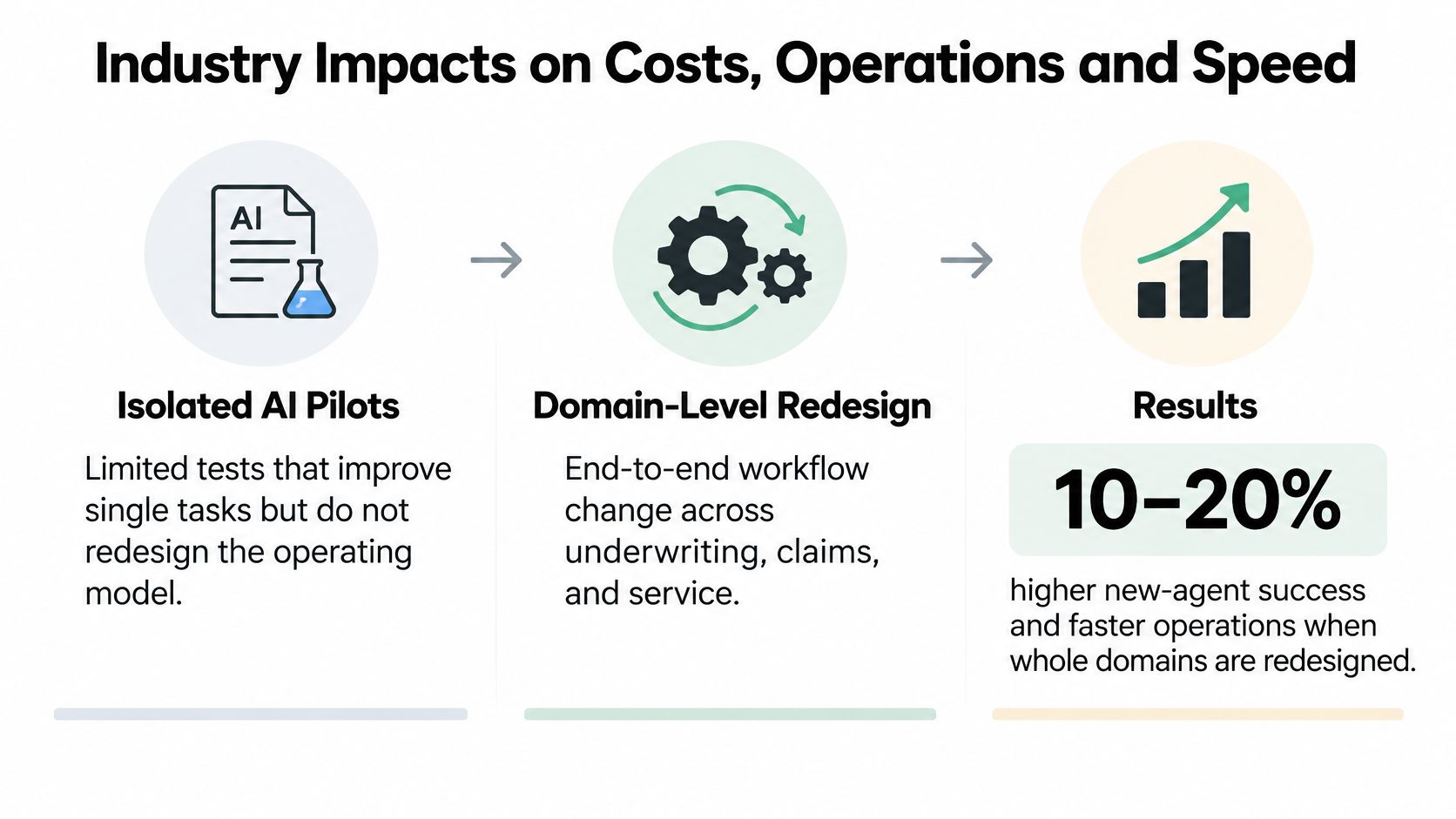
McKinsey reports that insurance organizations applying AI through domain-level operating-model redesign, not isolated pilots, have achieved 10-20% higher new-agent success and sales-conversion rates, 10-15% premium-growth increases, 20-40% lower new-customer onboarding costs, and 3-5% better claims accuracy. Those lifts show up when automation spans identity and application intake, external-data retrieval, underwriting rules, policy issuance, servicing, and claims.
The workable architecture is a reusable data-and-AI layer tied to policy-administration systems through APIs, with a person for exceptions. Straight-through processing creates value only when upstream data is standardized and the decision can post without rekeying. Claims are part of that chain, not a separate project. Teams comparing intake tools can review technologies for automated insurance claims against the same test: does the tool close the file, or only chat about it?
A short walk-through of why bolt-on tools stall is here.
Seven numbers that tell you if it's working
Split each metric by age, amount, data source, and underwriting outcome. An average can look healthy while one age band is stuck.
| Metric | What It Measures | Why It Matters | Warning Sign |
|---|---|---|---|
| Straight-through processing rate | Share of applications decided without manual handling | Drives onboarding cost | Rising rate after standards are loosened |
| Application completion rate | Share of started applications that are submitted | Shows friction in the digital journey | Drop-off concentrated in one question or age band |
| Submission-to-decision time | Elapsed time from submission to a decision | Shapes the customer experience | Long tails for specific segments |
| Onboarding cost per issued policy | Total acquisition and onboarding cost divided by policies issued | Shows economic return on digital investment | Costs hidden in shared technology budgets |
| Referral and exam rate | Share of applications needing extra evidence or a clinical exam | Shows how far automation reaches | High rate may mean rules are too strict or data is thin |
| Post-issuance correction rate | Policies that need changes after issuance | Signals data quality and extraction accuracy | Rising corrections after new data sources are added |
| Loss-ratio stability by segment | Claims relative to premiums for each cohort | Confirms that faster underwriting keeps risk selection sound | Needs several years of data before it is conclusive |
Gains stall in three places: fragmented data, legacy cores that can't take an API update, and automation that shortens the clock without improving the risk picture. A faster decline is not a better underwriting result.
What Consumers Gain From Digital Life Insurance
Take a household with a $60,000 salary, a $200,000 mortgage, and two children. A simple death-benefit sketch starts with income replacement for a set number of years, then adds the mortgage, other debts, and a slice of education cost, then subtracts what a workplace policy already pays. The gap is often larger than the group certificate suggests, and a digital quote can show that math in one sitting instead of a binder.
Three gains follow when the back office is connected.
Speed: straightforward cases that once waited weeks can clear in minutes, because the exam and the paper chase were the wait, not the pricing itself.
Access: skipping an appointment matters if your schedule doesn't have a free morning for a paramedic visit.
Clarity: a premium estimate in plain language, plus a scenario that moves when income or debt moves, beats a single number with no assumptions attached.
That household isn't an outlier. In the LIMRA and Life Happens 2024 Insurance Barometer Study, 42% of U.S. adults said they needed life insurance or needed more coverage, and more than 54 million younger adults, Gen Z and Millennials, reported a coverage gap. Younger adults were more likely than the general population to say they needed coverage.
Price confusion makes the gap worse. A 2024 LIMRA and Life Happens infographic reported that 49% of younger adults, 21 million people, overestimated the cost of life insurance. A transparent estimate, with the term length and the health class written next to the premium, is how a digital journey earns the click.
What to check on the estimate
Assumptions: years of income replaced, debts included, and whether workplace coverage was subtracted.
What changes later: marriage, another child, a new mortgage, or a job change should be a reason to rerun the number, not a surprise at claim time.
If the estimate won't show its assumptions, treat the premium as a teaser, not a plan.
Future Trends and How to Choose a Digital Policy
Three shifts are already visible, and none of them is "the agent disappears."
Life-event recommendations. Engines can suggest a coverage review at marriage, a first child, or a new mortgage. The useful version states its assumptions, including dependents and inflation, and doesn't turn every birthday into a sales ping.
Consent-based continuous underwriting. Device or wearable data belongs in a file only with clear, revocable consent. A checkbox buried in a privacy policy isn't that consent.
Hybrid guidance. Digital steps handle the routine file. A person is available when the amount, the health history, or the family situation stops being routine.
LIMRA's look at consumers under 40 found that 59% want direct digital engagement, yet only 31% of surveyed insurers provide enabling platforms. 77% expect data-driven recommendations, while only 16% of insurers deliver them at scale. Separate 2025 research in that same release reports that 51% of consumers use AI for insurance research and 55% for shopping, but only one in four would complete a life-insurance purchase entirely online.

Most buyers still want a human at the critical moment. The choice isn't online versus agent. It's digital guidance with a person you can reach.
Six questions to put in writing
- Which data sources are collected? Prescription files, motor vehicle records, credit-based data, and any device data should be named.
- Can I correct inaccurate information? Ask for the path and the clock, not a promise that "the system is accurate."
- Why was coverage limited or declined? You want the reason in writing, tied to a guideline, not a score with no explanation.
- Can I reach a human at a decision point? Name the moment: a rated offer, a postponed case, or a benefit that doesn't match your dependents.
- What assumptions sit behind the premium estimate? Dependents, inflation, term length, and existing workplace coverage should be on the page.
- What events trigger a policy review? Marriage, a child, a mortgage, or a business start should be listed, without a marketing blast attached.
Before you apply, line the offer up against the underwriting paths, instant, accelerated, exam, referral, or rated, and send those six questions to the provider in writing. Keep the replies with your application. That's the file you'll want if a decision later needs a second look.
Coveredly offers online term life insurance, with no exams for most applicants and coverage you can adjust as income, debts, and family needs change. That kind of digital path only helps if you know which data is used and when a person still reviews the file. When you're ready to compare a quote against the questions above, visit Coveredly.