A limited-pay life policy has premiums due only for a defined period, such as 10 or 20 years or until a stated age, while the death benefit generally continues for life. Each premium is higher than ordinary whole life because the insurer collects the funding over fewer years.
But does finishing the bills sooner leave your family better off? A payment finish line can be reassuring, yet it doesn't help much if reaching it leaves you short of emergency cash or unable to afford enough coverage.
Table of Contents
- What a Limited Pay Life Policy Has
- Limited Pay Versus Whole Life and Term
- Ten Pay Twenty Pay and Paid Up Ages
- Premiums Cash Value and the Illustration
- Limited Pay Is Not the Same as Fully Paid Up
- When Shorter Payments Help or Hurt
- Take the Next Coverage Step
What a Limited Pay Life Policy Has
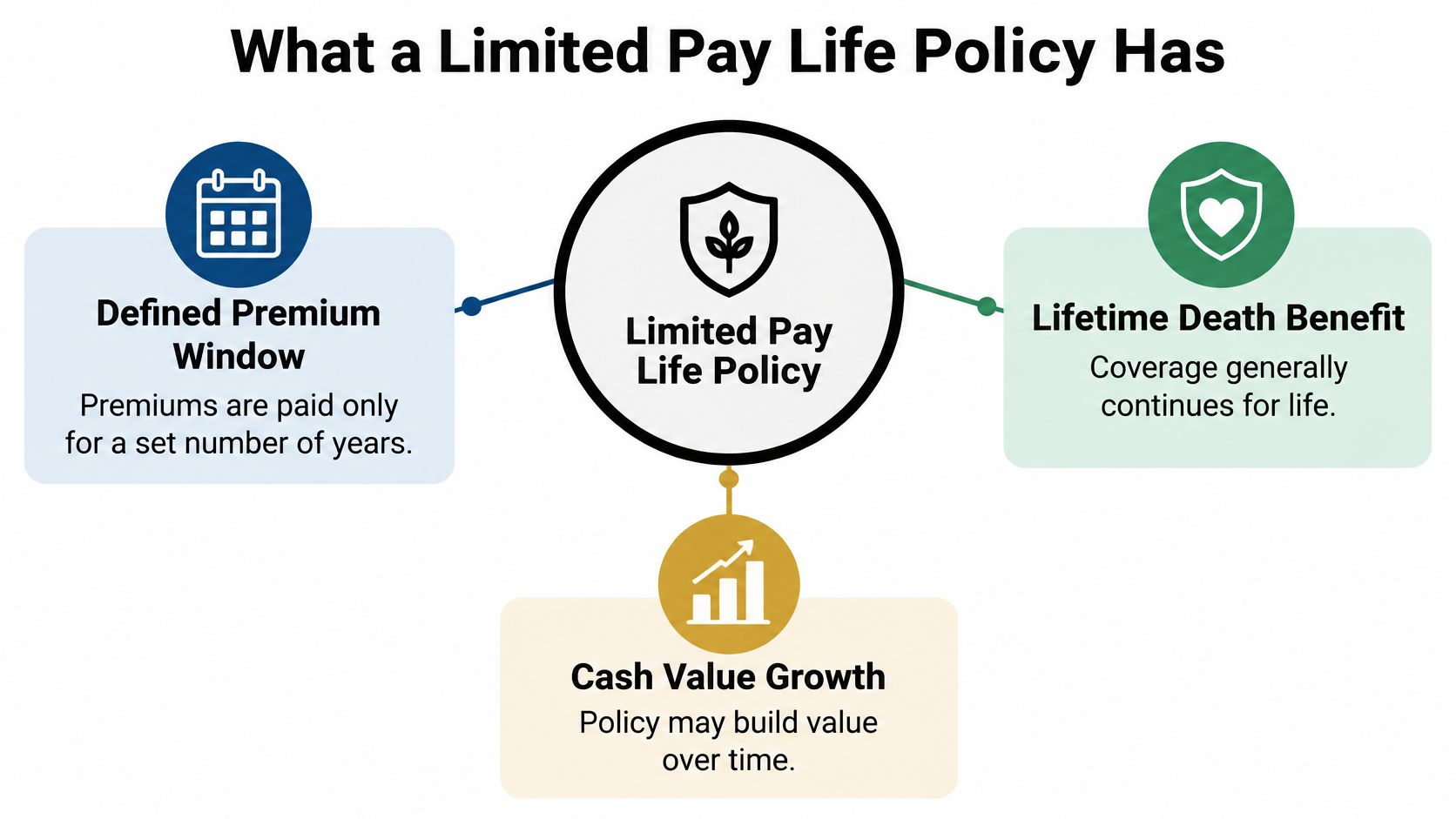
A limited pay life policy has a shorter payment window, a generally lifelong death benefit, and cash value that builds while the contract stays in force. Limited pay describes when you pay, not when your protection ends.
Think of the difference between a shorter mortgage and a longer mortgage. Compressing repayment raises the regular bill and brings the finish line forward. The analogy isn't exact, since insurance funds a death benefit rather than home ownership, but it captures the household budgeting trade-off.
A finish line for premiums
Say a newly married professional wants permanent coverage but doesn't want insurance premiums competing with retirement spending. Limited pay life insurance offers a contractual premium period that can end while lifetime coverage continues.
The New York Department of Financial Services describes 10-pay and 20-pay whole-life policies, along with policies paid up at a stated age such as 65 or 85, and explains that the shorter payment period makes each premium higher than ordinary whole life.
The features work together rather than as separate promises.
A payment schedule isn't a discount
Your age, health assessment, policy guarantees, cash-value provisions, and chosen schedule all affect the price. Paying over a shorter period doesn't automatically produce a lower lifetime cost.
- Premium window: Your contract identifies when required payments end.
- Death benefit: Your beneficiaries generally remain protected for life if the policy stays in force.
- Cash value: The policy develops a value you may be able to access under its terms.
Ordinary whole life spreads payments over a longer schedule, potentially throughout life. Term insurance instead protects you for a stated period and doesn't build cash value.
The comparison table separates those payment, protection, and cash-value features so a shorter premium period doesn't get mistaken for shorter coverage.
Limited Pay Versus Whole Life and Term
| Feature | Limited-pay whole life | Ordinary whole life | Term life |
|---|---|---|---|
| Premium period | Fixed years or until a stated age such as 65 or 85 | Often for as long as the insured lives | Only during the term, commonly 10, 20, or 30 years |
| Size of each premium | Higher, because funding is compressed into fewer years | Lower annual premium than limited pay for the same death benefit | Lowest of these designs for comparable coverage, because it's pure protection |
| Death benefit | Generally continues for life after the pay period | Continues for life while the policy stays in force | Paid only if death occurs during the term |
| Cash value | Builds while premiums are paid and the policy stays in force | Builds as premiums are paid | None |
| After the payment window | No further required premiums if contractual conditions are met | Premiums usually continue | Coverage ends unless renewed or converted under available provisions |
| Best fit | Buyers who can fund permanent coverage during peak earning years | Buyers who want permanent coverage with a smaller annual bill | Families who need large affordable protection for a defined period |
What limited-pay, ordinary whole life, and term each provide.
Limited pay is a whole-life variation
The important distinction isn't limited pay versus whole life as though they're unrelated products. Limited-payment whole life is a form of whole-life insurance. Its defining difference is the premium schedule.
The National Association of Insurance Commissioners describes limited-payment contracts as having fixed premium terms with coverage continuing for the remainder of the insured's life. To support that lifetime obligation, the insurer must build reserves over fewer premium-paying years, which requires a materially higher periodic premium.
That explains why 10-pay life insurance and 20-pay life insurance aren't ordinary whole life with some bills removed. You fund the lifetime promise earlier.
Ordinary whole life gives the insurer longer to collect premiums. For otherwise comparable coverage, that generally means a smaller annual bill, but you may still have payments when you're no longer earning employment income.
Term separates protection from saving
Term life is pure protection without an investment component. It generally fits a temporary financial exposure, such as replacing income while children depend on you or protecting a household with a mortgage.
Consider parents who need a substantial death benefit but have limited monthly surplus. Choosing term can let them buy the protection they need without also committing to a permanent policy's cash-value funding.
Our term versus whole life insurance comparison can help you separate a temporary protection need from a genuine need for permanent coverage.
Read the conditions behind the promise
A limited-pay policy can remain in force without further required premiums after its contractual payment period, provided it hasn't lapsed and the contract's conditions are satisfied. That's different from assuming every policy illustration guarantees the outcome shown.
Contracts can also be participating or nonparticipating. Participating policies may receive non-guaranteed dividends; nonparticipating policies rely on their stated guarantees.
Use the table to choose the design that matches your need. Don't treat a shorter billing schedule as proof that limited pay will be cheaper over your lifetime.
Ten Pay Twenty Pay and Paid Up Ages
| Schedule | Premiums required | Coverage afterward | Who it often suits |
|---|---|---|---|
| 10-pay | 10 annual premiums | Lifetime if the policy stays in force | High earners who can finish a large annual premium quickly |
| 20-pay | 20 annual premiums, then generally no further required premiums | Lifetime if the policy stays in force | Professionals who want premiums done before retirement |
| 30-pay | 30 annual premiums | Lifetime if the policy stays in force | Buyers who want an end date but a lower annual bill than 10-pay |
| Paid up at 65 | Premiums until age 65 | Lifetime if the policy stays in force | People aligning the last premium with their planned retirement |
| Paid up at 85 | Premiums until age 85 | Lifetime if the policy stays in force | Buyers who want a long pay period that still has a finish date |
Common limited-pay schedules and when premiums stop. Availability and exact payment dates come from the contract.
Choose a finish date you can fund
These schedules are the practical menu behind limited-payment whole life. They change how quickly you must fund permanent insurance, not just the date printed beside the final premium.
For otherwise comparable policies, the shortest schedule generally creates the largest annual commitment. A longer schedule spreads the funding burden, although your age at purchase also affects how many payments an age-based arrangement requires.
The Virginia life insurance consumer guide explains that a 20-payment life policy generally requires no further premiums after 20 annual payments while coverage continues for life. It also describes the trade-off of higher premiums during the payment period in exchange for eliminating that expense later, when income may be lower.
Count years and ages separately
Consider a hypothetical professional buying at age 35. A 20-pay whole life schedule would finish around age 55, while a paid-up-at-65 schedule starting at the same age would run for about 30 years; the exact final payment date would follow the contract.
Those aren't interchangeable choices. One targets a fixed number of payments; the other targets a birthday.
A shorter schedule may fit someone with reliable surplus income who wants the obligation finished quickly. A longer schedule may be more manageable for someone who wants paid-up life insurance eventually but can't comfortably carry the shortest schedule's bill.
Before choosing, match the finish line to realistic earnings rather than an optimistic career forecast. Bonuses, commissions, or business profits that fluctuate shouldn't be treated like guaranteed salary.
Permanent policies also build cash value as premiums are paid, and many plans' values increase while they remain in force. Premium-free later years don't mean the policy's value stops developing, but the guaranteed schedule, not the product nickname, tells you what to expect.
Premiums Cash Value and the Illustration
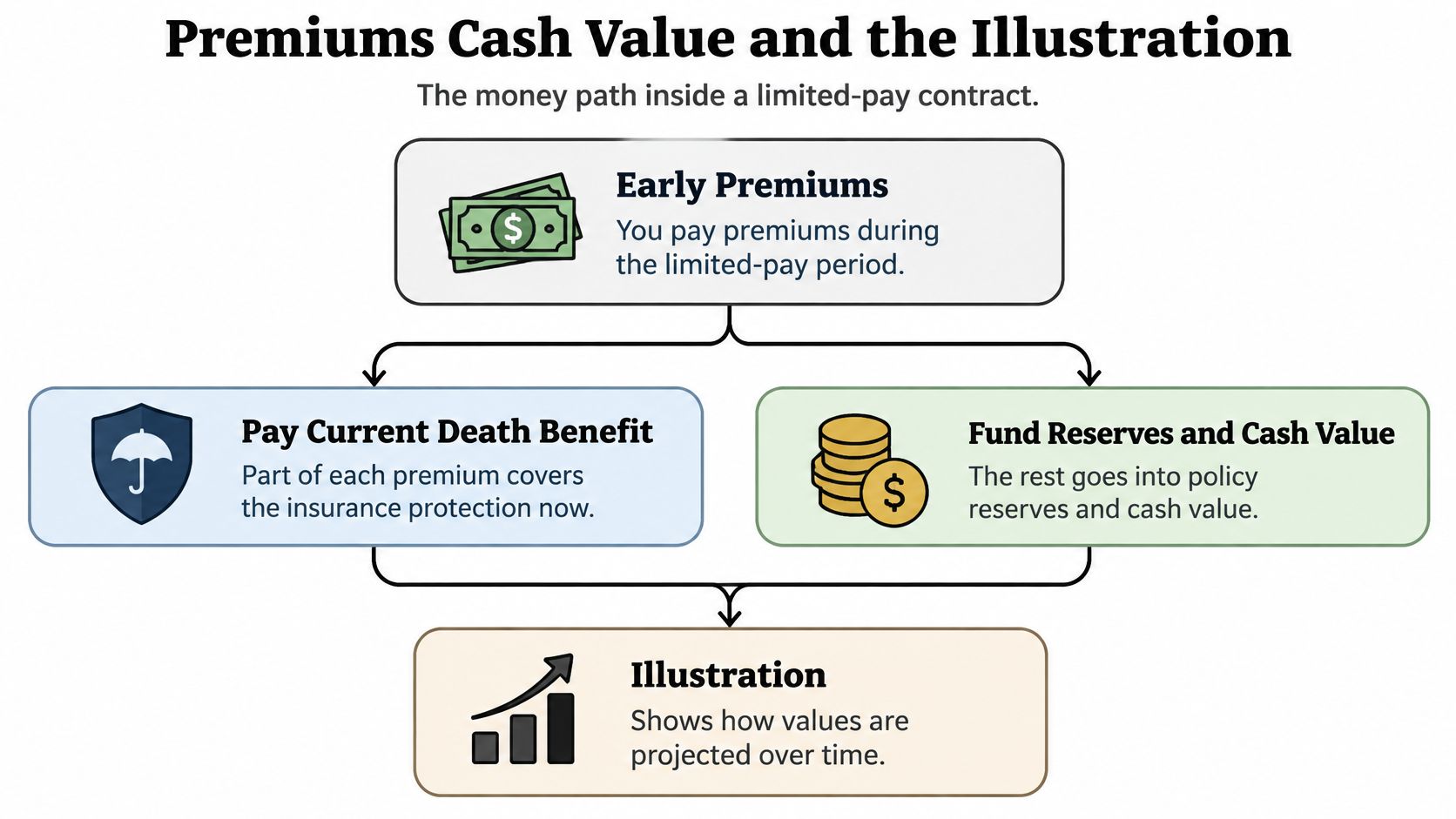
Early premiums support current insurance protection and help the insurer build reserves for future obligations. They also fund contractual cash value, while covering policy expenses, so don't assume every premium dollar becomes money you can withdraw.
The money path is easier to understand when protection and policy value are shown separately.
Separate promises from projections
A life insurance illustration shows scheduled premiums and how policy values may develop. The American Council of Life Insurers' buying guide explains that an illustration isn't part of the policy and isn't a legal document; the policy contains the contractual obligations.
Find these entries before judging the proposal:
- Premium-payment duration: Identify the guaranteed finish date, not just an illustrated date based on projected dividends.
- Required premium: Check the payment needed to maintain the stated benefits.
- Guaranteed values: Read the cash-value and death-benefit columns supported by the contract.
- Non-guaranteed values: Identify amounts that rely on dividends or other assumptions that may not materialize.
Ask whether the premium schedule ends because the contract says it ends or because projected earnings are expected to cover future bills. Those are different promises.
Payment certainty isn't the same as a guaranteed cash pile.
Accessing value changes the policy
Cash value isn't an ordinary bank balance. A policy loan accrues interest, and unpaid borrowing generally reduces what beneficiaries receive; substantial borrowing can eventually threaten coverage.
Withdrawals, where permitted, can reduce policy value and the death benefit. Early surrender can also return much less than the premiums you've paid because of policy costs and surrender charges.
Use our cash value life insurance calculator to explore assumptions, then compare them against the actual guaranteed schedule. A calculator can't replace contract terms or tell you that projected dividends will occur.
Ownership and access need extra care when guardianship is involved. For families dealing with that issue in Texas, the Law Office of Bryan Fagan guardianship guide from Law Office of Bryan Fagan, PLLC provides context for discussing policy management with legal counsel.
If the guaranteed column doesn't support the paid-up outcome you've been shown, don't let the more attractive projected column decide the purchase. Get the difference explained in writing before committing.
Limited Pay Is Not the Same as Fully Paid Up
Is the policy fully paid up after the last scheduled premium? It should be if you've completed the required premiums for a guaranteed limited-pay contract and satisfied its conditions, but the label alone doesn't prove that result.
Limited pay names a payment schedule. It doesn't tell you the guaranteed cash value, dividend treatment, loan rights, or consequences of changing the policy.

Questions that survive the last premium
Can the insurer change benefits or charges? Guaranteed whole-life terms are contractual promises, while non-guaranteed elements and owner-requested changes follow the policy's provisions.
What remains if dividends or assumed returns don't appear? The guaranteed benefit and value schedule gives the baseline, subject to any loans, withdrawals, or other changes you've made.
Can you reduce coverage if your family's needs shrink? Some contracts provide options, including reduced paid-up insurance, but these can leave a smaller death benefit and aren't the same as completing the original premium schedule.
Can a missed payment end coverage before the policy becomes paid up? Yes, missed required premiums can cause lapse after applicable protections are exhausted, although most policies include a grace period.
Don't confuse paid up with untouchable
Unpaid loans, accumulating loan interest, withdrawals, or insufficient remaining value can still impair coverage under the contract. A properly paid-up whole-life policy doesn't ordinarily require new premiums merely because dividends disappoint, but borrowing against it can create a different problem.
Finishing the premium schedule is a cash-flow milestone, not proof the policy can never lapse.
Confusion between policy types is common: a 2022 industry survey discussed by Corebridge Financial found that 59% of Americans incorrectly believed term insurance builds cash value; the 2025 Insurance Barometer also found that 61% of Americans without life insurance said they needed it, while 19% of existing owners said they needed more coverage.
Those findings point to separate questions: Do you understand what you bought, and is the death benefit enough? A completed payment schedule answers neither by itself.
Keep reviewing beneficiary details, outstanding loans, and the benefit your family would receive. A policy can be paid up and still be too small for the people relying on you.
When Shorter Payments Help or Hurt
Say a working couple has a new mortgage and childcare bills. They like the idea of finishing life-insurance payments before retirement, but the proposed limited-pay premium would use money they're currently putting toward emergency savings.
Their real question isn't whether an early finish sounds attractive. It's whether that commitment improves their finances without leaving them underinsured or short of usable cash today.
The household trade-offs deserve as much attention as the policy's finish date.
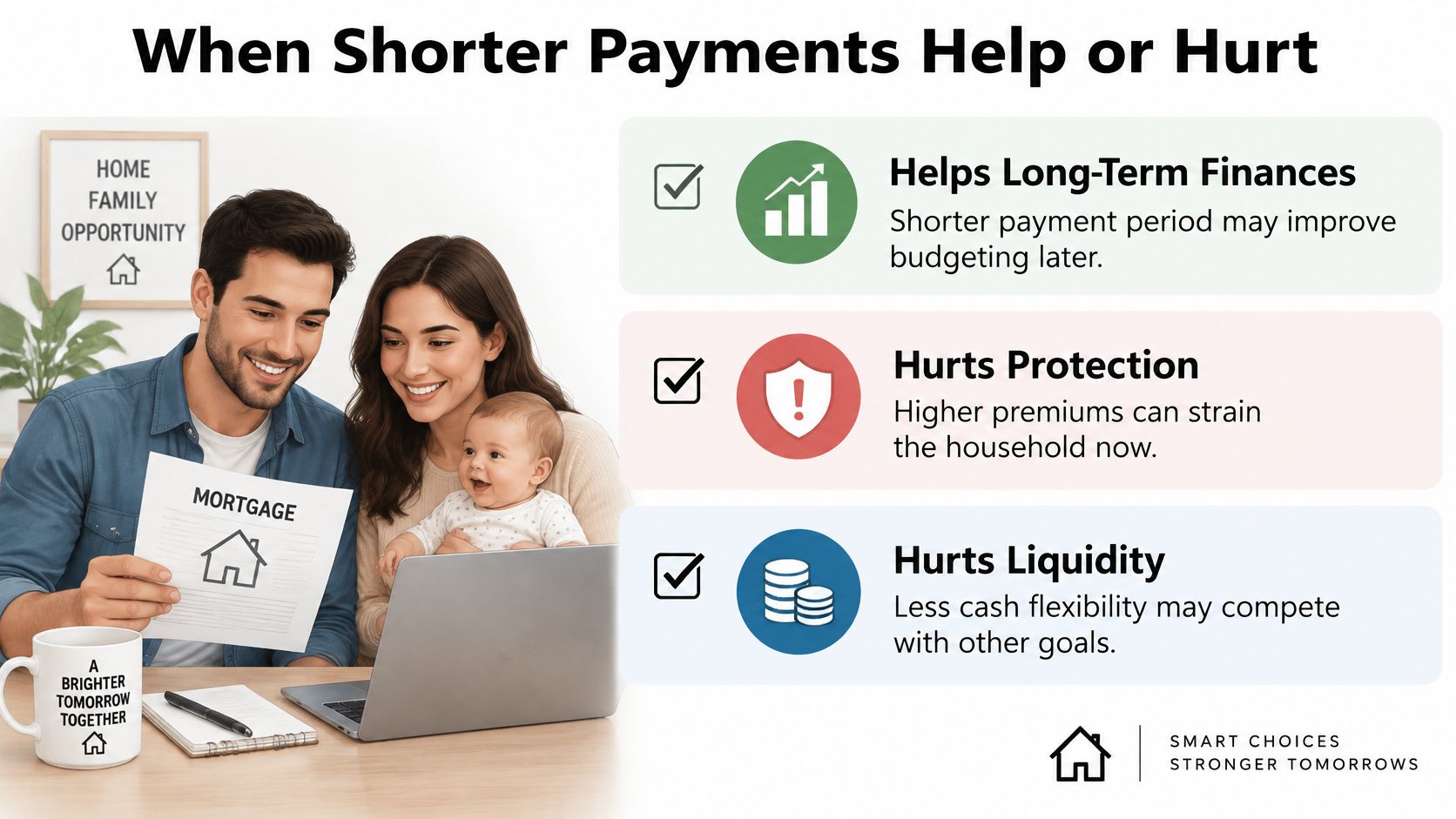
Test affordability before the finish line
LIMRA's 2025 life insurance facts report that 51% of U.S. adults have some life insurance and identify cost as a leading barrier; they also report that healthy adults ages 18–30 overestimated the cost of a $250,000, 20-year term policy by roughly 10–12 times, while about one-third of Gen Z and Millennials were unsure how much coverage or which type they needed.
That makes an actual comparison more useful than assumptions about affordability. The couple should test the permanent policy against their household budget and a term quote, not against an imagined term price.
Start with surplus income. Could they keep paying during parental leave, a job change, or a stretch of higher childcare costs without skipping retirement contributions or draining their emergency fund?
Then size the protection. A common starting guideline is 10–15 times annual income, adjusted for the mortgage, dependents, existing assets, and other needs; we help tailor coverage to each situation. That shortcut isn't a reason to buy permanent coverage or a substitute for adding up the household's actual obligations.
Compare outcomes, not just total premiums
Next, check whether the guaranteed values support the promised result after payments stop. A sales projection shouldn't be the only reason the family believes the policy will remain affordable.
Ask what happens if they stop early. Compare surrender proceeds with premiums paid, and understand whether a smaller benefit or lapse would follow.
Finally, put lower-cost term protection plus disciplined investing beside the limited-pay proposal. Investing the difference isn't guaranteed to outperform, and it only works if the household saves it, but it preserves a useful comparison between insurance funding and money available for other goals.
This video offers another way to consider the payment trade-off.
Limited pay can fit a household that already has liquid savings, needs permanent protection, and can fund the schedule during peak earnings. It's a poor first-policy choice when the higher premium forces a family to accept too little protection or sacrifice the cash needed for ordinary disruptions.
Take the Next Coverage Step
Before choosing a payment schedule, compare policies with the same death benefit. That keeps the appeal of finishing payments early from overshadowing the amount of protection your family would receive.
If permanent coverage fits your finances, request illustrations for a shorter fixed-payment schedule, a longer one, and an age-based finish date. Compare how long premiums are guaranteed, the guaranteed cash value, and any surrender charges. A larger projected balance does not necessarily mean a better fit.
Make the comparison usable
Set those illustrations beside a term quote sized for your current income-replacement need. Use the same insured person and death benefit to compare the cost of different coverage designs.
- Keep emergency savings separate: Money for a job interruption or urgent repair should remain available without relying on policy value.
- Choose a sustainable commitment: Base premiums on dependable surplus income, not hoped-for raises.
- Record the guarantees: Keep the contract provisions that support the premium finish date with your comparison.
If your main concern is a mortgage, young children, or a spouse who relies on your income, price protection for that period first. Then account for debts, dependents, savings, and existing coverage, rather than choosing an amount solely because its premium fits.
Preserve room to decide
You can protect your family now while considering whether a long-term premium commitment belongs in your budget. Term life can provide coverage for a set period, while permanent coverage may fit a need that lasts longer.
Coveredly compares multiple carriers and guides customers through their choices. Take time to understand both the policy's guarantees and what its premiums leave available for other household needs.
Coveredly offers term life insurance with no medical exam for policies up to $3M, and permanent life insurance is optional depending on eligibility. Many policies start as low as $15–$30 per month, depending on age, health, and coverage amount. Visit Coveredly to price term protection for your current needs before deciding whether finishing permanent-policy premiums early is worth the larger commitment.