You're probably already doing the big things right. You bought life insurance, you're building savings, and you're trying to make smart decisions for the people who depend on you.
Then one small checkbox shows up during the application process: accidental death benefit rider. The cost looks modest. The promise sounds simple. If death happens because of a covered accident, your family could receive more money than the base policy alone would provide.
That sounds appealing, especially if you're a new parent, a newly married couple combining finances, or a professional who spends a lot of time on the road. But this rider isn't a blanket upgrade. It's a narrowly defined add-on with real value in some situations and limited value in others. The key is understanding exactly what you're buying, when it pays, and when it won't.
Table of Contents
- Protecting Your Family From the Truly Unexpected
- What an Accidental Death Benefit Rider Actually Is
- Understanding Coverage and Common Exclusions
- How Payouts Work in Real-Life Scenarios
- Should You Add an Accidental Death Rider
- Comparing Riders to Increasing Your Base Coverage
- Adding a Rider and Frequently Asked Questions
Protecting Your Family From the Truly Unexpected
Maya and Chris have a toddler, a mortgage, and two incomes that keep everything moving. They've already agreed that life insurance is part of the plan. If one of them dies, the survivor needs time and financial space to keep the household stable.

Then they hit a common question. Is the base policy enough, or should they add something extra for a specific worst-case event like a fatal car crash?
That's where a rider comes in. A rider is an add-on attached to a life insurance policy. Think of your policy as the main house and the rider as a room added for one very specific purpose. It doesn't replace the foundation. It changes what the policy does in a defined situation.
An accidental death benefit rider is one of the most common examples. It's designed to increase the payout if the insured person dies from a qualifying accident. For many buyers, the appeal is emotional as much as financial. Accidents feel sudden, disruptive, and especially frightening when young children or a spouse rely on your income.
Why this rider gets attention
Some people like it because it offers a targeted layer of protection without buying a separate policy. Others like it because the price is often low enough to feel manageable inside a tight monthly budget.
Still, many find this aspect confusing. A standard life insurance policy already pays the death benefit if you die from many causes, including accidents. The rider doesn't create basic accident coverage from scratch. It typically adds extra money only if the death fits the rider's definition of accidental.
The practical question isn't whether the rider sounds useful. It's whether its narrow protection matches the risks you actually face.
Who usually pauses to consider it
A few life stages tend to make this rider more relevant:
- New parents: They want extra protection during the years when children are fully dependent.
- Frequent commuters: They spend a lot of time driving and think about road risk more often.
- Business travelers: They may want added protection tied to regular travel routines.
- Newly married couples: They're often building one shared financial life and want to reduce weak spots early.
For the right person, the accidental death benefit rider can feel like a smart buffer. For the wrong person, it can be a small extra cost for a benefit that may never apply.
What an Accidental Death Benefit Rider Actually Is
A parent buys a life insurance policy to replace income if something happens. Then they see an option for an accidental death benefit rider and wonder, “Is this extra protection, or am I paying twice for the same thing?”
The short answer is this. An accidental death benefit rider is an optional add-on to a life insurance policy that pays extra money if death is caused by a covered accident. It sits on top of your main policy rather than replacing it. As described in Aflac's overview of accidental death benefit riders, it remains tied to the underlying policy and usually costs less than buying a separate accident-focused policy.
That structure matters because the base life insurance policy is still doing the heavy lifting for your family. The rider only changes the payout in a narrower set of circumstances.
How the rider changes the payout
This rider functions like a second payment layer with a strict trigger. If the death meets the policy's definition of accidental, your beneficiaries receive the base death benefit plus the rider amount.
You may also hear the phrase double indemnity. In plain English, that often means the rider can add an amount equal to the base policy. Western & Southern notes that some riders are designed this way, so a $500,000 policy could pay $1,000,000 total after a qualifying accidental death, while the same policy would still pay the original $500,000 for a covered non-accidental death.
That is why this rider is best viewed as targeted extra protection, not broader life insurance.
Why that distinction helps with real decisions
A lot of confusion comes from the word “accidental.” People hear it and assume the rider creates a separate bucket of life insurance. It does not. Your main policy already covers many causes of death, including accidents. The rider adds more money only when the cause of death fits the rider rules.
If insurance language feels dense, this guide to how life insurance riders work can make the add-on structure easier to follow.
A simple way to test your thinking is this. Ask whether your family would still have enough protection if the rider never paid. If the answer is no, your base coverage may need attention first.
Where this can fit by life stage
The rider tends to make more sense when a household wants a small-cost add-on for a specific risk pattern.
For example, a new parent may like the idea of extra money during the years when childcare, mortgage payments, and lost income would all hit at once. A frequent business traveler may see it as a way to add accident-focused protection without raising the cost of the whole policy by much. A young couple on a tight budget may use it as a temporary supplement while they work toward larger base coverage later.
The appeal is easy to see. The monthly cost is often modest, and the possible payout increase can be large if the event qualifies.
The trade-off is just as important. The rider only earns its keep in a limited set of situations, so the decision should come down to your stage of life, your budget, and whether that narrow extra protection would make a meaningful difference for your family.
Understanding Coverage and Common Exclusions
A rider like this works less like a blanket and more like a spotlight. It shines on a narrow type of event: a death caused directly by an unexpected external injury. That narrow focus is why families sometimes assume the rider will pay, then learn the claim does not fit the policy language.
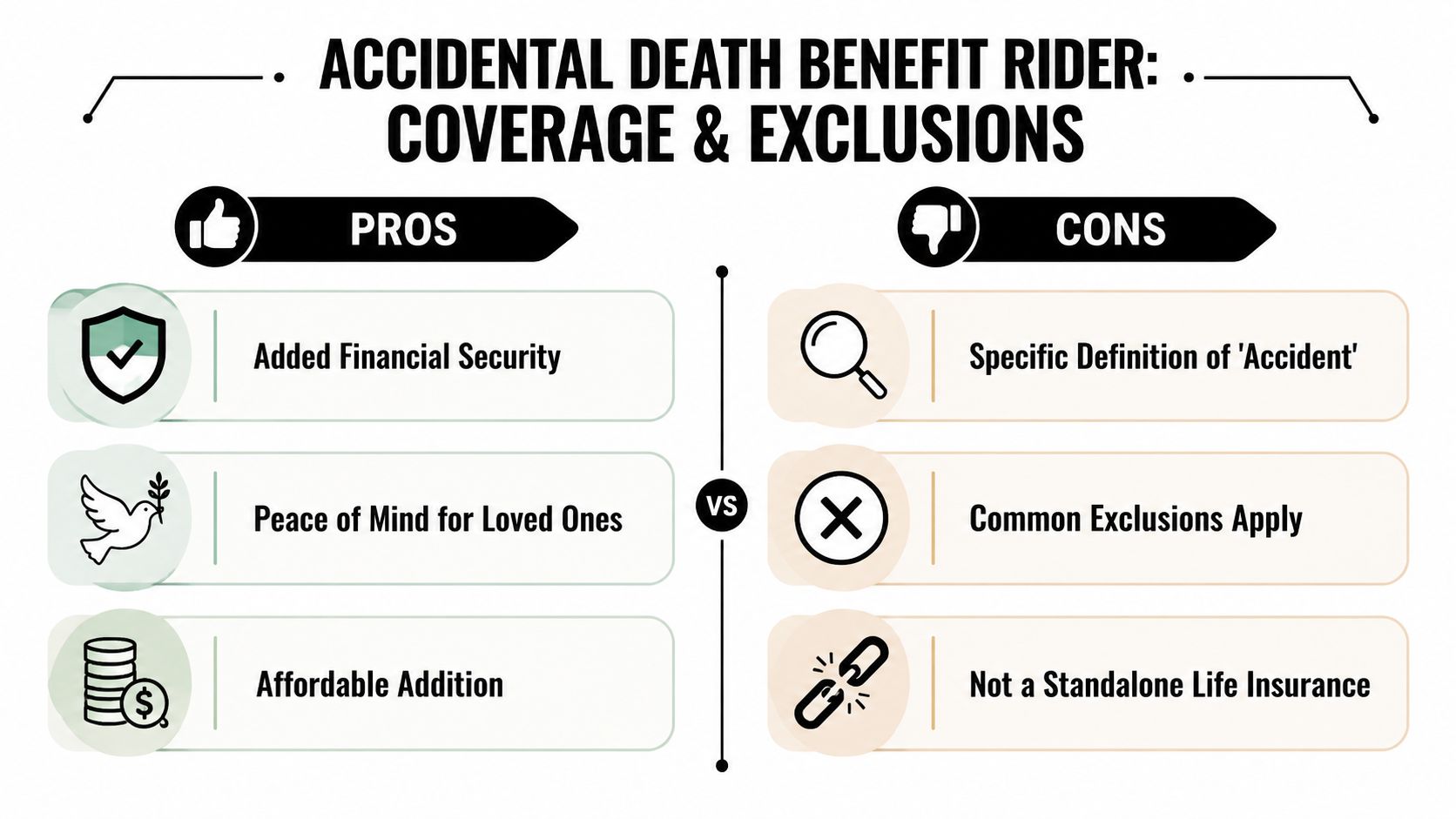
A useful way to read this coverage is to ask one practical question: What started the chain of events? If the answer is an accidental injury, the rider may apply. If the chain started with illness, self-harm, intoxication, or an excluded activity, the rider often does not.
If you want a broader refresher on accident-focused protection, this guide to what AD&D insurance covers helps separate similar terms that are often confused.
What usually falls inside the coverage lane
Policies often cover deaths tied to sudden outside events such as:
- Motor vehicle crashes
- Serious falls
- Certain workplace accidents
- Other external injuries that directly cause death
The word directly matters. If an injury clearly causes the death, the rider has a stronger fit. If other factors muddy the sequence, the claim gets harder to approve.
Where confusion usually starts
Many families hear “accidental death” and focus on the setting. Insurers usually focus on the cause.
Here is the difference. A fatal crash caused by icy roads may fit the rider. A fatal crash that happened because the driver had a heart attack may not, because the medical event came first. The accident was part of the story, but not the cause the rider was built to cover.
The rider usually works best when the cause-and-effect path is clear. Once that path is mixed with illness, substance use, or excluded conduct, the odds of a payout drop.
Common exclusions to look for
Exclusions vary by insurer, but many riders limit or exclude deaths related to:
- Suicide or self-inflicted injury
- Illness or disease
- Drug overdose
- Medical or surgical treatment
- War or military-related hazards
- Illegal acts
- Hazardous activities, such as racing or similar high-risk hobbies
Life stage matters. A new parent comparing a low-cost rider with a larger base policy should notice how narrow these exclusions make the rider. A frequent business traveler with a predictable routine may feel comfortable with that trade-off. Someone who regularly rides motorcycles, works in a dangerous occupation, or spends weekends on higher-risk hobbies should read the exclusions line by line before assuming the rider adds meaningful protection.
Time limits and age caps matter
Two contract details are easy to miss and can change the value of the rider.
| Policy detail | Why it matters |
|---|---|
| Death must happen within a stated period after the accident | Some riders pay only if death occurs within the policy's deadline after the injury. A long medical decline after the accident may fall outside that window. |
| Benefits may end at certain ages | Many riders stop at a set age or become less useful later in life, which can matter if you want protection that lasts through your highest earning years. |
For a young family, that may still be enough if the goal is extra protection during the mortgage-and-childcare years. For someone closer to the age cutoff, the same rider may offer less value per dollar because the coverage window is shorter.
How Payouts Work in Real-Life Scenarios
A rider can look simple on the quote page and feel much less simple during a claim. The easiest way to understand it is to walk through the kind of fact patterns insurers examine after a death.

Scenario one where the rider pays
A parent has a $500,000 term life policy and adds an accidental death benefit rider for the same amount. She dies in a covered car crash, and the accident is clearly the direct cause of death. In the previously cited Western & Southern example, that kind of setup results in the base policy paying $500,000 and the rider adding another $500,000, for a total of $1,000,000.
For a young family, that extra money can change the next few years in practical ways. It can cover the mortgage while a surviving spouse adjusts, replace income during the childcare years, or keep college savings from being abandoned. For a frequent business traveler, the same added payout may feel worthwhile because a large share of daily risk comes from time spent on the road or in transit.
The key point is simple. The rider usually pays on top of the base policy, not instead of it, if the death matches the rider's definition of an accident.
Scenario two where only the base policy pays
Now change one detail. A driver has a heart attack, loses control of the car, crashes, and dies. To the family, the crash is the visible event. To the insurer, the first question is the underlying cause of death.
If the records show the medical event came first, the life insurance policy may still pay, but the accidental death rider may not. The rider typically requires the death to result directly from accidental injury, not from illness that happened to lead to an accident.
This is one of the easiest places to get confused. The accident scene matters, but the cause-of-death chain matters more.
A helpful way to view it is this: the rider is built for "death because of an accident," not "death that involved an accident."
Timing can also decide the claim
Cause is not the only filter. Timing matters too. Fidelity Life's explanation of accidental death benefit riders explains that many riders require death to occur within a stated period after the injury.
That means someone could suffer a severe covered injury, spend weeks or months in treatment, and still fall outside the rider's deadline. Families often see one continuous tragedy. The contract may treat it as an accident followed by later complications that no longer meet the rider's terms.
For someone in a life stage with tight financial margins, such as new parents juggling a mortgage and daycare, that detail affects the rider's real value. A low monthly cost can still be worth it, but only if the policy language fits the kind of protection you believe you are buying.
What families should gather early
If a death may involve this rider, collect the documents that show both cause and timing:
- Death certificate
- Police or incident report
- Autopsy or coroner findings, if available
- The rider's exact wording on accidental cause and claim deadlines
Small paperwork details can have a big effect here. With an accidental death rider, the claim often turns on whether the records line up cleanly with the rider's narrow rules.
Should You Add an Accidental Death Rider
You are feeding a newborn at 2 a.m., paying for diapers, daycare, and a larger apartment, and trying to close the gap between what your family needs and what your budget can handle. In that season of life, a low-cost rider can sound appealing. A simpler question is: would this small extra premium protect against a risk that is both realistic for you and meaningful for your family?

An accidental death benefit rider is usually easiest to justify when two things are true. Your day-to-day life gives you more exposure to serious accidents than average, and you are not giving up better core coverage just to fit the rider into the budget.
It may fit well for these life stages
New parents often look at this rider during the years when the household has the least financial slack. If one income disappears suddenly, the pressure shows up fast in the mortgage payment, child care bill, and everyday cash flow. In that narrow situation, an extra payout from a covered accident can act like a temporary financial shock absorber.
Frequent commuters may also see a practical case for it. If a large share of your week is spent on the road, the rider lines up with a real part of your routine rather than an abstract fear.
Business travelers sometimes value it for the same reason. More time in airports, rental cars, hotels, and unfamiliar roads means more time in situations where accidents can happen. The rider still has limits, but it may match the life you live better than it would for someone who works from home and rarely travels.
It may be a poor fit for these situations
Sometimes the rider is the wrong tool.
- You can already afford the amount of base life insurance your family needs. Broad protection is often more useful than extra protection tied to one cause of death.
- Your hobbies or habits raise the odds of exclusions. If you participate in high-risk activities or worry your claim could run into exclusion questions, the rider may look better on paper than it does in practice.
- You want predictable protection. This rider only helps in a narrow set of outcomes.
- You are still underinsured on your main policy. In many cases, putting that same money toward increasing your term life insurance coverage gives your family a benefit they can count on more often.
A simple decision filter
Use these three questions before you add the rider:
| Question | If your answer is yes |
|---|---|
| Does my routine involve a lot of driving, flying, or time on the road? | The rider may match a real exposure in your current life stage. |
| Would an extra accident-only payout make a noticeable difference for my family over the next 5 to 15 years? | The rider may help cover a temporary protection gap. |
| Am I buying this after I have handled my core life insurance need? | The rider is more likely to be a smart add-on instead of a distraction. |
The best buyers are usually people in a specific season of life, not people chasing a vague sense of “more.” Buy this rider for the life you live, not for a vague sense that “more coverage must be better.”
Comparing Riders to Increasing Your Base Coverage
This is the question that matters most for value: should you spend extra money on an accidental death benefit rider, or use that same money to buy more base life insurance?
Narrow extra protection versus broad core protection
The rider can be appealing because it's usually framed as a low-cost way to boost the payout in one specific type of tragedy. If a covered accident happens, your beneficiaries may receive much more than the base policy alone would have paid.
Buying more base coverage works differently. It doesn't ask how death happened. If the policy is in force and the claim is covered, the full death benefit is there for the family whether death came from illness, accident, or another covered cause.
That's why eFinancial's discussion of accidental death benefit rider value raises a smart point. A key consideration is whether the rider's small additional premium is a better value than putting that same money toward a larger base death benefit.
A simple way to think about the trade-off
Use this comparison:
- Accidental death benefit rider: Lower cost, but only pays extra in a qualifying accidental death.
- Higher base policy amount: Potentially higher cost, but creates a more certain benefit regardless of cause of death.
If you want broader family protection, increasing the base amount often wins on simplicity. If your budget is tight and you want targeted accident-focused extra coverage, the rider may still have a role.
If you're weighing the broader option, this guide to increasing term life insurance coverage can help you think through the mechanics.
Which choice usually feels better later
People rarely regret having enough base life insurance. That's because the base policy solves the central problem: replacing income and protecting dependents no matter what covered cause of death occurs.
The rider solves a narrower problem. That doesn't make it bad. It just means it should come after the foundation is strong.
Start with the amount your family would need in the widest range of outcomes. Only after that should you evaluate specialized add-ons.
A balanced takeaway
Choose the rider when you want a focused layer of protection and you're comfortable with the exclusions. Choose more base coverage when you want the cleanest, most dependable answer to your family's long-term financial risk.
For many households, the best version of this decision is simple: first maximize the core policy you can reasonably afford, then consider whether the rider adds enough extra peace of mind to justify its narrow terms.
Adding a Rider and Frequently Asked Questions
If you're interested in an accidental death benefit rider, the easiest time to add it is usually when you apply for life insurance. That's when insurers lay out available riders, pricing, age limits, and contract definitions together so you can compare the add-on against your base policy.
If you already have a policy, adding a rider later may or may not be possible. Some insurers allow changes, while others only offer certain riders at issue. The answer depends on the carrier and the original contract.
What to review before you say yes
Don't just ask what the rider costs. Ask for the exact policy language on these points:
- Definition of accidental death
- Time limit between accident and death
- Excluded activities and substance-related exclusions
- Age when the rider ends
- Whether the benefit reduces, expires, or changes over time
A rider can sound straightforward in a quote and feel very different when you read the conditions.
Frequently asked questions
Can you add an accidental death benefit rider to an existing policy
Sometimes, but not always. Some insurers allow changes after issue, and some don't. Your policy contract and carrier rules control that answer.
Does this rider replace regular life insurance
No. It's an add-on to a life insurance policy, not a substitute for a strong base death benefit.
What happens when the term policy ends
If the rider is attached to a term policy, it generally ends when the underlying policy ends. The rider doesn't continue on its own.
Does every accidental death lead to a payout
No. The claim must meet the rider's definition of accidental death and avoid the listed exclusions. Cause of death, timing, and policy wording all matter.
The best way to approach this rider is with calm skepticism. It can be useful. It can also be narrower than many buyers expect. Read it the same way you'd review a safety feature. Don't just ask whether it exists. Ask when it works.
If you're shopping for life insurance and want to compare whether an accidental death benefit rider makes sense for your stage of life, Coveredly offers a digital way to explore flexible term coverage options, including up to $3 million of term life insurance with no exams for most. It's a practical place to start if you want coverage that fits your family, your budget, and the way you live.