You're self-employed, which means every insurance decision comes out of the same uneven income stream that pays your rent, supports your family, and keeps the business running. A low monthly premium can look responsible until a hospital bill, missed client work, lawsuit, or serious illness turns that “saving” into a much larger financial problem.
The right approach to affordable insurance for self employed professionals isn't finding the cheapest policy. It's calculating the lowest real cost after subsidies, tax treatment, deductibles, lost income, and uncovered risks. Health, life, disability, and liability coverage should work as one protection stack, not as four unrelated purchases.
Table of Contents
- What Self-Employed Coverage Actually Costs in Real Life
- The Four Coverage Pillars You Should Think About
- How Subsidies, Deductions, and HSAs Lower Your Real Bill
- Choosing Term Life, Disability, and Liability on a Budget
- Where to Shop for the Best Combination of Price and Fit
- A Practical Checklist for Your First Insurance Setup
- Why the Cheapest Plan Is Rarely the Smartest Choice
What Self-Employed Coverage Actually Costs in Real Life
Maria, a freelance graphic designer in Austin, chose the cheapest Bronze plan she could find. The premium was $312 a month, and she felt she'd made the sensible choice. Then her son broke his arm. After the emergency visit, imaging, treatment, and follow-up care, Maria owed $6,400.
Her premium wasn't the whole price of coverage. It was only the amount required to keep the policy active.
That distinction matters because self-employed buyers usually compare plans using the most visible number, the monthly premium. They often overlook the deductible, copays, coinsurance, out-of-pocket maximum, provider network, prescription coverage, and the income they'll lose while dealing with an injury or illness. A Bronze plan can be perfectly appropriate for someone who wants catastrophic protection and has enough cash reserves. It can be a poor fit for a parent who expects regular care and can't absorb a large bill.
Historical evidence also shows why the headline premium can mislead. A Duke University Press study of ACA premiums found that the average second-lowest silver plan premium was $8,305 before taxes and subsidies before the ACA, compared with $7,969 for pre-ACA coverage, a difference of $336, or 4.2%. After subsidies and the self-employed health insurance deduction, the after-tax cost fell to $3,591, which was $2,631, or 42.3% lower than the average pre-ACA after-tax premium.
The bill has more than one line item
A self-employed household can face several types of exposure at once:
- Medical cost: Deductibles, coinsurance, emergency care, hospital treatment, prescriptions, and specialist visits.
- Income cost: Lost billable work when you're sick, injured, caring for a child, or recovering from treatment.
- Business cost: Client delays, canceled contracts, professional mistakes made under pressure, or damage to someone else's property.
- Tax cost: Premiums and deductions may change your taxable income, while subsidy eligibility depends on household income and applicable rules.
Treasury reported that in 2022, 1.7 million self-employed workers ages 21 to 64 and 2.7 million small business owners ages 21 to 64 had Marketplace coverage at some point during the year. Together, they represented 3.3 million people, or 28% of Marketplace enrollment in that age range, according to the U.S. Treasury's analysis of Marketplace coverage. The same analysis found that 18% of self-employed workers and small business owners in that age group used ACA Marketplaces, compared with 6% of the rest of the population.
| Expense Category | Average Cost | Notes |
|---|---|---|
| Monthly health premium | $312 in Maria's example | The visible cost doesn't show the deductible or maximum exposure. |
| Family emergency treatment | $6,400 in Maria's example | A single accident can overwhelm a household budget. |
| Second-lowest silver premium before taxes and subsidies | $8,305 | Historical average reported in the Duke study. |
| After-tax and subsidy premium | $3,591 | The same study found a substantially lower net cost after support. |
| Lost billable work | Varies | Disability and illness can remove income even when medical bills are covered. |
Practical rule: Compare the premium, the likely annual spending, the worst-case out-of-pocket exposure, and the income you'd lose. The cheapest monthly bill often hides the most expensive year.
The Four Coverage Pillars You Should Think About
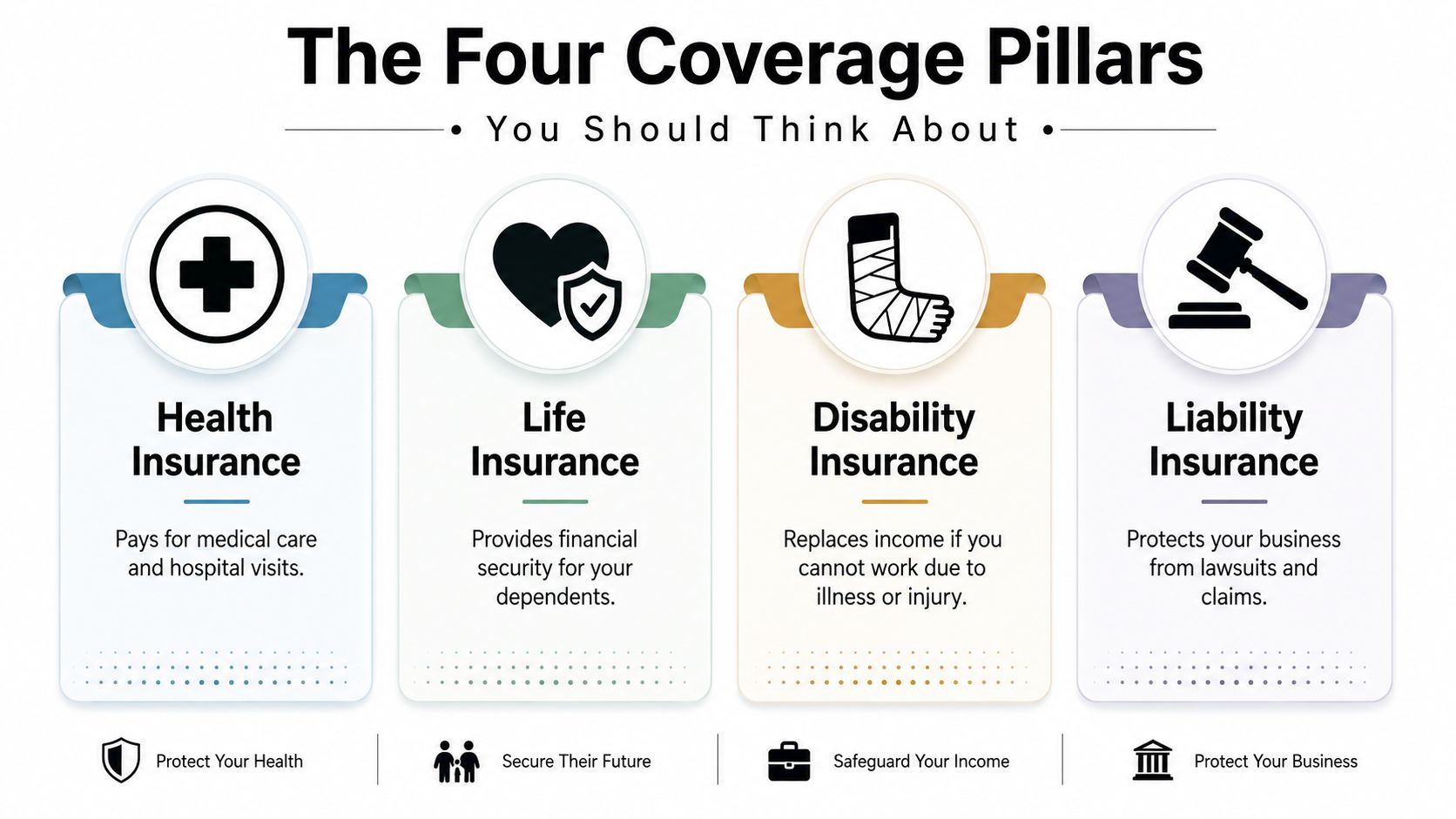
A strong self-employed insurance setup protects four things: your access to medical care, your family's future income, your ability to keep earning, and your business's legal obligations. Each policy handles a different failure point.
Health insurance pays the immediate bills
Health insurance covers eligible medical care, including emergency treatment, hospital services, preventive care, prescriptions, and other covered benefits. Without it, a broken bone or serious diagnosis can drain savings that your business needs for payroll, equipment, taxes, and operating expenses.
Health coverage also protects your decision-making. You're less likely to delay care because you're worried about the full hospital charge, and you can focus on recovery instead of negotiating every bill.
Life insurance protects people who depend on you
Life insurance isn't primarily about your business. It's about the mortgage, childcare, household bills, debts, and future plans that continue if you die. A spouse may be able to replace some income, but they may not be able to replace your business revenue immediately, especially if the company depends on your relationships or expertise.
Term life insurance usually offers the clearest budget fit for income replacement. Choose a term that matches major responsibilities, then set the death benefit around the debts and income your family would need to manage.
Disability insurance protects the income source
Health insurance pays medical bills. It generally doesn't replace the invoices you can't send while illness or injury keeps you from working. Disability insurance addresses that missing paycheck, which can be the most important asset a solo professional has.
A hospitalization that causes you to lose a key client contract can create a financial chain reaction. Disability coverage helps keep rent, mortgage payments, and household expenses moving while you recover.
Liability insurance protects the business itself
General liability coverage can respond to claims involving bodily injury or property damage. Professional liability coverage addresses allegations that your advice, work, or service caused a client financial loss.
The correct combination depends on your work. A contractor may need essential contractor coverage that reflects the risks of working on client sites, while a consultant may need professional liability more than commercial property coverage.
For a visual explanation of how these risks connect, this short video provides another way to review the four pillars:
Drop one pillar and the others carry more weight. Skip disability, and a medical problem can become an income crisis. Skip liability, and one claim can threaten business assets. Skip life insurance when dependents rely on you, and the household may lose both earnings and stability.
How Subsidies, Deductions, and HSAs Lower Your Real Bill
A plan with the lowest sticker price can still cost more after taxes, subsidies, and out-of-pocket exposure. Start with your real annual cost, then choose coverage that protects both your health and the income supporting life, disability, and liability policies.
The first lever is the ACA premium tax credit. Self-employed people who buy individual coverage through the Marketplace may qualify when household income falls within the applicable range. For 2026, eligibility is tied to household income of at least 100% of the federal poverty level and no more than 400%. The credit applies to individual exchange plans rather than SHOP exchanges, according to the Congressional Research Service explanation of the premium tax credit.
For 2026, the contribution rate reaches 9.96% at the top of the subsidy schedule. Households in the 300% to 400% FPL band are expected to contribute roughly that share of income toward benchmark coverage before the credit applies, as explained by the IRS premium tax credit guidance. Revenue changes can alter your credit, so update the Marketplace application instead of waiting for tax filing.
Deduct only the right premium dollars
The self-employed health insurance deduction can reduce taxable income for qualifying coverage established under the business. HealthCare.gov guidance for self-employed coverage explains how self-employed people can assess Marketplace coverage and possible Medicaid eligibility when income is low.
You cannot claim both a premium tax credit and a self-employed deduction on the same premium dollars. Only the portion you pay after subsidies is potentially deductible. The rules can also interact with the 7.5% AGI threshold for itemized medical deductions, as outlined by GoodRx's tax treatment overview. Have a tax professional confirm the final calculation, and keep organized records when you claim expenses as self employed.
Use an HSA when the plan fits
An HSA-qualified high-deductible health plan can reduce fixed premiums while funding an account for qualified medical expenses. HSA contributions can be deductible, investment growth can be tax-free, and qualified withdrawals can be tax-free. That triple tax advantage matters only if you can handle the deductible and contribute consistently.
| Step | Calculation | Net Monthly Cost |
|---|---|---|
| Starting premium | Full monthly plan price | $560 |
| Premium tax credit example | $560 less $420 credit | $140 |
| Tax effect example | $140 premium less a modeled tax benefit | $98 |
| HSA strategy | Separate tax-advantaged contributions for qualified care | Depends on contribution and usage |
The table is an illustration, not a universal quote. Your income, household size, state, plan, tax bracket, and eligibility determine the result. Life insurance premiums also have separate tax rules. Review this life insurance tax deduction guide before treating any premium as deductible.
Under current rules, income above 400% of the federal poverty level can eliminate the premium tax credit entirely. One estimate places the 2026 cliff at about $60,240 for one person and approximately $84,000 to $84,600 for a two-person household, according to Bean Count's 2026 subsidy cliff discussion. Set your income estimate, subsidy, deduction, and HSA strategy together before selecting a plan. That tax decision affects how much room remains for the disability, life, and liability protection your business and household need.
Choosing Term Life, Disability, and Liability on a Budget
Don't buy these policies in alphabetical order. Buy them according to the damage each uncovered risk could cause.
Start with the income you can't afford to lose
For many self-employed professionals, disability insurance deserves early attention. An illness or injury can stop revenue immediately, while household bills continue. Look for an individual policy with an own-occupation definition if your work depends on specialized skills, and compare the elimination period against your emergency savings.
A benefit near 60% to 70% of taxable income is a common planning target in the coverage guidance for this audience, but insurers apply their own underwriting and benefit limits. The right amount is the income your household needs to keep functioning, not an arbitrary percentage.
Short-term disability coverage can help address a shorter waiting period when cash flow allows. If you have little reserve, a shorter elimination period may matter more than squeezing out the lowest premium.
Add term life when someone relies on your earnings
Term life insurance is generally the straightforward budget choice for a family protection need. Select a term that aligns with the years when children are dependent, a mortgage is outstanding, or a spouse would struggle to replace your income.
The death benefit should account for more than funeral costs. Consider income replacement, debts, childcare, education, and the time your family would need to sell or transition a business. A solo professional without dependents may have a lower priority for life insurance, while a young parent with a mortgage shouldn't postpone it indefinitely.
You can review the mechanics of life insurance for self-employed professionals before requesting quotes.
Match liability coverage to the work
General liability usually addresses third-party injuries and property damage. Professional liability focuses on errors, omissions, negligence allegations, or financial harm tied to your service. Contractors may also need coverage for business property, tools, vehicles, or work performed at client locations.
| Coverage | Primary Purpose | Typical Budget-Conscious Choice | Key Decision Factor |
|---|---|---|---|
| Term life | Protect dependents after death | Level term coverage tied to family obligations | Income replacement and debt needs |
| Disability | Replace earnings after illness or injury | Individual policy with an affordable waiting period | Own-occupation definition and benefit |
| General liability | Address injury and property claims | Basic policy matched to client and site exposure | Contract requirements and exclusions |
| Professional liability | Respond to service-related allegations | Limits aligned with contract and client risk | Covered acts, defense costs, and exclusions |
Coverage priority: If money is tight, protect the ability to earn first, satisfy required liability obligations, then protect dependents with term life. Don't pay for overlapping policies that insure the same risk twice.
Where to Shop for the Best Combination of Price and Fit
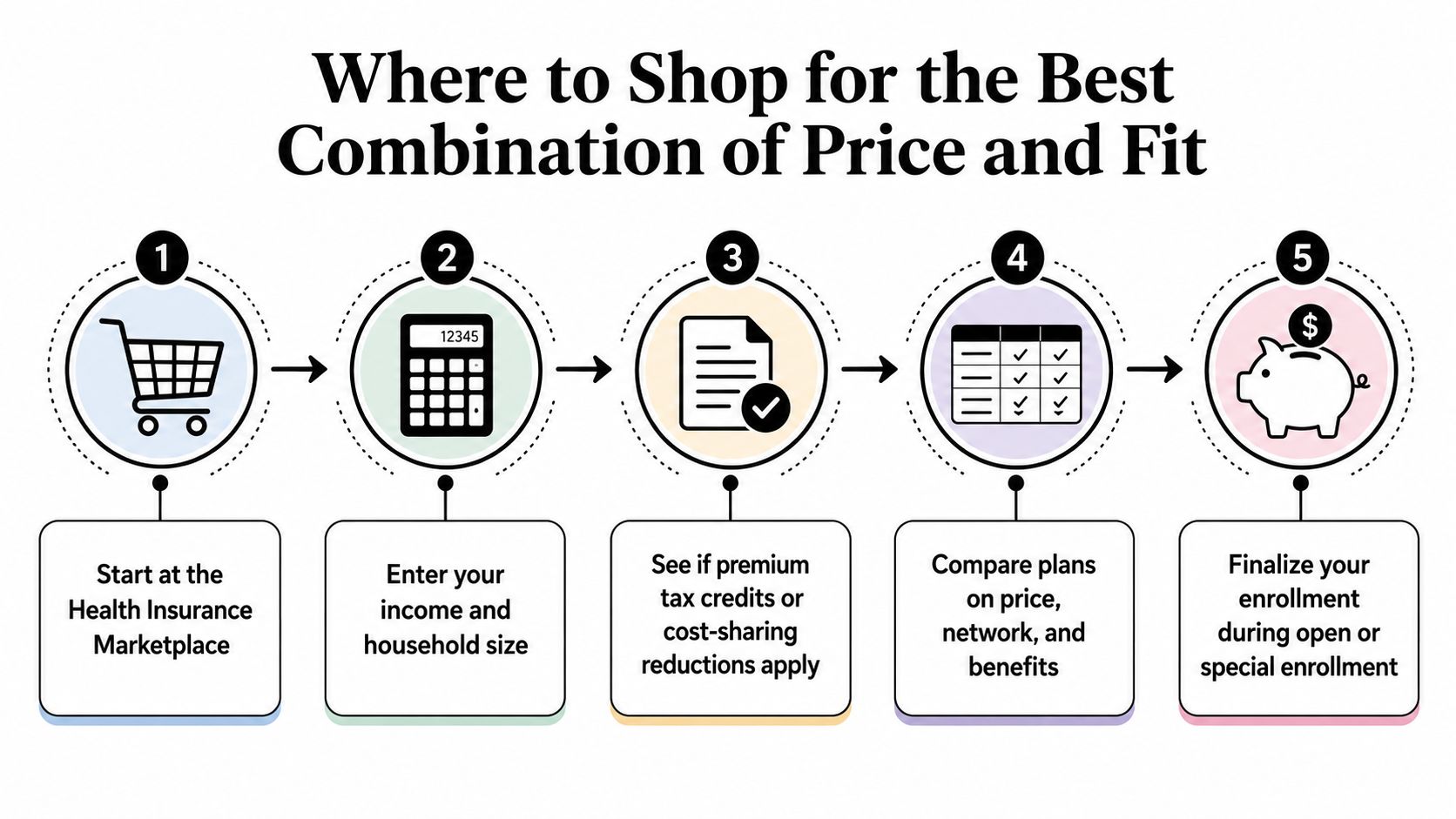
Start with the Health Insurance Marketplace for medical coverage. Enter your household size, projected income, location, preferred network, deductible, and potential out-of-pocket costs. The goal is to compare the full cost after any premium tax credit, not to pick the plan with the lowest listed premium.
Variable income makes the application harder. Use established business income as a starting point, then adjust for expected revenue, expenses, signed contracts, and seasonal changes. Recheck the estimate if your business outlook shifts, because the figure affects both eligibility and your eventual tax reconciliation.
Use a broker for complicated comparisons
A licensed broker can compare Marketplace and off-exchange plans, clarify provider networks, and show what you give up when a lower premium comes with a higher deductible or narrower access. Ask how the broker is paid and whether they can show every plan you are considering. That answer affects how much confidence you should place in the comparison.
Professional associations, local chambers, banks, and industry networks may refer you to vetted brokers. Association coverage can include useful features or member pricing, but it may not be cheaper and may not qualify for Marketplace subsidies.
Shop directly for non-medical protection
Buy term life, disability, and business liability through direct carriers or online platforms when you want faster side-by-side quotes. Direct platforms like Coveredly let you compare digital term life quotes, including no-exam options up to $3 million, in one place. Before applying, verify state licensing and review exclusions, waiting periods, renewal terms, and cancellation provisions. Use this term life insurance rate comparison guide to evaluate quotes on more than price.
Bring tax returns, income statements, projected revenue, business expenses, dependents, debts, existing coverage, health history, prescriptions, occupation, vehicles, property, contracts, client requirements, business structure, workers, work locations, and ownership responsibilities.
Compare annual cost across the full protection stack. Include premiums, deductibles, copays, coinsurance, exclusions, waiting periods, provider access, tax treatment, and the financial consequence of a claim. A cheap medical plan does not compensate for missing disability or liability protection.
A Practical Checklist for Your First Insurance Setup
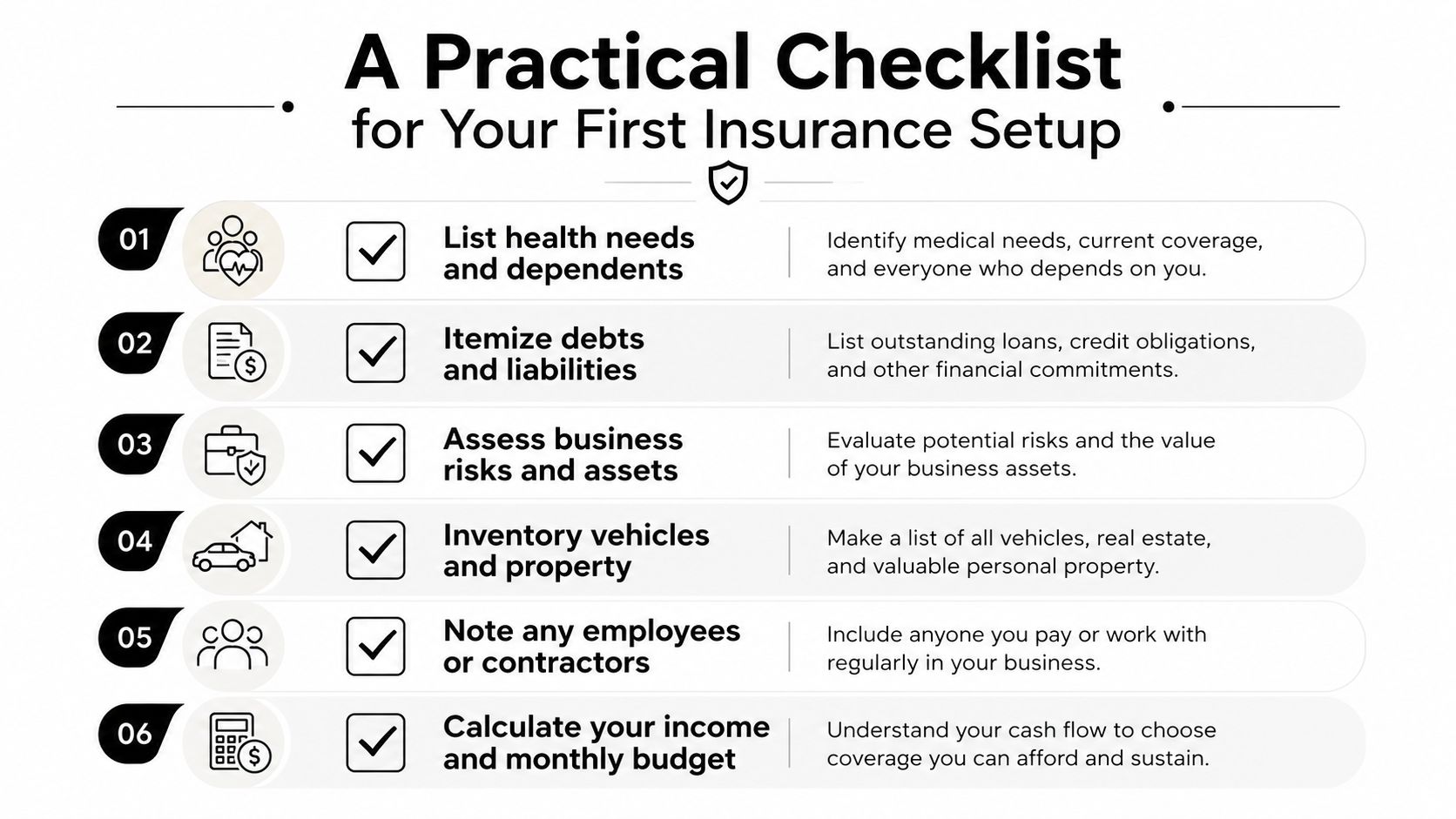
Set aside a weekend and build one protection plan. Buying separate policies at random makes it easy to insure a minor risk while leaving your income or family exposed.
Saturday morning identifies the risks
Write down the people, assets, and income streams that need protection:
- List health needs: Include prescriptions, preferred doctors, ongoing treatment, dependents, and expected care.
- Itemize debts: Record the mortgage, loans, credit obligations, and business liabilities your household would face.
- Assess business risks: Note client-site work, professional advice, equipment, contracts, and the mistakes that could trigger a claim.
- Inventory property: Include vehicles, tools, computers, office equipment, and other business assets.
- Note workers: Record employees, contractors, partners, and anyone whose work affects your legal or financial exposure.
- Calculate income: Estimate the monthly amount your household needs if you can't work.
Saturday afternoon compares the health options
Enter expected income and household information into the Marketplace application. Compare premium, deductible, out-of-pocket maximum, provider network, prescriptions, and expected usage. Then decide whether an HSA-qualified high-deductible plan fits your cash reserves and tax strategy.
Don't use a low premium to justify a deductible you couldn't fund. If the plan only works when nothing goes wrong, it isn't affordable for your household.
Sunday builds the protection stack
Request quotes from a Marketplace, a licensed broker, a professional association, and direct carriers. Check licensing, exclusions, cancellation terms, waiting periods, and customer-service reputation before applying.
A young family might begin with subsidized health insurance, HSA funding, term life, disability, and general liability. A solo consultant without employees may prioritize health, disability, and professional liability.
Before payment, confirm:
- Coverage dates: Every person and business asset has the correct effective date.
- Policy names: The insured names match your legal and business records.
- Payment schedule: Premiums, HSA contributions, and renewals fit your cash flow.
- Review calendar: Schedule an annual income and protection review.
Reassess after marriage, a child, a home purchase, a major contract, or a significant income change. Your insurance should change when your responsibilities change.
Why the Cheapest Plan Is Rarely the Smartest Choice
The cheapest plan myth survives because premiums are easy to compare. Risk exposure is harder.
A Bronze plan with a low premium may protect you from catastrophic medical bills while leaving you responsible for a large deductible and substantial cost sharing. A Silver plan may cost more each month but reduce the amount you pay when you use care, particularly when cost-sharing reductions apply.
Income volatility makes the comparison even more important. A solo founder may handle a predictable premium during a strong quarter but struggle with a sudden medical bill after two lean quarters. The financially sensible plan is the one that keeps the household and business solvent under a realistic bad-year scenario.
Test each plan against actual events
Use scenarios rather than optimism:
- Routine year: You use preventive care, fill prescriptions, and have occasional appointments.
- Moderate medical year: You need imaging, specialist visits, treatment, or an emergency visit.
- Severe interruption: You face hospitalization, recovery time, and lost billable work.
- Business claim: A client alleges property damage, professional negligence, or financial loss.
- Family loss: Dependents need income replacement after your death.
The figures below illustrate the comparison method requested, not universal insurance prices or guaranteed outcomes. A real analysis must use your quote, plan documents, income, tax position, and household needs.
| Scenario | Cheapest Plan Annual Cost | Optimized Plan Annual Cost | Real Out-of-Pocket | Protection Gap |
|---|---|---|---|---|
| Low-premium Bronze example | $180 monthly premium | Not applicable | $4,800 in the stated hospitalization example | High deductible exposure |
| Silver plan example | Not applicable | $310 monthly premium | Roughly $2,100 in the stated example after cost-sharing and HSA considerations | Lower medical exposure, subject to plan rules |
| Disability omitted | Premium savings vary | Disability premium varies | Lost billable income after a wrist injury | No income replacement |
| Liability omitted | Premium savings vary | Liability premium varies | Claim costs depend on damages and defense | Business assets exposed |
A freelancer who buys cheap term life but skips disability may protect the family after death while leaving the household exposed to a much more likely working-life interruption. A broken wrist can prevent a designer, consultant, photographer, or contractor from billing clients, even when the medical treatment itself is manageable.
Review coverage every January and whenever income, family size, contracts, or business risks shift. The best affordable insurance for self employed workers is not the policy with the smallest premium. It's the combination that produces a manageable net cost and closes the most dangerous protection gaps.
Coveredly offers digital term life insurance options for self-employed people, including flexible coverage and quotes for up to $3 million without exams for most applicants. Visit Coveredly to compare life insurance as part of a broader protection plan for your family and business.