You're comparing life insurance because your life is already doing enough. Maybe you've got a mortgage, a child on the way, and one partner juggling daycare drop-offs while the other worries about how long income would last if something happened. In that kind of conversation, Indexed Universal Life tends to sound appealing fast, because it promises permanent coverage plus a cash value account, but the core question is whether that structure fits your timeline, your budget, and your tolerance for trade-offs.
The best way to judge the benefits of IUL is to start with the mechanics, not the marketing. If you understand how the policy credits interest, where the floor helps, where the caps limit growth, and why early years can feel slow, you can compare it against the life you have now instead of an illustration that assumes everything goes right.
Table of Contents
- Who Benefits From Indexed Universal Life and Why It Matters
- How Indexed Universal Life Actually Works
- The Four Core Benefits of IUL Explained
- IUL Compared to Term Life and Whole Life
- Real Use Cases for Young Families and Business Professionals
- Costs, Risks, and the Time-to-Benefit Gap
Who Benefits From Indexed Universal Life and Why It Matters
A lot of people first look at IUL in a very specific season of life. They may be in their thirties, have just welcomed a second child, bought a home, or started a business, and the question becomes practical fast, how do you protect the family if income stops, while still keeping some long-term flexibility? That is a different question from finding the lowest-cost policy, and it is the reason IUL enters the conversation at all.
For a young parent, the appeal is usually permanence. Term life often fits a temporary need more cleanly, but some families want coverage that can stay in force for life if they keep funding it. For a business owner or professional with uneven income, the attraction is the ability to adjust premiums within policy limits, then build cash value over time if the contract is funded consistently. The product is not magic, it is a design choice with trade-offs.
Who usually gets the most value
IUL tends to make the most sense for people who already know they want permanent coverage and are comfortable with a more complex contract. That group often includes families who want lifelong death benefit protection, business owners thinking about succession or key-person needs, and higher earners who may value a tax-advantaged liquidity source later. Some insurers and educators also frame IUL as a policy that can support retirement planning, college savings, and business succession planning, which shows how broad the use case can be Investopedia's indexed universal life overview.
It matters just as much for people who are not a fit. If you mainly need the largest possible death benefit for the lowest cost during a specific window, term life usually belongs first in the conversation. If you want guarantees and simplicity above all else, a more traditional permanent structure may feel easier to manage. IUL is worth attention when the goal is protection plus optional accumulation, not when the goal is the cheapest pure insurance.
Practical rule: if your plan depends on cash value soon, ask hard questions about timing and fees before you get attached to the illustration.
A useful outside check is figuring out how much coverage your household needs before you decide what type of policy to use. The homebuyer-focused guide on how much homebuyer coverage you need is a practical starting point because it forces the conversation back to real obligations, not product preference.
How Indexed Universal Life Actually Works
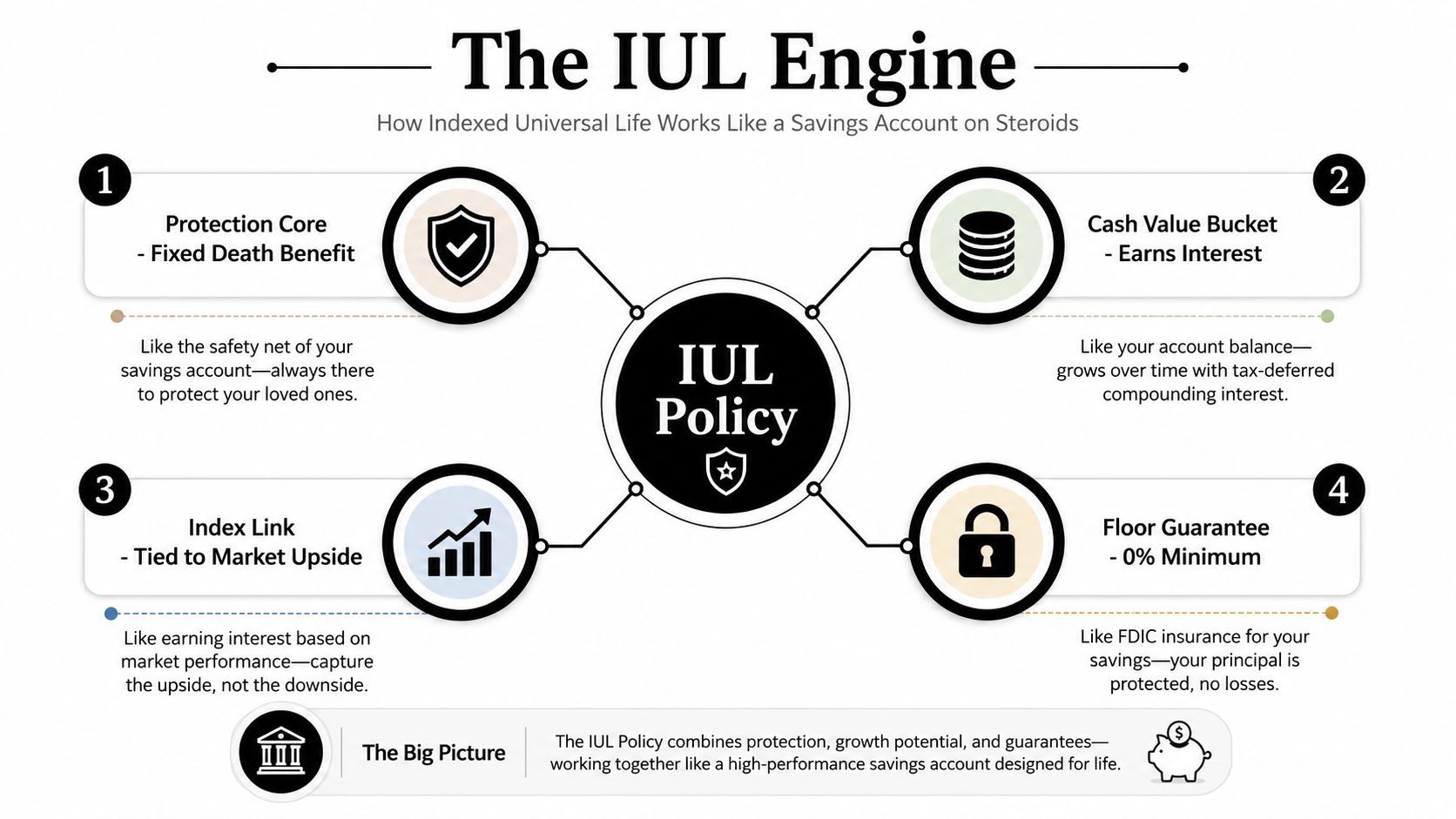
Think of an IUL policy like a protected savings bucket attached to a life insurance contract. You pay premiums into the policy, the insurer subtracts the cost of insurance and other charges, and whatever remains can go into a cash value account. The key point is that the cash value isn't directly invested in the stock market, the insurer uses an indexing formula to decide how much interest to credit.
The indexing formula in plain English
The insurer tracks how an index moved over a crediting period, then applies policy rules such as a cap, a participation rate, and a 0% floor. The cap limits how much upside you can receive in a period, the participation rate determines how much of the index movement counts, and the floor keeps the credited rate from going below zero in down periods. Guardian explains that this structure means the policy is not invested in the market, the insurer controls the credited result through its formula Guardian's indexed universal life explanation.
That distinction matters. If the market drops, the policy's credited rate generally does not get pulled below zero because of the floor. If the market rises sharply, the cap can keep you from capturing the full upside. So the trade is simple in concept, but not simple in execution. You give up direct market ownership in exchange for downside protection and a more controlled crediting path.
What to look for on an illustration
An IUL illustration usually looks technical because it is technical. The important lines are not the glossy projections, they're the funding assumptions, the policy charges, the cap and participation rate, and the effect those variables have over time. If a policy looks great only because the illustration assumes the index keeps behaving nicely and the policy stays heavily funded, that's not a reason to buy it, it's a reason to ask more questions.
The insurer's crediting rules matter more than the index name on the page.
Policyholders also need to understand that the account can usually be moved among a fixed option and indexed options, depending on the contract. The fixed option is straightforward, you get a declared rate. The indexed option is where the floor, cap, and participation formula come into play. That's why the same index can produce very different policy outcomes from one contract to another.
The Four Core Benefits of IUL Explained
Lifelong death benefit protection
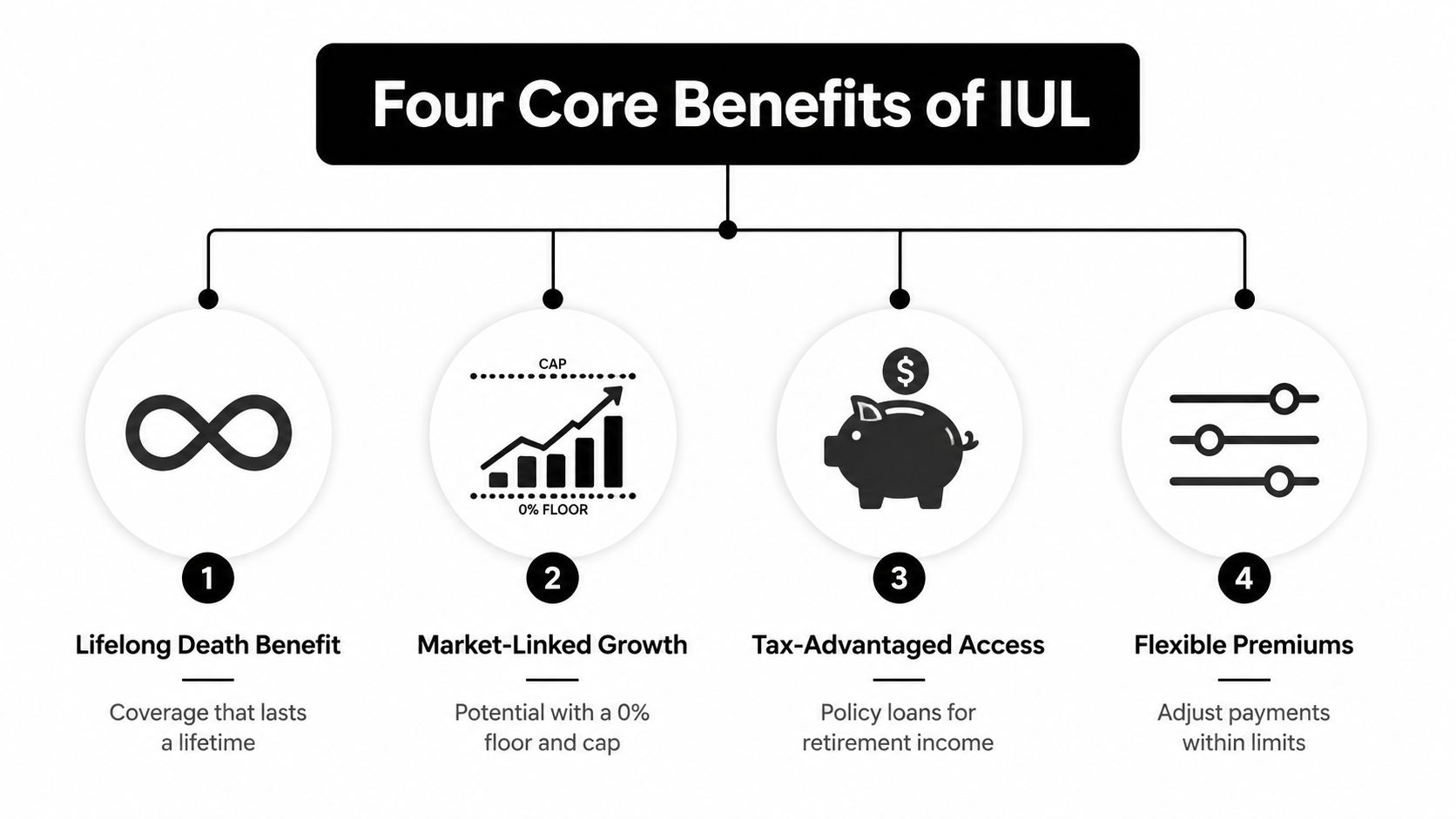
The most obvious benefit is permanent coverage. As long as the policy stays in force, your beneficiaries can receive a death benefit, which is the part many families want first. That's what separates IUL from term life, and it's why the product is often used by people who don't want coverage to expire when a term ends.
For a family, that can matter in a very ordinary way. A parent might want protection that outlasts the mortgage, or coverage that stays available even after the kids are grown, because financial responsibility doesn't always disappear on schedule. The policy's permanence gives you that option, though only if you maintain it properly.
Market-linked growth with a floor
The cash value can grow based on an index-crediting formula, and the 0% floor rate is one of the reasons people pay attention to IUL. Protective notes that the indexed account generally has a floor rate of 0%, so negative index performance doesn't reduce credited cash value the way direct market losses can Protective's IUL retirement article. That doesn't make the policy risk-free, because charges still exist, but it does change the shape of the ride.
This is useful for people who want some exposure to market-linked upside without owning the index itself. You're not buying stocks, and you're not getting uncapped market gains. You're buying a contract that tries to smooth the path.
Tax-deferred accumulation and tax-free access
The cash value grows tax-deferred, and policy loans are generally treated as tax-free when the policy stays in force and is structured properly. That can create a flexible source of liquidity later, whether someone wants retirement income, education funding, or business cash flow. Better Wealth describes this flexibility clearly, along with the ability to adjust premiums and death benefits within policy limits BetterWealth on indexed universal life.
For example, a household might fund the policy more heavily in a strong income year, then ease off later if cash value has already built up enough to support the contract. That kind of flexibility doesn't replace disciplined saving elsewhere, but it can help people who don't want every dollar locked into one rigid schedule.
Flexible premiums and death benefit options
Universal life design gives policy owners more room to adjust premiums than whole life usually does. That's one reason the product shows up in planning conversations for self-employed people, commission-based earners, and growing families whose cash flow changes from year to year. The flexibility isn't unlimited, but it's real.
The operational reason this matters is simple. Life gets uneven. A policy that allows some adjustment can be easier to keep in force than one that demands the same premium forever. That said, flexibility cuts both ways, because underfunding the policy can create problems later.
Bottom line: IUL's value comes from a blend of permanence, controlled growth, tax treatment, and funding flexibility, not from any single feature on its own.
IUL Compared to Term Life and Whole Life
| Feature | Term Life | Whole Life | Indexed Universal Life |
|---|---|---|---|
| Premiums | Usually lowest, focused on temporary coverage | Typically fixed and higher | Flexible within policy limits |
| Cash Value | None | Guaranteed growth | Cash value tied to an index-crediting formula |
| Death Benefit Length | Covers a set term | Lifetime if kept in force | Lifetime if kept in force |
| Common Use | Temporary protection | Predictable permanent coverage | Permanent coverage plus optional accumulation |
The most honest way to compare these products is to ask what job you need them to do. Term life is usually the simplest answer when the problem is temporary, like replacing income while kids are young or covering a mortgage during its early years. Whole life usually fits people who want predictability and a more traditional guarantee structure. IUL sits in the middle, with more flexibility and more moving parts.
That middle ground is useful, but it isn't automatically better. If you want the cleanest affordability for a large death benefit, term often wins. If you want straightforward guarantees and don't care about index-crediting mechanics, whole life may feel easier to understand. IUL becomes interesting when you want a permanent policy with a cash value component and the ability to accept a different kind of growth path.
If you're still sorting through the broader insurance decision, it helps to review term vs universal life insurance before you lean into an IUL illustration. That comparison keeps the focus on coverage purpose, not just product branding.
When each product tends to fit
- Term life: best when the need is tied to a specific period, like children at home or debt protection.
- Whole life: best when you want stable, traditional permanent coverage with a familiar structure.
- IUL: best when you want lifetime coverage and are willing to trade some upside for flexibility and a floor.
Real Use Cases for Young Families and Business Professionals

A young family building optional retirement income
A couple in their early thirties may start with term life because the budget is tight and the mortgage still feels new. A permanent policy can make more sense later, after school costs are more predictable and income has become steadier. In that setting, IUL can serve as a second layer, not the whole plan.
The value is not that the policy replaces retirement accounts. The value is that it can build a separate pool of tax-deferred cash value that may be borrowed against later if the policy has been funded properly and kept in force. For a family that wants another source of liquidity besides a 401(k) or brokerage account, that can matter, especially if they want the death benefit to remain in place.
That benefit comes with a delay. Early premiums go first toward insurance charges and policy expenses, so the cash value usually needs time to build before it becomes useful for borrowing or other planning. Families who understand that timing gap are better able to judge whether the policy fits their real timeline instead of an illustration on paper.
For tax questions around policy value, it also helps to review whether cash value in life insurance is taxable.
A business owner funding continuity
A business owner may use IUL for a different purpose. Western & Southern notes that IUL is used in business succession planning, and that is where the policy can support a buy-sell agreement, key-person planning, or an executive benefit structure Investopedia's indexed universal life overview. The permanent death benefit and flexible funding can make the policy useful when a company needs continuity planning, not just personal protection.
A simple example is a partner who wants the company to have money available if the other partner dies unexpectedly. Another is a small firm that wants to provide a long-term benefit to a key executive without locking into the structure of a traditional pension. In both cases, the policy is doing two jobs at once, it supports a business objective and still provides personal insurance protection.
Practical takeaway: families often use IUL as a long-term flexibility tool, while owners often use it as a continuity tool.
The common thread is control. Different households can use the same policy mechanics for different reasons, but they are all trying to solve long-horizon problems with one contract that combines protection and accumulation. That is why the same policy can feel useful to one buyer and unnecessary to another.
Costs, Risks, and the Time-to-Benefit Gap
The parts marketing often skips
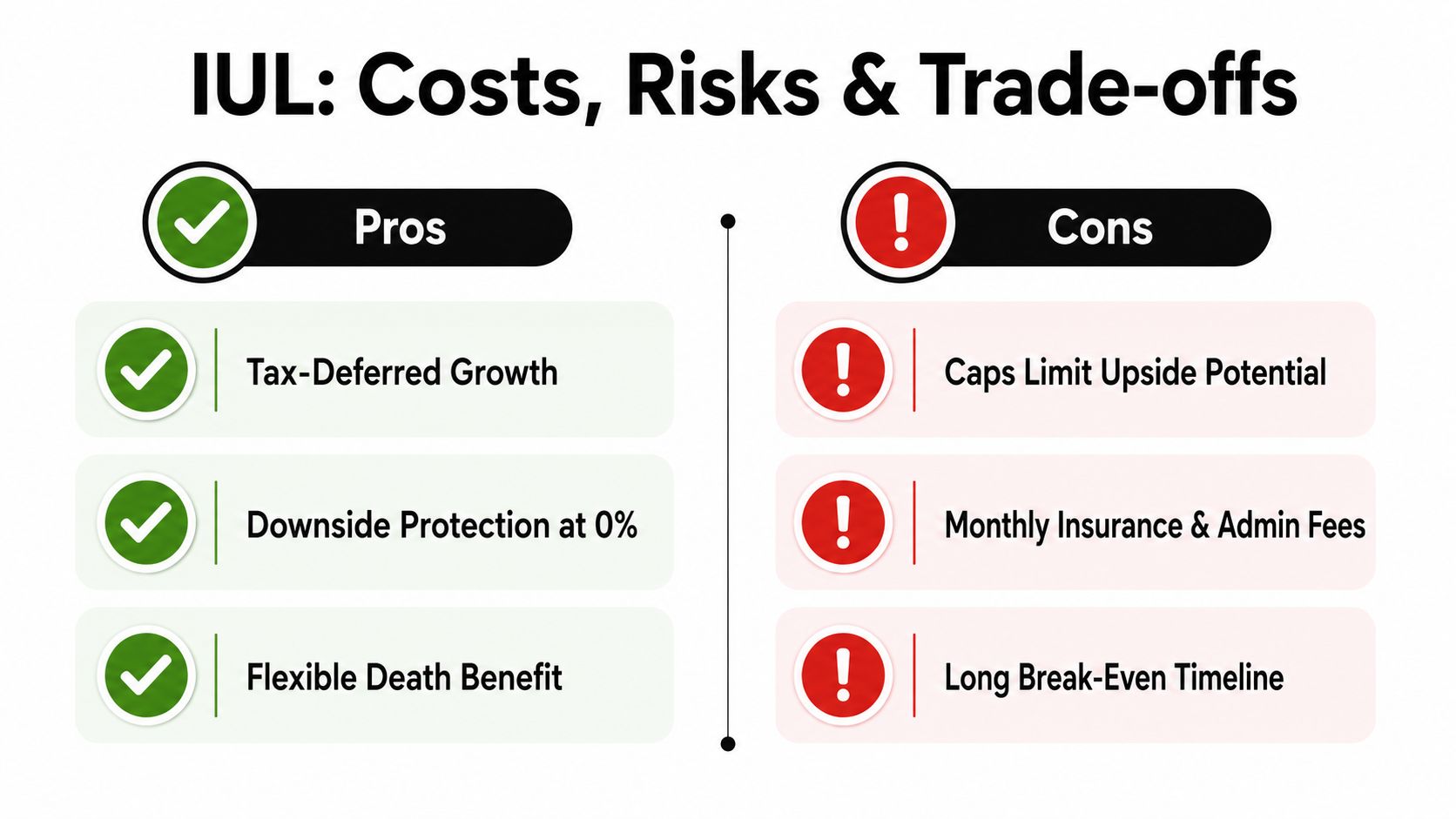
An IUL illustration can make the policy look like a smooth path from premium payments to tax-advantaged cash value, but the contract has friction points. Caps limit how much index growth you receive, participation rates can trim the credited return, and early policy charges reduce the amount that stays inside the policy. Administrative fees and the cost of insurance matter too, especially while the policy is still young and the cash value has not had much time to build.
Investopedia's discussion of the pros and cons of indexed universal life lays out the trade-off clearly, the policy can offer tax-deferred growth and downside protection, while high costs, fees, and limited upside can materially reduce outcomes Investopedia's pros and cons of indexed universal life. That is the part many sales pages soften. The policy can still serve a useful purpose, but the result depends on steady funding and on whether the policy is being used on a realistic timeline.
Why the first years can feel slow
The time-to-benefit gap is where many buyers get surprised. Cash value does not become useful right away, because the policy must first absorb early insurance costs and build enough surrender value before loans or withdrawals become meaningful. Neutral expert analysis notes that policyholders may need roughly 3-4 years before they can borrow meaningfully from the policy, which matters for families who are hoping to use the money sooner Insurance and Estates on IUL implementation strategy.
That delay changes how the policy should be evaluated. If your real need is emergency liquidity next year, IUL is usually the wrong tool. If your goal is long-term flexibility and permanent coverage, the slow build may still fit. The mistake is treating the policy as if cash value were ready on day one just because the illustration shows a future projection.
Funding discipline and tax treatment
Policy loans can be useful, but only if the contract stays in force and the policy is not a Modified Endowment Contract. The tax implications of life insurance cash value also depend on how the policy is structured and how loans are handled over time. Better Wealth notes that loans are generally not treated as taxable income under those conditions, which is one reason people describe IUL as a tax-efficient source of liquidity BetterWealth on indexed universal life. The tax treatment can be attractive, but it does not cancel the policy mechanics.
Practical rule: if the illustration only works when every assumption goes your way, ask what happens when funding drops, caps reset lower, or you need cash earlier than expected.
One more cost many people overlook is surrender charges in the early years. They can make the policy expensive to exit before it has had time to mature. That does not automatically make IUL a bad choice, but it does mean the contract should be treated as a long-term commitment, not as a flexible checking account.