You're 32, your baby is six months old, and the mortgage payment comes out every month whether you're ready for it or not. During a lunch break, you search for “buy term life insurance online,” enter a few details, and see a premium that looks affordable. The application takes only a short time. The difficult part comes afterward, when an insurer decides whether that price, coverage amount, and approval path apply to you.
Buying online is convenient, but it isn't a single-click transaction. You're making several connected decisions: how much coverage you need, how long it should last, whether no-exam underwriting suits you, which carrier deserves your trust, and what you'll do after the policy is issued. The application is usually the simple part. Underwriting determines the final outcome.
Digital life insurance shopping has been established for years. By 1999, more than 5 million households had researched life insurance online, and comparison sites were concentrating largely on term coverage, helping make term policies closely associated with online quote shopping (historical term life insurance data). The modern process is faster and more polished, but the core lesson remains: compare carefully, answer accurately, and treat convenience as a tool rather than a substitute for judgment.
Table of Contents
- Planning a Confident Online Life Insurance Purchase
- Determining Coverage and Term Before You Shop
- Comparing No-Exam and Exam-Based Term Policies
- Getting and Comparing Online Term Insurance Quotes
- Completing the Application and Understanding Underwriting
- Avoiding Common Online Life Insurance Mistakes
- Final Checks and Next Steps After Purchase
Planning a Confident Online Life Insurance Purchase
At 12:20 p.m., the parent in that scenario has three browser tabs open, a mortgage statement nearby, and a calendar packed with meetings. The online quote looks easy. What isn't obvious is whether the proposed benefit would replace enough income, last through the family's most vulnerable years, or survive the insurer's underwriting review at the displayed rate.
A sensible purchase starts with a sequence. First, estimate the financial loss your household would face if you died. Then select a term that matches the years your family depends on your income. After that, compare no-exam and exam-based policies, review carrier terms, complete the application, and inspect the issued contract.
Convenience doesn't decide approval
An online form can collect your information quickly, but an insurer still has to assess risk. The company may verify your identity, review medical and prescription information, examine driving records, and decide whether your answers support the requested coverage and rate class. Some applicants receive a quick decision. Others move into manual review, are asked for an exam, or receive a different offer.
That difference matters for a young family. A policy isn't valuable because the application was effortless. It's valuable because the death benefit, term, premium, exclusions, and beneficiaries work as expected when your family needs the contract.
Practical rule: Use the online application to save time, not to skip the insurance decisions that protect your household.
Online buying preference remains substantial, but buyers still want human assistance. In 2023 LIMRA-based reporting, 32% of consumers said they preferred buying life insurance online, compared with 29% who preferred buying in person, while 74% still wanted to speak with an agent during the process (LIMRA-based market reporting). That combination supports a hybrid approach: complete the digital steps yourself, then ask a licensed professional to explain an unclear underwriting question or policy provision.
Before requesting quotes, decide what you're trying to solve. A new parent may need income replacement, mortgage protection, and future education funding. A professional without dependents may focus on shared debt, final expenses, and future insurability. Neither should buy a policy solely because the monthly figure fits a lunch-break budget.
Determining Coverage and Term Before You Shop
The cheapest policy is often the one that leaves the largest unpaid obligation. Set your coverage target before opening a quoting tool, otherwise the quote itself may anchor you to an amount that looks comfortable but doesn't protect the people who rely on you.
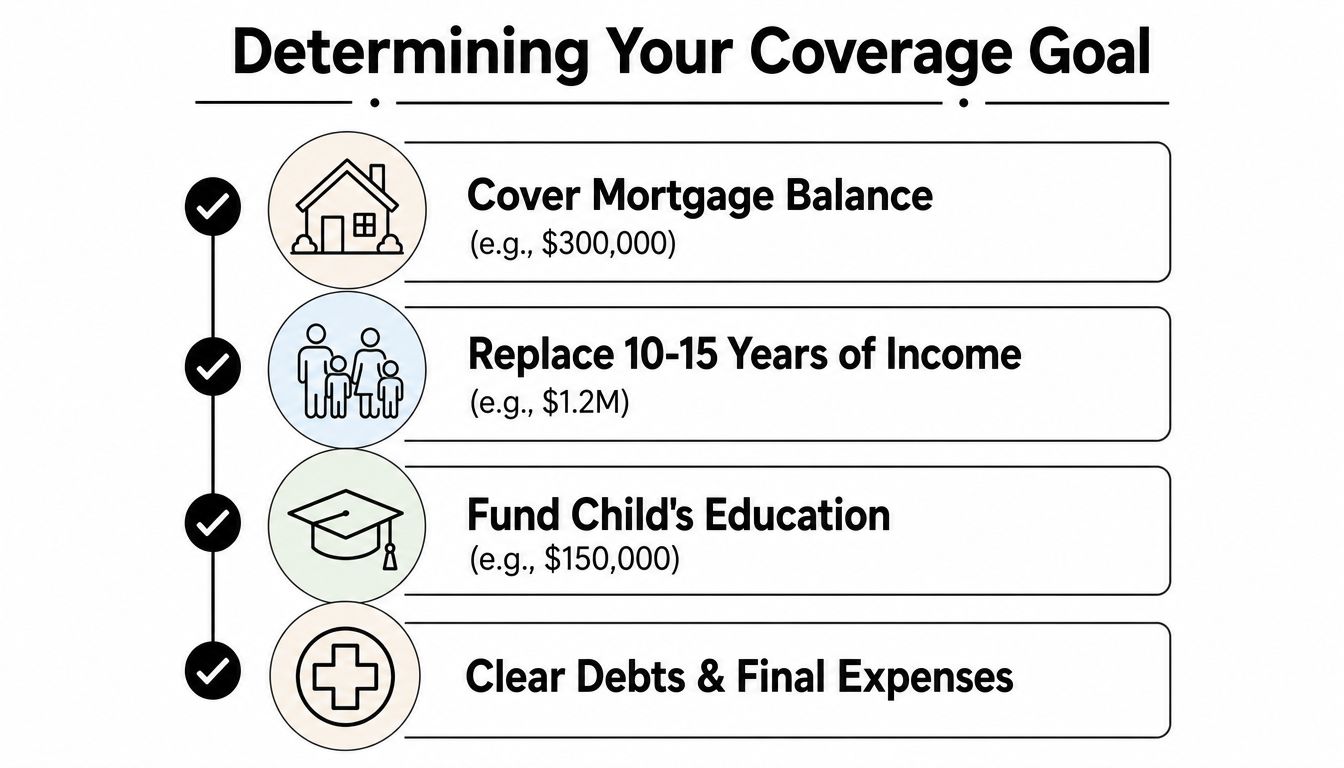
Start with four financial goals:
Build a quick estimate first
For a fast starting point, consider replacing 10 to 15 years of income, then add the mortgage balance, shared debts, and a reasonable education fund. Subtract assets your household could realistically use without creating a new financial problem. This method is useful when you need a preliminary figure before comparing carriers.
A detailed needs analysis is better when your situation includes variable income, business ownership, multiple dependents, substantial savings, special-needs planning, or a spouse whose earning capacity would change after your death. List obligations and resources rather than relying on a broad income shortcut.
Use this checklist:
- Income replacement: Estimate the years your household would need support, not just the current monthly bills.
- Mortgage protection: Include the balance and consider whether your family would want to eliminate the payment or continue it.
- Education funding: Add a realistic target for a child's future education, without treating an uncertain estimate as a guaranteed cost.
- Debt clearance: Include credit obligations, personal loans, and debts that a surviving partner might otherwise have to repay.
Match the term to the obligation
Choose the term by identifying the longest period during which your family has a meaningful financial dependency. A mortgage with many years remaining, a child who won't reach adulthood for a long time, or a career transition can justify a longer term.
Common choices include 10, 15, 20, and 30 years. A 10-year term may suit a short debt or a near-term income gap. A 20-year term often fits a young family's child-rearing years. A 30-year term can align with a long mortgage or a household that wants extended income protection.
Level premiums generally keep the scheduled premium stable throughout the selected term. Decreasing coverage or premiums may align with a debt that declines, but review the contract carefully. A lower starting price doesn't automatically provide equivalent protection.
Prepare accurate application details
Gather your date of birth, height, weight, medical history, medications, tobacco use, occupation, and higher-risk hobbies before applying. Include information about prior diagnoses and treatment rather than guessing what an insurer considers relevant.
Accurate answers protect the policy later. Omitting a prescription, diagnosis, or dangerous hobby can create avoidable disputes during a claim review and may affect the policy's validity under its terms.
Comparing No-Exam and Exam-Based Term Policies
A short online application can feel like the purchase is nearly complete. It is not. No-exam coverage removes the appointment and much of the paperwork, while the insurer still evaluates your risk through application answers, prescription history, motor vehicle records, medical data, and internal models.
The underwriting path matters more than the application length. Accelerated underwriting can produce a faster decision, but it may still require records, follow-up questions, or an exam. Fully underwritten coverage takes more time and effort, yet gives the insurer broader evidence to price your policy.
| Feature | No-Exam Term Policy | Exam-Based Term Policy |
|---|---|---|
| Approval path | Data-driven accelerated or simplified underwriting | Full underwriting with broader evidence |
| Health screening | Prescription histories, motor vehicle records, medical data, and application answers | Paramedical exam, blood and urine work, medical records, and detailed review |
| Decision speed | Often minutes to days, though some cases require further review | Usually slower because more evidence is collected and assessed |
| Coverage limits | Often constrained by age and underwriting path | More suitable for larger benefit amounts |
| Rate classes | May offer fewer pricing classes | Can provide preferred pricing for exceptionally healthy applicants |
| Best fit | Applicants who value speed and have straightforward risk factors | Applicants seeking larger coverage, stronger pricing, or review of complex health histories |
| Potential trade-off | Convenience can come with lower limits or a different price | More effort and waiting, but potentially broader underwriting flexibility |
Use compare no exam life insurance plans to identify questions about limits, health evidence, pricing classes, and follow-up requirements. The guide to no-exam term life insurance can also help you examine eligibility rules and coverage limits before choosing this route.
When no-exam coverage makes sense
Choose accelerated no-exam underwriting when you are relatively healthy, need a moderate benefit, have straightforward medical and lifestyle information, and value a faster decision. It suits a busy professional who needs family protection in place without arranging an exam, provided the final offer covers the household's actual obligations.
Review the benefit limit before applying. One industry roundup reports express underwriting for ages 18 to 60 reaching up to $1 million, accelerated underwriting for ages 18 to 50 reaching up to $3 million, and accelerated underwriting for ages 51 to 60 reaching up to $2 million (no-exam coverage comparison). These are eligibility ceilings, not promises. Your age, health history, requested benefit, carrier rules, and application answers determine the actual offer.
A quick approval is useful only when the policy is large enough and priced fairly for the protection you need. Do not choose a smaller benefit merely because the application is easier.
When an exam is worth the inconvenience
Select fully underwritten coverage when you need a larger benefit, want the strongest chance of a preferred rate, or have a medical history that automated screening may interpret poorly. The exam and records review give the insurer more evidence. A healthy applicant may use that evidence to qualify for a better risk class, while someone with complex health factors may receive a more considered assessment.
The slower path can be the better financial trade-off for a young family with substantial income to protect. A modest online policy that cannot cover the household's obligations solves the application problem, not the insurance problem.
Some carriers combine both workflows. They may start with accelerated underwriting, then request an exam or additional records when the available data does not support an immediate decision. That request is not automatically a rejection. It means the insurer needs more evidence before pricing or approving the requested coverage. Be ready to complete the extra steps rather than abandoning an otherwise suitable application.
Getting and Comparing Online Term Insurance Quotes
Requesting several quotes is useful only when the inputs match. A low illustrated premium may reflect a preferred health assumption, a shorter term, a smaller benefit, or missing riders. It isn't comparable to a quote built on different assumptions.
Set up one comparison sheet and use the same information for every carrier:
| Input / Feature | Carrier A | Carrier B | Carrier C |
|---|---|---|---|
| Coverage amount | Same target | Same target | Same target |
| Term length | Same term | Same term | Same term |
| Assumed health class | Record assumption | Record assumption | Record assumption |
| No-exam or exam path | Identify path | Identify path | Identify path |
| Riders | List each rider | List each rider | List each rider |
| Payment mode | Record frequency | Record frequency | Record frequency |
| Final underwriting conditions | Pending or stated | Pending or stated | Pending or stated |
Compare the assumptions, not just the premium
Age, health class, term length, riders, payment mode, and state can all affect the displayed price. A quote tool may show a preferred class before the insurer reviews your records. Treat that figure as an illustration until the company issues a formal offer.
Look for the policy features that survive the quote screen:
- Conversion rights: Check whether you can convert term coverage to permanent insurance and identify the deadline and eligible products.
- Renewal terms: Review what happens after the level-premium period ends.
- Exclusions and contestability language: Read the contract provisions rather than relying on a summary card.
- Rider availability: Confirm whether waiver of premium, child coverage, or other optional benefits are included or priced separately.
- Carrier support: Make sure you know how to reach a licensed representative if underwriting produces a question.
Approved quoting tools can reduce data-entry errors, but they don't replace contract review. Save screenshots or PDFs of the assumptions, including the selected benefit, term, underwriting path, and riders. If the final offer differs, you'll have a clear record of what the initial illustration showed.
For a faster starting point, you can compare instant online life insurance quotes, then verify every assumption before submitting an application. Don't choose a carrier because its first screen is cheapest. Choose the offer that remains suitable after the underwriting path and policy provisions are clear.
Completing the Application and Understanding Underwriting
A simple online form can take minutes, while the insurer's decision may require records, automated checks, or an exam. Treat the application as a serious underwriting document, not a checkout screen. It determines whether the carrier can offer the benefit, term, and price shown in the quote.
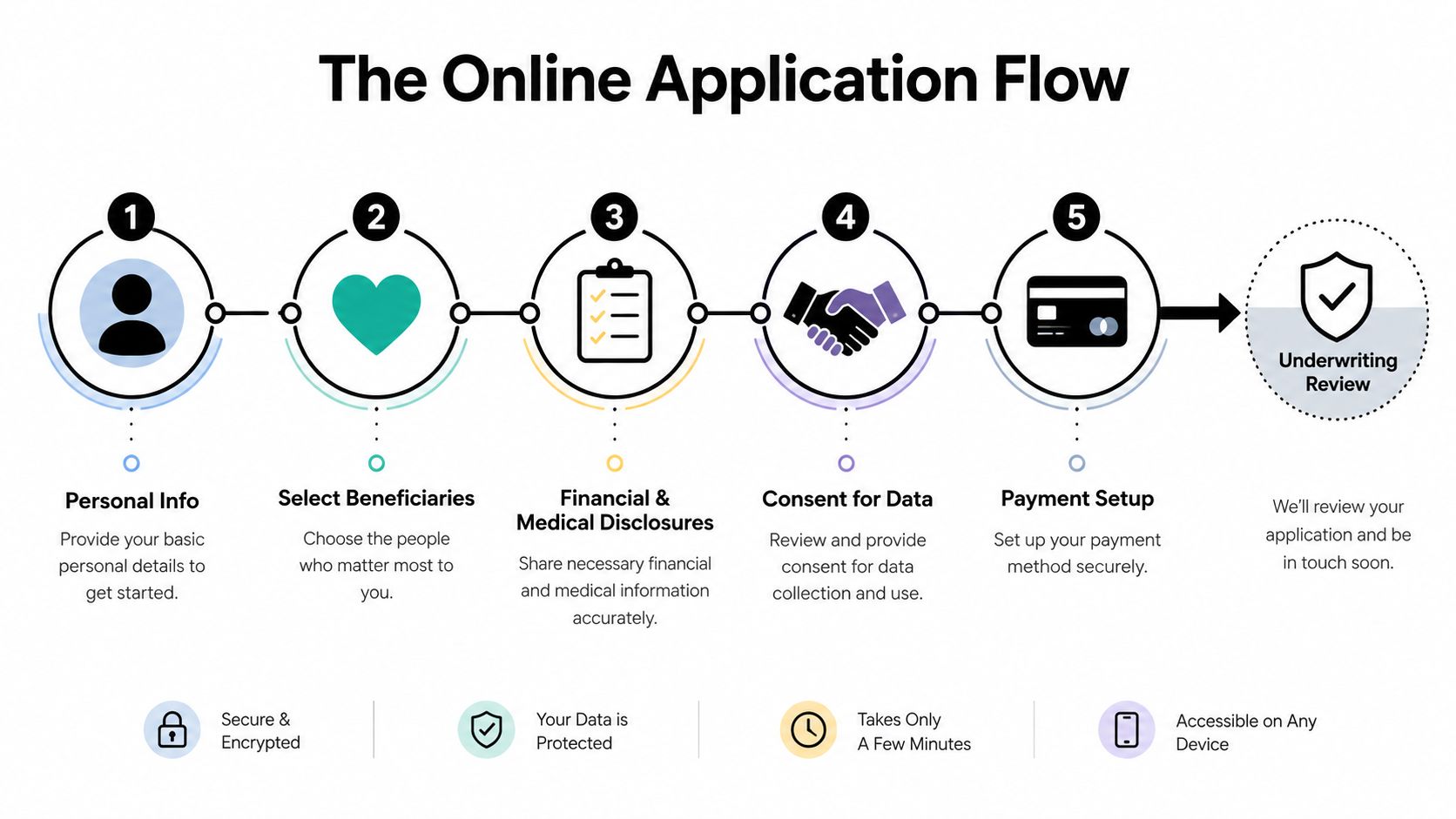
Complete each field with your legal name, address, employment details, and identity information exactly as requested. Add primary and contingent beneficiaries, then check whether those choices fit your household. A married couple with minor children may need to coordinate beneficiary designations with a trust or estate plan instead of naming a child directly without understanding the consequences.
Financial questions help the insurer assess whether the requested benefit fits your income and obligations. Medical questions require complete answers about diagnoses, treatment, medications, hospitalizations, tobacco use, and related history. Do not shorten an answer to keep the application moving. An omission can create questions later and complicate a claim review.
The insurer may verify your identity and obtain outside information. Accelerated underwriting can use prescription histories and motor vehicle records. Other review paths may consult medical information databases or request supporting records. The NAIC accelerated underwriting guidance explains that this approach uses external data to assess eligibility, while some applicants still need additional review or a medical exam.
The application is the front door. Underwriting is where the insurer decides what it can actually offer.
Automated review isn't the same as automatic approval
Insurers use automated underwriting systems to process application data and route straightforward cases. The result may be approval, referral to a human underwriter, a request for more evidence, or a requirement for an exam.
Expect one of these outcomes:
- Approval as applied: The insurer accepts the requested benefit and rate class.
- Approval with a different rate: The insurer accepts the risk but assigns a higher premium class.
- Additional evidence: The company requests records, an exam, bloodwork, urine testing, or an attending physician statement.
- Reduced offer: The insurer offers a lower benefit than requested.
- Decline or postpone: The company cannot offer coverage under its current rules or needs a later review.
A no-exam decision is convenient, but it is not automatically the better choice. If your health history is straightforward and speed matters, accelerated underwriting can reduce friction. If the automated path produces a higher rate or reduced offer, a fully underwritten policy may justify the extra records and waiting time.
Decision timing varies by applicant. Accelerated cases often move faster than traditional underwriting, but survey medians are not promises for your application. Keep your phone available, respond to verification requests, and help your doctor's office release records promptly.
For a clear explanation of evidence collection, risk classification, and review stages, read this guide to the life insurance underwriting process. Complete the application privately, review every answer before submitting, and save the confirmation and requested documents.
Avoiding Common Online Life Insurance Mistakes
Speed creates predictable errors. A buyer sees a low premium, reduces the benefit to make the payment smaller, and forgets that the policy may no longer cover the mortgage, income gap, and childcare burden.
Avoid these traps:
- Buying too little coverage: A small policy may be easy to approve, but it can leave a surviving partner with the same mortgage and fewer resources.
- Choosing the cheapest term: Compare conversion rights, renewal provisions, riders, exclusions, and carrier support before deciding.
- Omitting medical information: Leaving out a diagnosis, prescription, or treatment can create serious claim problems later.
- Ignoring rider costs: Waiver of premium or child coverage may be useful, but confirm what each rider does and what it costs.
- Forgetting beneficiary updates: Review beneficiaries after marriage, divorce, a birth, or another major household change.

A young family should connect the benefit to mortgage and childcare years, not to the smallest premium available. A busy professional can apply during a lunch break, but should reserve time that evening to read the declarations page and policy delivery materials.
Don't assume the online offer is final. The insurer may change the rate class, request an exam, or reduce the benefit after reviewing external data. If the issued contract differs from what you expected, contact the carrier or advisor before accepting it.
Final Checks and Next Steps After Purchase
Approval is a milestone, not the end of the decision. Read the issued contract and declarations page before filing it away.
Confirm each item:
- Death benefit: Verify the amount matches the accepted offer.
- Term length: Check the coverage period and any conversion deadline.
- Premium amount: Confirm the amount and whether it reflects the final rate class.
- Billing mode: Make sure the payment frequency and method are correct.
- Beneficiary designations: Check primary and contingent beneficiaries for accuracy.

Store the policy in a secure personal records system and keep a digital copy. Add the insurer's customer service and claims contact details to a shared family location, so your beneficiaries aren't forced to search for them during a crisis. Tell the appropriate people that coverage exists without sharing sensitive account credentials.
Set a calendar reminder before each annual renewal to review affordability, household obligations, and beneficiary details. If your health or lifestyle improves substantially, ask whether the carrier will reconsider your rate. If your needs grow, consider additional coverage or a conversion option rather than allowing the original policy to lapse.
Finally, retain your underwriting disclosures and the final offer. The cleanest online purchase is one where the family can locate the contract, understand the benefit, and know whom to contact.
Coveredly offers a digital term life insurance application with no-exam options for most applicants, subject to eligibility and underwriting rules, including coverage of up to $3 million. Visit Coveredly to compare an online application path with the coverage amount, term, and underwriting trade-offs your household needs.