Is the question whether you can get life insurance after cancer, or whether your medical record supports a better offer now than it would have during treatment? A yes-or-no answer misses what matters most: timing, evidence, and the protection your family needs while you wait.
Understanding cancer and life insurance starts with separating eligibility from affordability. You might qualify for coverage but receive a higher premium, a smaller benefit, or restrictions on early payouts. The useful next step is to identify which option fits your history without assuming approval or leaving your household exposed indefinitely.
Table of Contents
- When Cancer Timing Decides Your Life Insurance Options
- What Underwriters Check After a Cancer Diagnosis
- Disclosure Mistakes That Can Put a Claim at Risk
- Term, Guaranteed Issue and Graded Options Compared
- How a Cancer History Changes Your Premium
- Coverage Continuity Check Before You Buy
- How to Apply for Life Insurance After Cancer
- Confirm Your Timing and Request a Quote
When Cancer Timing Decides Your Life Insurance Options
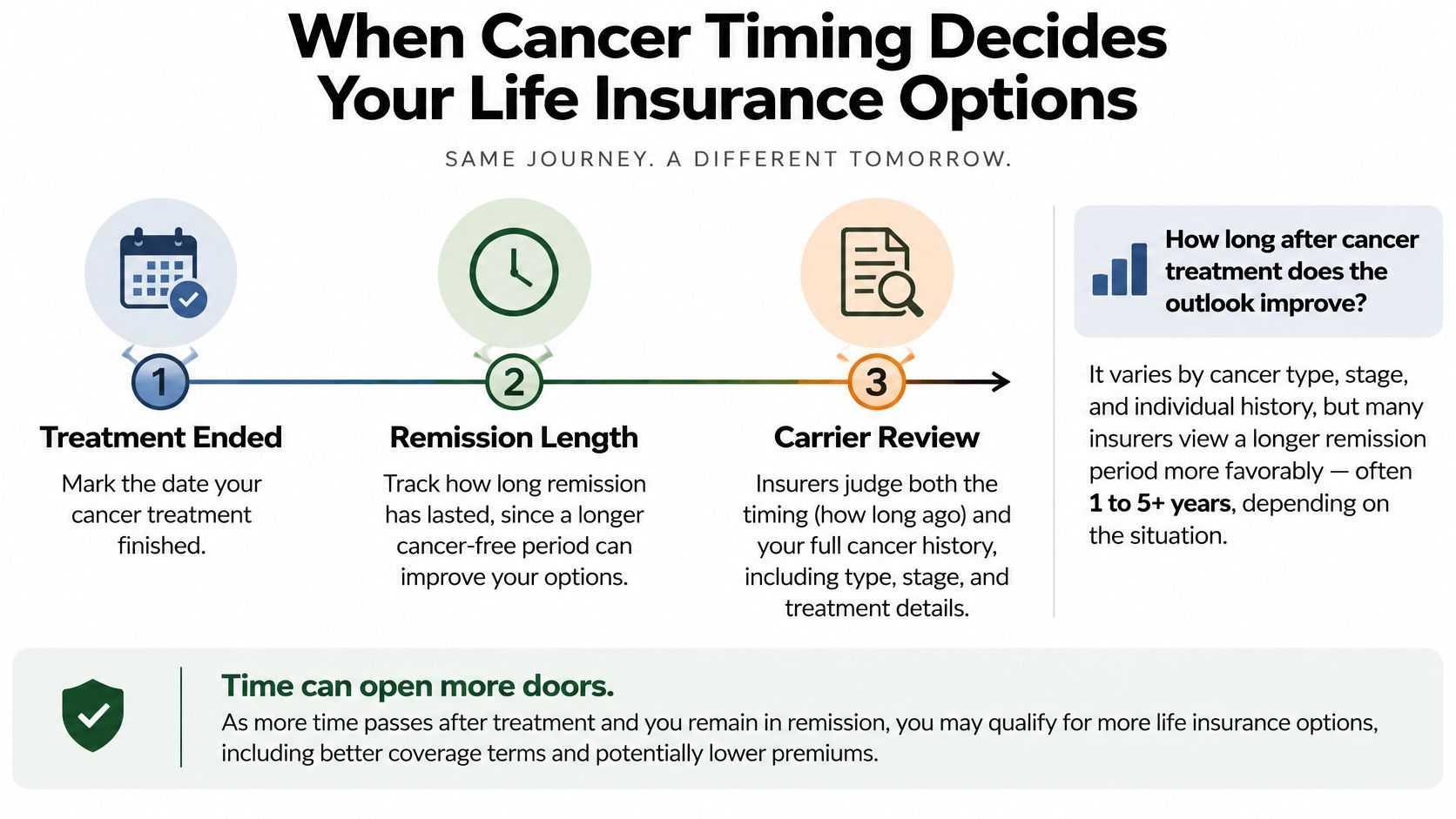
How long after cancer treatment does the outlook improve? There isn't a universal anniversary when every insurer will accept an application. Underwriters consider when treatment ended, how long remission has lasted, and what your follow-up records say about your particular cancer.
The National Cancer Institute's survivorship overview reflects why a past diagnosis shouldn't be treated as a complete description of someone's current health. For an insurance application, the distinction between recent treatment and sustained remission matters more than the label cancer survivor alone.
Eligibility outlook by time since cancer treatment
| Time since treatment ended | Typical underwriting outlook | What to do next |
|---|---|---|
| Active treatment, including chemotherapy or radiation | Usually postponed | Apply after treatment is documented as complete |
| Less than 2 years in remission | Often rated or declined for traditional coverage | Compare guaranteed issue options or wait |
| 2 to 5 years in remission | Traditional coverage possible; many insurers require 2 to 5 years | Request quotes from fully underwritten and simplified carriers |
| 5 to 10 years in remission | Better odds of standard rates on many cancers; some cases need up to 10 years | Reapply to compare offers |
| 10 or more years cancer-free | Often eligible for standard underwriting | Confirm with carriers; outcomes vary by cancer type |
Treat these rows as screening guidance, not eligibility promises. Active treatment commonly means postponement. Early remission may leave fewer choices, while a longer, well-documented recovery can support a broader review.
The timeline below captures the sequence an insurer needs to understand.
Use your dates, not an assumed waiting period
Say a parent with stage I breast cancer finished radiation 18 months ago. The same person applying at year four, with reassuring follow-up results, could receive a different decision because the insurer has a longer medical record to assess. Neither point guarantees a particular rate.
Longer remission doesn't erase the original diagnosis. Cancer type, stage, recurrence, and other health conditions still influence the outcome, even after a lengthy cancer-free period.
Your first action is simple: write down your treatment completion date and the remission date recorded by your oncologist. Find the matching row before requesting a quote, then ask whether the carrier measures its waiting period from diagnosis, treatment completion, or another clinical milestone.
What Underwriters Check After a Cancer Diagnosis
An underwriter reads a medical file to understand what happened, how it was treated, and what has happened since. Cancer survivor underwriting is therefore a review of several connected facts, not a single checkbox.
The factors described in Ethos's guide to life insurance for cancer patients include cancer type, stage, treatment, remission, hereditary risk, medications, and follow-up findings. Organizing those details makes medical underwriting easier to understand.
Underwriting factors and what each one signals
| Factor | What the insurer asks | Why it matters |
|---|---|---|
| Cancer type | Diagnosis type and body site | Some cancers carry higher recurrence risk than others |
| Stage or grade | Stage at diagnosis and pathology report | Stage describes spread; grade describes how abnormal the cells appear |
| Age at diagnosis | Age when first diagnosed | Younger onset may be weighed differently |
| Time since diagnosis | Diagnosis date and treatment end date | The insurer assesses how risk changes over time |
| Treatment | Surgery, chemotherapy, radiation, hormone therapy | Completed treatment and ongoing care require different assessments |
| Recurrence and family history | Any repeat cancers and hereditary risk | These findings can affect the risk classification |
| Follow-up results | Recent scans, bloodwork, and specialist notes | Reassuring results support a clearer assessment |
| Medications and other health | Current medications and other conditions | Other health risks affect the overall rating |
Make the medical evidence specific
Collect the pathology report, diagnosis date, treatment completion date, and most recent specialist notes. A statement that you're doing well is useful context, but it doesn't replace the clinical details an insurer needs.
Consider survivors with the same cancer diagnosis. One has consistently reassuring scans; another has an unresolved finding awaiting investigation. They may receive different decisions even if their original treatments were similar.
Regular surveillance itself isn't a negative finding. Many survivors continue routine monitoring, so distinguish scheduled follow-up from testing ordered because a clinician suspects recurrence.
Early-stage, fully treated disease with low recurrence risk may support consideration sooner than higher-stage or recurrent disease. Ask for the carrier's requirement for your cancer category rather than assuming every diagnosis follows the same timetable.
For broader context on conditions that may also affect your application, our guide to life insurance for people with health issues explains how a complete health history fits into the decision. Before requesting quotes, list each factor in the table alongside the record that documents it.
Disclosure Mistakes That Can Put a Claim at Risk
A contestability period doesn't make inaccurate answers safe. The safest application is one that matches your medical records from the beginning, not one that relies on a future deadline.
The New York Department of Financial Services guidance on contestability explains that life policies generally become incontestable after two years in force, with certain changes measured from their effective dates. During the applicable period, an insurer needs actual proof of a material misrepresentation to contest a claim; suspicion alone doesn't justify refusing payment.
That's a New York rule, not a substitute for checking the law and policy provisions where you live. A material misrepresentation concerns information that could have changed whether the insurer accepted the risk or the terms it offered.
Correct these assumptions before signing
- An old or small cancer doesn't count. Answer the question as written, including early-stage diagnoses when requested.
- An approximate date is close enough. Check the record, or clearly identify an estimate and arrange to confirm it.
- An unrelated-looking consultation can be omitted. Disclose consultations, investigations, and surveillance findings when the application asks about them.
An omission discovered during a claim can lead to a payment dispute or an attempt to rescind coverage. Our explanation of what happens if you lie on a life insurance application gives additional context on why complete answers matter.
Protect your beneficiaries: Keep the signed application, supporting disclosures, and every written clarification from the insurer together.
Before signing, compare your answers with your medical timeline and ask the agent to identify in writing which questions cover your cancer history. Don't let someone else shorten an answer until it becomes misleading.
If you're also sorting out employment, benefits, or legal questions during care, Sunridge Medical's resource on cancer insurance and disability support offers a separate starting point. Those issues deserve attention alongside, rather than instead of, accurate life insurance disclosure.
Term, Guaranteed Issue and Graded Options Compared
Life insurance options for applicants with a cancer history
| Option | Health questions or exam | Typical amount | Waiting period | Best fit |
|---|---|---|---|---|
| Fully underwritten term | Full medical review, often records and sometimes an exam | Largest amounts; carrier limits apply | No graded waiting period once coverage takes effect | Long remission with reassuring follow-up |
| Simplified issue term | Short health questionnaire, sometimes no exam | Moderate amounts; carrier limits apply | None in most cases, subject to policy terms | Stable remission with recent normal results |
| Guaranteed issue | No health questions; no health-based decline for eligible applicants | Usually capped at about $25,000 | Full benefit after a waiting period | Active treatment or no other route available |
| Graded death benefit | Few or no health questions, depending on the underlying policy | Usually modest; carrier limits apply | Often premiums plus interest for covered natural-cause death in years 1 to 2 or 3, then full benefit | Recent diagnosis when other routes fail |
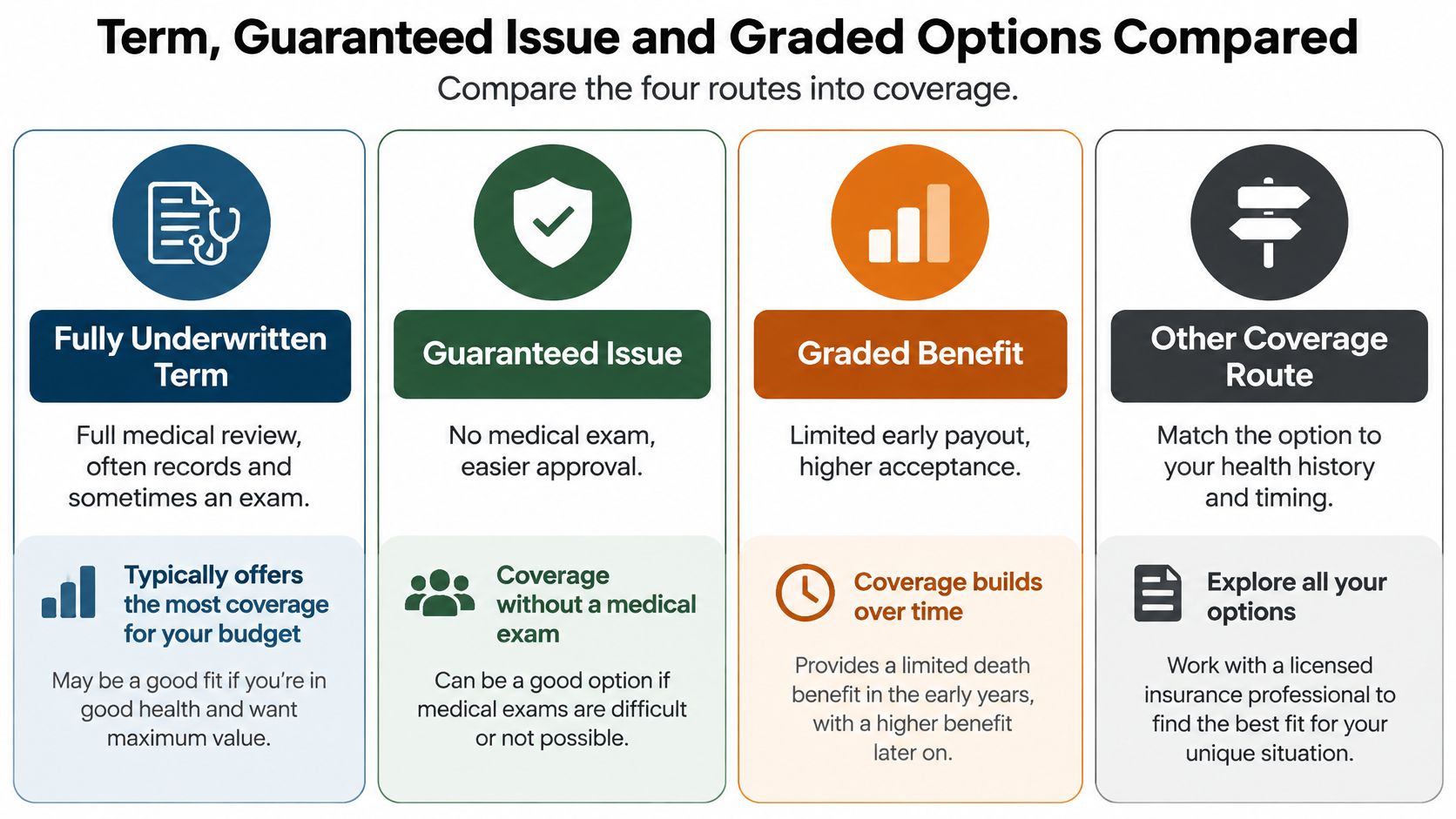
These are different trade-offs, not interchangeable products. Guaranteed issue is an acceptance method; a graded death benefit is a payout provision, and they often appear in the same policy.
The comparison graphic highlights the broad routes into coverage.
Match the review to your record
Fully underwritten term suits applicants whose records can support a detailed assessment. It generally offers access to larger benefits and potentially lower premiums than limited-underwriting alternatives, although a cancer-related rating can change the price comparison.
Simplified issue term uses fewer application questions and may avoid an exam. Say a hypothetical 38-year-old in the first year of remission receives an offer through this route. That outcome wouldn't mean another applicant with a different cancer history would qualify.
Guaranteed issue can be worth considering when traditional coverage isn't available. A parent still receiving chemotherapy might find this is the only available route, but age, location, product availability, and nonmedical eligibility requirements still apply.
Graded coverage needs careful reading because the advertised benefit may not be payable immediately for a cancer-related death. Our explanation of a graded death benefit helps distinguish the face amount from the early payout.
Many carriers offer flexible underwriting for pre-existing conditions. In many cases, no medical exam is needed because insurers use digital underwriting and health data, but no exam doesn't mean no medical assessment.
For another way to review the coverage discussion, use the video below.
Start with the most fully underwritten option your record reasonably supports. Move to guaranteed issue if that route is declined or unavailable, and verify the actual early-benefit terms before paying.
How a Cancer History Changes Your Premium
Insurers price life insurance by estimating the likelihood of paying a death claim during the coverage period. A cancer history can increase that estimate, but the relevant risk isn't necessarily the same immediately after treatment as it is after sustained remission.
Gen Re's actuarial discussion of cancer survivor mortality explains the mortality ratio: observed mortality among survivors divided by expected mortality among comparable people in the general population. Its central pricing implication is that additional charges should reflect how excess risk changes with time, rather than treating every past diagnosis as permanently identical.
Understand the reason for the extra charge
An insurer may apply a rating, which raises the premium above its standard classification, or a flat extra, an additional charge associated with the assessed risk. The cancer's type, stage, treatment response, and recurrence history help determine the decision.
Other risks matter too. Smoking or heart disease may have more influence on an applicant's overall assessment than a remote, fully treated cancer.
Suppose an applicant receives a higher rating shortly after treatment. After a substantially longer period of reassuring follow-up, another review might support standard terms, but that's a possible outcome, not a scheduled reduction.
A better medical outlook doesn't automatically reduce an existing policy's premium. Ask whether the insurer allows reconsideration or whether you'd need a new application.
Premiums also reflect your age, coverage amount, term length, and policy type. Waiting may improve the cancer assessment while increasing the age-related cost, so only actual quotes can show the combined effect.
Before accepting an offer, get clear answers to these questions:
- Reason for the rating: Which medical findings led to the additional charge?
- Duration of the extra: Is it temporary, reviewable, or built into the premium throughout the term?
- Reconsideration milestone: What new evidence would justify another assessment?
Question an unexplained permanent extra, but don't assume it's automatically inappropriate. Keep existing protection in force while any replacement application is reviewed.
Coverage Continuity Check Before You Buy
Getting approved isn't the same as protecting your household adequately. After cancer, savings may be lower, debts may be higher, and one income may be less dependable, even when health insurance has covered much of the treatment.
A UT Health San Antonio report on workplace benefits and cancer survivors found that employed U.S. survivors without employer health coverage were 70% more likely to worry about paying medical bills. That finding concerns health benefits, not life insurance, but it illustrates why the source and stability of household protection deserve attention.
Total the obligations that would remain
A common starting guideline is 10 to 15 times annual income, and we help tailor the amount to each situation. Use that only as an initial check, then calculate what your family would need.
- Essential expenses: Housing, food, utilities, transportation, and ongoing household costs.
- Outstanding debt: Mortgage balances and other obligations your survivors would need to address.
- Care and education: Childcare, replacement caregiving, and education goals.
- Available resources: Accessible savings, dependable survivor income, and existing individual coverage.
Avoid double-counting the mortgage if you've already included its payments in a long-term household budget. Also allow for unpaid caregiving work, not just salary.
Check what happens when employment ends
Employer-provided life insurance may end when employment ends. Ask the benefits administrator for the termination date, any portability or conversion rights, and the deadline to use them before a job change leaves a gap.
For example, a survivor with a 12-year-old child and a mortgage may need individual protection alongside workplace benefits. Review beneficiaries after family changes and confirm that the designations still match your intentions.
Life insurance, health insurance, disability coverage, and critical-illness benefits serve different purposes. Ordinary term life insurance pays beneficiaries after death; it doesn't fund treatment while you're alive unless an applicable supplemental benefit provides otherwise.
For recovery-related expenses, Lake City Physical Therapy's page can help you confirm your rehabilitation insurance benefits. Keep that benefit check separate from your life insurance calculation, then total expenses, debt, caregiving needs, and available resources before requesting coverage.
How to Apply for Life Insurance After Cancer
A useful application starts with a complete file, not the fastest form submission. The Wall Street Journal's guide to cancer and life insurance underwriting notes that many applicants need approximately one to five years without disease, while some cases may require up to 10 years.
Those ranges aren't a reason to delay automatically. They're a reason to establish which carrier rules apply to your medical history before submitting an application.
The process graphic shows the main stages to organize.

Build the file and choose the route
Gather the medical records. Collect the diagnosis date, pathology report, stage, treatment dates, an oncologist's letter confirming treatment status, and current follow-up results. Missing documents can delay review, so request them before you need an immediate decision.
List every condition, medication, and treatment, including maintenance therapy and issues that seem minor. Don't decide on the insurer's behalf that something is irrelevant.
Choose an application window. Match your documented history to the carrier's requirements, including whether ongoing medication counts as continuing treatment for that product. If you're receiving active care, ask about postponement or guaranteed issue rather than submitting applications blindly.
Set the benefit using your household obligations and resources. Don't choose a smaller amount solely because an online form makes it easy to select.
Select the coverage route. Compare the available medical-review options against your records, budget, and required benefit. Don't assume a shorter questionnaire will produce a more favorable decision.
Submit carefully and inspect the offer
Complete the personal information, health history, and lifestyle questions fully. The insurer may request an attending physician statement from your doctor, so confirm the practice's contact details and respond promptly to requests for clarification.
Review before accepting. Check the premium classification, exclusions, benefit limitations, effective date, and payment terms. Coverage typically begins once approval is complete and the first payment is processed; most policies also include a grace period before a missed payment affects coverage.
Don't cancel an existing policy based on a preliminary quote. Confirm that replacement coverage is in force and that its written terms meet your needs.
Check the completed application package
- Medical timeline: Diagnosis, treatment, completion, recurrence history, and current status.
- Clinical evidence: Pathology, specialist notes, and requested follow-up findings.
- Financial target: Benefit amount, intended protection period, and affordable premium.
- Application copies: Signed answers, supporting explanations, and insurer correspondence.
- Review milestone: The clinical event or updated evidence that could support reconsideration.
If the offer is postponed or expensive, ask what specifically would change the decision. A documented follow-up milestone is more useful than repeatedly applying without new evidence.
Confirm Your Timing and Request a Quote
Your next decision should begin with your treatment dates, not an advertised premium. Identify the timing category that best matches your record, then write down unresolved questions about ongoing therapy, remission, and the carrier's evidence requirements.
Use the same medical file and coverage target for each quote. Otherwise, a cheaper offer may reflect a smaller benefit, different term, or more restrictive payout provision.
Compare written terms, not eligibility summaries
Request a fully underwritten or simplified term assessment where your record supports it. Obtain a guaranteed issue fallback if eligibility or timing makes that necessary, rather than assuming the easiest application offers the best protection.
For each offer, record:
- Price and rating: The premium and the stated reason for any additional charge.
- Benefit terms: Exclusions, early payout restrictions, and coverage effective date.
- Future review: Whether an extra charge is temporary and what would support reconsideration.
We're a licensed insurance agency that partners with carriers to issue policies and compares multiple carriers. Our team guides customers through the process, answers questions, and helps them choose coverage for their circumstances, but approval isn't guaranteed.
The image below accompanies our online coverage experience.

We offer term life insurance with no medical exams for policies up to $3M, subject to eligibility and underwriting. That doesn't mean a cancer history bypasses medical review or that every applicant can obtain the maximum amount.
Book a timing check with your records and household figures ready. Let the insurer's written decision, rather than a general eligibility table, determine whether the offer is right for your family.
At Coveredly, we help you compare term life insurance options and understand how your cancer history may affect the available coverage. Visit Coveredly to request a timing check and quotes with your treatment timeline, follow-up records, and coverage target in hand.