You're filling out life insurance after bedtime, one eye on your laptop and one ear on the baby monitor. A question asks about smoking history, weight, medications, or an old diagnosis. You pause. Maybe you used to vape but quit. Maybe your doctor once mentioned high blood pressure and you never followed up. Maybe it feels easier to round things in your favor and move on.
That moment matters more than many realize.
A life insurance application isn't just paperwork. It's the foundation of the contract. The insurer prices and approves coverage based on the answers you give, and your family may rely on that policy years later when they need stability most. A small omission can feel harmless when you apply. It can feel very different if a claim is reviewed after your death.
For young families, newly married couples, and busy professionals, the better question isn't just whether any lie can void coverage. It's which answers are claim-critical, what counts as a real misrepresentation, and what changes once the policy has been in force for a while.
Table of Contents
- Introduction Why Honesty on Your Application Matters So Much
- Understanding Material Misrepresentation and How Insurers Judge It
- How the Two Year Contestability Period and Incontestability Protection Work
- What Actually Happens When a Lie Is Discovered Denial Rescission and Legal Risk
- Real World Examples That Show Which Lies Trigger Problems
- How to Disclose Correctly and Fix a Mistake Before It Becomes a Claim Issue
- Conclusion Protecting Your Family With an Honest Application
Introduction Why Honesty on Your Application Matters So Much

A lot of people who search what happens if you lie on life insurance application aren't plotting fraud. They're worried about something more ordinary. They left out a smoking habit from a few years ago. They guessed on their weight. They didn't mention a prior diagnosis because they thought it was minor, old, or unrelated.
That's exactly why this topic gets confusing.
Insurance law doesn't treat every wrong answer the same way. A typo in your address isn't the same as hiding a heart condition. Forgetting the month of a doctor visit isn't the same as answering “no” to a question about tobacco use when the truthful answer is “yes.” The line that matters is usually whether the missing or false information would have changed the insurer's underwriting decision.
Why families get blindsided
When a claim is made, beneficiaries often assume the only question is whether the policy was active. Sometimes there's a second question. Was the application accurate enough to support the coverage that was issued?
If the insurer finds a serious mismatch between the application and the medical or lifestyle facts, that can create a dispute. During the early life of a policy, that dispute can become a denial or rescission. Later, the insurer's options may narrow sharply.
Practical rule: The risk usually isn't that insurers expect perfect memory. The risk is that an answer hid something that affected the insurer's decision to issue or price the policy.
What to keep in mind right now
Three ideas will help you make sense of this:
- Materiality matters most. Not every mistake is fatal.
- Timing matters almost as much. Early discovery and late discovery can lead to very different outcomes.
- Fixing an error early is safer than hoping it stays hidden. Silence feels easy now and expensive later.
If you've already applied and you're second-guessing an answer, that doesn't automatically mean disaster. But it does mean this is worth handling carefully, before your family ever has to test the policy in a claim.
Understanding Material Misrepresentation and How Insurers Judge It
A useful comparison is a mortgage application. If you misspell your employer's street address, the lender probably doesn't care. If you hide half your income source or fake your debt load, the lender cares a lot. Life insurance works in a similar way.
The phrase to know is material misrepresentation. It usually means a false statement or omission that mattered to the insurer's decision. If the insurer would have declined the application, charged a different premium, or changed the terms had it known the truth, the answer may be material.
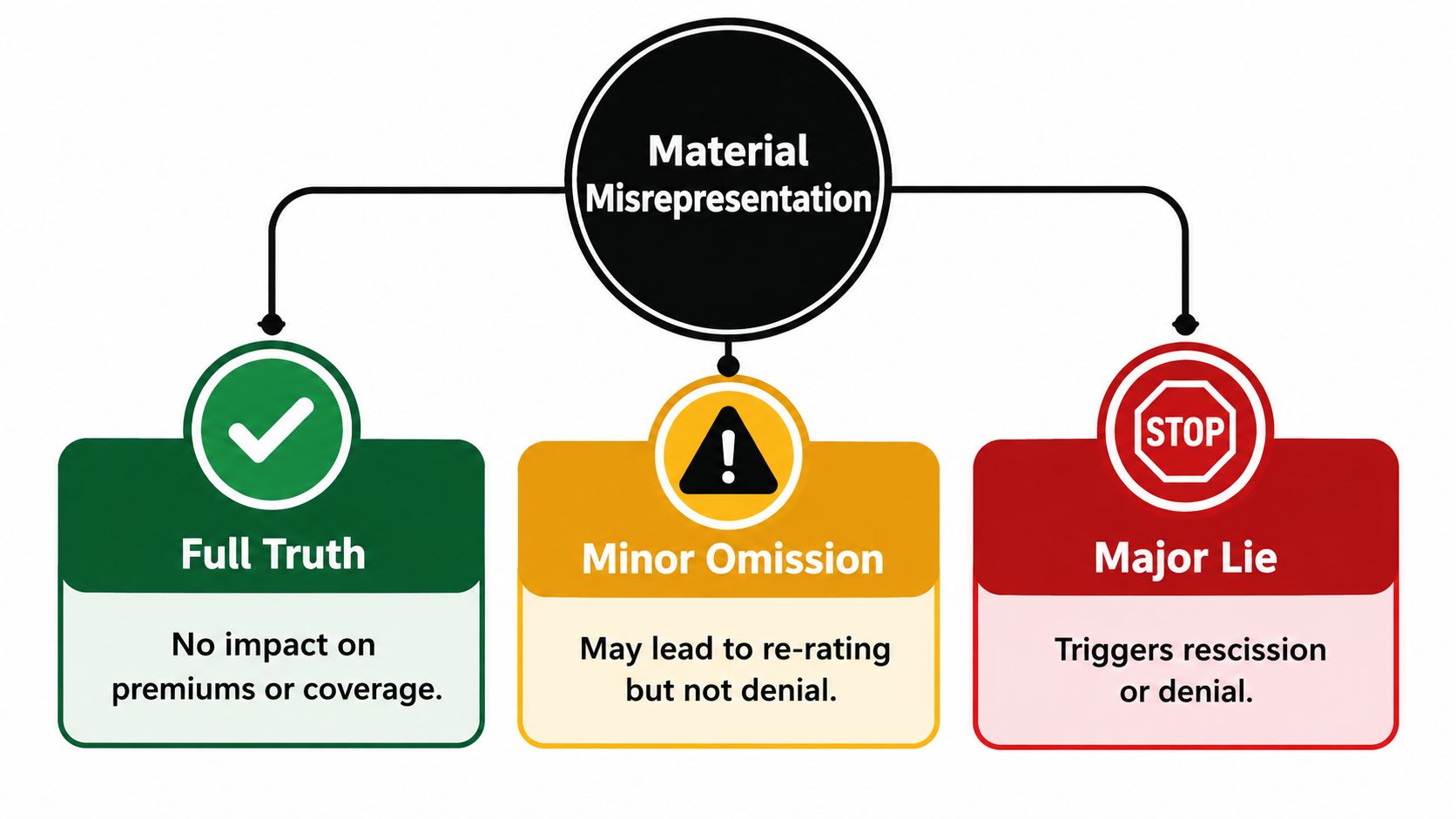
What usually counts as claim-critical
Independent legal guidance emphasizes an important point. Rescission usually requires the false statement to be material and relied on by the insurer, not just technically wrong, and the burden can vary by jurisdiction, as discussed in this guide on misrepresentation versus innocent mistake.
That's why some disclosures are much more sensitive than others:
- Smoking or nicotine use: Underwriters often price this differently from non-smoker status.
- BMI or weight history: A meaningful understatement can affect rate class.
- Prior diagnoses: Conditions like heart, cancer, or metabolic issues often matter even if you feel fine now.
- Medications and specialist visits: These can reveal risks that basic answers don't.
By contrast, a harmless clerical error usually isn't what claim disputes turn on.
The gray zone people miss
The hard part is the middle. Not every bad answer is a dramatic lie. Some are half-answers, misunderstandings, or guesses.
Maybe you thought occasional cigar use didn't count as tobacco. Maybe you answered based on feeling healthy rather than on your chart. Maybe you omitted an old diagnosis because no treatment followed. Those facts don't automatically excuse the error, but they do help explain why these cases can become disputes about judgment, wording, and underwriting relevance.
A wrong answer becomes much more dangerous when it changes how the insurer saw your risk at the time the policy was issued.
How insurers look at the application
Underwriters don't read your application like a school test where every wrong answer gets the same red mark. They look for risk signals. If you want a deeper look at how those decisions work, Coveredly's explainer on life insurance underwriting gives a practical overview.
A simple way to self-check is to ask:
- Would the truthful answer have changed my premium or approval?
- Did the insurer likely rely on this answer in pricing the policy?
- Is this error about identity, contact details, or something directly tied to health and risk?
If your answer mainly affects contact information or harmless details, that's one category. If it affects mortality risk, that's another.
How the Two Year Contestability Period and Incontestability Protection Work
Most life insurance policies have a two-year contestability period, and the clock usually starts on the policy's issue date or on a reinstatement date after a lapse, according to this life insurance contestability overview.
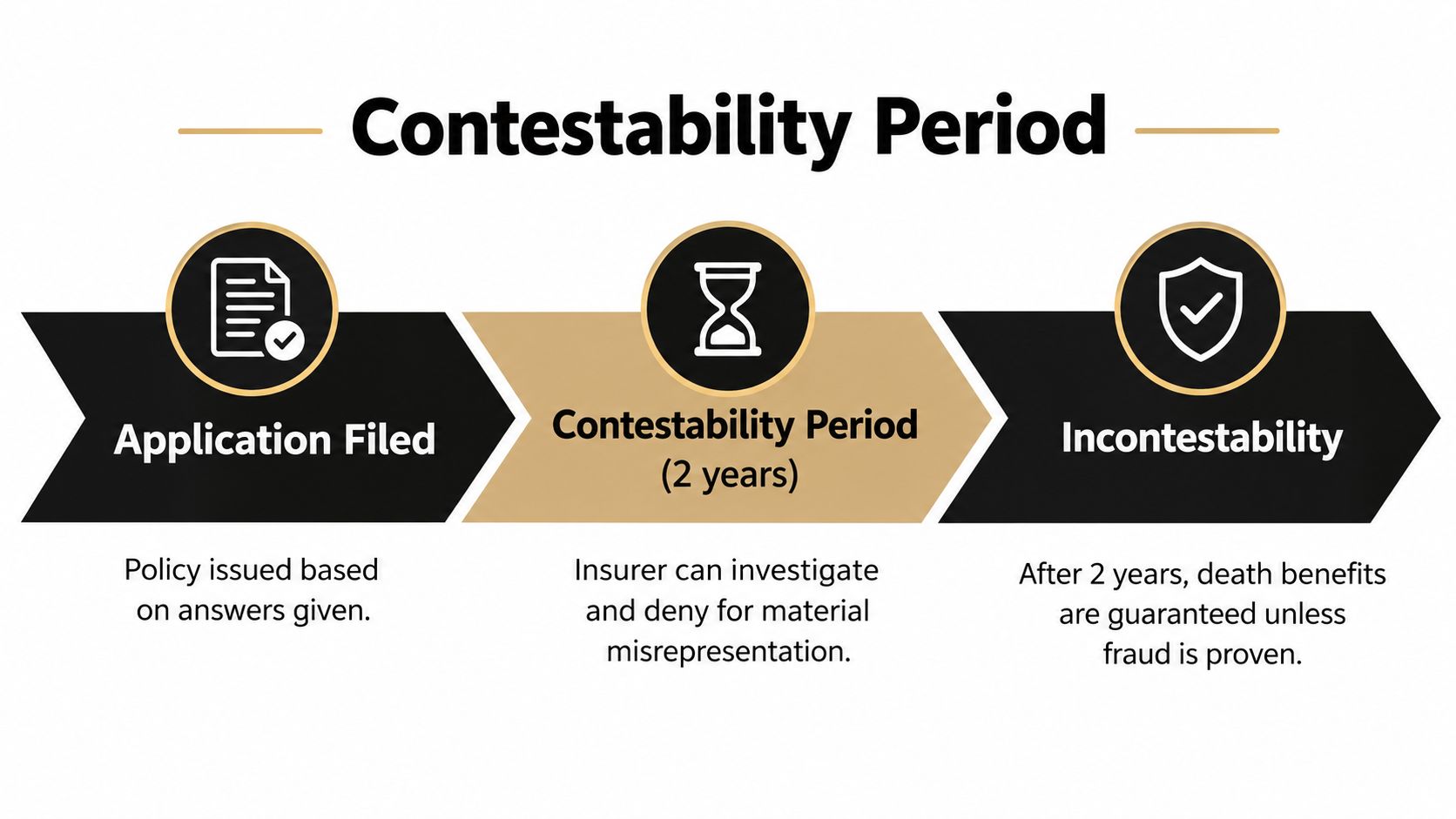
That window is the most important timeline in this topic. During it, the insurer can investigate the application and challenge the policy if it finds a material misrepresentation. After it expires, the policy is generally much harder to attack, except in limited fraud-related situations depending on the policy and jurisdiction.
The before and after logic
Think of the contestability period like the return window on a major purchase, except the stakes are far higher.
During the first two years, the insurer has broader room to ask, “Would we have issued this policy the same way if we had known the truth?” After that, the policy usually gains incontestability protection, which means the insurer's ability to unwind coverage becomes much narrower.
A short visual can help anchor the timeline:
If you want a plain-language version focused on consumer decisions, Coveredly's article on the life insurance contestability period is useful.
Why this rule exists
Historically, incontestability clauses emerged in the mid-19th century and became a standard legal protection in the early 1900s because insurers had been seen as avoiding payment over minor application misstatements, as explained in this discussion of hidden truths and material misrepresentations.
That history matters because it shows the law trying to balance two concerns:
- Protect insurers from real fraud
- Protect families from endless post-claim fishing for technical errors
How state rules can shape the outcome
State law can sharpen the rule further. New York law, for example, requires individual life policies to be incontestable after two years from the date of issue, and state guidance says only actual proof of a material misrepresentation within that two-year period supports contesting a claim or rescinding a policy. That same guidance also says post-claim rescission generally requires judicial determination rather than unilateral cancellation, according to the New York Department of Financial Services circular letter.
The same false answer can lead to a very different result depending on when it's discovered and which state's rules apply.
One timing detail people forget
If a policy lapses and is later reinstated, a new contestability period may start from that reinstatement date. That catches people off guard because they assume an older policy is automatically beyond review.
What Actually Happens When a Lie Is Discovered Denial Rescission and Legal Risk
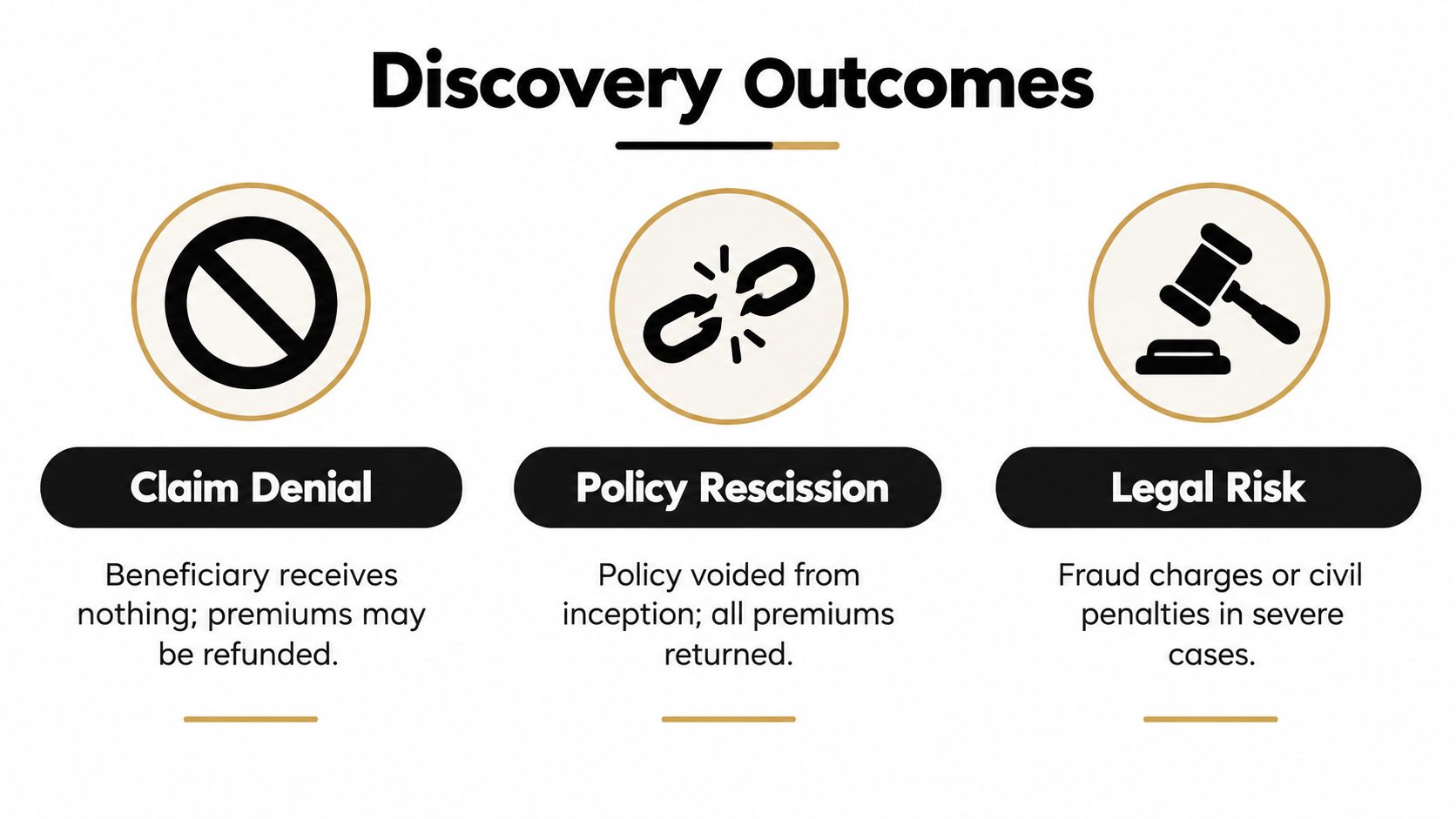
When a lie or serious omission is discovered, the outcome usually falls into one of three buckets. Not every case ends the same way, and that's where people often get lost.
Claim denial
This is the outcome families fear most. If the insured dies and the insurer proves that a material false statement affected underwriting, the insurer may deny the death benefit, especially if the case falls within the contestability window.
This doesn't happen because any tiny imperfection exists on the application. It happens when the insurer can connect the false statement to a decision it made when issuing the policy.
Policy rescission
Rescission means the policy is treated as voidable. According to the NAIC discussion of life insurance rescission and material misrepresentation, a material misrepresentation can let the insurer rescind the policy during the contestability period, which is commonly two years in major U.S. markets. In that setting, premiums are typically returned, and the death benefit can be denied if the insurer proves the false statement affected underwriting or pricing.
That point surprises many people. A premium refund doesn't soften the problem. Your family expected a death benefit, not a return of past payments.
Adjustment instead of full denial
Some disputes live in a middle ground. If the issue changed pricing more than insurability, the insurer may argue for a different premium basis rather than a total wipeout, depending on the policy, the facts, and the governing law. This isn't guaranteed, and outcomes vary. But it's one reason the better question is often which lies are claim-critical rather than whether every wrong answer destroys coverage.
Consequences by Timing and Severity
| Situation | Likely Insurer Action | Impact on Beneficiaries |
|---|---|---|
| Minor clerical error with no underwriting impact | Usually no rescission issue | Claim is less likely to turn on that error |
| Material health or lifestyle lie found during contestability period | Investigation, possible denial or rescission | Benefit may be delayed, reduced, or denied |
| Material issue found after incontestability protections apply | Narrower challenge options, often more procedural hurdles | Beneficiaries may have stronger protection, though disputes can still happen |
| Ambiguous omission that mainly affected pricing | Possible argument over rate class or policy terms | Outcome may be less absolute than full denial |
Legal risk and bad-faith questions
Intentional deception can also create legal risk beyond the contract itself. In severe cases, fraud allegations may enter the picture. That said, many families dealing with a denied claim are focused on a different issue. Was the insurer acting within the policy and the law, or did it handle the claim unfairly?
For that side of the equation, this overview of bad faith in insurance from Porter Law Group is a helpful primer on how claim handling itself can become part of the dispute.
Bottom line: Discovery doesn't automatically mean denial. But if the false answer was material and the timing favors the insurer, the risk becomes very real.
Real World Examples That Show Which Lies Trigger Problems
Examples make this easier because most application errors don't look dramatic when they happen.
The broader claims picture helps keep this in perspective. An analysis by the National Association of Insurance Commissioners covering 2001 to 2014 found 140,106 denied or resisted life-insurance claim observations, with 71.58% denied and 28.42% resisted. The same analysis reported 21.42 denied or resisted claims per 1,000 submitted claims, and among the recorded denial reasons, material misrepresentation accounted for 55,250 cases, or 56.03% of the listed reasons, according to the NAIC claims analysis. So disputes are uncommon relative to total claims, but when they do happen, misrepresentation is a major driver.
Hiding tobacco use
A parent applies for coverage and answers “no” to tobacco questions because they only smoke socially on weekends.
If the insurer would have priced the policy differently for any nicotine use, that answer may be material. If death occurs during the contestability period and records or lab evidence contradict the application, this is the kind of issue that can trigger a serious review. If the same fact surfaces after the policy has long become incontestable, the insurer's path is usually narrower.
Understating weight
Someone reports a much lower weight to fit into a better rate class.
This example sits in the gray zone. A small difference may not matter much. A large difference can. The question is whether the truthful number would have changed pricing or eligibility. If yes, the insurer may treat it as material. If no, it may be an annoyance rather than a claim-killer.
Small inaccuracies aren't judged by how embarrassing they are. They're judged by whether they changed the risk the insurer thought it was taking.
Omitting a prior heart diagnosis
An applicant leaves out a past cardiac diagnosis because it was years ago and they feel healthy now.
This is much more likely to be claim-critical. Even if the applicant personally thought the issue was resolved, a prior diagnosis tied to mortality risk is the kind of fact underwriters typically care about. Within the contestability period, this is the kind of omission that can support rescission if the insurer shows it relied on the answer.
Forgetting a minor ER visit
An applicant forgets one urgent care or ER visit for a short-lived issue that didn't lead to ongoing treatment.
This is the kind of fact that often worries consumers more than it worries underwriters. If the visit involved something routine and unrelated to underwriting risk, it may not be material. The error is still worth correcting if you notice it, but it's not in the same category as concealing smoking or a serious diagnosis.
The practical takeaway from these examples
The pattern is simple once you see it. Health risk, tobacco use, and significant diagnoses tend to be more dangerous than harmless administrative mistakes. Timing then decides how much power the insurer has to act on the issue.
How to Disclose Correctly and Fix a Mistake Before It Becomes a Claim Issue
If you're applying now, the safest approach is straightforward. Answer the question that was asked, not the one you wish had been asked.
If a form asks whether you've ever had a diagnosis, don't translate that in your head to “do I still feel sick?” If it asks about tobacco, don't narrow it to “daily cigarettes only.” Applications often use broader underwriting language than casual conversation does.
A simple way to answer more safely
Use this checklist while you apply:
- Check records before guessing: If you're unsure about medications, dates, or diagnoses, pause and verify.
- Disclose gray areas: If you're debating whether something counts, that's usually a sign to mention it and let underwriting decide.
- Read the full wording: Many mistakes start when people answer from memory and skip qualifiers in the question.
- Keep your own copy: Save the completed application and any follow-up emails or amendments.
For a practical companion to this step, Coveredly has a clear guide to life insurance health questions.
If you already made a mistake
Don't wait for a future claim to test it.
- Contact the insurer or your agent in writing. Ask how to correct the application.
- State the correction clearly. Be specific about what answer was incomplete or wrong.
- Keep documentation. Save confirmations, revised forms, and dates.
- Follow up until you receive written acknowledgment.
If you're shopping digitally, one option in the market is Coveredly, which offers online life insurance and lets applicants complete the process without exams for most cases. The important point isn't which platform you use. It's that any correction should be documented clearly and promptly.
Why early correction matters
An honest correction may affect pricing or underwriting, but that's usually far better than leaving a hidden problem in place. Once a death claim exists, the conversation gets harder, slower, and more adversarial.
If you notice a meaningful error, treat it like finding the wrong name on a legal document. Fix it while everyone can still update the file calmly.
Conclusion Protecting Your Family With an Honest Application
The question isn't whether any lie voids life insurance. The issue is whether the answer was material, whether it changed the insurer's view of your risk, and when the problem is discovered.
That's good news in one sense. Insurance law usually doesn't punish every harmless mistake the same way. It focuses on claim-critical facts like smoking, major diagnoses, and other underwriting-sensitive details. It also gives families stronger protection over time through incontestability rules, which limit how long insurers can challenge validity in many situations.
But none of that makes honesty optional. The cleanest way to protect your spouse, kids, or other beneficiaries is still the simplest one. Tell the truth up front, slow down when a question feels fuzzy, and correct meaningful mistakes while you still can.
If your planning goes beyond the policy itself, beneficiary structure matters too. Families considering trust-based planning may find this trust administration guide from Bryan Fagan helpful for understanding how a life insurance trust can fit into the bigger picture.
A life insurance policy is supposed to create certainty at a hard moment. Honest answers are what make that certainty real.
Coveredly offers online life insurance designed to fit real life, including straightforward guidance during the application process when questions about health history or disclosure come up. If you want help choosing coverage and answering application questions carefully, visit Coveredly.