A quote for a children's life insurance policy arrives folded between a birthday invitation and a bill. The numbers look small, the language sounds responsible, and it sits on the counter for a week while you decide. You have a toddler, a mortgage, and a savings account that finally has a cushion in it.
The question isn't whether you love your child. It's whether this particular contract earns a place in your budget, and that answer is narrower than the marketing suggests. A policy on a child is a small, specific tool. It covers a set of costs most parents hope never to face, and it can protect your child's ability to buy insurance later. It does not replace your own income protection, fund college, or repair a thin emergency fund.
Here's the walkthrough a careful educator would give at the kitchen table: what the product pays, what it typically pays, how it compares with the alternatives, who should receive the money, and how to decide whether it fits your family at all.
Table of Contents
- What Children's Term Life Insurance Is and How It Pays
- Typical Coverage Amounts and What They Pay For
- Term, Whole Life and Child Riders Compared
- Alternatives to a Child Policy and When They Fit
- Naming Beneficiaries and Protecting the Payout
- Pros, Cons and Whether a Child Policy Fits Your Family
What Children's Term Life Insurance Is and How It Pays
Your two-year-old is asleep, the house is quiet, and a brochure on the counter offers a small policy "just in case." That's the moment most parents start looking at children's term life insurance. The instinct is sound even when the product isn't necessary: you're trying to keep a terrible day from becoming a financially catastrophic one.
You'd buy term insurance, which covers a defined period, commonly 10 or 20 years, and pays a death benefit only if the insured person dies during that period, as the National Association of Insurance Commissioners explains. The money goes to the beneficiary you name, never to the child. If the child outlives the term and you haven't converted or renewed, the policy ends and pays nothing.

What the payout is actually for
A child's death doesn't remove a salary from the household, so this isn't income replacement. It's liquidity for costs that arrive fast and won't wait for a savings transfer:
- Funeral and burial costs, which are the historical reason these policies exist at all.
- Medical bills left after insurance pays its share.
- Unpaid leave, when one or both parents stop working for weeks.
- Childcare disruption, including paying for siblings to be cared for elsewhere.
- Travel and lodging for relatives coming in.
- Counseling, for parents and for siblings.
The NAIC notes that child policies were historically intended to cover burial expenses, and it cautions that newer products marketed as investments aren't a good vehicle for college savings. Keep that in view. A policy is protection, not a savings plan with a logo on it.
The conversion feature that carries most of the value
Many juvenile contracts let you convert to permanent coverage at a set age in the child's early twenties without a new medical exam. If your child develops a chronic condition at nine, that right is the difference between guaranteed coverage later and a declined application at twenty-five. The death benefit is modest. The insurability guarantee is the durable part.
A child term policy works like a smoke detector. It's small, cheap, and built for one specific risk. Nobody expects it to replace the locks, the roof, or the homeowners policy.
Before you fill out anything, answer three questions. What costs would follow your child's death, and what would you pay for them? How many years should coverage last to match those costs? And does conversion matter to you, given your family's health history?
Typical Coverage Amounts and What They Pay For
Start with the market's own numbers, because they show what these policies are built to do rather than what a sales page says.
| Coverage reference | Reported value | What it means for parents |
|---|---|---|
| Typical juvenile whole-life death benefit | $25,000 to $30,000 | Historical benchmark for final-expense-sized policies |
| Average individual child policy | $23,600 | Typical amount for children with their own policy |
| Average group child coverage | $20,700 | Typical amount for children covered through group plans |
| Children with individual coverage | 25% | Share of U.S. children with their own policy |
| Children covered through group policies | 26% | Share of U.S. children covered by group plans |
| Juvenile policies as share of life sales | 20% to 25% | Share of all sales for children under 18, roughly steady for a decade |
These figures come from a 2010 report citing LIMRA data, published by Wealth Management, and they describe a market built around modest benefits, guaranteed conversion, and future insurability rather than income replacement. Treat them as a historical reference. Ask any insurer you're considering for its current issue limits and typical face amounts before you settle on a number.
How to read the benchmarks
The first three rows are about size. A policy in the $25,000 to $30,000 range covers a funeral, some unpaid leave, and travel for family. The last three rows are about prevalence: roughly a quarter of U.S. children have their own policy and another quarter are covered through a group plan, so a child with no coverage at all is not unusual.
One family's arithmetic
Suppose you price it out yourself. You estimate burial and a service, two weeks of unpaid leave for one parent, flights and a hotel for grandparents, and a few counseling sessions. Say your own total comes to about $18,000. That sits inside the historical benchmark, which tells you a small face amount is proportionate rather than stingy.
Then adjust for your situation. A child with a developing medical condition may justify more coverage and a policy with strong conversion rights. A family with solid group coverage through an employer may need less, or nothing beyond a rider. If you're estimating the funeral line and want a detailed breakdown of what that costs, this guide to life insurance and funeral costs walks through the components.
One rule holds regardless of the arithmetic. Never size a child's policy to match your own income-replacement coverage. A $750,000 face amount on a two-year-old is a mismatch between a contract and a risk, and it invites scrutiny from regulators.
Term, Whole Life and Child Riders Compared
A child policy can be structured as term coverage, whole life insurance, or a rider attached to a parent's policy. Each works differently, so start with the duration and purpose of the coverage.

| Feature | Standalone child term | Juvenile whole life | Child rider on parent's policy |
|---|---|---|---|
| Coverage length | Set period, such as 10 or 20 years | Lifetime | Tied to the parent's policy terms |
| Cash value | None | Grows over time | None |
| Premium level | Typically lower than whole life | Significantly higher than term | Added to the parent's premium |
| Conversion | Depends on the policy | Already permanent | Depends on the parent's policy |
| Best for | Protection during a set period | Lifelong coverage with a cash value component | Adding a small benefit to an existing policy |
Standalone child term provides protection for a set period and has no cash value or investment component. Its premiums are typically lower than whole life premiums. When the term ends, coverage ends unless the policy allows conversion to permanent insurance.
Juvenile whole life covers the child for life and builds cash value over time. Its premiums are significantly higher than term premiums. The trade-off is lifelong coverage and a savings component, rather than protection for a defined period.
A child rider adds a death benefit for a child to a parent's policy. The coverage limit, conversion options, exclusions, and termination age depend on the parent's contract. Read those terms before deciding whether the rider meets your needs. For more on how these additions work, see this guide to child rider life insurance.
Matching the structure to the goal
Term may fit a family seeking lower-cost protection for a defined period. Whole life may fit when lifelong coverage and cash value are priorities, and the higher premium does not displace adult insurance or retirement savings. A rider may suit a parent who already has a policy and wants to add a small child benefit.
Let the goal determine the structure. If you cannot name what the payout would cover, pause before choosing a policy.
Premiums vary with the child's age at issue, the face amount, the term length, the insurer, and whether coverage is added as a rider. Ask for quotes at the same face amount and term. Then compare the total premium over the full term, not only the monthly payment.
Before buying, ask how long coverage lasts, whether conversion is available and when, what exclusions apply, and what happens if the child outlives the term.
Alternatives to a Child Policy and When They Fit
A child policy competes with several other uses for the same dollars.
| Option | What it covers | Main limit |
|---|---|---|
| Parent's term coverage | Income replacement and household debts | Must be sized to the adults' income needs |
| Emergency savings | Immediate costs such as funeral bills and short-term childcare | Limited to the balance available |
| 529 or education account | College and training costs | Not insurance; does not pay a death benefit |
| Child rider on parent's policy | Small child death benefit | Limits, exclusions and termination age set by the parent's policy |
| Standalone child term policy | Final expenses and insurability protection | Pays only if the child dies during the term |
The order of priorities matters more than the product choice. Work through it in this sequence:
- Cover the earning adults first. Your own term coverage should match the income the household would lose. This is the policy that keeps the mortgage paid and the lights on.
- Build emergency savings. A cushion handles the funeral bill, the unpaid leave, and the short-term childcare without a claims process.
- Fund education separately. A 529 or similar account does the college job. The NAIC's caution about using life insurance for college savings is worth taking seriously.
- Then consider child coverage. A rider or a small standalone policy comes last, as a narrow tool for final expenses or insurability.
What the coverage gap looks like
In a 2023 study of more than 8,000 U.S. household financial decision-makers by LIMRA and Life Happens, 59% of parents with minor children owned life insurance, compared with 52% of adults overall. Yet 47% of those parents said they lacked sufficient coverage, against 41% of the wider adult population. Among Gen Z and millennial parents, 56% said they did not have enough.
The same study found a 23-percentage-point gap in perceived security. 71% of insured parents said their household would be financially secure after a primary earner's death, compared with 48% of uninsured parents. The protection that moves that number is on the adults, not the children.
Fund the gap on the adults first. Then look at what's left, and decide whether a child policy is the best use of it.
If the answer is no, you haven't failed at planning. You've prioritized correctly.
Naming Beneficiaries and Protecting the Payout
The technical problem with a child policy isn't eligibility. It's who receives the money. The National Association of Insurance Commissioners states that most insurers will not pay life insurance proceeds directly to a minor. Name a young child as beneficiary and the payout may end up in court-supervised administration, with a judge deciding how the funds are released.
Here's the process that avoids that.
Step one, choose the receiving structure. Decide whether the payout goes to a trust, a custodial account, or an adult guardian. A trust gives you the most control because it names who manages the money and when it's released.
Step two, write the terms in detail. The trust document should specify the manager, the permitted uses, the distribution timing, and successor beneficiaries. Vague language creates the disputes the trust was meant to prevent.
Step three, pick a distribution method. The NAIC distinguishes per stirpes, which preserves a deceased beneficiary's share within their family branch, from per capita, which reallocates that share among surviving beneficiaries. For a young family with more than one child, that choice determines what happens if one of them dies before the trust pays out.
An estate attorney should review the beneficiary language, especially where guardianship, divorce, special-needs planning, or multiple children are involved. If probate questions come up in your planning, this overview of estate administration help for grieving families explains how proceeds and probate interact, which is exactly the tangle a properly named beneficiary avoids.
State rules cap what you can buy
New York's regulator publishes concrete limits for juvenile coverage. For a child younger than 14 years and 6 months, the combined coverage generally can't exceed the greater of $50,000 or 50% of the life insurance in force on the adult applying, according to the New York State Department of Financial Services. For a child younger than 4 years and 6 months, the ceiling is the greater of $50,000 or 25% of the applicant's in-force coverage.
The state also requires an adult with an insurable interest in the child, or an adult the child depends on for support, to arrange the policy. Insurable interest means a legitimate legal stake in that child's life. These are anti-speculation safeguards, and they show that juvenile policies are subject to real underwriting rules rather than issued on request. Check your own state's requirements before applying.
Before you sign, confirm five things in writing: the beneficiary designation and whether it's a trust, the successor beneficiary, the per stirpes or per capita election, the conversion age, and the grace period if a payment is late. If the trust can be amended later, note who holds that power. If you're weighing backups, this guide to the contingent beneficiary in life insurance explains how a second name protects the payout if the first is unavailable.
Pros, Cons and Whether a Child Policy Fits Your Family
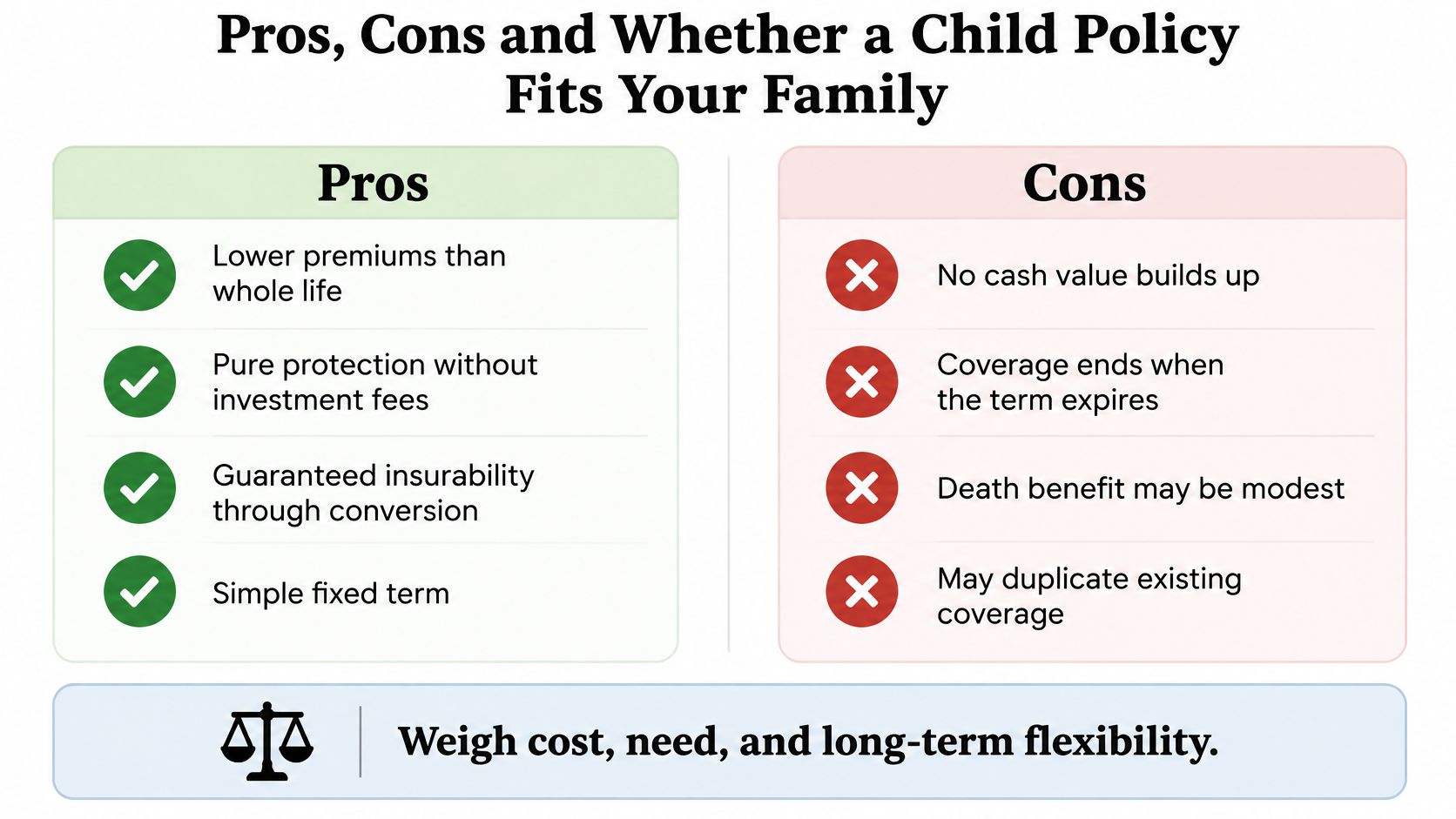
Most content treats a child policy as an automatic planning step. It isn't. The honest case runs in both directions.
The case for it
- Lower premiums than whole life for the same face amount, because you're buying pure protection with no savings component.
- No investment fees or market risk, which keeps the product simple to understand.
- Guaranteed insurability through conversion, the feature that protects a child who develops a health condition later.
- A simple fixed term, so you know exactly when coverage ends and what it cost.
The case against it
- No payout if the child outlives the term, unless you convert before it expires.
- No income replacement, because a child doesn't earn the household's living.
- Little savings value for college, where a dedicated education account does the job better.
- Overlap with coverage you already have, particularly a child rider or group dependent coverage through an employer.
Is the risk real
Dismissing child mortality as impossible is misleading. The World Health Organization estimated 4.9 million deaths among children under five globally in 2024, plus 2.1 million among older children, adolescents, and youth, according to the 2025 child mortality estimates. That's a global figure, and it doesn't translate into a universal U.S. priority. What it does is rule out the argument that this risk never happens.
Insuring a child is a decision about a specific family's exposure, not a universal obligation and not a scam. Both extremes are wrong.
The decision framework
Start with one yes-or-no question. Have you covered the income needs of the earning adults, and is there a specific child-related cost your savings couldn't absorb? If the answer to either part is no, a child policy is optional and probably premature.
If the answer is yes, work the list:
- Estimate child-specific costs in dollars, line by line.
- Confirm adult coverage at a level that replaces income.
- Choose a term that matches the years of greatest expense, not the longest term available.
- Compare a standalone policy with a rider on your existing coverage.
- Check conversion rights and the expiry age in writing.
- Confirm exclusions and the grace period before the first payment.
- Name a trust or custodian and have an attorney review the language.
The verdict
For most young families, the right sequence is adult term coverage, then an emergency fund, then education savings. A child policy comes after those, and sometimes never. If your savings can absorb a funeral and a few weeks of lost work, self-insuring is a legitimate and often cheaper choice. The case for buying strengthens when you want the conversion guarantee, when group coverage is thin, or when your child has a health issue that could complicate underwriting later.
The first action this week is small and concrete. Write down your estimate of child-specific costs and pull the numbers on your own coverage. Then request quotes at the same face amount and term and compare them side by side. We price term life insurance with no medical exams for policies up to $3M, and our process is fully digital with instant approvals for most applicants, so you can raise or lower coverage as your family's needs change instead of starting over.
When you're ready to run the numbers, Coveredly can quote term coverage for the earning adults in your household and help you size it against the costs you've written down, all online without a medical exam for most applicants. Start with the adult policy that protects your child's daily life, then decide whether a small child policy earns its place beside it. You can adjust the amount later as your budget and your family change.