
You probably already know the feeling. A house payment, daycare, groceries, and insurance bills leave less breathing room every month, and the will you signed a few years ago still sits in a drawer acting like nothing has changed. That's the trap with a cost of living will, the paper may still be valid, but the dollars inside it can lose real-world force.
A young family can do everything right on the legal side and still leave beneficiaries underprotected on the financial side. If the bequest amount was set years ago, it may no longer match housing, tuition, or basic household costs. The legal document survived. The purchasing power didn't.
Table of Contents
- Why Your Current Estate Plan May Already Be Outdated
- How Inflation Erodes the Real Value of Bequests Over Time
- When and How to Update Your Will for Inflation Protection
- Strategies to Preserve Beneficiaries' Purchasing Power
- Practical Implementation Steps for Young Families and Professionals
- Building an Inflation-Resistant Estate Plan That Lasts
Why Your Current Estate Plan May Already Be Outdated
A parent drafts a will after the first child is born, names a guardian, leaves a fixed amount to each child, and then files it away. Ten years later, that same family might still have the same document, even though the cost of everyday life has changed enough to make the numbers feel stale. That's the hidden problem with a cost of living will. The document can be legally current while the value it delivers has slipped.
The set-it-and-forget-it mistake
Treating estate planning like a one-time errand is common. That mindset is comforting, but it's wrong. Inflation doesn't wait for a convenient review cycle, and it doesn't care that you were careful when you first signed.
A fixed bequest from 2010 can look generous on paper and feel much smaller in practice by 2026. If the goal is to protect a child, spouse, or parent, the question isn't whether the will still exists. The question is whether the dollars inside it can still do the job.
Practical rule: If your estate plan still reflects the life you had before your biggest cost changes, it's already lagging behind.
The issue becomes more obvious when families rely on a single number and never revisit it. A life insurance policy, a cash gift in a will, or a simple inheritance formula can all suffer from the same flaw. They're written in nominal dollars, while your beneficiaries live in real prices.
For heirs who may face probate without clear cash reserves, context matters too. A practical overview like the Arizona probate guide for heirs can help family members understand what happens when planning is missing or outdated, especially in a state where intestate outcomes can create confusion. If you're also trying to sort out whether insurance sits inside the estate or passes outside it, the life insurance and estate treatment guide is worth reading before you assume a beneficiary form solves everything.
The warning signs you should not ignore
You don't need a full legal crisis to know your plan is stale. If your estate plan still names children before a major move, before a second child, before a mortgage, or before a big income jump, it deserves a fresh look. If your current numbers only made sense when rent, tuition, and childcare were lower, the plan is probably underfunded.
This is especially true for young families. They often have the most to lose from delay because the gap between today's costs and tomorrow's needs grows faster than they expect. A will isn't a time capsule. It's a funding instruction.
How Inflation Erodes the Real Value of Bequests Over Time
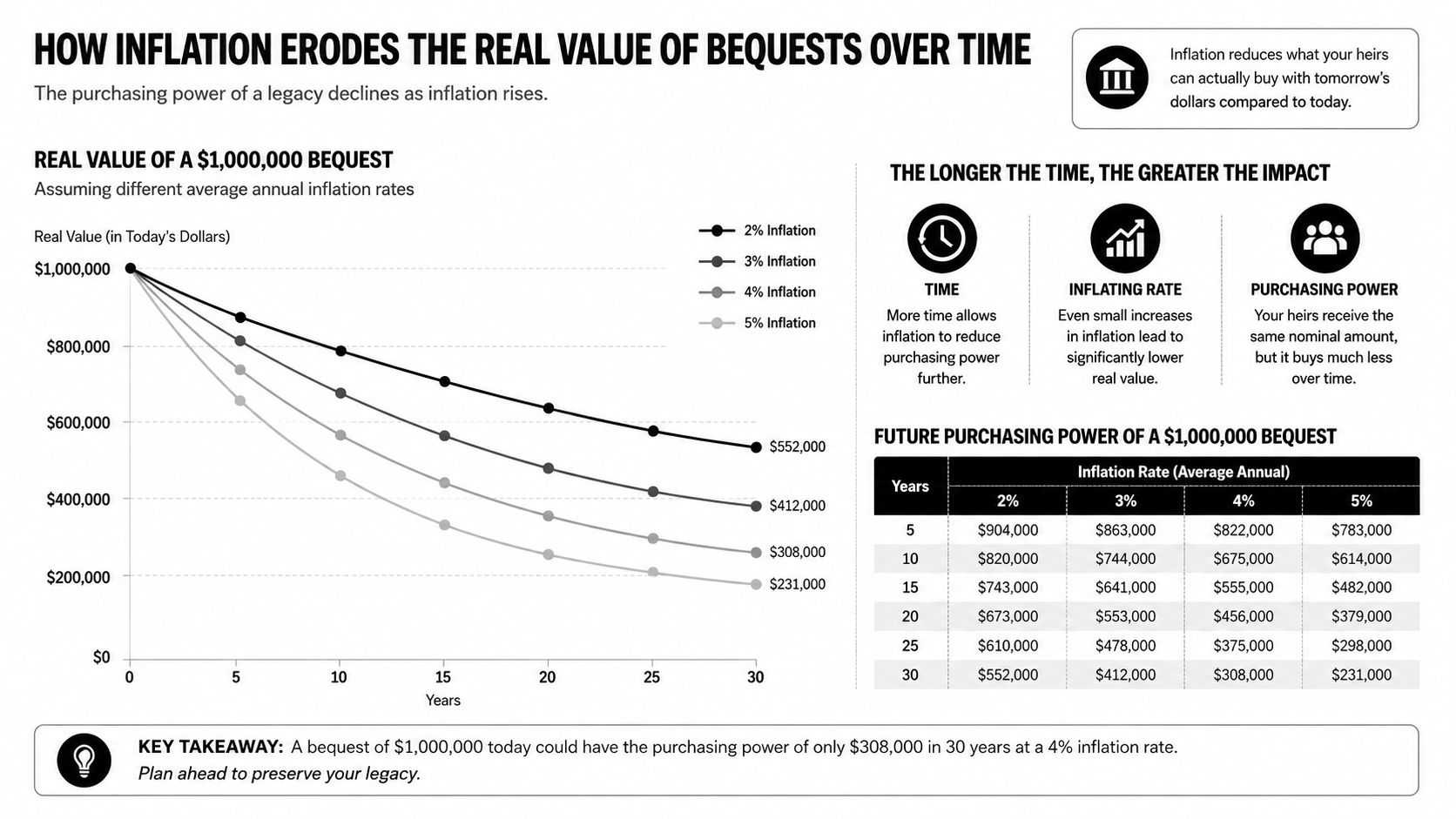
A bequest written as a dollar amount is a nominal value, not a purchasing plan. That is the part families miss. The figure in the will can stay fixed while its ability to buy housing, education, and everyday services keeps slipping.
The long-run benchmark for that erosion is the CPI. The U.S. government first began publishing a national CPI in 1921, and it was designed from the start to track prices for everyday goods and assess whether wages could support a living standard. That same index still shapes Social Security and many other adjustments today, including the 2.5% cost-of-living adjustment announced for January 2025 in the reference material. The point is simple. Fixed amounts stay fixed, while prices keep moving.
Nominal dollars versus genuine spending power
A bequest of $100,000 sounds concrete. It feels complete. What it delivers depends on the year your beneficiaries receive it and what they need to pay for. If the money is supposed to help with rent, a down payment, tuition, or emergency care, inflation changes the outcome even when the legal amount never changes.
Broader U.S. data show inflation is still a live issue. The Bureau of Labor Statistics reported that the Consumer Price Index for All Urban Consumers rose 4.2% over the last 12 months in May 2026 (BLS CPI). Historical comparisons show how household pressure can separate across generations. One 2026 comparison found people today have about 63% more purchasing power than in 1973, yet necessities like housing and education have climbed sharply in the same span.
A fixed bequest protects a number. It does not automatically protect the lifestyle that number was meant to support.
Which bequests lose value fastest
The weakest gifts are the ones written as fixed sums. Specific-property bequests can also become awkward if the asset changes in value or usefulness. A life insurance policy can help, but only if the coverage amount still matches the future cost of the job it is supposed to do.
Tuition is the clearest example. Public college tuition increased from an inflation-adjusted $3,519 in 1973 to $9,750 in 2023, a 177% increase, while private college tuition rose 158% from $13,639 to $35,248 (BLS CPI). That is not trivia. It is a warning that an amount that looks generous today can feel thin when a child needs it.
Young families should read that as a planning warning, not an academic note. If your estate plan assumes prices will stay tame, your beneficiaries are the ones taking the risk.
When and How to Update Your Will for Inflation Protection
Review your estate documents on a schedule, not only after bad news. The baseline should be every few years, and sooner whenever your household costs or goals change in a meaningful way. A cost of living will only works if the numbers stay tied to reality.
The triggers that should force a review
Certain life events should move an estate review to the top of your list.
- Children reaching a new stage: College age, first job, or financial independence can change how much support a bequest needs to provide.
- Major career changes: A promotion, business sale, or income drop can change what your family can realistically fund.
- Inheritance or windfall: Extra assets often create tax, liquidity, and fairness questions that an old will won't answer well.
- Approaching retirement: The mix of income, insurance, and estate goals changes once paycheck replacement is no longer the main issue.
A good rule is to treat major household changes as a reset button. Don't wait for the document to feel “old.” By the time it feels old, it's usually already behind.
Codicil or rewrite
Minor changes can sometimes be handled with a codicil, but don't use one as a shortcut for a plan that has drifted out of sync with your life. If the basic structure still works and you're changing a beneficiary name, a small dollar amount, or a backup appointment, a codicil may be enough. If the family structure, asset mix, or funding logic has changed, rewrite the will.
That distinction matters because piecemeal edits can create confusion later. Probate courts read the actual documents, not your intentions. Clean language now saves your heirs from arguments later.
Don't forget the linked accounts
The will is only one piece. Beneficiary designations on retirement accounts, life insurance policies, and payable-on-death accounts can override the will if they're stale. Update those forms at the same time you update the estate plan, or you'll leave a contradiction behind.
If you're comparing planning methods and want a practical view of structure, the guide on financial planning for young families is a useful companion. It helps frame the estate plan as part of the larger household balance sheet, which is how families live.
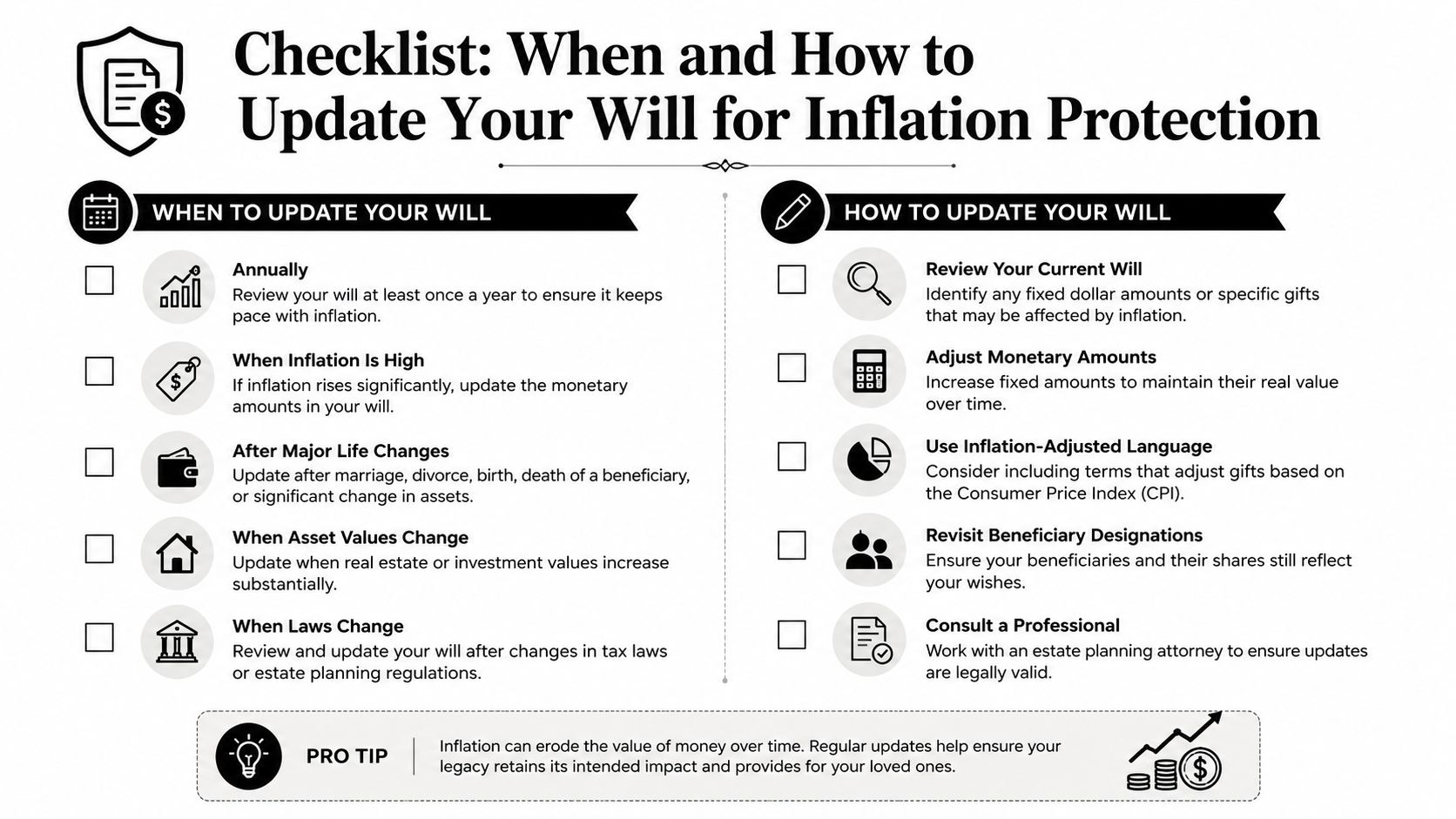
For most families, the right move is boring and effective. Set a calendar reminder, review the documents, and update the beneficiary forms on the same day.
Strategies to Preserve Beneficiaries' Purchasing Power
Different tools solve different problems. If your goal is to keep inheritance value intact, don't just ask what sounds advanced. Ask what stays useful when prices rise, what costs to maintain, and what creates friction for your heirs.
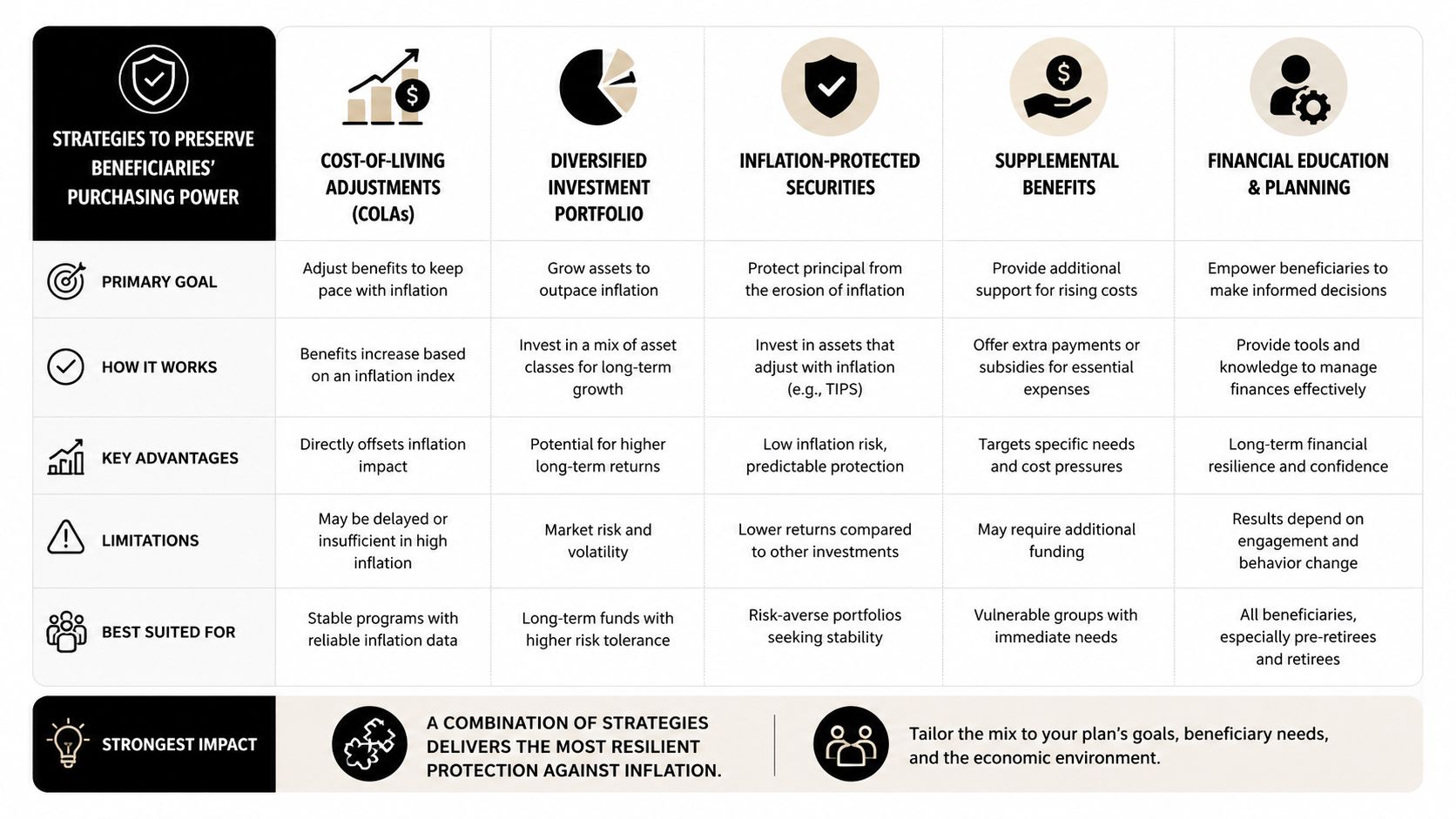
Fixed amount, percentage, trust, or insurance
A fixed-dollar bequest is the easiest to understand, and the easiest to outgrow. It works best when the amount is intentionally modest or when the estate is so large that inflation won't change the family outcome much.
A percentage-based bequest adjusts automatically because it moves with the size of the estate. That makes it more resilient, but it also makes the final amount less predictable.
Trusts can build in more control, which is useful if you want money staged over time or tied to specific purposes. If your estate is likely to intersect with tax planning or multi-generational transfer issues, a discussion like the Utah estate tax planning guide shows why some families use trusts not just for taxes, but for timing and control as well.
Life insurance is the simplest lever for many young families because it creates an immediate pool of cash when it's needed most. The downside is obvious. If the coverage stays flat while needs rise, the protection weakens.
What works best for which family
For young families, simplicity usually wins. A base level of insurance plus a will that uses percentages instead of stale fixed amounts can do more good than a complicated trust nobody maintains. For families with more assets or special distribution goals, a trust can be worth the added effort.
Best use case: Use the simplest structure that still protects the real-life expense your beneficiaries will face.
The living will cost question gets more attention than it deserves, but there's still a practical affordability range to understand. Free state forms may only need notarization, typically around $10 to $25, while attorney-drafted documents commonly start around $200 to $300 and can exceed $1,000 in broader estate-planning packages (SmartAsset). The National Institute on Aging also notes that many states offer free advance directive forms, and some specialized software costs $20 to $100 (NIA). That means the barrier to entry is low. The core question is whether the structure matches the size and complexity of your family's needs.
If you need a more permanent structure, a trust may be the better fit. If you need fast, affordable protection, insurance and clean beneficiary coordination are usually the first move. If you're in Utah and comparing trust-based strategies, the linked guide above is a useful starting point before you talk to counsel.
Practical Implementation Steps for Young Families and Professionals
Start with the family you have, not the one you expect to have later. A dual-income couple with young children, a single professional supporting aging parents, and a family with special needs all face different pressure points, but the first move is the same, make the plan fit the cash flow.
A dual-income couple with a high household income needs enough liquidity to cover child care, housing stability, and the time the surviving spouse needs to make decisions without panic. That usually means the estate plan and insurance coverage should be built around replacing future expenses, not just the current mortgage balance.
A single professional in their 30s often has a different problem, real responsibility without a second paycheck in the room. If aging parents may need help later, the plan should not lock every asset into a rigid gift that ignores future support obligations.
A family with special needs should be even more careful. The right setup usually has to preserve access, avoid accidentally disqualifying support, and keep control structured over time. That is not the place for a one-page template that was never reviewed.
How to think about coverage and coordination
Do not use a simple income-multiple rule and call it done. Build the number from the future cost of housing, education, debt cleanup, and replacement income, then test it against inflation. If the policy or bequest is supposed to last for years, the plan needs room to breathe.
Coordination matters just as much as the amount. Your will, insurance beneficiary designations, and retirement account forms should all tell the same story. If they do not, your family may spend time and money sorting out a conflict that should never have existed.
A resource like financial planning for young families can help you decide whether a trust belongs in that coordination mix. The point is not to add paperwork. The point is to keep the money moving in the direction you intended.
Clean beneficiary forms beat clever intentions every time.
A 30-day action plan
Start with a document review, then update beneficiaries, then confirm whether your will still reflects the people and amounts you care about. After that, get the insurance, trust, and account designations aligned. Tell your spouse or executor where the paperwork lives and why the structure is the way it is.
That conversation matters. Beneficiaries handle grief better when they understand the plan was deliberate. It was built to survive rising costs.
If you want a fuller roadmap, start with secure your family's financial future. Then turn the broad advice into documents that match your household.
Building an Inflation-Resistant Estate Plan That Lasts
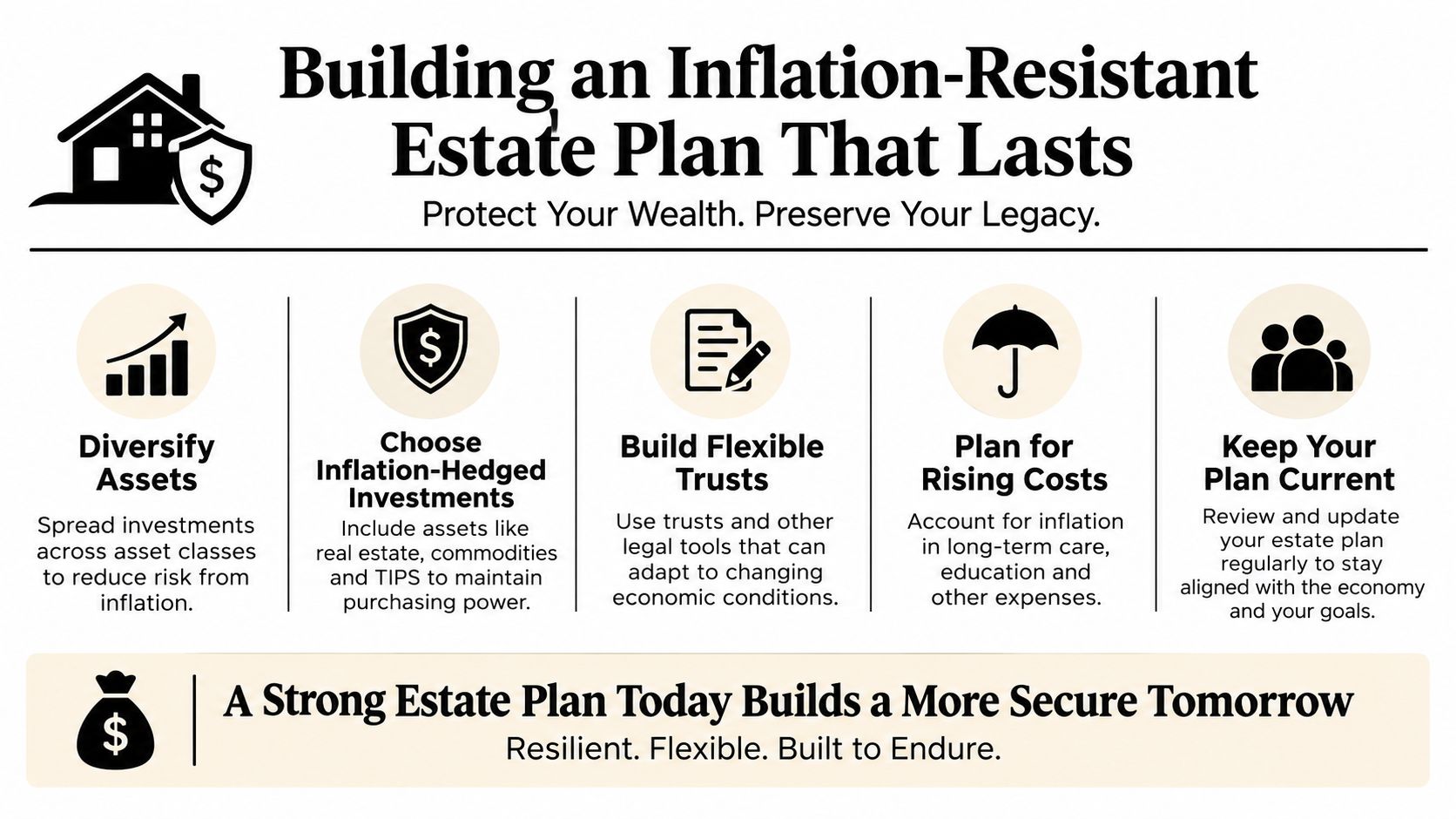
The best plan is the one you can maintain. That means you need a repeatable process, not a heroic one-time overhaul. Set your review rhythm, keep your beneficiary forms aligned, and decide in advance who will help you when the plan needs to change.
If you're overwhelmed, start small. Update the items that move fastest, like account beneficiaries and insurance coverage, then tackle the will itself. If the family picture is more complex, work with a professional who can translate your priorities into documents that won't fight each other later.
The biggest barrier is procrastination. The second is assuming cost has to be high to get started. That's not true. Free forms, low-cost software, and modest attorney review can cover a lot of ground before you ever get into a more advanced structure. The guide on how to secure your family's financial future is a solid reminder that protecting wealth is less about perfection and more about not leaving obvious gaps open.
A durable estate plan should evolve with your household, not sit apart from it. Once your documents, accounts, and goals all point in the same direction, inflation stops being a quiet threat and becomes just another planning variable you already accounted for.
Coveredly helps young families build protection that fits real life, including the changing costs that can weaken a fixed estate plan over time. If you want a simpler way to cover the people who rely on you, visit Coveredly and start turning today's plan into something that still works tomorrow.