There's no universal correct number, and many manage well with one to three cards. The deciding test for how many credit cards one should have is whether every account can be tracked and paid on time.
That test matters more than matching an average. A card count that works for a single earner with steady bills can strain a household coping with a new baby, a marriage, or a drop to one income. Think of management capacity as your real limit. Each extra card adds a due date, a limit, a set of rewards rules, and another statement to check for errors or fraud.
Table of Contents
- Card Counts That Fit Common Situations
- How Utilization Changes the Math
- How to Work Out Your Number in Five Steps
- When a New Card Helps and When It Backfires
- Life Stages That Change Your Limit
- Confirm Your Count Before Your Next Application
Card Counts That Fit Common Situations
Credit cards are already mainstream, so you don't need a large collection to be normal. The Consumer Financial Protection Bureau estimate put card ownership at 208 million of 267 million adult residents, or 78%, with a credit-card account in their own name at the end of 2023. Among consumers with at least one card, slightly more than 45% had one or two cards, while 23% had five or more.
That spread tells you something useful. People aren't clustered around one ideal figure, because their jobs for a card differ. One person needs a simple way to pay bills and build history. Another separates business spending, keeps an older account open, and uses a backup on a different payment network.
Card Count by Financial Situation
| Situation | Typical card count | Role of each card | Main watch-out |
|---|---|---|---|
| Thin credit history or FICO score below 670 | One card | Everyday spending, paid in full every month | Even one card can be hard to manage if due dates slip |
| First job, single earner | One primary card | Everyday spending and recurring bills | Autopay the statement balance, not just the minimum |
| Steady income, most households | Two cards | Primary card plus a backup from another payment network | Two due dates and two sets of fees to track |
| Rewards-focused household | Two or three cards | Each card has one clear category or purpose | Annual fees and category rules change over time |
| Four or more cards | Only with a tracked purpose per card | Business separation, an older account kept open, or a specific rewards category | Requires monitoring every balance, fee and due date |
Read the table as a starting point, not a ranking. A two-card setup often gives you resilience if one card is declined, frozen for fraud, or not accepted. A third card only earns its place when it does a job the first two can't, such as a distinct rewards category you use every month.
Larger collections exist, but they demand a system. CreditCardCult's look at a 26-card collection is a useful reminder of how much tracking and annual-fee math a big portfolio requires. Most households don't need that complexity to get reliable payments and useful rewards.
Practical rule: Keep a card only if you can name its job in one sentence and check its balance without hunting for login details.
The count passes when every card is tracked, paid on time, and kept well away from its limit. If one account regularly surprises you at statement time, you've found your ceiling, even if that ceiling is one card.
How Utilization Changes the Math
Many people open a second card because they've heard it can help their score. Sometimes it can, and the reason is credit utilization, the share of your available revolving credit you're using. It's simple division: balance divided by limit.
Experian's explanation of adding credit uses a $200 balance on a $1,000 limit, which is 20% utilization, and shows that adding another $1,000 limit makes that same $200 equal 10% of $2,000. Amounts owed account for 30% of a FICO Score, so that change can matter.
The Per-Card Trap
Here's where readers often get confused. Scoring doesn't only look at your combined picture. If that $200 sits entirely on the first card, that card still reads 20%, even though your overall utilization is 10%.
| Scenario | Total limit | Overall utilization | Per-card utilization |
|---|---|---|---|
| One $1,000 card, $200 balance | $1,000 | 20% | 20% |
| Two $1,000 cards, $200 balance on one | $2,000 | 10% | 20% and 0% |
| One $5,000 card, $1,500 balance | $5,000 | 30% | 30% |
| Two $2,500 cards, $1,000 and $500 balances | $5,000 | 30% | 40% and 20% |
Look at the last row closely. The household hasn't spent more than the row above it, and the total limit is identical. Yet one card is at 40%, because the balance is concentrated. Splitting spending thoughtlessly, or putting one large purchase on a low-limit card, can undo the benefit you expected from a bigger total limit.
What the 30% Figure Really Means
Treat 30% as a warning level, not a target to aim for. Lower is generally better, and no single percentage guarantees a particular score. If you're routinely near that line, a normal month with car repairs or holiday travel can push you over it before the statement closes.
A new limit only lowers utilization if your spending stays the same. If the balance grows to fill the extra room, you've added debt, not headroom.
Check the per-card number before you celebrate the overall one. Pay attention to which card carries recurring bills, because subscriptions and insurance premiums can stack onto one account. Moving a recurring charge to a higher-limit card you already own may fix a per-card spike without any new application.
If balances keep climbing month after month, don't diagnose it as a card-count problem. That's a cash-flow signal. Another card can hide it for a while by spreading balances thinner, but the total owed still rises, and interest follows it.
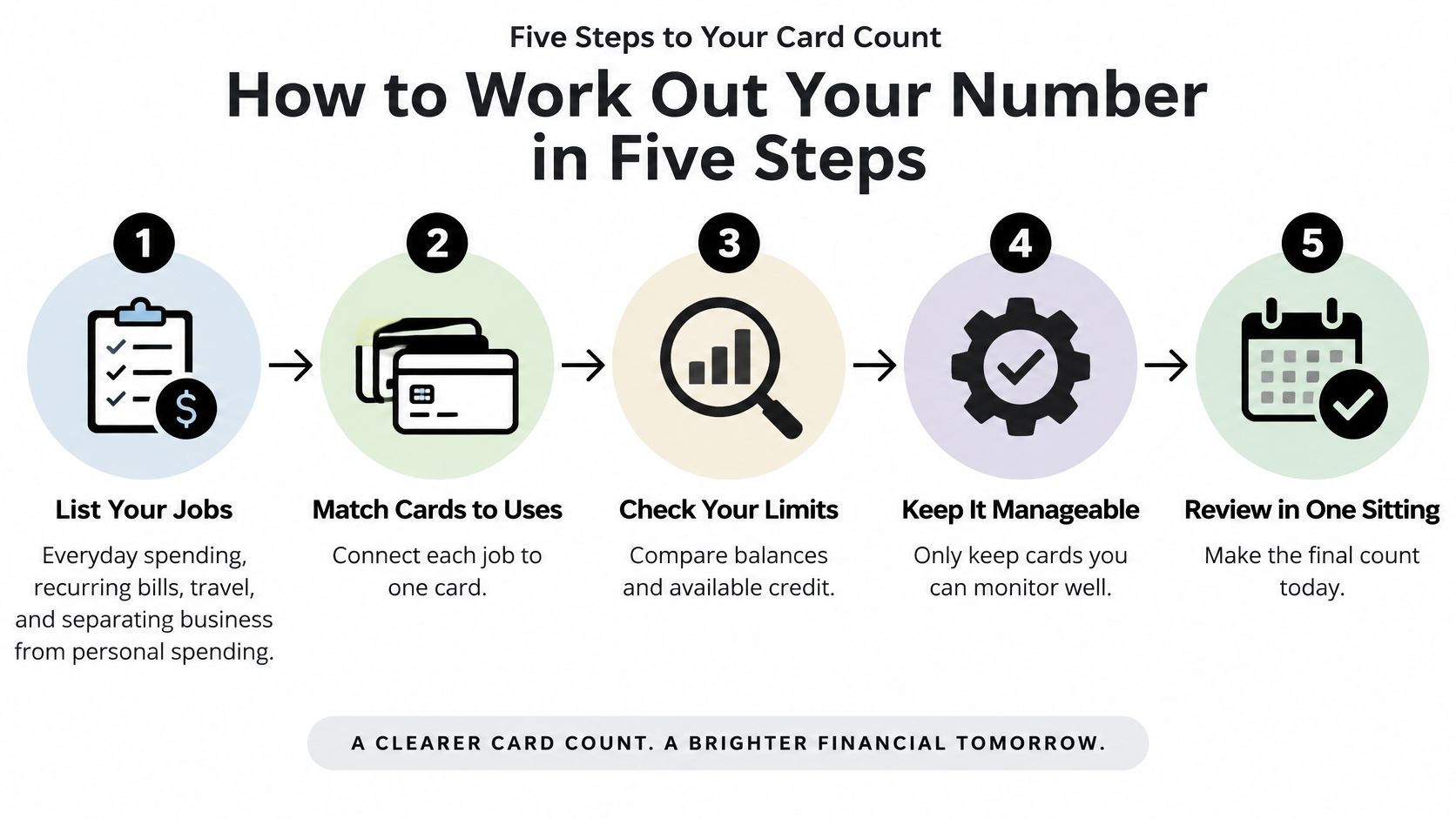
How to Work Out Your Number in Five Steps
You can settle your count in one sitting with a notebook, your banking app, and your last few statements. The CFPB guide to getting good credit identifies below 30% utilization as a commonly recommended ceiling, and the routine below turns that idea into a household decision.
Steps One and Two
- List the jobs first: Write down what your cards must do, such as everyday spending, recurring bills, travel, or separating business from personal spending. Don't list rewards you might use someday. List jobs you already have, because a card without a current job is just another due date.
- Calculate overall utilization: Add all revolving balances, add all credit limits, then divide balances by limits. Compare your highest monthly statement balance with your total limit, too. A card setup that works in a quiet month but strains in December isn't giving you enough capacity.
The common slip in step two is using today's balance instead of the statement balance. Charges you paid yesterday may still have appeared on last month's statement. Use statement figures so you're measuring what gets reported and billed.
Steps Three and Four
- Check each card separately: Run the same division for every account. A concentrated balance can hurt even when your combined ratio looks comfortable, so flag any card that's carrying far more than its share. Note annual fees beside each one while you're there.
- Automate every payment: Set autopay for at least the minimum on every account, and aim for the full statement balance where cash flow allows. Confirm the autopay amount after any card replacement, because a reissued number can break an old instruction. If you can't pay a card in full, treat that as evidence your count, or your spending on it, is too high.
Don't assume autopay covers a card you rarely use. A forgotten streaming charge on a dormant card can become a missed payment. Put a small recurring bill on cards you want to keep active, then automate it.
Step Five and a Worked Example
- Review quarterly: Revisit the list every three months and ask whether each card still has its job. Before closing one, remember that closing removes its limit from your total, which can raise overall utilization. Pause spending on it or ask about a downgrade first if it still provides useful available credit.
Say a household spends steadily, travels twice a year, and has one card nearing its limit each month. Step one gives two jobs: everyday spending and a reliable backup. Steps two and three show the primary card is crowded, step four puts both payments on autopay, and step five sets a review date. The answer is one primary card plus one backup, not a third card for a category they barely use.
That example is the method in miniature. You're not hunting for a magic number. You're matching the smallest set of accounts to real jobs, then proving you can run them without missed payments or creeping balances.
When a New Card Helps and When It Backfires
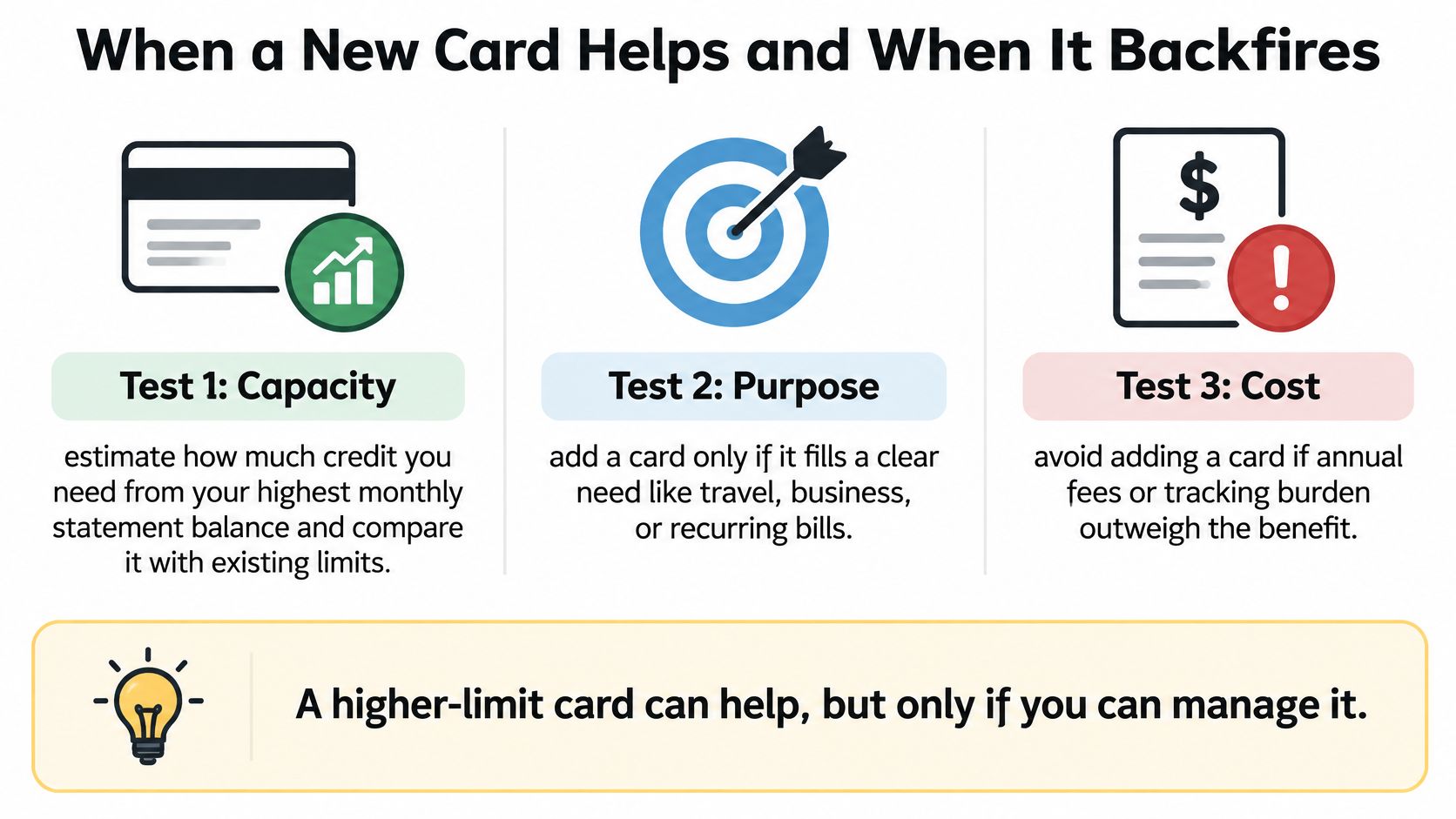
A new card is useful when it solves a specific problem you can manage. It may add available credit, provide a backup payment method, or replace an account that no longer suits you. It also means another account to track, another due date, and potentially another fee.
Test One and Test Two
Capacity comes first. Compare your highest monthly statement balance with your current credit limits. FICO's answers on credit scores indicate that when you need an extra $5,000, one $5,000-limit card generally has less score impact than two $2,500-limit cards. A single application may also be easier to manage than several.
Timing comes second. Space applications out and apply only for credit you need. Several applications close together can make it harder to keep track of new accounts and their terms.
Test Three and the Failure Case
Cost and control come third. Before applying, write down what could go wrong: an annual fee in year two, a promotional rate expiring, a forgotten due date, added fraud exposure, or extra spending because the limit looks roomy. Many cardholders carry a balance at some point, so a higher limit should not be treated as permission to spend more.
- A new card helps when: It eases a crowded limit, replaces a costly account, or gives you a backup on another network.
- A new card helps when: You can set up payment for the full statement balance from day one.
- It backfires when: You're opening it mainly to make existing balances look smaller.
- It backfires when: The fee, category rules, or due date add work you won't reliably do.
Household planning belongs in this decision, too. Learn how debt may be handled after a person dies to understand why account ownership matters alongside balances. Clear records can make shared obligations easier to review.
Open a card only when it solves a defined capacity, cost, or backup problem.
If you can't name the problem in one sentence, wait. An extra card is worthwhile only if you can track it, pay it, and give it a clear job.
Life Stages That Change Your Limit
Your safe card count can change even when your income doesn't. What changes is your attention, your cash-flow cushion, and the number of bills competing for both. These short scenarios show how households adjust.
The picture below captures the kind of joint review that helps couples agree on roles before accounts multiply.

A newly married couple merges two sets of habits and keeps one shared primary card for household bills plus one individual card each only if they can assign who pays what. They read up on how to combine finances after marriage before merging due dates. Their count doesn't rise just because the household did. It stays flat until shared autopay runs cleanly for a few cycles.
A new parent faces higher recurring costs and broken sleep, which is a poor mix for manual bill paying. The household adds a backup card only after autopay is tested, because visibility matters more than an extra rewards category right now. Their count rises by one, but their manual work falls.
The video below walks through the household budgeting side of that kind of transition.
A household moving from two incomes to one often needs the opposite move. It pauses spending on a third card and concentrates on one primary account, because a temporary income drop can turn a manageable balance into revolving debt. A larger total limit can make that cash-flow problem less visible by letting balances spread across accounts.
That trimming pattern shows up in national figures. AARP's review of credit card habits reports that U.S. consumers held an average of 3.7 active cards in 2025, down from 4.1 a decade earlier.
Across every stage, hold three tests steady. Every balance can be paid in full, every account has autopay and a stated purpose, and the household can absorb a short income shock without leaning on revolving credit. When one test fails, reduce complexity first.
Confirm Your Count Before Your Next Application
Do this checklist in one sitting, before you open any application page. You'll need your card apps or statements, a calendar, and about twenty minutes.
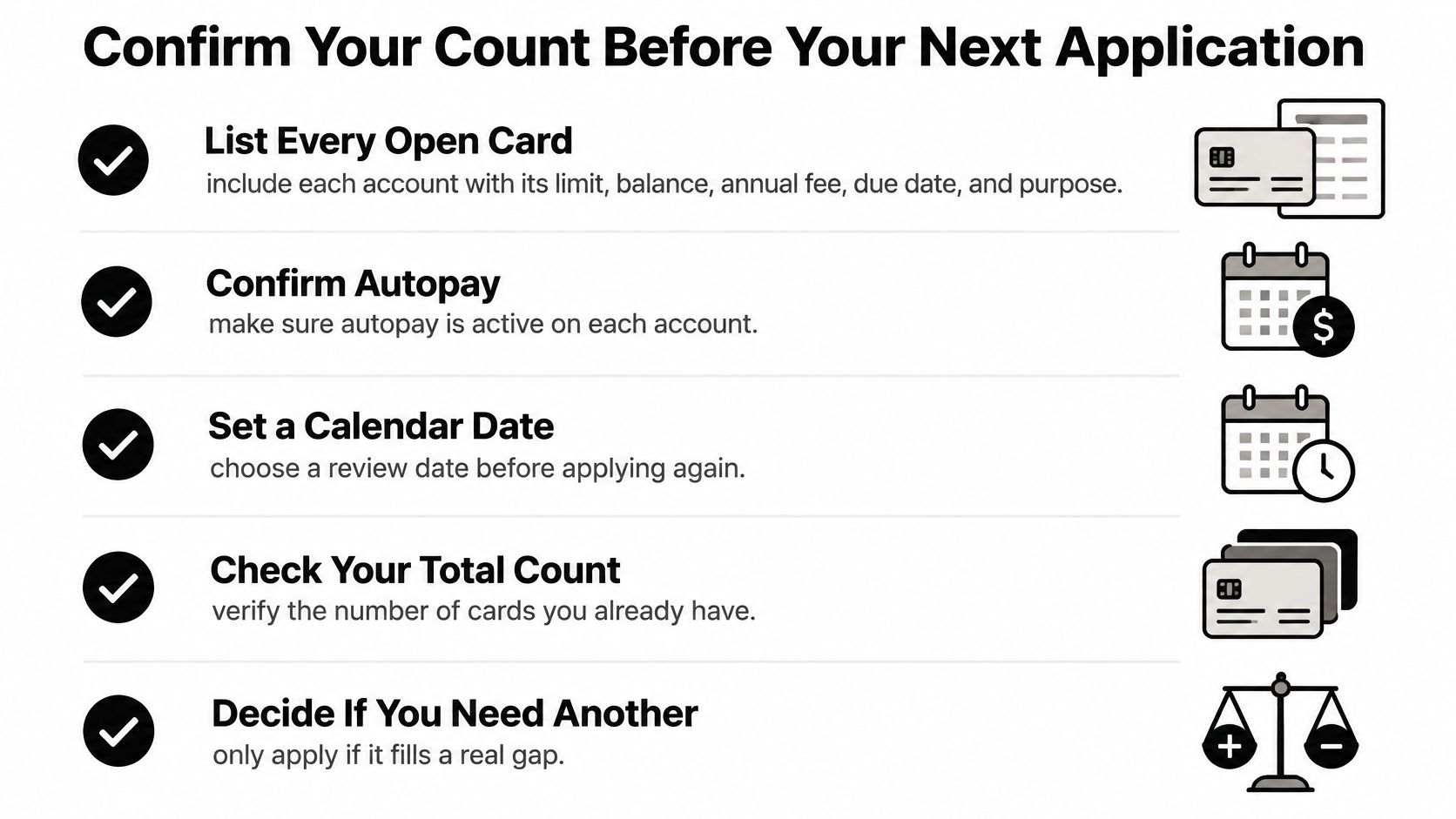
- List every open card: Write its limit, balance, annual fee, due date, and purpose in one row.
- Confirm autopay: Open each account and verify the payment amount and bank account, rather than trusting your memory.
- Calculate both ratios: Check overall utilization and each card's own figure against the warning level.
- Set the review date: Put a quarterly calendar appointment in place now, while you're already looking at the accounts.
- Name the gap: Write the specific job a new card would fill that no current card can fill.
Experian's guidance on having too many cards identifies roughly 30% utilization as a warning sign and notes that additional applications may produce hard inquiries and reduce the average age of your credit history. Scoring models don't impose a fixed maximum, but that doesn't make fast additions harmless.
The Decision Rule
If every card passes the three household tests, keep your count and stop shopping. If one card has no clear role or carries a balance you can't pay in full, pause new applications and fix that account first. If a single card's utilization is high, ask about a limit increase on an existing account or move recurring charges before you add another account.
This week: Write the purpose of each card on one list. Any account you can't describe is your first candidate to pause.
That one list answers how many credit cards should one have for your household right now. Revisit it when your life stage changes, not when a tempting offer lands in your inbox.
Your card count is only one part of protecting a household, and Coveredly helps young families and newly married couples think through the income protection side with flexible term life insurance that fits real budgets and changing stages. Applying is free and does not affect your credit score, so you can explore coverage without adding pressure to the credit picture you've just tidied. Visit Coveredly to see how coverage can be matched to your situation.