
“Multiply your income by ten” is popular advice because it's easy to remember. It's also a poor way to decide how much life insurance your family needs. A household with a mortgage, young children, one primary earner, and little savings has a very different protection problem from a dual-income couple with no dependents.
In 2024, about 42% of U.S. adults, roughly 102 million people, said they needed life insurance or more of it, and 54% of people estimating their own coverage admitted the figure was a gut guess or wild guess (LIMRA). Stop guessing. Build the estimate from the obligations your policy would need to handle.
Table of Contents
- Why a Single Number Is the Wrong Starting Point
- The Five Building Blocks of a Coverage Estimate
- How to Calculate Income Replacement That Holds Up
- Worked Examples for Young Families Couples and Professionals
- The Affordability Myth That Keeps People Underinsured
- When to Review and Update Your Coverage
- Putting It Together Your Coverage Action Plan
Why a Single Number Is the Wrong Starting Point
A quick calculator can produce a number before it asks meaningful questions. That convenience creates false confidence. The result might look precise while ignoring childcare, a mortgage, employer coverage that disappears after a job change, or the unpaid work performed by a stay-at-home parent.
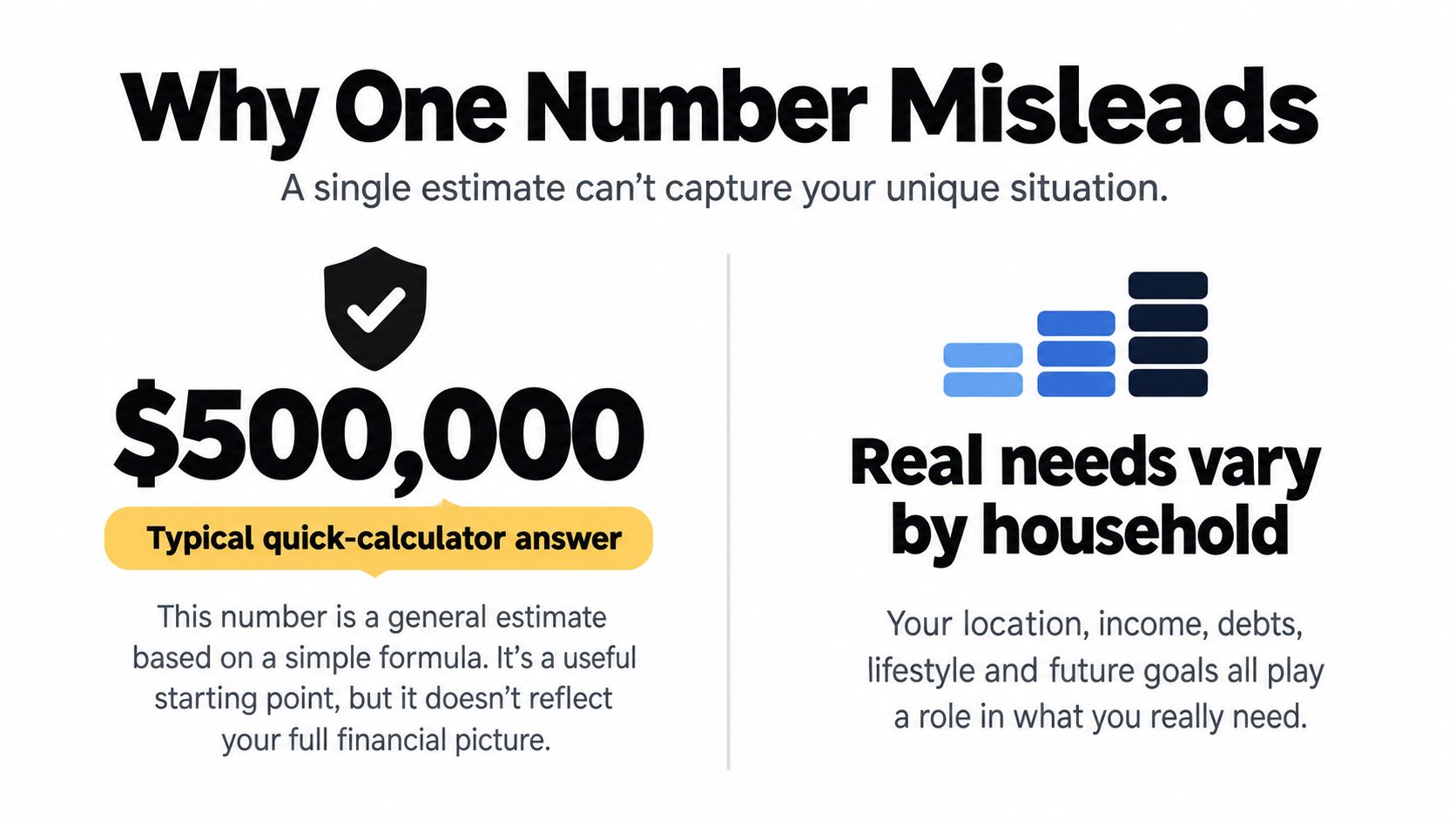
The familiar five-to-eight-times-income shortcut can serve as a rough screening tool. Multiplying income by ten is no better as a final answer. Income is only one part of the financial responsibility being transferred to a life insurance policy.
Replace the shortcut with a needs model
A defensible estimate answers five questions:
- How much income would survivors need to replace?
- Which debts should the death benefit clear?
- What would childcare and education cost?
- Which final expenses and near-term cash needs must be covered?
- What resources already exist and can be subtracted?
That last question matters. Existing individual insurance, liquid savings, employer benefits, and dependable survivor income all reduce the amount of new coverage required. Ignoring them can lead to an unnecessarily expensive recommendation. Double-counting them can leave the household exposed.
Practical rule: If you can't show how each major assumption affects the recommendation, you don't yet know how much coverage you need.
The long-term ownership picture reinforces the problem. The American Council of Life Insurers ownership data reports that 56% of U.S. households had some life insurance in 2022, while the median face value of in-force policies was $150,000. A household can technically own a policy and still lack enough protection for its actual obligations.
The right output isn't a magic number. It's a transparent range, supported by a base case and alternative assumptions.
The Five Building Blocks of a Coverage Estimate
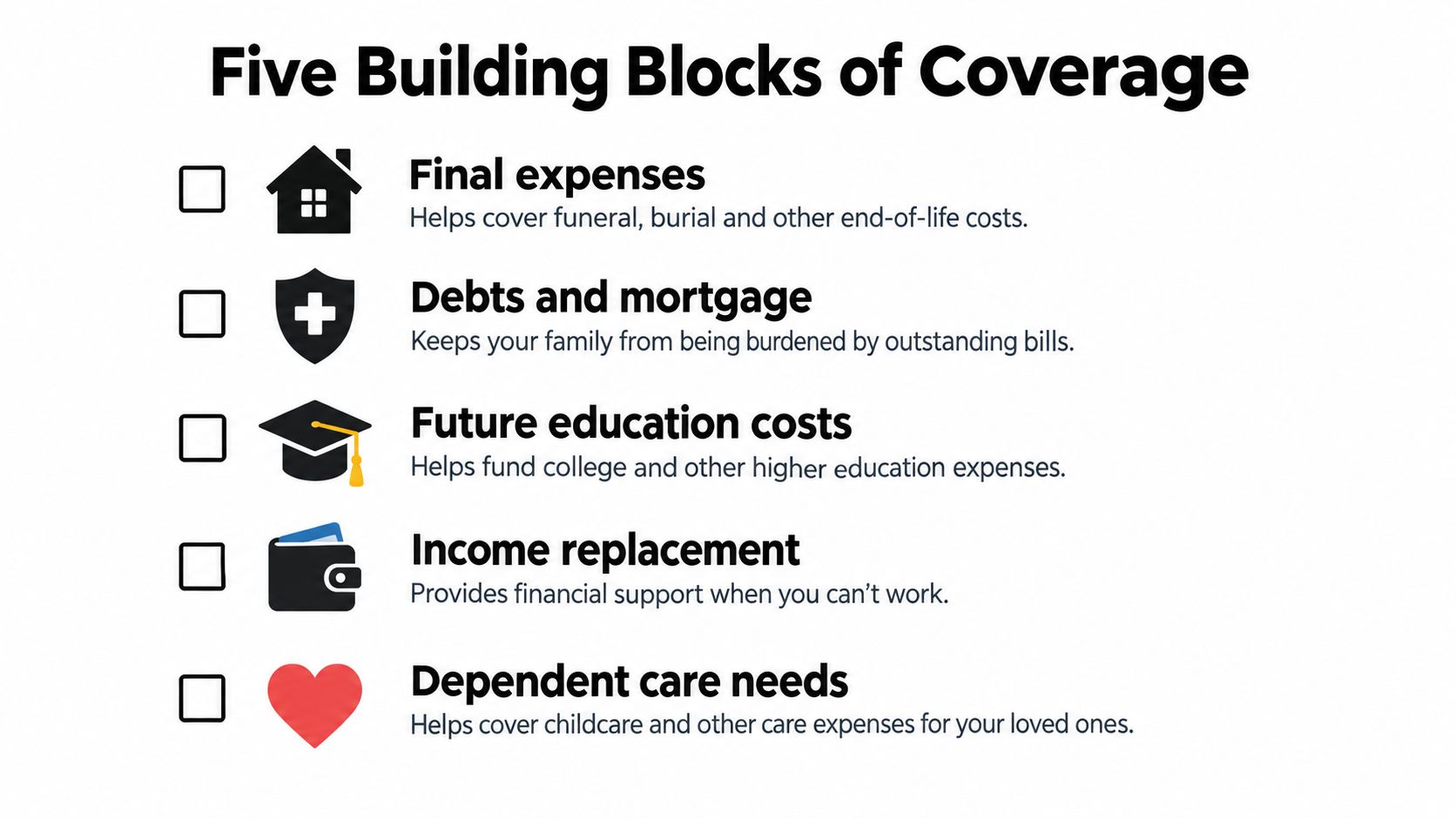
The National Association of Insurance Commissioners names the practical purposes of a life insurance death benefit: income replacement, funeral expenses, medical or nursing-care costs, debt repayment, childcare, education funding, and mortgage payoff (NAIC consumer buyer guide). Organize those uses into five blocks before you request quotes.
Income replacement
Start with the money the surviving household would need to maintain a workable standard of living. Don't automatically replace gross salary. Estimate the annual spending that would disappear if the deceased person were no longer contributing, then consider how long the family would need that support.
For a primary wage earner, include housing, food, transportation, insurance, and regular household costs. For a stay-at-home parent, include the cost of replacing childcare, transportation, household management, and other services.
Debts and mortgage
List the mortgage, car loans, student debt, credit balances, and other obligations that survivors would inherit or need to manage. Decide whether the goal is to eliminate each debt immediately or provide enough liquidity for the survivor to handle it over time.
A mortgage payoff can be a major part of the recommendation, but it isn't automatically the right choice for every household. The surviving spouse may prefer to keep the loan and preserve cash for income replacement or childcare.
Childcare and education
Young children create expenses that are easy to underestimate because parents often provide the labor themselves. Add paid childcare, after-school care, transportation, and the support required while the surviving parent works.
Education funding belongs in a separate line. Keep it visible rather than burying it inside income replacement, so you can test the result with and without that objective.
Final expenses and immediate liquidity
Final expenses, medical or nursing-care costs, and the cash required during the first months after death deserve their own block. Survivors may need money before assets are sold, benefits are processed, or household arrangements change.
Use an amount that fits your household's likely obligations. Don't confuse this short-term liquidity reserve with the much larger capital required to replace years of income.
Subtract what already exists
The final block is a subtraction, not another expense. Deduct individual life insurance already in force, liquid assets you genuinely intend to use, employer-provided coverage, and reliable survivor income.
Employer coverage needs careful treatment. It may end when employment ends, and it may not be large enough to handle mortgage, childcare, and income-replacement needs together. A detailed life insurance needs analysis can help you document each input instead of relying on a vague estimate.
Write every item on one page. That simple discipline makes omissions visible and gives an advisor something specific to challenge.
How to Calculate Income Replacement That Holds Up
Income replacement is usually the largest block, and it's where people make the biggest mistake. They replace a salary for an arbitrary period instead of estimating what the household spends and how long the dependency lasts.

Use a present-value replacement target. First, estimate annual household spending that needs replacement. Next, choose a time horizon. Then account for future costs conservatively, add one-time liabilities, and subtract existing resources.
Test the horizon instead of assuming it
Suppose a household needs $60,000 a year of replacement spending. A simple undiscounted illustration produces different totals before you add a mortgage, childcare, education, or final expenses:
| Replacement horizon | Annual spending | Basic income-replacement illustration |
|---|---|---|
| 10 years | $60,000 | $600,000 |
| 20 years | $60,000 | $1,200,000 |
| 30 years | $60,000 | $1,800,000 |
These are examples, not recommendations. They show why duration can change the answer by hundreds of thousands of dollars. A calculation that assumes ten years when the youngest child may need support for much longer can understate the protection gap.
A more refined model discounts future costs conservatively and separates recurring spending from one-time liabilities. Test at least a shorter horizon, a base horizon, and a longer horizon. If the recommendation changes sharply, explain which assumption caused the change.
The youngest child's path to financial independence often provides a more useful anchor than the insured person's age. A mortgage maturity date, expected retirement, or a spouse's return to work can also affect the horizon.
The right question isn't “What multiple should I use?” It's “How long would this household need replacement cash if this person died tomorrow?”
Count the value of unpaid work
A stay-at-home parent may not earn a salary, but that parent can provide childcare, meal preparation, transportation, household administration, and daily supervision. If that work vanished, the surviving parent might need paid services or might reduce working hours.
Include those replacement costs as part of the needs model. Otherwise, the policy protects wages while ignoring the labor that allows those wages to continue.
For a practical discussion of this part of the calculation, compare guidance on life insurance for income replacement and document the assumptions in an income replacement policy analysis. The goal isn't to produce false precision. It's to make the recommendation explainable.
Use the video below as a visual companion while reviewing the inputs.
Worked Examples for Young Families Couples and Professionals
The same model can produce very different answers for different households. The figures below are illustrative scenarios, not quotes or personal recommendations. Their purpose is to show how the categories interact.
A young family with two children
Assume a single primary earner supports two children under five. The household has a $320,000 mortgage, needs income replacement for 22 years, and wants the death benefit to address childcare, education, and final expenses. It also has $50,000 in savings that the family is willing to use for protection needs.
The calculation starts with the 22-year income-replacement target. Add the mortgage payoff, childcare and education funding, and final expenses. Then subtract the $50,000 savings balance. The answer will be materially higher than a simple income multiple if the surviving parent would need to purchase childcare and maintain household income.
The key issue is the long dependency period. Two young children create years of care, transport, school-related costs, and income vulnerability. A short policy term may leave the family exposed while the larger obligations remain.
A dual-income newly married couple with no children
Now consider two earners, no children, and a $450,000 mortgage. Their needs are not automatically half of the young family's needs, because the mortgage is larger, but the income-replacement requirement may be narrower.
Each spouse should model the income shortfall after the other's income continues. The surviving spouse may need a temporary income bridge, mortgage support, and liquidity while deciding whether to keep or sell the home. Duplicating full income replacement for both people could waste premium if the survivor can maintain most living expenses independently.
A smaller policy, carefully matched to the mortgage and transition period, may be more efficient than buying identical large policies. The right answer depends on cash flow and each spouse's contribution, not on marital status alone.
A professional with variable compensation and equity
A business professional with bonuses, commissions, restricted equity, or partnership interests needs more than a base-salary multiple. Separate dependable compensation from variable compensation, then decide how much of the variable amount the household relies on.
Review the vesting schedule, liquidity, tax exposure, and whether the equity would retain value after death. Don't count an asset at its headline value if the surviving household couldn't access it promptly or if its value depends on continued employment.
Model several years of compensation rather than using one unusually strong year. Then add debts, family obligations, and near-term liquidity. The policy should address the household's real cash-flow risk, not merely mirror an employment contract.
| Scenario | Income replacement | Debts paid off | Childcare and education | Total coverage |
|---|---|---|---|---|
| Young family with two children | 22-year replacement period, based on household spending | $320,000 mortgage | Childcare and education included | Income replacement plus mortgage, dependent costs, and final expenses, less $50,000 savings |
| Dual-income newly married couple | Survivor's income shortfall and transition bridge | $450,000 mortgage considered separately | No childcare or education block | Survivor shortfall plus selected mortgage and liquidity needs |
| Professional with variable compensation and equity | Multi-year total-compensation analysis | Personal and housing debts | Based on actual dependents | Replacement target plus liabilities, adjusted for usable assets and benefits |
The table is intentionally transparent rather than falsely exact. A serious estimate shows the categories, the assumptions, and the resources deducted.
The Affordability Myth That Keeps People Underinsured
Many people reject an appropriate coverage target before checking the premium. They assume the number will be unaffordable, postpone the application, and leave the household exposed while waiting for a better financial moment.
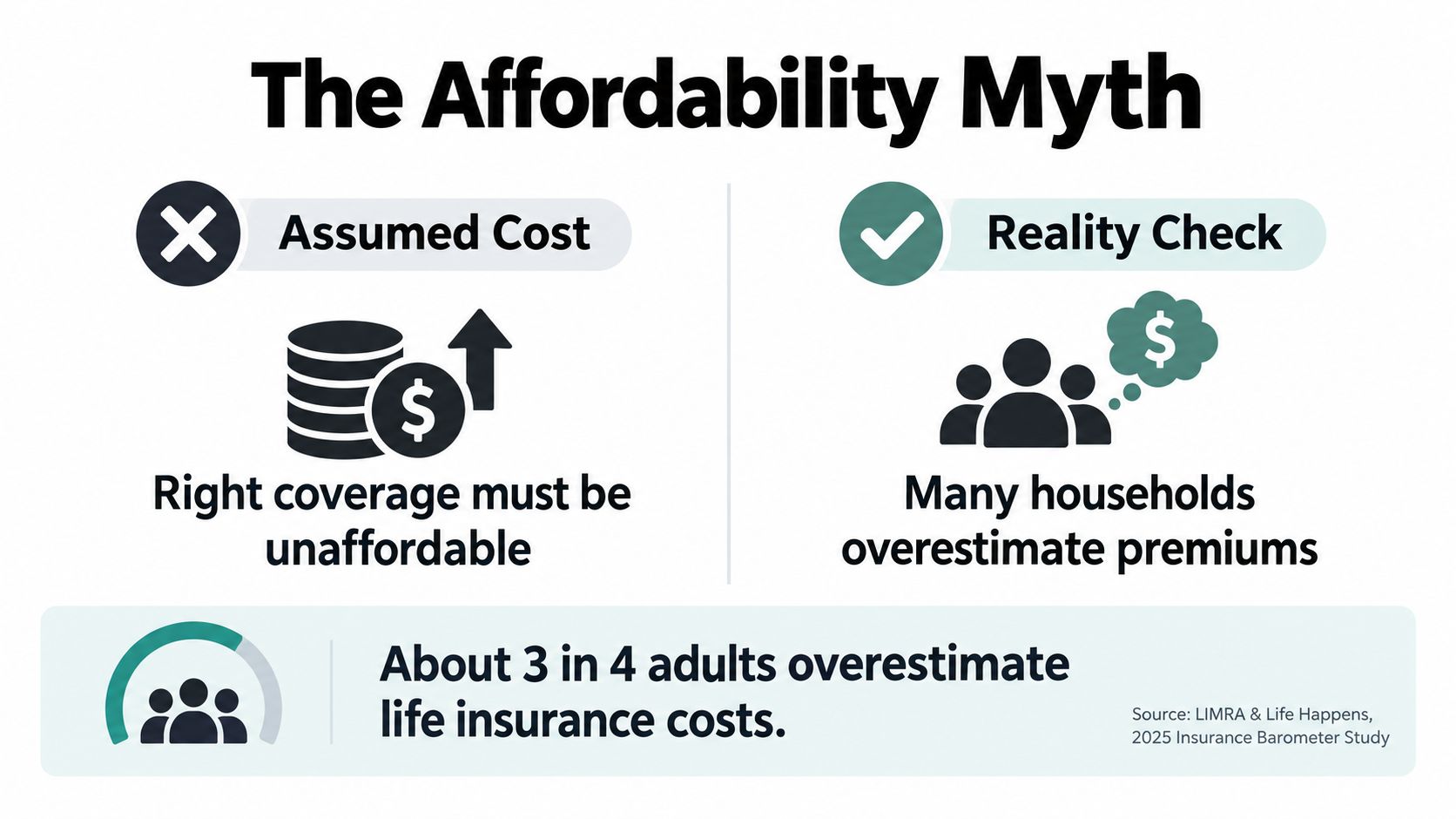
Only 10% of Americans correctly estimated the monthly cost of a $250,000, 20-year term policy for a healthy 30-year-old. 57% overestimated the premium, while 32% didn't know the cost (Corebridge Financial). That misconception affects both whether people buy and how much they buy.
Buy workable protection before chasing perfection
An affordable policy purchased now usually protects a family better than an ideal policy purchased later. The danger isn't merely choosing the wrong number. It's having no protection during the period when a death would create the greatest financial damage.
That doesn't mean buying any policy without analysis. It means separating two decisions:
- Coverage decision: Identify the protection the household needs.
- Budget decision: Choose a sustainable amount and term that can be purchased now.
If the full target doesn't fit the budget, consider a practical starting point and schedule a review. Cutting coverage in half may be less sensible than adjusting the term length, removing a nonessential objective, or prioritizing income replacement and mortgage protection first.
Term length changes affordability because it changes how long the policy must provide protection. Match the term to the dominant obligation. A family with young children may need protection through the dependency period, while a couple with no children may focus on mortgage and transition risk.
When to Review and Update Your Coverage
A coverage estimate is a snapshot. Your obligations change, and the policy should be reviewed when the assumptions behind it no longer hold.
Use these events as triggers:
- Marriage: Combine obligations and recalculate the survivor's income needs.
- Divorce: Reassess beneficiaries, support obligations, debts, and the purpose of existing coverage.
- Childbirth or adoption: Add dependent care, education, and a longer income-replacement horizon.
- Home purchase: Add the new mortgage and decide whether the survivor should retain or repay it.
- Major salary change: Update the income-replacement target and account for changed lifestyle costs.
- Job change: Check whether employer coverage ended, changed, or became portable.
- A second earner leaves work: Add the value of lost income and the cost of replacing household labor.
- A new dependent: Recalculate support for a grandchild or another person who relies on the household.
Reviewing insurance cover alongside broader financial records can help catch changes in beneficiaries, debts, and protection gaps. Stewart Accounting Services on insurance reviews offers useful context for treating insurance as part of an ongoing financial review rather than a one-time purchase.
Even without a major event, refresh the assumptions every two to three years. Check the remaining term, household spending, debt balance, employer benefits, assets, and the age of the youngest dependent.
Putting It Together Your Coverage Action Plan
Set aside an afternoon and complete five tasks:
- List income replacement, debts, childcare and education, final expenses, and near-term liquidity.
- Subtract existing insurance, liquid assets, employer benefits, and dependable survivor income.
- Run a base case, a shorter horizon, and a longer horizon.
- Choose a term length that matches the obligation that matters most.
- Price the result against the household budget and schedule the next review.
Use a free term life insurance calculator to organize the inputs, then compare the result with broader risk-planning guidance such as AmbitionCFO's guide to risk planning. The calculation doesn't need to be perfect before you start. It needs to be visible, defensible, and easy to update.
Get the estimate, then price the policy this week. The biggest risk isn't choosing a figure that needs revision. It's leaving your family unprotected while you keep refining it.
Coveredly helps people assess an appropriate life insurance amount and explore flexible term-life coverage, including no-exam options for eligible applicants. Visit Coveredly to turn your household assumptions into a practical coverage decision and start comparing your next step.