
You're 35, you have a five-year-old and a mortgage with 27 years left on it, and this is the year you've decided to stop meaning to buy life insurance. You open a quote form, answer six questions, and a number appears: a monthly premium for half a million dollars of term coverage. It looks affordable. It also looks arbitrary.
That number isn't arbitrary, but it isn't final either. It's an estimate built from a rate table, and your answers selected a row in that table. Change one answer, and the row changes. Get through underwriting with a prescription on your record, and the row changes again.
This is a walk through that calculation the way an underwriter runs it: a base rate you can work out yourself, the findings that push the final offer up or down, and the policy structures that make two identical face amounts cost very different amounts over 20 years. Knowing how to calculate life insurance premium ranges on your own means the quote stops feeling like a verdict and starts looking like a starting position.
Table of Contents
- Estimate Your Premium in Five Steps
- The Base Factors That Set Your Rate
- How Health and Lifestyle Change Your Rate
- Compare Total Cost, Not Just the Monthly Quote
- Check Your Estimate and Avoid Costly Errors
Estimate Your Premium in Five Steps
Say you want $500,000 of 20-year term coverage and you want a number before you talk to anyone. You can get one in five minutes with a rate table and a calculator.
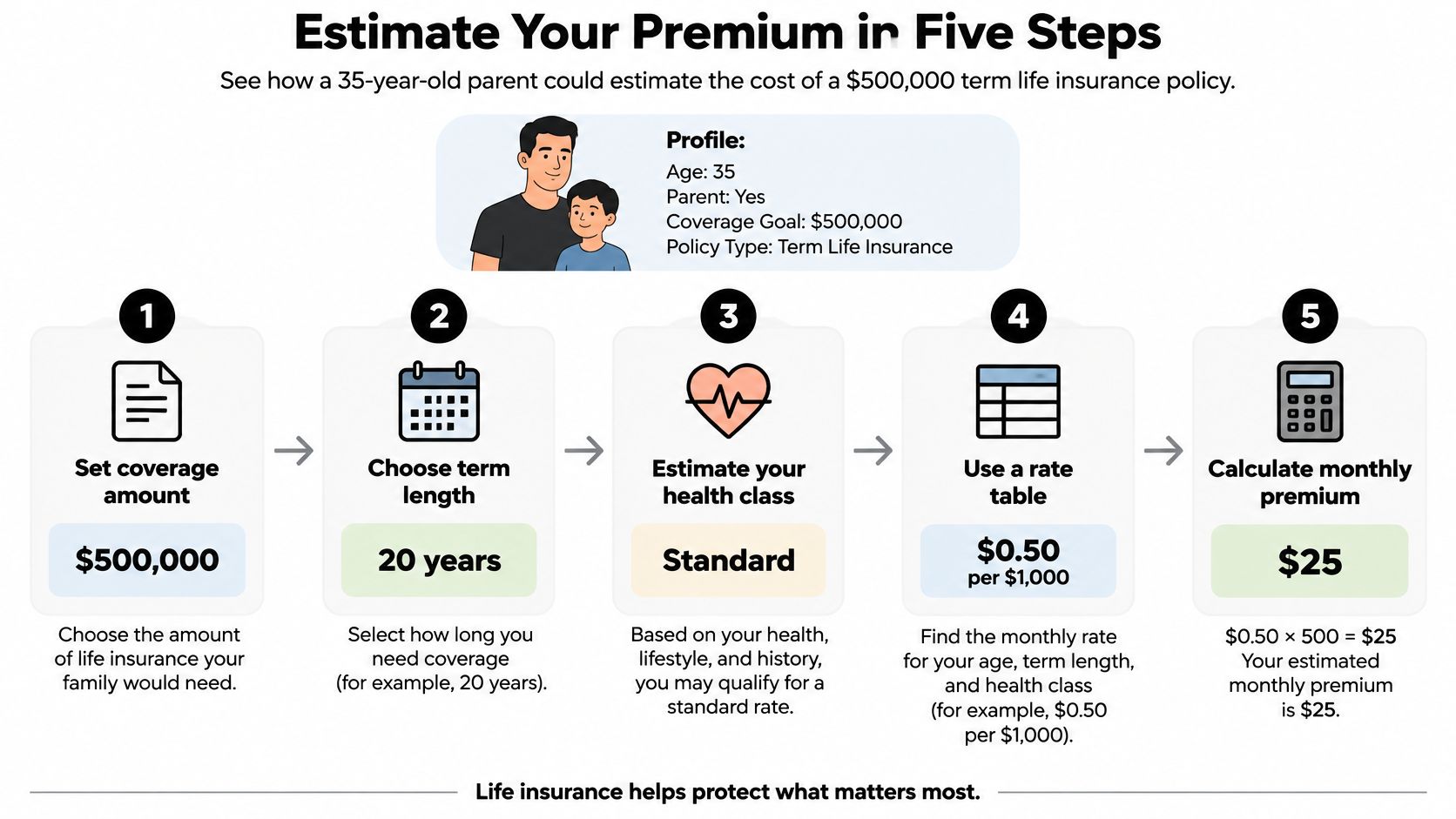
The Five Steps, in Order
- Set the coverage amount. A common guideline is 10 to 15 times annual income. At $60,000 a year, that's a target between $600,000 and $900,000. The worked example below uses $500,000 to keep the arithmetic visible, but run the guideline on your own salary first.
- Pick the term length. Usually 10, 20 or 30 years. Match it to the years your family depends on your income or the years your mortgage stays open. A 20-year term on a mortgage with 27 years left leaves a seven-year gap.
- Note your age at issue and whether you use tobacco. These two answers decide which row of the rate table applies to you, and no other input moves the price as much.
- Find the rate per $1,000 and multiply. Divide coverage by 1,000 to get units, multiply by the rate for your row, then add the policy fee. In Syntaqx's life underwriting example, a standard non-tobacco policy comes to $1,110 annually: 500 units times $2.10 equals $1,050, plus a $60 policy charge.
- Compare that base figure with the quote you receive. A few dollars apart is noise. A quote that arrives 60 percent higher means the insurer placed you in a different rating class, and the next section explains which findings cause that.
Sanity check: your estimate should land in a range, not match a single figure to the dollar. If your arithmetic says $1,110 and the offer comes back at $1,900, the gap has a cause, and it's worth naming before you accept or walk away.
One habit makes this useful. Write your estimate down before you request quotes, with the rate per $1,000 you used. When the formal quote arrives, you'll be comparing two numbers instead of reacting to one.
The Base Factors That Set Your Rate
Age is the strongest input in the calculation, and it's the one you can't negotiate. The NAIC's consumer guide to choosing coverage explains that the risk of death increases each year, and state insurance guidance in Illinois adds that an older applicant, or one whose health has changed, will often pay more for a new policy and may become uninsurable altogether.
Put a 30-year-old and a 45-year-old side by side, both non-smokers in decent health, both asking for $500,000 over 20 years. They qualify for the same coverage amount. The 45-year-old's rate per $1,000 will be a multiple of the 30-year-old's, because the insurer is pricing a longer claim window against a higher annual probability of death.
The rest of the inputs work the same way, each one shifting either the row you land in or the number of units you're buying.
| Factor | Effect on premium | What to gather |
|---|---|---|
| Age at issue | Premium rises as age climbs because mortality risk increases each year | Date of birth and planned start date |
| Sex | Some insurers rate by sex; others use unisex tables | Sex as listed on the application |
| Tobacco use | Tobacco users are typically rated higher than non-users | Date of last nicotine or tobacco use |
| Term length | Longer terms cost more per year because the claim window is longer | Years your family would need the benefit |
| Coverage amount | Cost scales with each $1,000 unit of coverage | Target benefit, often 10 to 15 times annual income |
| Payment mode | Monthly payments usually total more over a year than annual payments | Preferred monthly or annual schedule |
Two Inputs That Don't Behave Alike
Coverage amount and term length look similar on a form and behave very differently in the math. Doubling your coverage doubles your units, so the base cost roughly doubles. Moving from a 20-year to a 30-year term doesn't double anything, because the unit count stays the same; it raises the rate per unit for every one of those years. If your budget is tight, shortening the term usually saves more than trimming the benefit.
Payment frequency is the quiet one. Monthly billing spreads the same annual premium across 12 payments and adds processing charges on top, so a policy quoted at an annual figure will usually total more when paid monthly. Ask for both figures before you choose a schedule.
Our guide to life insurance rates by age shows how the same coverage amount reprices as the issue age rises, which is the clearest way to see the lever in action.
Test One Lever at a Time
Change a single input and re-run the arithmetic. Move the term from 20 years to 30 and see how far the annual figure travels. Then put your age back and change the coverage from $500,000 to $750,000. Doing this one variable at a time tells you which lever is affordable to pull, and it stops you from cutting the benefit when the term was the expensive part all along.
If you want the human side of this decision, the discussion of life insurance insights on The Sleep Consultant covers how families think through dependents and timing, which is the context all this arithmetic serves.
How Health and Lifestyle Change Your Rate
Skipping the medical exam feels like it should be the cheaper route. Often it isn't, and the reason is simple: no-exam doesn't mean no underwriting. The NAIC's report on accelerated underwriting explains that accelerated programs replace the physical with data-driven risk assessment, and it notes that policies requiring less detailed health information may cost more and provide less coverage.

What Underwriting Actually Looks At
The first quote assumes a standard applicant. Underwriting decides whether you are one. The findings that most often move people out of the standard class:
- Controlled high blood pressure, well managed or not, because the insurer prices the condition rather than the current reading.
- A recent prescription, which shows up in pharmacy databases and gets read as a diagnosis signal.
- A hazardous driving record, pulled from motor-vehicle records rather than from your answers.
- A past tobacco designation, even if you quit, because the nicotine history stays on record.
- Consumer data, including public records that insurers use to verify identity and check for undisclosed risk.
Classes work in plain terms. Preferred goes to clean health and clean records and gets the lowest rate. Standard is the baseline. Rated classes add a percentage or a flat extra on top, and the label usually names the severity: Table 4 means four steps above standard.
| Rating class | Annual premium | How it is calculated |
|---|---|---|
| Standard non-tobacco | $1,110 | 500 units x $2.10 plus $60 policy charge |
| Table 4 rating | $2,160 | 500 units x $4.20 plus $60 policy charge |
| Difference | $1,050 | About 95 percent higher than standard |
A rating class is not a judgment about your health. It's the insurer's price for a specific finding, and a different carrier may price the same finding differently.
Three Questions to Ask After Any Quote Change
Ask which finding caused the change, so you know what to document or dispute. Ask which class you were placed in, so you can compare it against the offer from another carrier. Ask for the rate per $1,000 attached to that class, so the arithmetic from earlier still works and you can see the loading in dollars.
Many carriers offer flexible underwriting options for people with pre-existing conditions, and in many cases no medical exam is needed at all, because policies are approved using digital underwriting and health data. A typical application asks for basic personal information, health history and lifestyle questions, so gather those answers before you start rather than midway through.
Blood pressure, cholesterol and weight carry real weight in that review, which makes steps to improve metabolic health worth understanding well before you apply. Our explainer on life insurance underwriting covers the timeline from application to decision.
Compare Total Cost, Not Just the Monthly Quote
Twenty-five dollars a month looks cheaper than thirty. Multiply both by 12 and then by 20, and the gap widens into a number worth arguing about. A monthly quote works like a rent figure that ignores the length of the lease: it can be accurate and still answer the wrong question.
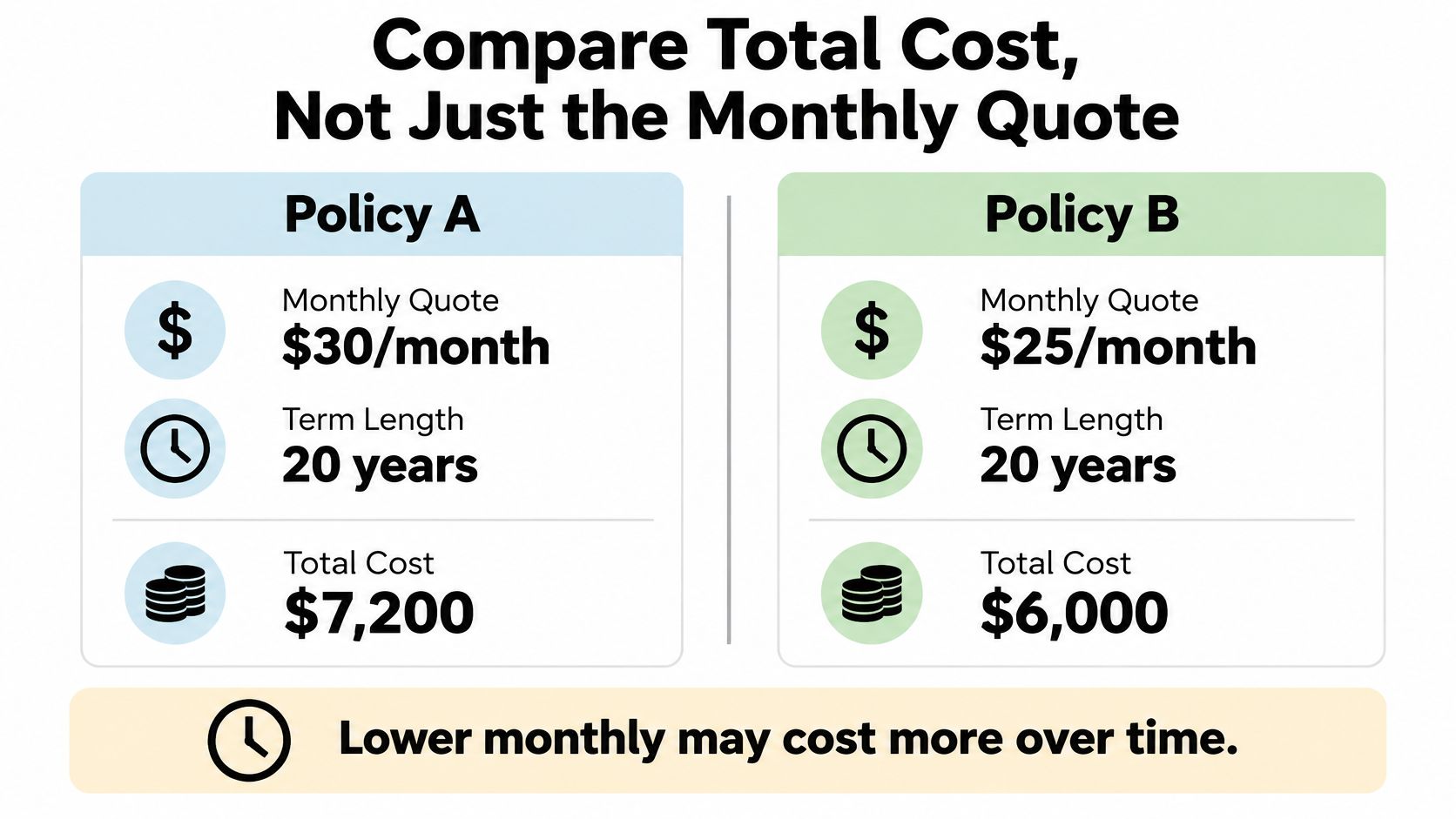
Three Policy Structures, Three Totals
Take a policy quoted at $60 a month for a 20-year term. Total premiums are $60 times 12 times 20, which comes to $14,400. That figure is what you are budgeting for, not the $60.
The multiplication only works cleanly when the payment never changes. Three structures move the total in different ways:
| Policy type | Premium pattern | Guarantees | Cost to add to the total |
|---|---|---|---|
| Level term | Same payment for the full term | Fixed premium and benefit for the term | Total scheduled premiums across the term |
| Annual renewable term | Premium increases at each renewal | Coverage renewal, premium not level | Expected premiums at each renewal after the first term |
| Whole life | Level payments, significantly higher than term | Lifetime coverage with cash value growth | Premiums plus policy charges over the insured's lifetime |
The life insurance buyer's guide from the Utah Insurance Department, which follows NAIC guidance, recommends comparing whether premiums or benefits vary from year to year, how benefits build up, which portions are not guaranteed, and the effect of interest on money paid and received at different times.
Whole life needs its own line. Comparing a term quote with a whole life quote on premium alone can make whole life look unaffordable. The fair comparison is total premiums plus policy charges against the cash value that builds over decades. Neither number settles it by itself.
Term life is pure protection for a set period, such as 20 years, with no investment component. Whole life covers the insured for their entire life and includes a cash value savings component that grows over time, so its premiums sit significantly higher than term. A large monthly gap is what that structure costs, not proof that one quote is the wrong one.
Ask What the Highest Premium Could Be
The NAIC's consumer guide to life insurance tells buyers to ask whether premiums increase later, whether they could still afford coverage if they do, and what the highest premium would be to keep the policy in force. Those three questions take a minute and protect a 20-year budget.
Practical rule: write down total premiums over the period you actually need coverage, then test that total against a drop in income or a renewal that doubles the payment. If the policy fails the stress test, it is too expensive regardless of the monthly figure.
A side-by-side breakdown of how to compare life insurance costs puts scheduled premiums, guarantees, and renewal patterns on one page.
Check Your Estimate and Avoid Costly Errors
An estimate is only as good as its inputs. Five mistakes account for most of the gap between what people expect to pay and what they're quoted, and each one has a fix that takes minutes.
Five Errors That Distort the Estimate
- Using last year's age. Rates reset at your issue age, so use your age on the planned start date. A birthday between the quote and the application can move you to a new row.
- Buying years you don't need. A 30-year term on a need that ends when your youngest turns 18 inflates the premium for a decade after the risk has passed. Match the term to the dependency.
- Treating the face amount as the whole story. Two policies with the same $500,000 benefit can differ in fees, guarantees and renewal terms. Compare those before you decide.
- Comparing quotes on different bases. A $750,000 quote at 30 years will always look worse than $500,000 at 20 years. Standardize the amount and term first.
- Assuming a missed payment ends coverage instantly. Most policies include a grace period before coverage is affected by a missed payment. Read your contract for the exact length instead of guessing.
A Five-Point Check Before You Apply
- Confirm your coverage target against income, debts and dependents, not against a round number that felt right.
- Gather health history, prescription details and your driving record before requesting quotes, so nothing surfaces late.
- Compare at least three quotes on the identical term and amount, recording both the annual premium and the total scheduled premium for each.
- Ask each insurer which elements are guaranteed, how renewal premiums move, and which rate class you were placed in.
- Accept an offer only when total cost and rate class fit your budget. If a quote sits well above your estimate, ask which factor caused the gap first.

Ask directly: "Which rate class was I assigned, and what is the rate per $1,000 for that class?" An answer in those terms lets you check the arithmetic yourself instead of accepting a number on faith.
Here's one working note: the difference between a quote and an offer usually has a single cause. A prescription, a driving record, a tobacco history, or a coverage amount that crossed an underwriting threshold. Ask for that cause and you'll either fix it or learn to price it.
We compare multiple carriers to find competitive pricing, and we offer term life insurance with no medical exams for policies up to $3M, so the underwriting path is part of the conversation rather than a surprise at the end. Start with your own estimate, then run it against real quotes at Coveredly.
A life insurance premium is a moving estimate, not a fixed price, and the five steps above give you the base rate before anyone else weighs in. Coveredly compares multiple carriers so you can see how your age, health and coverage amount price out side by side, and coverage can be raised or lowered as your mortgage shrinks and your kids grow. Visit Coveredly to run your own numbers and see what your estimate looks like against real quotes.