
You're filling out a life insurance application after getting married, buying a home, or welcoming a child. Then you reach the beneficiary field. Your spouse's name seems obvious, but the next questions aren't: Who's the backup? Should you name your child? Would a trust make things easier or harder?
Choosing a life insurance beneficiary means giving the insurer a legal payout instruction, not recording whom you love. The practical test is whether the form identifies the right recipient, explains the intended shares, and can be found when your family needs it. Start with the payout order, then audit the wording.
Table of Contents
- Who Gets Paid First and Who Comes Next
- How to Choose Your Beneficiary in Six Steps
- Beneficiary Choices for Common Family Situations
- When a Trust or Estate Makes Sense
- Keep Designations Current and Findable
Who Gets Paid First and Who Comes Next
Primary beneficiaries receive the death benefit first if they survive the insured; contingent beneficiaries provide the backup when a primary beneficiary dies first. You can name several people in either category, but the form needs clear allocation instructions rather than a loose list of names.
A beneficiary's position and identity answer different questions. Primary or contingent establishes priority. Naming a person, trust, estate, or business establishes who receives and manages the proceeds.
Beneficiary types and when they receive proceeds
| Beneficiary type | Receives proceeds when | Common use | Key check |
|---|---|---|---|
| Primary beneficiary | Insured dies and the primary outlives them | Spouse or partner | Full legal name and percentage |
| Contingent beneficiary | A primary beneficiary dies first | Adult relative or trust | At least one per primary line |
| Estate | Every named beneficiary dies first | Last-resort backstop | Proceeds may become probate property |
| Revocable trust | Insured dies and trust terms apply | Minor children or staged payouts | Trust must be drafted correctly |
| Business | Insured dies and buy-sell terms apply | Business owners and partners | Matches the business agreement |
A trust or business can occupy a primary or contingent position. An estate can also be expressly named, rather than receiving proceeds only as a fallback. Confirm how your carrier handles contingent allocations, especially when several primary beneficiaries are listed.
The form usually outranks the will
The IRS guidance on assets with beneficiary designations explains that life insurance with a beneficiary designation generally isn't controlled by a will; if all designated beneficiaries die first, proceeds may pass to the estate and become probate property. That makes beneficiary designation versus will a practical distinction, not just estate-planning terminology.
A will leaving everything to your current spouse generally won't redirect a policy that still names someone else. Likewise, a family conversation about who should receive the money doesn't replace the insurer's record.
Match the backup to the family
Say a hypothetical policyholder is 35, married, and has a three-year-old. They might name their spouse for 100 percent of the primary benefit and a properly established trust for the child as contingent, rather than naming the child directly.
Our explanation of what a contingent beneficiary does in life insurance can help you distinguish a backup recipient from someone who shares the initial payout.
Run this check now: pull the current form, confirm both beneficiary levels are complete, and make sure each set of percentage allocations totals 100 percent. If the form uses equal shares instead, confirm that instruction applies to the intended group.
How to Choose Your Beneficiary in Six Steps
The National Association of Insurance Commissioners' life insurance guidance explains that owners can name multiple primary and contingent beneficiaries, specify percentages or equal shares, and generally change designations through a formal written request, subject to the policy and state law. Treat the task as completing an enforceable instruction, not filling an address book.
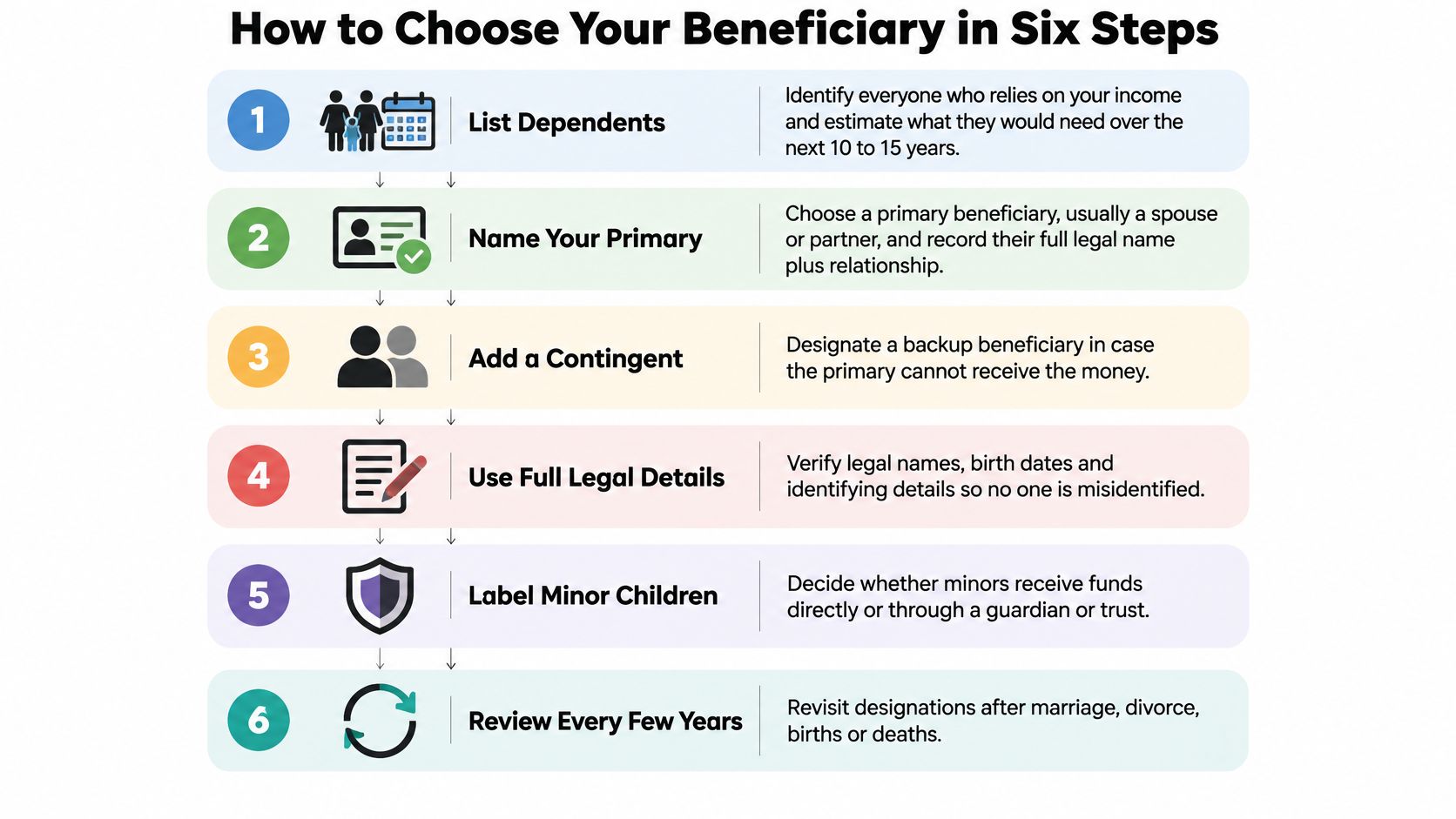
Use this visual checklist to organize the decisions before entering names on the carrier's form.
Make the decisions before submitting
List everyone who depends on you. Include the people who rely on your income and unpaid work, then write down housing, childcare, debt, and education needs. For a hypothetical planning exercise, estimate what your household would need over the next 10 to 15 years, rather than choosing a recipient without considering the bills they'd face.
Choose the primary beneficiary and identify them precisely. A spouse or partner is often the practical choice, but use their full legal name and provide a Social Security number or tax-identification number where requested. Relationship labels alone, such as spouse or eldest child, leave more room for uncertainty than a clearly identified person.
Add a contingent beneficiary. Choose another adult or an appropriately established trust for the situation in which the primary beneficiary dies first. If there are multiple primary recipients, ask how the carrier applies contingent instructions to a deceased recipient's share.
Decide how a minor's money would be managed. Consider a trust or legally available custodial arrangement rather than assuming a child can receive and control proceeds directly. Confirm the arrangement with an attorney or adviser and have the insurer verify the required designation wording.
Specify the distribution method and allocation. Choose whether a deceased child's descendants should inherit that child's share or whether surviving members of the named class should divide the money. Use the carrier's accepted wording and ensure the completed allocation accounts for the entire benefit.
Submit the request and obtain confirmation. Send the completed form through the insurer's required written process, then request written confirmation that the designation is recorded. For a new policy, separately confirm that coverage has begun: coverage typically begins once the policy is approved and the first payment is processed.
Choose the inheritance path deliberately
Per stirpes versus per capita distribution
| Method | How the share passes | Best fit | Watch for |
|---|---|---|---|
| Per stirpes | A deceased child's share passes to that child's descendants | Families where grandchildren should inherit a parent's share | Name the exact term on the form |
| Per capita | Shares divide equally among surviving members of the class | Designations among children or siblings of the same generation | A deceased member's share goes to the survivors |
These terms aren't interchangeable. Ask the insurer to explain how its form would distribute the benefit under your actual family circumstances, particularly if a deceased beneficiary leaves children.
For an additional walkthrough, use the video alongside the actual beneficiary form.
Before submitting, inspect preprinted defaults and existing entries. Some forms may already show an estate or a former spouse; replace unintended entries rather than assuming a new application has blank beneficiary fields.
Claims-officer test: Could someone who has never met your family identify every recipient and calculate each share without guessing?
Keep sensitive identifying information within the insurer's secure submission process. A household planning note can explain your intentions, but it shouldn't become an unsecured duplicate of everyone's personal information.
Beneficiary Choices for Common Family Situations
The right designation changes when your family changes, and the beneficiary form is the payout instruction that has to keep up. Start with who needs the money, then check whether the intended person can legally receive and manage it.
Partners holding separate policies or coverage through different employers should review their forms side by side: naming each other on one policy leaves the other untouched.

Beneficiary choices by family situation
| Situation | Usual designation | Key trap |
|---|---|---|
| Newly married couple | Spouse as primary, adult relative as contingent | Older policy still names a former partner |
| Parents of a young child | Spouse as primary, trust or custodian for the child | Direct payment to a minor can stall |
| Blended family | Spouse as primary, a stated share for each child | Unequal shares left unstated |
| Separation or divorce | Revise the form after the decree | A decree may not change the policy form |
| Adoption or guardianship change | Update child and guardian names | Old names still on file |
For a blended family, translate that shorthand into actual allocations. If children should receive money at your death, they need an expressly structured share or trust arrangement; contingent status behind a surviving spouse pays only if that spouse cannot be paid.
Marriage and children require different checks
Newly married couples should request the designation currently on file rather than rely on memory. A policy opened years earlier may still pay a former partner. Confirm the insurer accepted the new spouse's details in writing, and unmarried partners should review the considerations in life insurance for unmarried couples.
Parents of young children need to separate the intended recipient from the person who would manage the funds. The NAIC consumer life insurance guide advises against naming a minor directly because payment may require court involvement or an authorized adult arrangement, and recommends revisiting designations as family circumstances change.
Blended families should write the intended shares on the form. Assuming a surviving spouse will later pass money to children from an earlier marriage leaves that outcome to goodwill. Remarriage agreements sometimes set obligations the form has to match, such as a reserved share for children from a prior marriage; couples remarrying in Florida can use a prenup guide for remarrying Floridians to frame that conversation before updating the designation.
Separation and guardianship need legal coordination
Separation or divorce calls for a review of the policy and the settlement documents together. Luso-American Financial's beneficiary rules overview notes that divorce outcomes vary across policies and jurisdictions, and a court order or settlement may require continued coverage or restrict beneficiary changes. Resolve the legal obligation first, then submit the updated form.
Adoption or a guardianship change means checking the child's identifying details and any trustee or custodian named alongside them. Updating a guardian's name doesn't, by itself, authorize that person to manage insurance proceeds on the child's behalf.
Naming your children directly isn't always the family-friendly answer. Choose an arrangement that gives the intended adult lawful authority to manage their support.
The question to resolve is concrete: Who would handle the money, and does the form clearly support that arrangement?
When a Trust or Estate Makes Sense
Naming a trust doesn't automatically solve the estate-tax question. A trust's distribution rules and a policy's tax treatment are related planning issues, but they aren't the same decision.
In the United States, life insurance death proceeds are generally excluded from the recipient's gross income, but the IRS guide for survivors, executors, and administrators explains that federal estate-tax inclusion can arise when the insured retains incidents of ownership. These include powers to change beneficiaries, cancel or assign the policy, or borrow against it.
Have the ownership documents and proposed beneficiary language available when discussing the structure with an estate-planning attorney.

Choose control only when you need it
Naming a capable adult spouse directly is administratively simpler than creating a trust solely to receive insurance. That adult receives the money in their own capacity, without a separate set of trust distribution instructions.
A properly drafted trust adds governance. It can establish who manages funds, what expenses the trustee may pay, and when beneficiaries receive distributions. That can matter for minor children or a family that wants staged access rather than an unrestricted payout.
Before naming the trust, settle the details: successor trustees, distribution standards, treatment of minors, and intended creditor protections. Ask the attorney which protections are available under the proposed structure rather than assuming the word trust guarantees them.
An estate designation serves a different purpose. It may fit a deliberate plan to fund estate administration, but it isn't interchangeable with a child-focused trust. Our guide to whether life insurance is part of an estate explains the distinction between payment to an estate and other estate-related questions.
Coordinate business and personal obligations
A business owner might have a policy supporting a partner's buy-sell agreement, with the business named for continuity or stock redemption. That designation should match the agreement's funding mechanism rather than compete accidentally with the household's protection plan.
High-net-worth policyholders and business owners should have a qualified estate-planning attorney examine ownership, beneficiary selection, and trust structure together. Changing a recipient without checking ownership can leave the central tax or control issue unresolved.
Use this implementation checklist before filing:
- Obtain the rules: Get the carrier's current beneficiary requirements.
- Confirm priority: Verify primary and contingent designations.
- Verify ownership: Identify who holds the policy rights.
- Coordinate documents: Match the designation to the estate or business plan.
- Secure acceptance: Obtain written confirmation from the insurer.
- Schedule review: Calendar an annual check.
A technically complete form can still implement the wrong plan. The documents need to agree on who receives the proceeds and who controls them afterward.
Keep Designations Current and Findable
Review your beneficiaries after marriage, divorce, widowhood, a birth or adoption, or the death of a named recipient. A move to another state, a guardianship change, or a major shift in income or debt also deserves a fresh look.
Put an annual beneficiary review on your calendar even if nothing obvious has changed. Compare legal names, dates of birth, contact details, and addresses with the insurer's actual record, not just the copy saved on your laptop.
Update the record, not just your notes
To change a designation, submit the insurer's formal written request, retain its confirmation, and read back the updated record. Don't treat an uploaded document or an email to an adviser as proof that the carrier has accepted the change.
During the review, look specifically for these easily missed problems:
- A deceased recipient: Check whether the remaining instructions still carry out your wishes.
- Forgotten workplace coverage: Find records from former employers and verify whether any coverage remains in force.
- Conflicting documents: Flag a will or family agreement that expresses a different intention from the policy form.
Our team guides customers through each step, answers their questions, and helps them choose coverage for their situation. Legal questions about divorce obligations, trusts, or ownership still belong with the appropriate attorney.
Build a beneficiary readiness file
Digital records need a handoff plan. Allianz Life's estate-planning guidance treats access and control of online accounts as part of planning for incapacity or death. For life insurance, that means leaving a survivor enough information to identify the policy and contact the insurer without impersonating you online.
Create a beneficiary readiness file containing:
- Policy identification: Policy number, insurer name, and claims contact details.
- Ownership: The policy owner's name and whether coverage is individually owned or employer-provided.
- Coverage status: Current premium information and where to verify that the policy remains active.
- Payout instructions: Primary and contingent beneficiaries, allocations, and the date of the accepted designation.
- Document location: Where the signed form, policy, and insurer confirmation are stored.
- Access directions: How an authorized person can locate the records, without including passwords.
Keep the roles distinct. The policy owner holds contractual rights under the policy; the beneficiary is designated to receive proceeds; an authorized account user may have limited access without either ownership or beneficiary rights. Listing someone as a contact doesn't turn them into a beneficiary.
Practical rule: Leave instructions for finding the policy, not instructions for logging in as you.
Store the file securely and tell each named beneficiary, or a trusted attorney or accountant, where to find it. Keep sensitive identification documents separate from any broadly shared summary.
Complete the handoff this week
Pull your policy and request the beneficiary record currently held by the insurer. Compare it with your intended payout plan, correct discrepancies, and save the acceptance confirmation with your readiness file.
Then send the file's location to the person who would need it. A clear designation and a discoverable policy solve different problems; your family needs both.
We offer term life insurance, with no medical exams for policies up to $3M, and permanent life insurance is optional depending on eligibility. Visit Coveredly to discuss coverage for your situation and get guidance as you work through your beneficiary choices.