You open the mail between school pickup and your first meeting. The notice says your life insurance has lapsed. You're a 32-year-old marketing manager, the policy protects your partner and children, and the missed payment may have started with nothing more dramatic than a replaced bank card. Your stomach drops because the family safety net you thought was in place may no longer exist.
An insurance cancelled policy needs immediate attention. The word “cancelled” may describe an insurer's formal termination, while “lapsed” usually describes coverage ending after premiums remain unpaid beyond the applicable grace period. Consumers often use the terms interchangeably, but the legal process, deadlines, and recovery options can differ. The practical priority is the same: confirm your status, protect your beneficiaries, and arrange active coverage before assuming the problem will resolve itself.
Table of Contents
- What an Insurance Cancelled Policy Actually Means
- Common Reasons Your Policy Gets Cancelled or Lapses
- Immediate and Long-Term Consequences of Cancellation
- Your First 72 Hours After Receiving a Cancellation Notice
- Reinstating Your Policy Versus Buying New Coverage
- How to Prevent Cancellation Before It Happens
- Real-World Scenarios and Frequently Asked Questions
What an Insurance Cancelled Policy Actually Means
A cancelled policy is no longer active. If the insurer cancels an in-force policy, it has formally ended the contract. If you voluntarily cancel it, you've instructed the insurer to stop coverage. A lapse is different in cause, because it generally happens when you miss premium payments and coverage ends after the applicable grace period. The distinction matters because reinstatement rules, notice requirements, and available evidence can vary by policy and jurisdiction.
For life insurance, a lapse can be especially dangerous. A later death usually isn't covered once the policy has become inactive, although the contract may provide a grace period or reinstatement route under specific terms. Guidance on the legal distinction between cancellation and lapse explains that a lapse generally follows nonpayment and can end coverage automatically, subject to statutory grace-period rules and contract language. The legal difference between cancellation and lapse is worth understanding before you assume a notice means the same thing as a final termination.
Three forms of termination
- Voluntary cancellation: You end the policy, often because you're replacing it, changing financial priorities, or no longer need the protection.
- Involuntary cancellation: The insurer ends the policy for a permitted reason, such as nonpayment, fraud, material misrepresentation, or another statutory ground.
- Lapse: The policy becomes inactive because premiums weren't paid within the required payment and grace-period window.
A cancellation notice isn't automatically proof that your coverage ended on the day you opened the letter. Regulated markets commonly require written notice and a stated effective date. A common framework uses 30 days' written notice for ordinary cancellation and 10 days for nonpayment, although the exact rule depends on the jurisdiction and reason. Rhode Island's insurance cancellation regulation illustrates how notice and permitted grounds can shape the process.
Practical rule: Treat the notice as urgent, not conclusive. Confirm the policy's current status and exact termination date directly with the insurer.
Until the insurer confirms reinstatement or a new policy becomes effective, assume you have no protection. That means no death benefit for beneficiaries and no claim protection under the cancelled contract. Your next decision should be based on written confirmation, not a portal message you haven't saved or a phone conversation you can't document.
Common Reasons Your Policy Gets Cancelled or Lapses
Nonpayment is the first place to look. Young families often have several recurring bills moving through different accounts, and a premium can fail because a card expired, a bank account changed, or an automatic debit was rejected. For individual life insurance, lapse activity remains a material retention problem. The ACLI's 2025 fact book records voluntary lapse rates of 7.3% in 2023 and 6.6% in 2024, after 5.7% in 2022. The ACLI Life Insurance Fact Book 2025 provides that historical context.
Nonpayment also creates measurable leakage in other lines. LexisNexis Risk Solutions reported that 1.3 million UK motor insurance policies were cancelled in the previous year, close to 32% of all new policies written, and estimated that cancellations could cost the sector more than £32 million. Its analysis used a contributory database covering more than 90% of the UK motor insurance market. LexisNexis Risk Solutions' motor cancellation analysis shows why a missed payment isn't merely an administrative nuisance.
Cancellation causes aren't all the same
Misrepresentation or fraud can trigger insurer action when an application omitted material information, such as smoking history or a significant health condition. Don't guess about disclosure questions. Ask the insurer or agent to explain which statement they believe was inaccurate and what evidence supports that position.
Policy-term violations can also matter. An insurer may rely on contract terms, licensing requirements, property conditions, or other permitted grounds, depending on the line of insurance and local law. Some insurers may also withdraw from a product line or reassess risk in a market, leading to nonrenewal or cancellation subject to applicable rules.
| Reason | Type | Estimated frequency | Preventable? |
|---|---|---|---|
| Missed premium or failed autopay | Usually lapse, sometimes cancellation | A major cause of life-policy lapse activity, with recent rates documented by the ACLI | Usually |
| Misrepresentation or fraud | Insurer-initiated cancellation | Varies by policy and insurer | Sometimes |
| Breach of policy terms | Insurer-initiated cancellation | Varies by line and jurisdiction | Sometimes |
| Insurer withdrawal or risk change | Nonrenewal or insurer-initiated action | Varies by market | Usually not |
The key distinction is behavioral. A lapse is passive, usually caused by unpaid premiums that remain unresolved. Cancellation is active, whether you initiate it or the insurer does. If your problem started with a failed debit, review the guidance on lapse of insurance coverage and move quickly rather than waiting for another notice.
Immediate and Long-Term Consequences of Cancellation
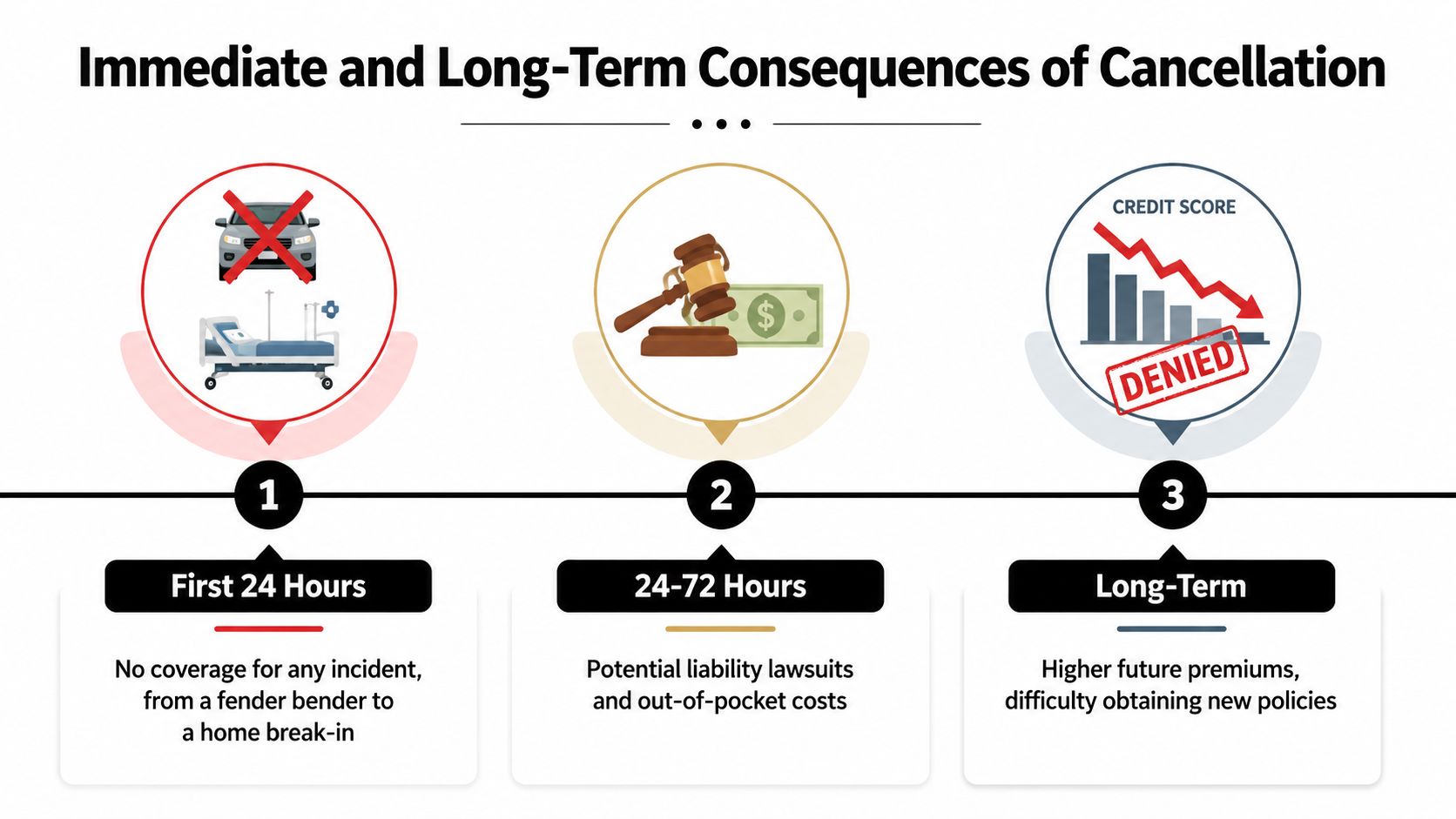
A cancellation or lapse can create an uninsured gap within hours. The right response is to verify the status, protect beneficiaries and property, and arrange replacement coverage before the gap grows.
First 24 hours
If coverage ended before an incident, the insurer may deny the claim. A life-policy cancellation can leave beneficiaries without the death benefit. With auto, home, or health insurance, you could face liability, repair costs, property loss, or medical bills without the protection you expected.
Read the notice closely. Confirm the notice date, effective date, stated reason, and policy number. Save the letter, email, portal screenshot, payment history, and any payment receipt in one folder. If the notice involves an auto policy and a traffic matter is part of the broader problem, how to fight a Wilton Manors ticket explains how a separate ticket may be challenged. It does not restore insurance.
For life insurance, contact the insurer promptly and ask whether reinstatement is available without a new application or with updated underwriting. If beneficiaries depend on the policy, tell them coverage is being verified and start comparing replacement options. Do not assume a pending reinstatement protects you until the carrier confirms the policy status in writing.
Within 24 to 72 hours
The priority is stopping a longer gap. Ask the insurer whether the policy is within a grace or reinstatement period, what payment or documents are required, and whether coverage is retroactive. Request written confirmation of the answer. Until the carrier confirms active coverage, do not drive an insured vehicle or represent that you have coverage.
Notice rules vary by jurisdiction and policy type. For the cited auto-insurance framework, Illinois requires at least 10 days' notice for nonpayment and 30 days for other cancellation reasons, according to the Illinois Department of Insurance. Those periods do not automatically apply to every life, home, or health policy.
Long-term exposure
A replacement policy may require new underwriting. Changes in health, occupation, finances, or lifestyle can produce different terms or a declined application. You may also lose the advantage of a policy purchased when you were younger and healthier.
Cancellation history can appear in insurer databases or consumer reports and may affect pricing, eligibility, or future application questions. A coverage gap can also create problems with lenders, landlords, business partners, and family members who require proof of insurance.
For a young family, even a short uninsured period needs a written plan. Protect beneficiaries first, document every contact, and secure replacement coverage before treating the problem as resolved.
Your First 72 Hours After Receiving a Cancellation Notice
The first 72 hours should be administrative, not emotional. You need a verified status, a deadline, an evidence file, and a backup quote.
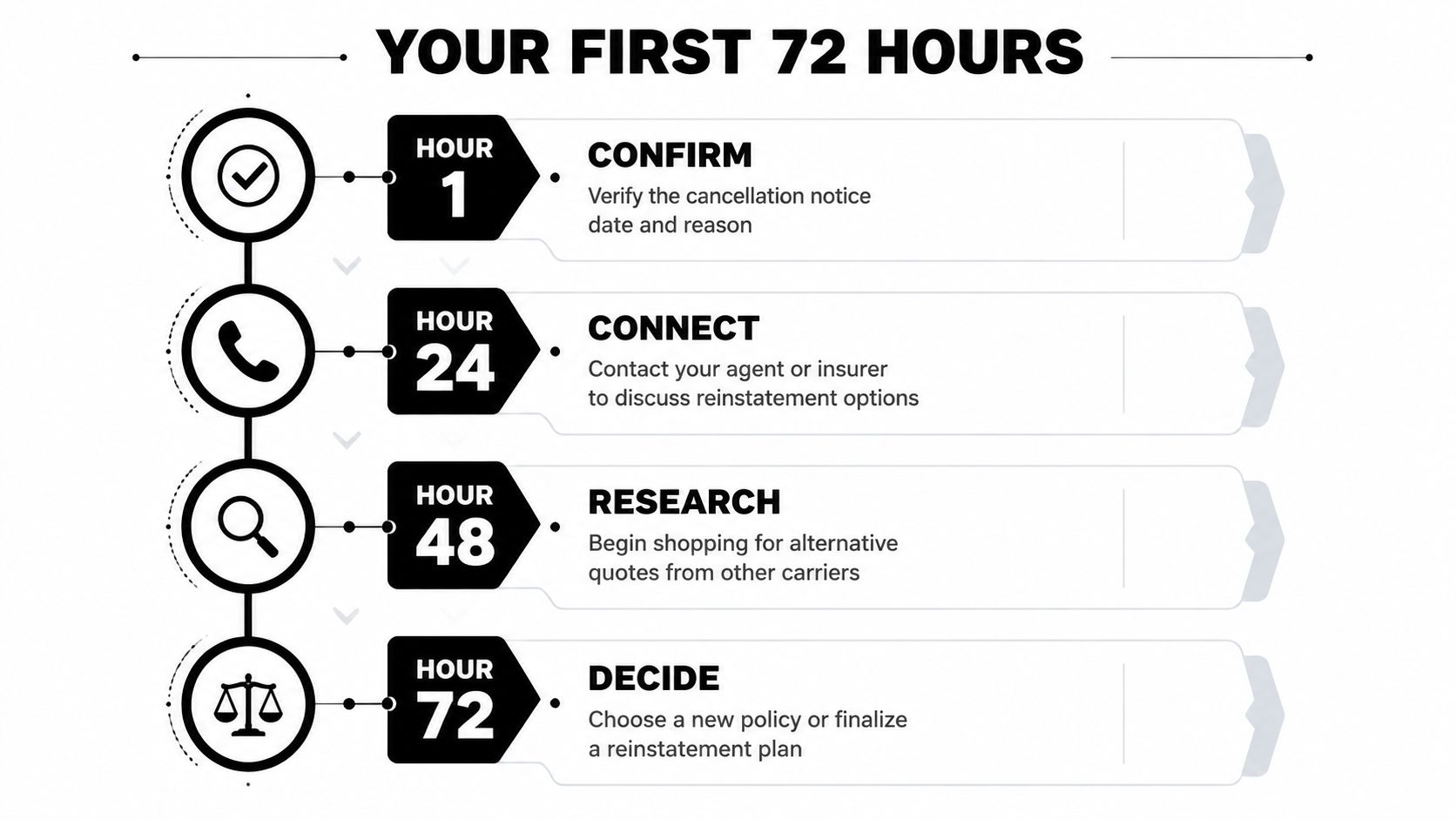
Hour 1, confirm the facts
Log in to the insurer's portal, then call the customer-service number printed on the policy documents. Don't rely on one email or letter when the issue may be a system error. Ask five direct questions:
- Is the policy active, pending cancellation, cancelled, or lapsed?
- What is the exact effective date and time?
- What payment, underwriting, or policy issue caused the action?
- What is the final date for reinstatement or correction?
- What documents and payment are required?
Ask the representative to send confirmation through the portal or email. Record the call time, representative's name, department, and reference number.
By hour 24, cure payment problems
If the issue is nonpayment, make the catch-up payment through the insurer's verified payment channel and save the receipt. Ask whether interest, fees, or additional forms apply. Then request written confirmation that the payment was received and whether coverage has been restored.
A grace period is not a vague courtesy. It's a contract and regulatory concept with specific conditions, so review what an insurance grace period means alongside your policy documents. Don't assume the deadline is the same for every product.
If an automatic debit occurred but the insurer failed to credit it, dispute the cancellation formally. Attach bank statements, payment confirmations, screenshots, and the relevant correspondence. State the outcome you want, such as correction of the ledger, withdrawal of the cancellation, and written confirmation of active coverage.
By hour 48 to 72, build a backup
Start replacement quotes before you know whether reinstatement will succeed. Ask each carrier about effective dates, underwriting, exclusions, and whether an application can proceed without cancelling or surrendering the existing contract.
For auto coverage, don't drive uninsured while you investigate. If a suspended licence or related driving issue complicates your search, suspended license car insurance help can help you identify questions to ask an agent.
Escalate when the insurer won't explain the decision, refuses to review clear payment evidence, or misses its own response commitments. File a written complaint with the carrier first, then contact your state insurance department or commissioner with the policy, notice, timeline, and evidence. A regulator can review compliance, but it can't guarantee reinstatement or decide every contract dispute.
Reinstating Your Policy Versus Buying New Coverage
Reinstatement preserves continuity only if the insurer approves it and confirms the policy is active. A new policy creates a fresh contract and may be easier to obtain if the old reinstatement window has closed. Don't choose based on the monthly premium alone.
Reinstatement often means paying overdue premiums, possible interest or fees, and completing updated health questions. A longer lapse may lead to additional underwriting or a medical exam. The principal advantage is preserving the original policy's age and rate class, provided the carrier allows reinstatement on those terms.
A replacement policy may offer updated riders, different pricing, or a better fit for your current income and family responsibilities. But you must disclose the prior cancellation or lapse accurately and coordinate the new effective date. Never cancel the old policy just because an application has been submitted. An application is not active coverage.
Compare the two routes
| Factor | Reinstatement | New policy |
|---|---|---|
| Speed | Can be quicker after payment and required forms are accepted | Depends on application and underwriting |
| Health assessment | May require updated health questions or further evidence | New underwriting generally applies |
| Existing rate class | May preserve original terms if approved | New rate reflects current age, health, and risk |
| Outstanding amount | Past-due premiums and possible charges may be required | New premiums begin under the replacement contract |
| Coverage gap | May close the gap if the insurer confirms restoration | Must be coordinated with the effective date |
| Best fit | Short lapse, unchanged health, and favorable existing terms | Closed reinstatement window, changed needs, or better available terms |
Push for reinstatement when the lapse is recent, your health hasn't changed, and the existing rate is valuable. Shop seriously for replacement coverage when the policy no longer matches your needs, the reinstatement terms are burdensome, or the insurer won't restore it.
If you switch, use precise written wording. Coveredly's guide on how to switch insurance providers includes the practical instruction to request cancellation effective on a specified date because replacement coverage is in force. The sequence matters. Get written acceptance and an effective date for the new policy first, then cancel the old one.
For life insurance, also review beneficiaries, face amount, riders, exclusions, and contestability provisions. A cheaper policy with less protection may solve a payment problem while creating a family-protection problem.
How to Prevent Cancellation Before It Happens
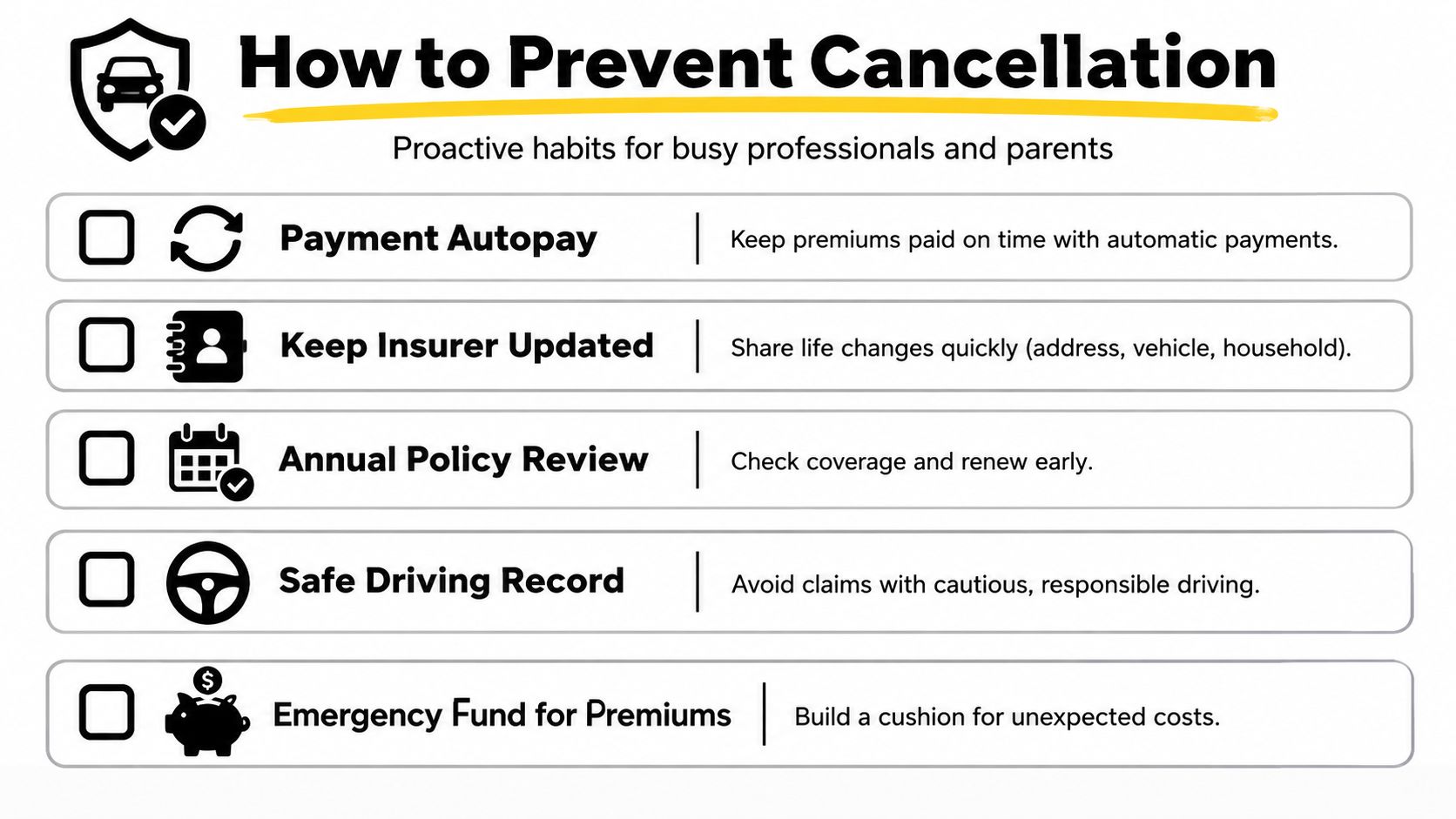
Most accidental lapses begin with a weak payment system, not a deliberate decision to abandon coverage. Build a process that survives travel, a house move, a job change, and the arrival of a new baby.
Make payment boring and reliable
Use autopay from a dedicated account that holds a buffer for recurring premiums. A dedicated account makes it easier to spot a failed debit and reduces the chance that rent, childcare, or a large annual bill drains the payment account first.
Enable both email and SMS reminders. Set them to arrive several days before the due date, then review the insurer's portal after each payment. Autopay is a control, not a substitute for monitoring.
Review the policy on a recurring schedule
Spend a short quarterly check-in verifying:
- Active status: Confirm the policy shows as in force.
- Beneficiaries: Check names, percentages, and contact details.
- Personal information: Update your address, phone number, and email.
- Payment details: Replace expired cards and changed bank accounts immediately.
- Coverage fit: Reconsider the amount after marriage, a new child, a mortgage, or a major income change.
Variable-income households should ask about annual payment plans, flexible billing, or policy features that can support premiums under the contract. Don't assume a cash value balance automatically protects every policy. Ask exactly how missed premiums are handled and when an automatic loan or other mechanism may apply.
Family safeguard: Add a spouse or trusted relative as a secondary contact where the insurer permits it. A second person may notice a warning that the policyholder misses.
Treat unexplained premium increases, returned mail, changed insurer correspondence, and failed portal access as warning signs. Contact the carrier before the next due date. Prevention is cheaper, calmer, and more reliable than reconstructing coverage after termination.
Real-World Scenarios and Frequently Asked Questions
A young couple moves apartments and misses a life premium because their bank account changes. They should confirm the policy status, identify the grace or reinstatement deadline, pay the overdue amount, submit any health declaration, and obtain written confirmation that coverage is active. If reinstatement fails, they should apply for replacement coverage immediately and avoid cancelling anything else until the new policy is approved and in force.
A new parent changes bank accounts and the auto premium fails. The parent should stop driving until coverage is verified, ask the insurer whether the policy is pending cancellation or already terminated, provide payment evidence, and request reinstatement or a new policy. If a driving-related issue is also involved, the insurer may require separate documentation.
A freelancer loses health coverage after an income or employment change. The freelancer should ask the insurer or plan administrator for the termination reason and date, check whether another enrollment route is available, and arrange replacement coverage before ending any continuation option. Health-plan cancellation rules vary by plan type, so written confirmation matters more than assumptions.
Common questions
Can a cancelled policy be reinstated after the grace period?
Sometimes. The contract and insurer determine the reinstatement window, required payment, updated health questions, and any additional underwriting. Ask for the deadline in writing and apply immediately.
Will a cancellation show up on my insurance record?
It may. Cancellation records can remain visible in insurer databases or consumer reports for years and may affect future pricing, eligibility, or application disclosures. Report the reason accurately.
How long does a lapse affect future premiums?
There's no universal period. A future insurer may ask about prior lapses or cancellations, and the effect depends on the product, reason, jurisdiction, and underwriting decision.
Does my beneficiary get paid if I die during a lapse?
Usually not if the policy was inactive when death occurred. Confirm the contract's grace-period language and current status immediately.
Can I dispute a cancellation that was an error?
Yes. Submit a formal written dispute with payment records, bank statements, notices, and a precise request for correction. If the carrier doesn't respond appropriately, contact your state insurance regulator.
Coveredly provides digital term life insurance, including coverage of up to $3 million with no exams for most applicants, as described by the publisher. If you're replacing a lapsed policy, compare its underwriting, exclusions, effective date, beneficiaries, and premium against reinstatement rather than treating a quick application as a complete solution.
If you're dealing with an insurance cancelled policy today, start by confirming the status and deadline with your insurer, then compare reinstatement with replacement coverage before beneficiaries face a gap. Coveredly offers digital term life insurance for people who want to review coverage online, so visit Coveredly to explore an option alongside your insurer's reinstatement decision.