
Maya and Daniel are balancing a mortgage, a newborn, student loans, and two careers. They know their family would need substantial financial support if either income disappeared, but they also know those obligations won't stay the same forever. A single large policy can provide reassurance today, yet it may leave them paying for far more coverage than their household needs later.
Laddering term life insurance offers a way to match protection with the timeline of real obligations. Instead of buying one policy that stays flat for decades, you combine policies with different coverage amounts and expiration dates. The result is a stepped-down death benefit that follows the household's changing needs.
Table of Contents
- Why Your Coverage Needs Drop Over Time
- What Laddering Term Life Insurance Is
- Laddering vs a Single Long Policy
- How to Build a Term Life Ladder Step by Step
- Who Benefits Most From a Laddered Strategy
- Trade-offs and When Laddering Is Not the Right Fit
- Building and Reviewing Your Own Ladder
Why Your Coverage Needs Drop Over Time
Maya and Daniel are in their early 30s. They have a $420,000 mortgage, a newborn, and $48,000 in combined student loans. If one of them died today, the surviving partner would need help replacing income, maintaining the home, caring for the child, and managing education-related costs.
Their financial picture won't remain frozen. Over the next decade, mortgage principal should decline as payments continue. Student loans may be reduced or eliminated. Their child will move through dependent years and may reach financial independence around age 22. By age 65, retirement accounts may replace much of the earned income that life insurance is designed to protect.
That creates a mismatch with flat coverage. An $800,000 death benefit purchased today may fit their obligations in 2026, but it could provide more protection than necessary in 2046, when the mortgage is smaller, the child is independent, and accumulated assets support the surviving spouse. The opposite problem exists at the beginning. If their actual needs exceed the policy amount, they may be underinsured during the years when obligations overlap most heavily.
| Obligation | Year 1 Balance | Year 10 Balance | Year 20 Balance | Year 30 Balance |
|---|---|---|---|---|
| Mortgage | $420,000 | Declining balance | Smaller remaining balance | Potentially paid off |
| Student loans | $48,000 | Reduced or paid off | Typically no remaining balance | No remaining balance |
| Child dependency and education | Newborn dependent | Active child-rearing years | Later education or transition needs | Child financially independent |
| Income replacement | Highest need | Still significant | Reduced as assets grow | Lower as retirement resources replace earnings |
The table illustrates the planning logic, not a guaranteed payoff schedule. Mortgage amortization, education choices, income, savings, and family circumstances all affect the actual numbers. The important point is that financial obligations usually move in different directions and end at different times.
A divorce can change those obligations just as sharply as marriage, homeownership, or the arrival of a child. Anyone navigating that transition may benefit from guidance on how to reassess insurance coverage after divorce before keeping an old policy structure unchanged.
The central question is simple: if your liability curve falls while one death benefit stays flat, why keep paying for coverage you no longer need? A term ladder answers by assigning each obligation its own time window.
What Laddering Term Life Insurance Is
Suppose your family needs the most protection while a mortgage, child-rearing costs, education expenses, and income replacement overlap. Those obligations do not all last equally long. Laddering term life insurance matches separate policies to those time periods, so coverage can reduce as specific financial responsibilities end.
Laddering means buying two or more term life insurance policies with staggered expiration dates. Each policy has its own coverage amount and term length. While all layers are active, their death benefits combine to provide the highest protection. As shorter policies expire, the total benefit steps down.
The structure resembles a staircase. The longest layer supports an obligation that may last for decades. A middle layer covers a need with a shorter horizon, while the top layer addresses the years when debts and income-replacement needs are greatest. Once that layer ends, the longer layers remain.
A sample structure could assign each policy to a particular obligation:
- A 30-year, $300,000 policy aligned with a mortgage.
- A 20-year, $250,000 policy aligned with a child's dependency and education years.
- A 10-year, $250,000 policy covering peak earning years and remaining debts.
During the first decade, the combined death benefit is $800,000. After the shortest layer expires, coverage falls to $550,000. After the 20-year layer ends, the mortgage-focused policy remains.
Each policy is independently underwritten, priced, and administered. You can buy every layer from one carrier or compare different carriers based on available terms, pricing, underwriting, and conversion features. The contracts stay separate, so one policy's expiration does not automatically change the others.
Laddering is a manual stacking strategy, not permanent life insurance, a packaged product, a single rider, or one oversized policy. The policyholder selects separate term policies and assigns each layer to a defined obligation.
Core idea: Match each policy's duration to the obligation it protects.
Shorter terms generally cost less because the insurer covers a shorter period in which a claim could occur. Independent consumer-finance coverage describes potential savings that can exceed 50% versus one large, long-duration policy, while other guides report typical long-run savings of 25% to 30% or more, depending on age, health, and policy design (Policygenius explains the term ladder strategy). The benefit is not only a lower premium. Coverage also becomes easier to reduce when a mortgage, child-related cost, or other obligation disappears.
Laddering vs a Single Long Policy
A family with a mortgage, young children, and one primary income may need the most protection today, then less as each obligation shrinks. A single 30-year policy keeps the same death benefit throughout the term. Laddering matches separate policy layers to those changing responsibilities, much like using different-sized containers for expenses that empty at different times.
Consider a healthy 32-year-old nonsmoker seeking roughly $800,000 of coverage. One illustration compares a single 30-year level term policy at about $720 per year with three policies: $300,000 for 30 years, $250,000 for 20 years, and $250,000 for 10 years. The ladder begins near $610 per year, then costs less as shorter layers expire. These figures illustrate the structure, not a quote for every applicant.
| Year | Single 30-Year ($800K) | Ladder Active Coverage | Ladder Annual Premium |
|---|---|---|---|
| 1 | $800,000 | $800,000 | Near $610 |
| 10 | $800,000 | $800,000 | Near $610 |
| 11 | $800,000 | $550,000 | Lower after 10-year layer ends |
| 20 | $800,000 | $550,000 | Lower than starting premium |
| 21 | $800,000 | $300,000 | Lower after 20-year layer ends |
| 30 | $800,000 | $300,000 | Lowest remaining ladder cost |
The layers can each serve a defined purpose. The longest policy may follow the mortgage, the middle layer may cover child-rearing and education, and the shortest layer may replace income during the years when the household has the greatest overlap of expenses. After a layer ends, the related obligation may also be smaller or finished, so the premium falls with the need.
A separate illustration compares about $695 per year for a three-policy ladder with $975 per year for one 30-year policy, a 29% annual savings that could reach $15,000 or more over the policy lifetime (Policygenius provides the illustration). Actual results depend on age, health, policy terms, and underwriting.
The trade-off is administration. You manage several contracts, renewal dates, and beneficiaries, but you can drop one layer early, reduce excess coverage, or explore conversion for one policy without changing the others. A single policy is simpler and may preserve guaranteed insurability for the full 30-year term if your health changes after purchase.
For a plain explanation of level-term mechanics, review Coveredly's guide to level term life insurance. The choice rests on whether the potential savings and obligation-based design justify handling more than one contract.
How to Build a Term Life Ladder Step by Step
A useful ladder starts with obligations, not policy products. Write down what your household would need to fund if your income disappeared, then assign each responsibility to the period when it matters.
Start with the obligations timeline
List the mortgage, debts, childcare, education, income replacement, business obligations, and transition costs. A household might have a 28-year mortgage payoff, a 12-year college runway, and an 8-year income-replacement buffer for a non-working spouse. Those terms don't need to become exact policy lengths, but they reveal where coverage is concentrated.
Subtract resources that would already be available to survivors, such as savings and other liquid assets. This liquidity offset prevents you from insuring every expense with the full gross amount. The goal is to estimate the gap survivors would face, not add every asset and liability without context.
Create policy buckets
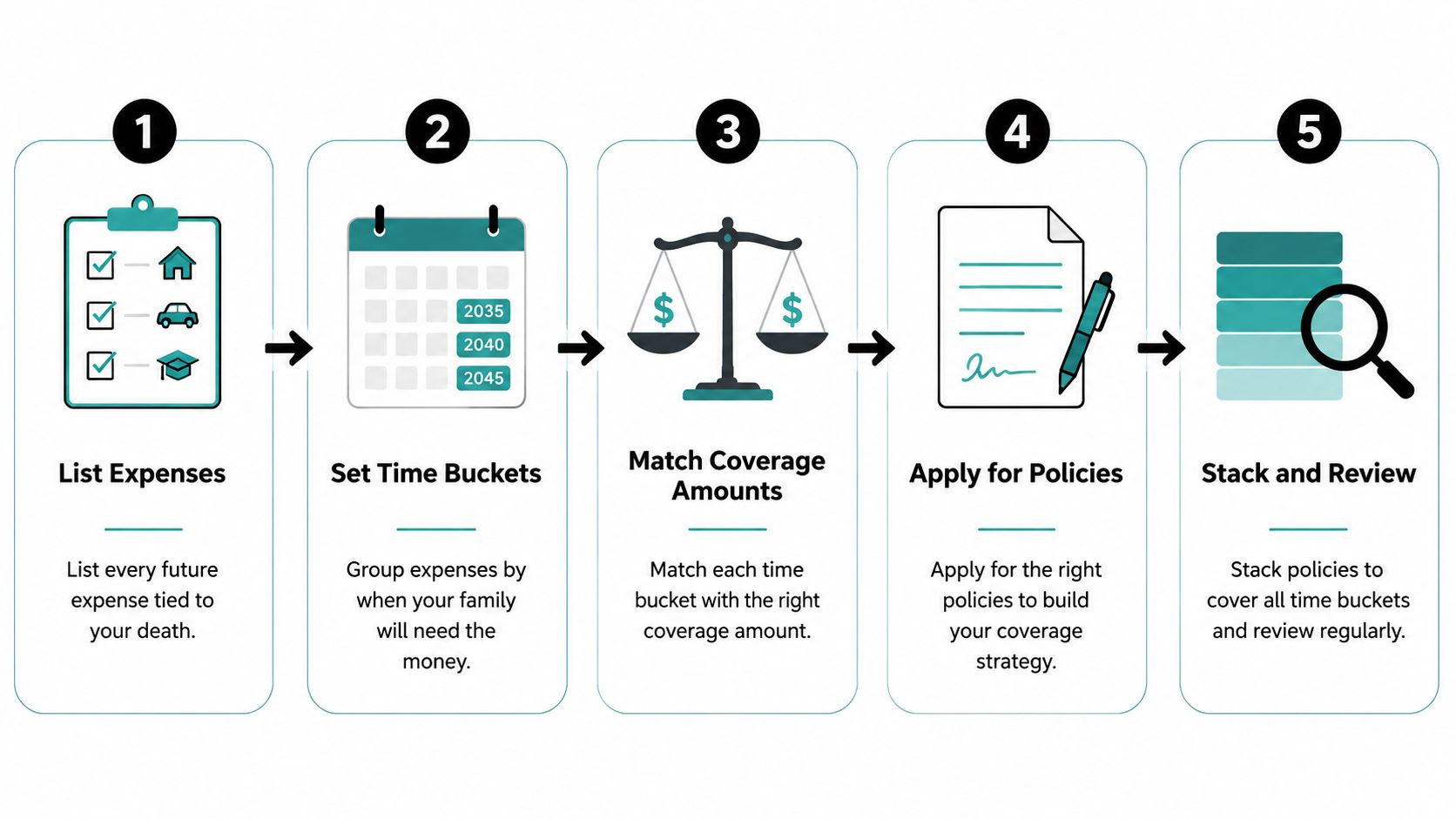
Group obligations into time buckets. A common workflow uses short-term 0 to 10 years, mid-term 11 to 20 years, and long-term 21 to 30 years, then assigns one layer to each bucket (The Insurance Scout outlines the time-bucket method).
A 30-year layer might protect a mortgage. A 20-year layer can address child-rearing and education. A 10-year layer may cover high early-career income replacement or debts expected to disappear sooner.
Estimate each coverage tier
Estimate the amount required in each bucket using today's dollars, then consider how future costs may change. Add a modest contingency only if your broader plan supports it. Avoid treating every layer as a duplicate of the total death benefit. Each policy should answer a specific question, such as, “What would this household need during these particular years?”
Compare carriers by layer
Request quotes from 3 to 5 carriers for each policy tier, using the same health classification, coverage amount, term length, and conversion terms. The carrier with the lowest price for a 30-year policy may not offer the lowest price for a 10-year layer. Comparing identical assumptions keeps the decision useful.
Apply and verify the contracts
Submit applications simultaneously when possible, while confirming how the insurer handles multiple applications and total coverage. Some planning guidance recommends applying for the longest layer first because underwriting information may be shared across the structure.
Before accepting the policies, check renewability, conversion privileges, exclusions, payment schedule, beneficiaries, and the contestability period. A ladder only works if every layer has a clear end date and the household knows what remains afterward.
Practical rule: Keep a one-page schedule showing each policy's owner, insured person, face amount, premium, term end date, conversion deadline, and beneficiary.
Who Benefits Most From a Laddered Strategy
The best candidates usually have obligations that are large now but scheduled to decline. Three households show how different timelines produce different ladders.
A young family with two children under five may have a $420,000, 30-year mortgage and a goal of funding college in 18 years. One possible structure is a $500,000, 30-year base layer, a $250,000, 20-year education layer, and a $150,000, 10-year buffer layer. The base layer follows the home, the middle layer follows education planning, and the shortest layer protects the years when childcare, early debt, and income replacement overlap.
A business professional in their early 40s may face a five-year earn-out clause, a seven-year college runway, and a 25-year mortgage. That person may need a short layer for the business obligation, another layer for education, and a longer layer for the mortgage. The structure concentrates coverage during the high-risk earning years without requiring every dollar of protection to continue through the mortgage's entire duration.
A recently married couple in their late 20s may have a modest mortgage, no children yet, and combined income that needs only 10 to 15 years of replacement. A short ladder can protect current obligations while preserving the option to add coverage after a child, home purchase, or career change. The couple shouldn't assume today's structure will remain adequate if their family grows.
| Profile | Key Obligations | Suggested Ladder | Why It Fits |
|---|---|---|---|
| Young family | Mortgage, children, college goal | $500,000 for 30 years, $250,000 for 20 years, $150,000 for 10 years | Keeps the largest protection in the years of overlapping family costs |
| Business professional | Earn-out, college runway, mortgage | Short business layer, education layer, longer mortgage layer | Separates business risk from household debt |
| Newly married couple | Modest mortgage, income replacement, possible future children | 10-year and 15-year layers, with room to add coverage | Protects current needs without assuming future obligations |
The amounts above are planning examples, not universal recommendations. A household should account for income, debts, savings, employer coverage, dependents, and survivors' resources. Readers comparing multiple policies can also review whether you can have two life insurance policies before deciding how much coverage to place in each layer.
Trade-offs and When Laddering Is Not the Right Fit
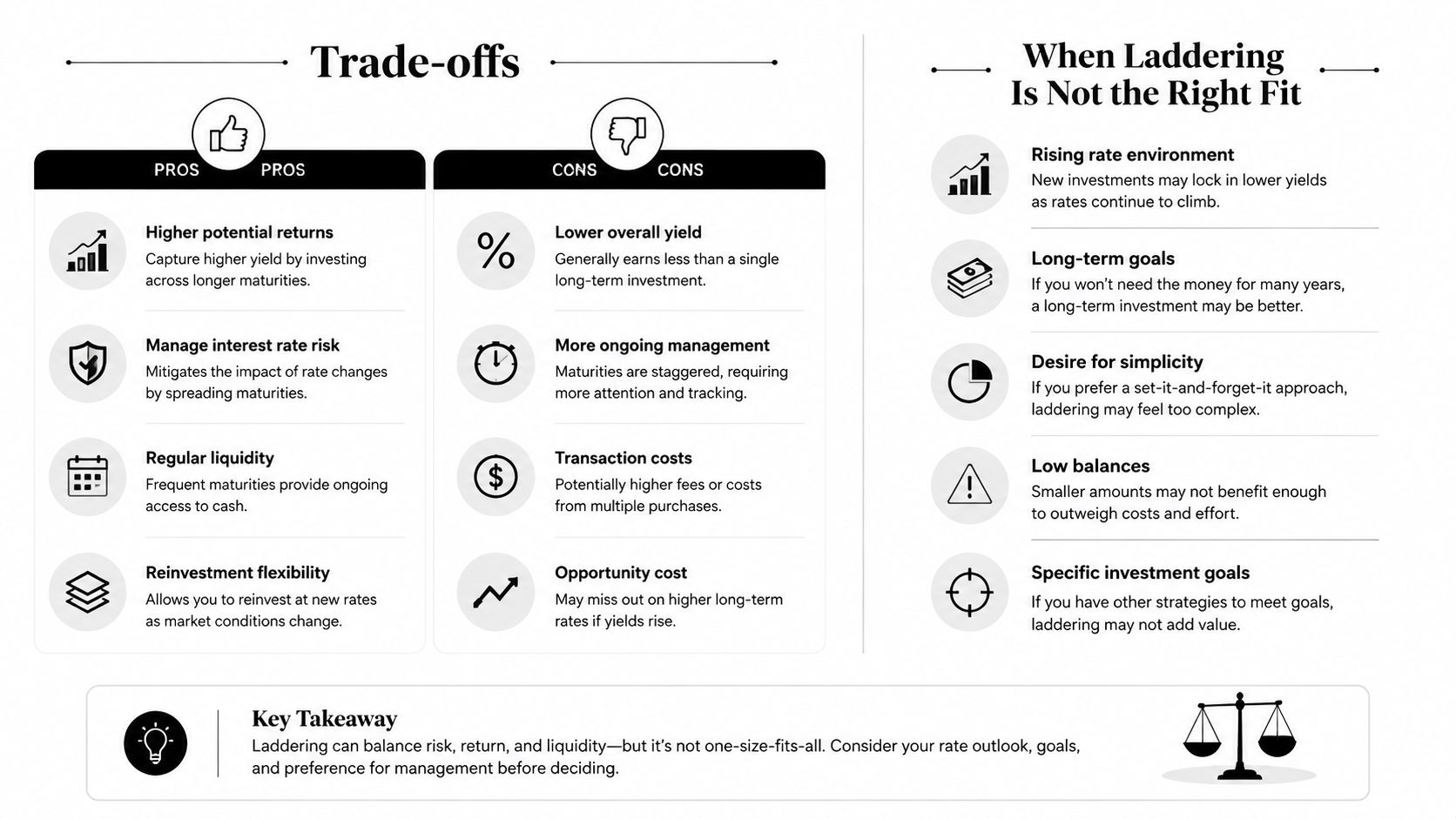
Laddering can improve alignment, but it introduces moving parts. You may have multiple applications, policy documents, billing dates, beneficiary records, and expiration dates to track. A missed notice or outdated beneficiary designation can undermine an otherwise careful plan.
Health is another concern. If you apply for later layers separately, a health change between applications may affect pricing or availability. Buying multiple policies at the outset can address some of that risk, but it doesn't remove the need to review underwriting decisions and contract terms carefully.
Short policies also have limits. They generally aren't designed to renew indefinitely into advanced ages, often past age 95 or so, and renewal pricing can become unattractive. A ladder needs a clear plan for what happens when a layer ends, especially if the related obligation hasn't disappeared.
Where gaps can appear
The most common design problem is timing. A mortgage may last longer than expected. A child may need extended support. A business obligation may be renewed. If a policy ends before the liability, the household could face a coverage gap.
Conversion rights require equal attention. Some policies allow conversion to permanent coverage during a stated window, while others may impose restrictions. Never assume one policy's conversion privilege applies to the rest of the ladder.
A ladder is a tool, not a default. The right structure depends on whether the savings justify the extra oversight and whether each obligation has a reliable end point.
When one policy makes more sense
A single long policy may win when one large obligation lasts for the full term. It can also be preferable when simplicity matters more than premium optimization, when future underwriting is especially risky, or when the household wants guaranteed insurability for a long period.
Permanent estate-planning needs are a different problem. If the purpose is to provide a benefit whenever death occurs rather than protect temporary income or debt obligations, term laddering may not solve the underlying need. In that situation, the policy type, ownership arrangement, and tax planning deserve separate professional review.
Building and Reviewing Your Own Ladder
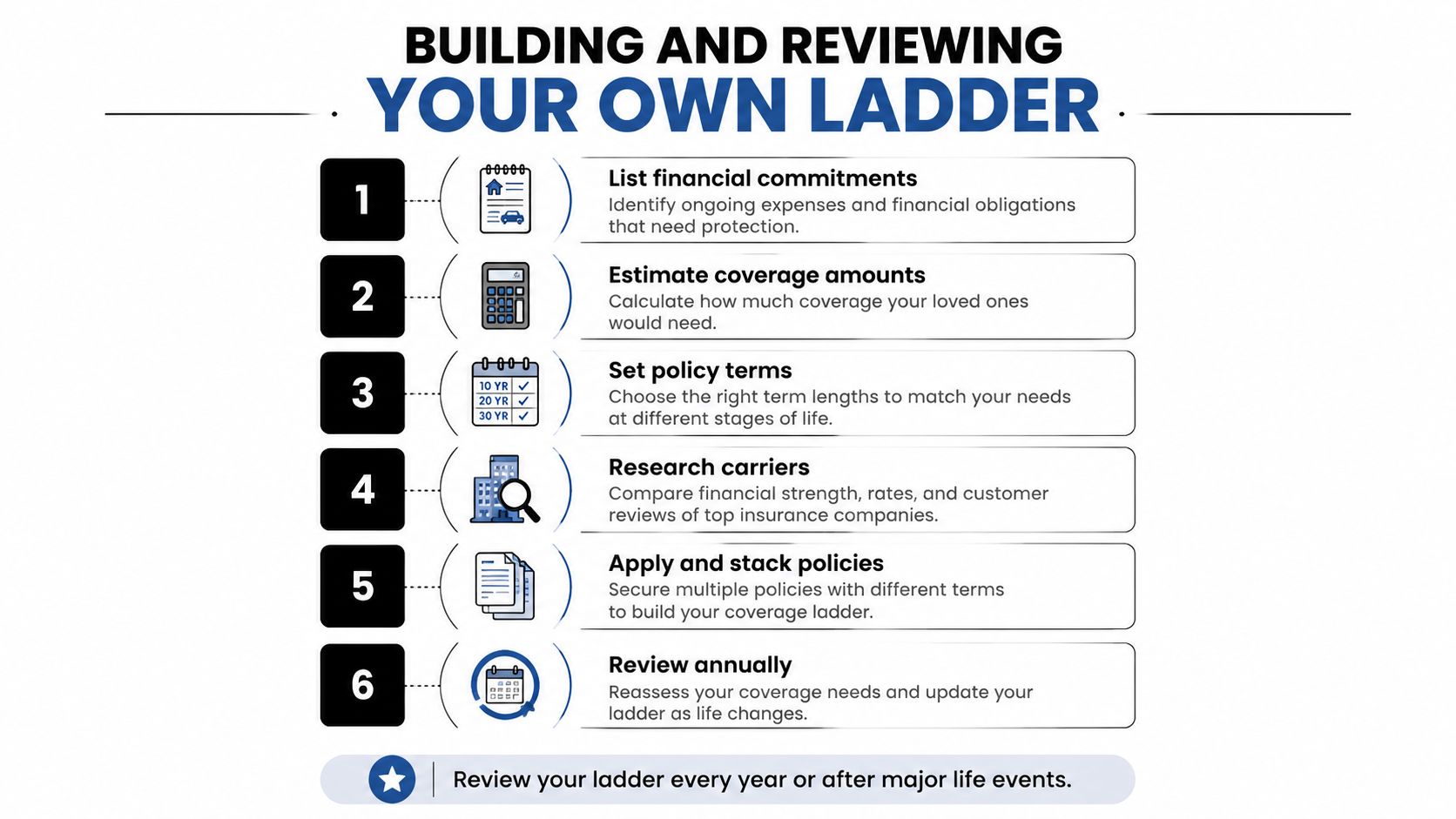
Begin with a clean inventory. List every commitment tied to your income, including the mortgage balance, children's college years, remaining working years, business debts, and any transition costs your household would face. Next to each item, record when the obligation should end and what savings or other resources would offset it.
Match those entries to coverage layers. A long mortgage may support a longer policy. Education may call for a middle layer. Early income replacement and short-term debt may justify the shortest layer. This turns an abstract death-benefit target into an obligations timeline that you can update.
A practical review checklist
- Map the money: Record balances, expected end dates, income needs, liquid assets, and existing employer coverage.
- Set the layers: Choose staggered term lengths that correspond to the periods of greatest financial exposure.
- Standardize quotes: Request insurer illustrations on the same coverage and term-length grid so you can compare like with like.
- Check the contracts: Confirm premiums, beneficiaries, conversion provisions, renewability, exclusions, and expiration dates.
- Document ownership: Keep policy numbers and insurer contact details where your beneficiaries can find them.
- Review the result: Compare the remaining death benefit with the obligations that still exist, rather than relying on the original purchase decision.
Certain life events should trigger an immediate reassessment rather than waiting for the calendar:
| Trigger | What to Recheck |
|---|---|
| New child | Income replacement, childcare, education funding |
| Home purchase | Mortgage protection and term length |
| Mortgage payoff | Whether the longest layer is still necessary |
| Job change | Employer coverage and income needs |
| Health diagnosis | Existing conversion rights and policy continuity |
| Divorce | Ownership, beneficiaries, support obligations, and coverage amounts |
| Child leaving college | Education layer and remaining dependency costs |
The shortest layer, often the first to expire, should prompt an annual review of the remaining structure. Laddering isn't set and forget. Your job is to confirm that the stepped-down death benefit still follows the obligations that remain, not to let policies disappear unnoticed.
For help estimating a starting coverage amount, you can use Coveredly's free term life insurance calculator. Then take three concrete steps: pull illustrations on a standardized term-length grid, request quotes from at least three highly rated carriers, and schedule a yearly calendar reminder to verify that your ladder still matches your real obligations.
Coveredly offers online term life insurance with coverage options designed to adjust as financial needs change, including the ability to increase or decrease coverage through its laddering feature. Visit Coveredly to compare a flexible starting point for a mortgage, children, income replacement, or other time-limited obligations.