You pay a bill on time, assume everything is fine, and move on with your week. Then a notice shows up, or a claim gets questioned, and you realize the policy you thought was active may not be protecting you anymore. For young families and busy professionals, that kind of surprise is exactly what makes a lapse of insurance coverage feel so unsettling, because the gap often shows up only after life has already changed.
The hard part is that a lapse isn't just a missed payment. In practice, it can mean a policy has ended, a claim may be denied, and the protection you were counting on isn't there when your family needs it most. That's true whether you're talking about life, health, or auto coverage, and the consequences can linger even after you try to fix the problem.

Table of Contents
- What a Lapse of Insurance Coverage Actually Means
- Why Policies Lapse and Who Is Most at Risk
- Financial and Legal Consequences of a Coverage Gap
- How to Reinstate a Lapsed Life Insurance Policy
- The Hidden Costs That Persist After Reinstatement
- Practical Strategies to Prevent Future Coverage Gaps
- Protecting Your Family Starts with Keeping Coverage Active
What a Lapse of Insurance Coverage Actually Means
A young parent can think a policy is fine because the last payment was made and the renewal date hasn't been top of mind. Then the insurer's system says something different, and the family learns that a missed premium can do more than create an overdue bill. It can trigger a formal status change, where the policy is no longer in force and the protection people assumed they had is gone.
That's why the word lapse matters. In actuarial and legal terms, it's often tied to a termination event caused by nonpayment, insufficient cash value, surrender, or a switch to reduced paid-up or extended-term status, not just a late reminder notice. LSE research on lapse-based insurance makes the key point clearly, once the grace period ends, the contract can stop automatically without further notice.
A missed payment during a grace period is not the same thing as a true lapse. Inside the grace period, the insurer may still accept payment and keep the policy alive, which is why timing matters so much. Coveredly's explanation of insurance grace periods is useful here, because it helps people check whether they're still inside that short window before coverage ends, what a grace period in insurance means.
Practical rule: if the grace period ends, the policy can stop, and the missed bill stops being a billing issue.
That's the reason a lapse feels so different from a normal late payment. If a covered loss happens after the policy has lapsed, the general rule is that no benefit is owed for that post-lapse event, even if the policy is later reinstated. For a family that thought they were protected, that's the difference between a paperwork delay and a real loss of coverage.
Why Policies Lapse and Who Is Most at Risk

People like to explain lapses as simple forgetfulness, but that story leaves out a lot. Renewal notices get delayed, addresses change, billing systems fail, and replacement coverage doesn't start cleanly on the same date the old policy ends. Research on insurance gaps points to structural and administrative drivers such as delayed renewal notices, complex revival procedures, poor customer service, frequent address changes, and high premium rates as common reasons people end up uninsured or underinsured over time economic-sciences.com research on coverage gaps.
That matters because many lapses are really coordination failures. A move, a job change, a divorce, or a policy switch can create a short timing gap that feels harmless in the moment, but some regulators treat short gaps mechanically. Georgia, for example, can treat a lapse as 10 days or more between policies or no new policy information within 30 days after termination, which shows how a tiny administrative delay can become a formal lapse Georgia insurance lapse rules.
Who tends to be exposed
Young families and busy professionals are especially vulnerable because they're juggling multiple deadlines at once. Health insurance data show how common coverage gaps can be in working-age adults, with 26% of U.S. adults ages 19 to 64 experiencing a gap in 2011, including 16% uninsured at the time of the survey and 10% who had been insured but spent part of the year uninsured Commonwealth Fund 2012 analysis.
Life insurance lapses are also not unusual. The Society of Actuaries reported a 4.9% overall lapse rate on a policy basis and 7.8% on a face-amount basis for the 2001 to 2002 observation period, with whole life lower at 3.9% and 5.8% respectively Society of Actuaries persistency report. Those numbers show that lapse risk is part of the market, not an outlier.
Key takeaway: the people most at risk are often the ones trying hardest to stay organized, but dealing with too many moving parts at once.
The lesson is that lapse prevention isn't only about discipline. It's also about building a system that catches billing errors, notice problems, and timing gaps before they turn into lost protection.
Financial and Legal Consequences of a Coverage Gap
A coverage gap can get expensive quickly, because the consequences depend on the type of policy and the timing of the loss. Life insurance is the clearest example. If the insured person dies while the policy is lapsed, the beneficiaries may lose the death benefit entirely, even if the missed premiums are paid later. That is not a minor billing issue. It means the contract's main promise is gone.
Auto insurance can create a different kind of problem, one that reaches beyond the insurer. New York DMV explains that an insurance lapse means there is no liability insurance coverage for a registered vehicle, and the lapse can lead the DMV to suspend both registration and driver license New York DMV insurance lapse rules. Louisiana treats lapses differently in some pricing situations, and a first lapse under 90 days cannot be used to raise the rate or add a surcharge under that rule. A state rule like that shows why a short missed payment can become a legal and administrative problem, not just a missed premium.
Health coverage gaps cause a slower kind of harm. Care may be delayed right away, but the effects can continue after coverage returns, because people often keep postponing visits, skip follow-ups, or lose continuity with the doctors who already know their history. Restoring the policy does not automatically restore access in the same way. The interruption can leave a lasting mark on how and when care gets used.
The same idea applies outside personal health and auto coverage. If you want a clear example of how uncovered losses can affect a business or household once liability protection disappears, the ISU Insurance Services liability guide shows how quickly risk can shift back onto the policyholder after coverage ends.
What makes the consequences so sharp
A lapse changes more than payment status. It changes whether a claim has a live policy behind it on the day something goes wrong.
- Claims can be denied: if the loss happens after the lapse, the policy may owe nothing.
- Penalties can stack up: auto lapses can bring registration or license problems.
- Protection can disappear at the worst time: life and health gaps can hit during already stressful moments.
That is why a lapse is more than a short interruption. It moves a family or business from protected to exposed, and the hard question is whether the policy was in force on the exact day it was needed.
How to Reinstate a Lapsed Life Insurance Policy
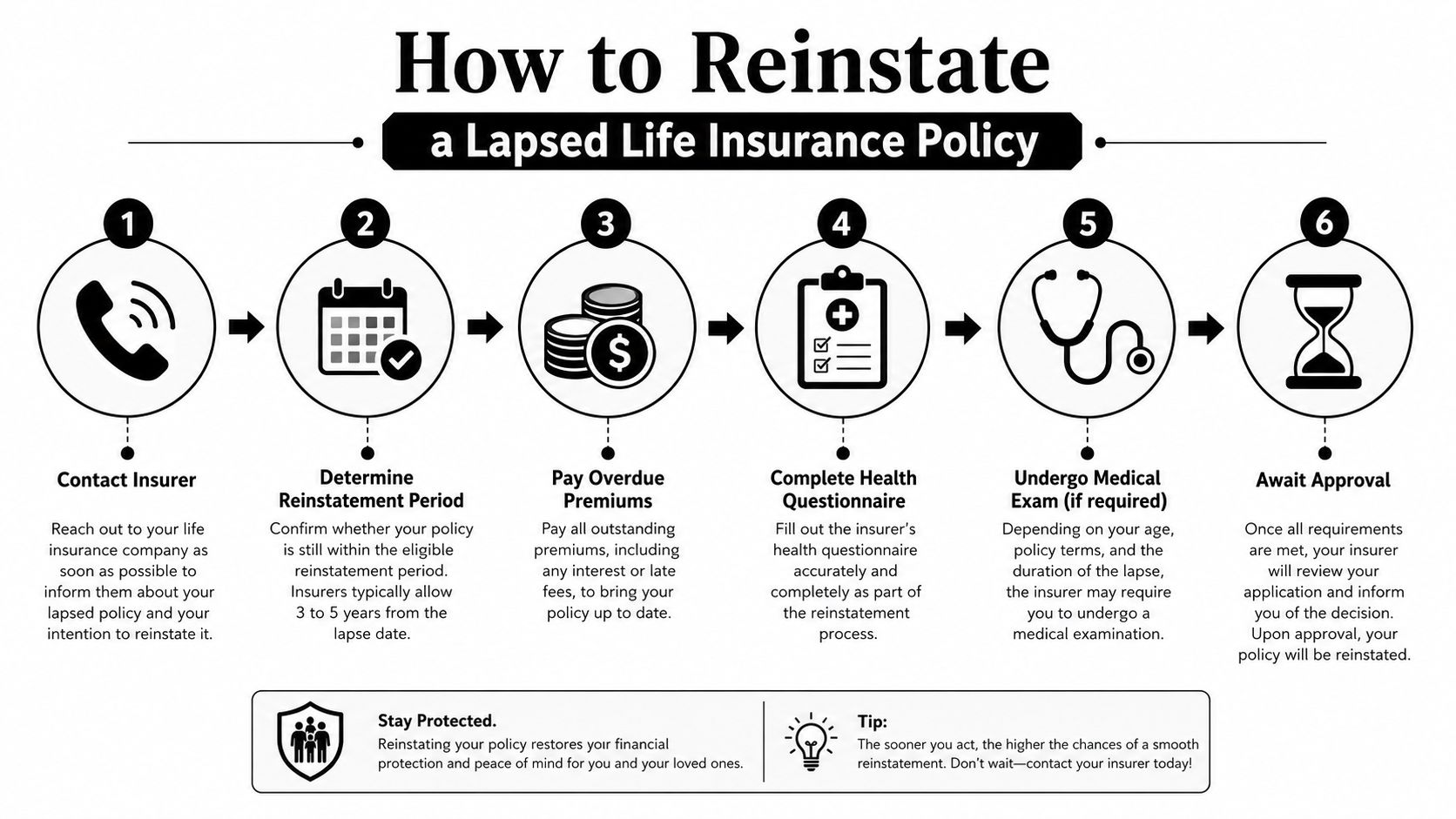
The first move is simple, call the insurer right away. Ask whether the policy can still be reinstated and how much time you have left, because reinstatement rights usually depend on the policy language and how long the lapse has lasted. If you wait too long, the insurer may treat it as a brand-new application instead of a restoration of old coverage.
The usual reinstatement path
- Contact the insurer. Confirm the policy status and ask for the reinstatement packet.
- Check the reinstatement window. The insurer will tell you whether the policy is still eligible.
- Pay past-due amounts. Many carriers require back premiums, and some also charge interest.
- Complete updated health questions. The insurer needs current information before deciding.
- Provide a medical exam if asked. Some reinstatements need fresh underwriting evidence.
- Wait for approval. Coverage isn't back until the insurer accepts the request.
Practical rule: don't assume reinstatement is automatic just because you paid the bill.
That's where people get tripped up. Reinstatement is usually a review process, not a cashier's window. Insurers want to know whether the risk has changed since the policy lapsed, and they may ask for proof that you're still insurable on the terms originally issued.
For readers dealing with forms, Coveredly's explanation of an evidence of insurability form can help make sense of the paperwork insurers sometimes request during reinstatement or coverage changes. That kind of form is usually about answering underwriting questions clearly and truthfully so the insurer can decide whether to restore coverage.
If reinstatement is denied, ask about alternatives right away. A new policy may be available, but the new underwriting could be different, and the pricing may not match your old plan. Acting quickly matters because every extra day after the lapse can make the process harder, especially if your health has changed.
The Hidden Costs That Persist After Reinstatement
Getting the policy back doesn't always erase the damage. Health coverage interruptions can still affect how people use care after insurance returns, because a gap may change appointment timing, delay treatment, or disrupt the relationship with a provider. That means reinstatement solves the policy status problem, but it doesn't always solve the medical or administrative fallout.
Families feel this most when care is recurring. A child's follow-up visit can get pushed out. A specialist referral can stall. A household managing a chronic condition may discover that the old rhythm of care has been interrupted, and the return to coverage doesn't automatically rewind the clock. The same thing can happen when someone is trying to coordinate claims, records, and ongoing authorizations.
Why the ripple effects last
A lapse can leave behind unfinished billing records, missing continuity notes, or confusion about whether a service was covered during the gap. Even after a policy is back in force, those interruptions can make claims processing slower and more frustrating. For people shopping again after a gap, the process can also narrow options or change pricing because the market now sees a break in coverage history.
That's why the question isn't just, “How do I restart coverage?” It's also, “What did the gap do in the meantime?” The answer is often more complicated than people expect, especially for families who rely on regular care or business owners who need uninterrupted liability protection.
A reinstated policy is not the same thing as an untouched one. The gap may be over, but the administrative and care-related consequences can still show up later.
The best way to think about reinstatement is as damage control, not time travel. It can restore protection going forward, but it can't always undo delays, missed appointments, or claim complications that happened during the lapse. That's why prevention is usually less expensive and less stressful than recovery.
Practical Strategies to Prevent Future Coverage Gaps
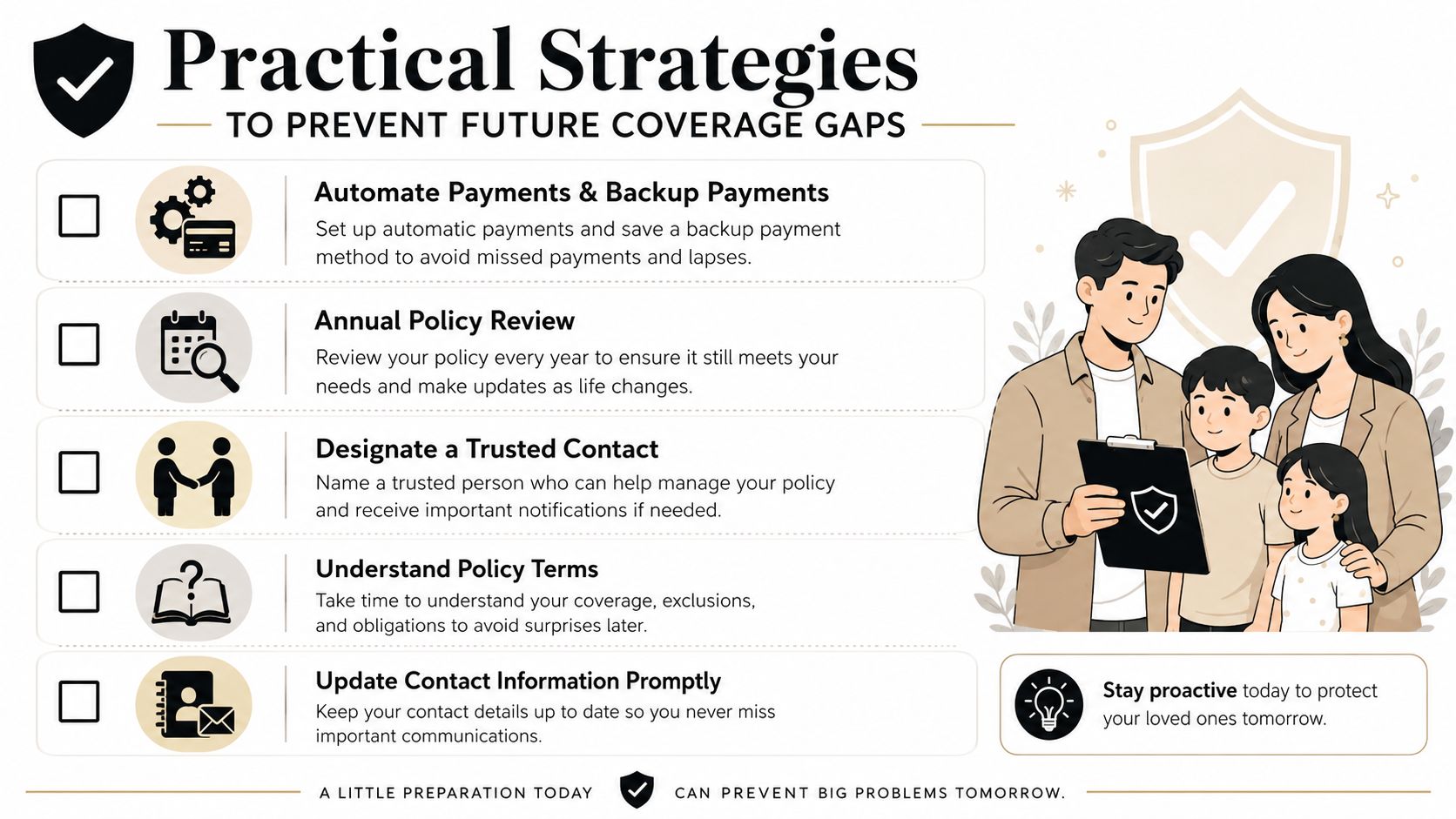
Prevention works best when it matches the failure mode. If the problem is a missed notice, a lost email, or a job change that shifts effective dates, then one reminder isn't enough. You need a backup system that catches the gap before the insurer does.
Build redundancy into the process
- Automate payments and backup payments. Autopay helps, but a second card or account matters if one payment source fails.
- Keep contact information current. An outdated address or email can mean a renewal notice never reaches you.
- Reconcile replacement dates. When you switch policies, make sure the new coverage starts before the old one ends.
- Review your policy every year. Life changes, and coverage should change with them.
- Choose one trusted contact. A spouse, partner, or family member can help spot missed notices when you're overloaded.
If you want a structured way to review life coverage, Coveredly's life insurance policy review checklist is a practical starting point for checking whether the policy still fits your household.
For payment reminders and recurring bill tracking, a tool like stop subscription charges with FloosYo can help busy households track due dates and avoid preventable misses. The point isn't the tool itself, it's creating a system that notices trouble before a policy drops.
Match the strategy to the pressure point
If your premium feels stretched, don't wait for a lapse to force the issue. Look at whether the coverage level still fits the budget, then adjust proactively rather than gambling on a missed bill. A smaller policy you can sustain is usually safer than a larger policy that disappears.
Lapses often happen during transitions, so those are the moments to slow down and check the details. Job change, move, divorce, renewal season, or a policy switch, each one deserves a confirmation that the dates line up and the payments are live.
Protecting Your Family Starts with Keeping Coverage Active
A lapse of insurance coverage is not a minor billing problem. It's a status change that can end protection, expose a family to claim denial, and create headaches that linger even after coverage comes back. The safest move is to treat every policy like a living system that needs date checks, payment checks, and contact updates.
If you already found a gap, act fast. Contact the insurer, confirm whether reinstatement is still available, and gather the paperwork they ask for before the window closes. If you're still covered, don't wait for a notice to tell you something's wrong. Check the payment method, update your contact information, and confirm the grace period in writing.
Your family's financial security depends on coverage that's in force, not just assumed to be in force.
Coveredly helps people keep life insurance simple, digital, and flexible, which matters when you're trying to avoid a gap in the first place. If you want a clearer way to review coverage and keep your family protected, visit Coveredly and take a look at the options built for real life transitions.