Most American households are underinsured by an average of $200,000. The right life insurance coverage limit depends on your family's debts, income needs, dependents, and available assets, not on a universal rule.
You may already have life insurance through work, or perhaps you bought a policy when you got married. Then life changed. A mortgage appeared, a child arrived, one partner reduced work hours, or employer benefits became less certain. The policy still exists, but its death benefit may no longer match the financial life it's meant to protect.
That distinction matters. A policy can be active and still leave a serious coverage gap. The useful question isn't just, “Do we have life insurance?” It's, “Would the limit give the surviving family enough time and money to remain financially stable?”
Table of Contents
- Why Most Families Are Underinsured
- Understanding Coverage Limit Types and How They Work
- How to Calculate Your Ideal Coverage Limit
- No-Exam Policies vs Traditional Underwriting Limits
- Real Family Examples of Coverage Limit Calculations
- Common Misconceptions About Coverage Limits
- Putting It All Together Your Next Steps
- Frequently Asked Questions About Coverage Limits
Why Most Families Are Underinsured
Sarah and Mike are newly married, have a newborn, and recently bought a home. During an employee-benefits review, they discover that each has $200,000 of term life insurance through work. At first, the number sounds substantial. Then they list the mortgage, lost income, childcare, household bills, and future support their child may need.
Their concern becomes clearer when they compare their policy with broader consumer data. Forty-two percent of U.S. adults, approximately 102 million people, said they either had no life insurance or needed more coverage in LIMRA and Life Happens' 2024 Insurance Barometer Study findings. About half of American adults reported owning life insurance, but ownership alone doesn't show whether the benefit is sufficient.

What a coverage limit means
A life insurance coverage limit, also called the face amount or death benefit, is the amount the insurer is contractually expected to pay when a covered claim is approved. It isn't a general estimate of what your family might need. It's the ceiling built into the policy.
Sarah and Mike's combined workplace coverage might help with immediate bills, but it may not replace income for the years their child depends on them. Middle-income households face the same problem. Among households earning $50,000 to $149,000 annually, 4 in 10, roughly 50 million adults, reported lacking adequate protection in the same study.
Gender differences also appear in ownership data. Fifty-seven percent of men reported having life insurance compared with 46% of women, while 56 million women reported a coverage gap. These figures don't mean every household needs the same limit. They show why a simple ownership measure can hide unequal protection within a family.
Practical rule: Treat employer coverage as one resource in the calculation, not as proof that the household is fully insured.
A policy limit should account for the survivor's financial reality. That can include final expenses, mortgage debt, income replacement, childcare, education, and the value of unpaid household work. If a spouse provides daily childcare or manages the home, replacing that work may require additional paid support even when that spouse doesn't earn a salary.
Understanding Coverage Limit Types and How They Work
Insurance documents use several kinds of limits, and confusing them can lead to poor decisions. The face amount is the stated death benefit on an individual policy. A per-life limit caps the amount available for one insured person, which commonly matters in group arrangements. Aggregate and per-event limits are more common in other insurance designs, but the underlying idea is useful: a policy can restrict the maximum amount payable for an individual, a group, or a particular claim.

How insurers set the maximum
There isn't one universal dollar cap for U.S. life insurance. Insurers generally assess the requested amount against income, assets, debts, age, health, dependents, and the financial purpose of the coverage. The insurer wants to see that the proposed death benefit reflects a credible need rather than an unsupported amount.
That process is called financial underwriting. For larger applications, an insurer may request income verification, tax or financial records, medical records, prescription history, and other evidence. Medical underwriting evaluates mortality risk, while financial underwriting helps determine whether the requested limit fits the household's circumstances.
Policy design matters, too. Term life insurance pays a stated benefit if death occurs during the selected term. Permanent insurance combines a death benefit with cash value, and some policies allow loans or withdrawals. A larger face amount doesn't automatically guarantee payment in every situation. Nonpayment, material misrepresentation, exclusions, and contestability provisions can affect a claim, as explained in this overview of life insurance ownership and policy considerations.
| Limit concept | What it tells you |
|---|---|
| Face amount | The stated death benefit on the policy |
| Per-life limit | The maximum amount available for one insured person |
| Aggregate limit | The maximum amount available across covered lives |
| Per-event limit | The maximum triggered by one covered claim or incident |
A family comparing a substantial individual policy can use a resource such as find £1m life insurance quotes to understand how insurers present higher limits. The quote itself doesn't replace a needs analysis. It helps connect the desired protection amount with available policy designs, underwriting, and premiums.
How to Calculate Your Ideal Coverage Limit
A salary multiplier is easy to remember, but it can miss the timing of expenses. Swiss Re's approach is more defensible: calculate the present value of future income replacement needs, then subtract financial assets, existing life insurance, and survivor benefits. Its U.S. analysis estimated the average household protection gap at approximately $495,000, equal to about 45% of household income-replacement needs. See the Swiss Re analysis of the mortality protection gap.
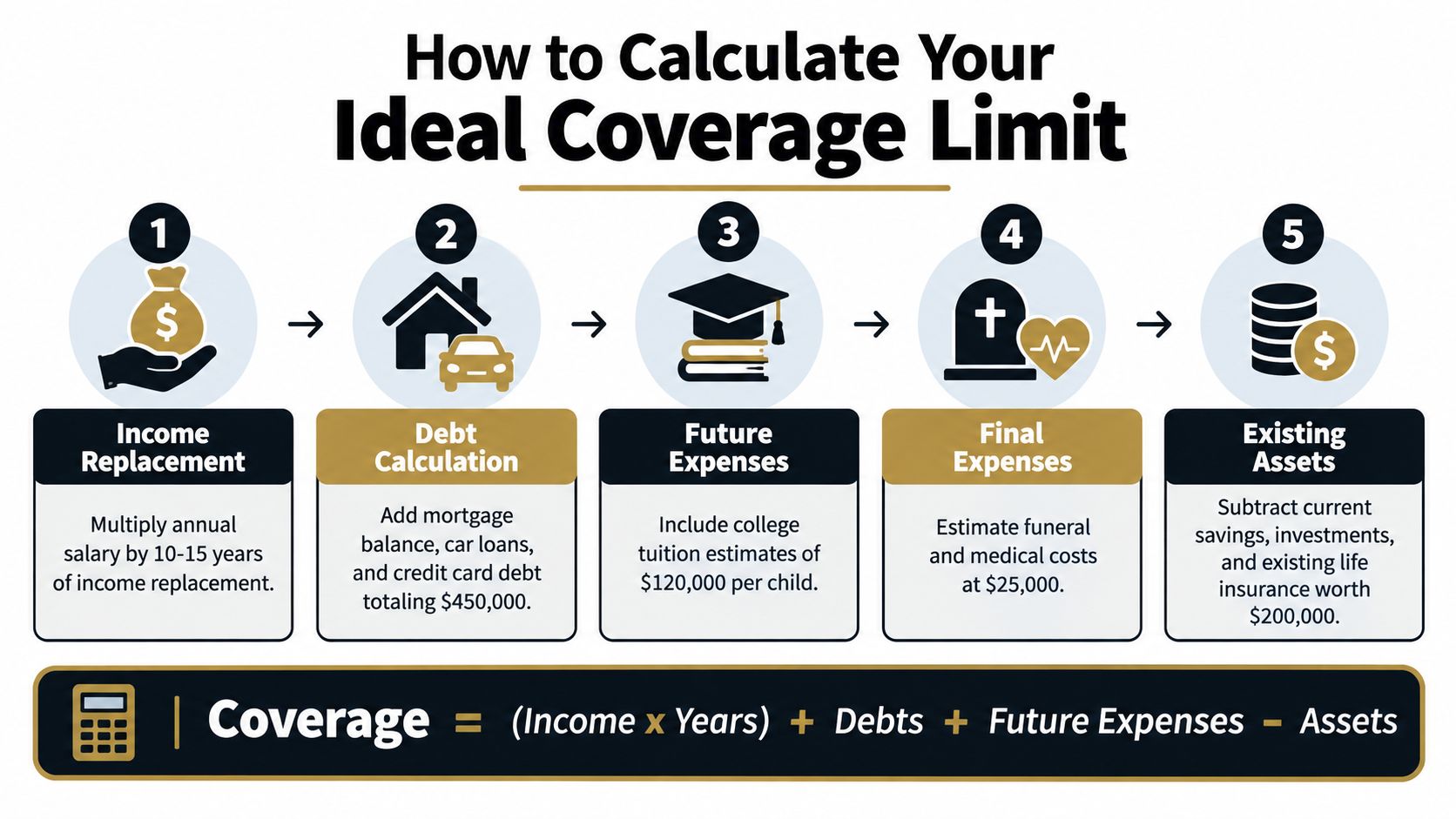
Use this process:
List immediate obligations. Include final expenses, outstanding debts, mortgage requirements, and cash the survivor may need soon after death.
Map income dependence by year. Estimate how long the household would need replacement income. A child in infancy creates a different timeline from a child nearing independence. Include the income of the deceased partner and the value of services the survivor would need to purchase.
Add medium- and long-term needs. Childcare, housing, education, and retirement support may occur at different points. Discounting future cash flows prevents you from treating a payment needed years from now as though it were due today.
Subtract available resources. Count liquid savings, investments, existing individual coverage, and reliable survivor benefits. Be cautious with employer coverage if it may end when employment ends.
Stress-test the result. Ask whether the limit still works if one partner takes parental leave, another child arrives, earnings change, or childcare becomes more expensive.
LIMRA's Life Insurance Needs Model estimates that most households require roughly 5.25 years of income replacement through insurance and savings, while its broader calculation uses 75% of household income for up to seven years or until age 65, plus debt and approximately $15,000 in final expenses, less existing resources. The LIMRA needs model illustrates why duration matters more than a fixed salary multiple.
A useful formula is: coverage limit = immediate obligations + present value of dependent support + future costs minus liquid assets and existing coverage.
Business owners should also separate personal protection from commercial risk. A company may need key person insurance for family businesses when the death of a key owner or employee could disrupt revenue, ownership transitions, or debt repayment.
For another way to organize the personal calculation, use this life insurance needs guide as a starting point, then verify the assumptions against your household's actual cash flow.
No-Exam Policies vs Traditional Underwriting Limits
No-exam insurance and fully underwritten insurance solve different problems. A no-exam application can be useful when speed, convenience, or avoiding a medical appointment matters. Traditional underwriting usually requires more documentation and may include a medical exam, but it can support a larger, more precisely evaluated request.
Coveredly offers online term life insurance with coverage amounts up to $3 million for eligible applicants, subject to underwriting rules. That makes it one option for a family whose calculated need falls within the product's available limit and whose timeline makes a simple application attractive.
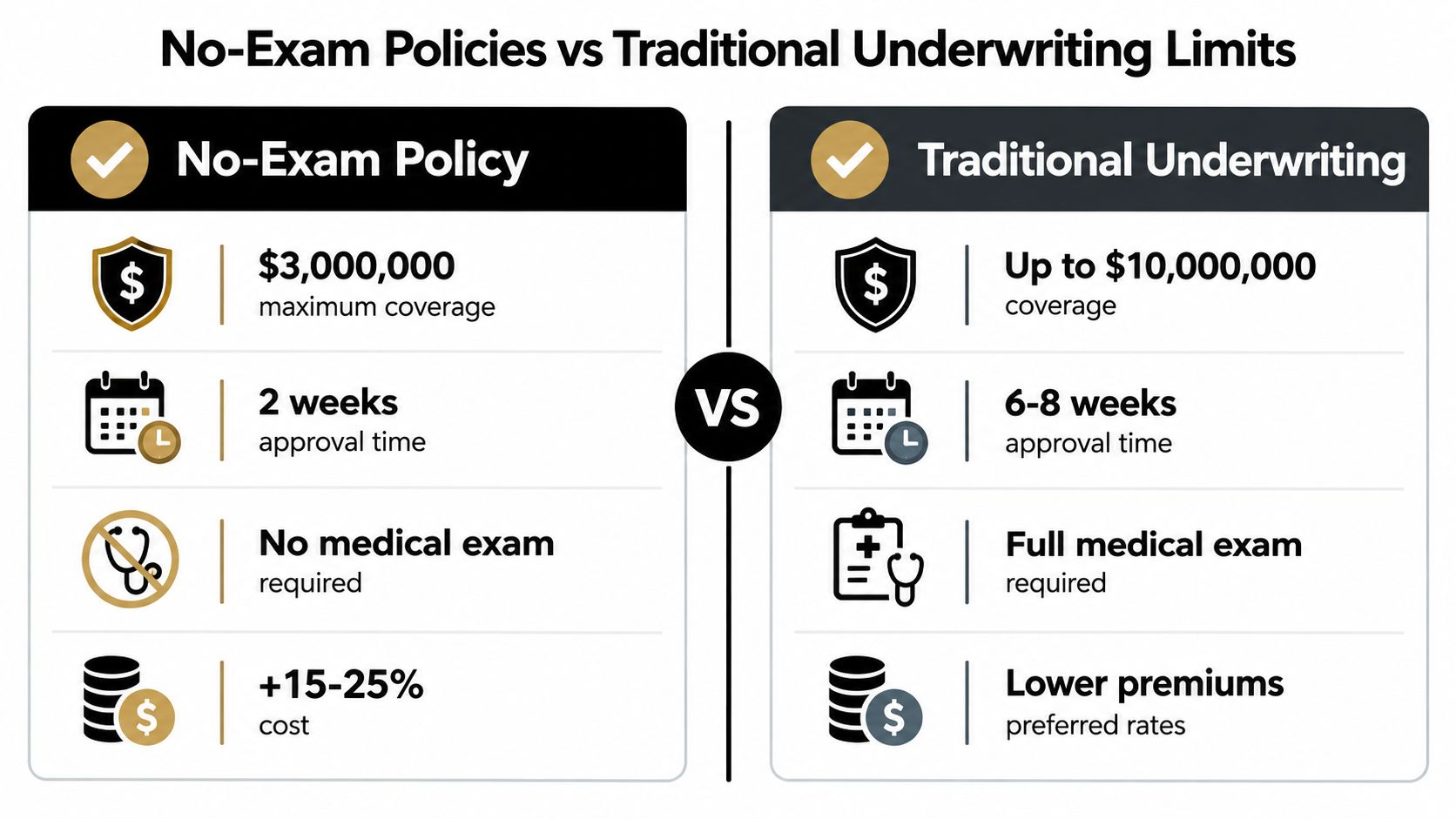
The trade-off is fit, not quality
A no-exam policy doesn't automatically mean weaker protection. If the approved limit matches the calculated need, the policy can serve its intended purpose. The concern is that an applicant may accept a convenient amount before checking whether it covers the family's full obligations.
Traditional underwriting may make more sense when:
- The required limit is substantial: A larger income-replacement need may exceed simplified-issue availability.
- The applicant is healthy: Detailed underwriting may produce more favorable pricing than a policy that groups applicants into broader risk categories.
- The financial situation is complex: Business ownership, unusual income, trusts, or significant existing coverage may require deeper documentation.
- The applicant has time: A family planning ahead may prefer a fuller review over an immediate decision.
No-exam coverage may be appropriate when:
- The gap is urgent: A new parent or homeowner may need protection while completing a broader financial review.
- The requested amount is within the available range: Convenience is useful only if the face amount is adequate.
- Medical scheduling is difficult: The simplified process may remove a practical barrier.
Compare the exact term, exclusions, premium structure, renewal provisions, and portability before choosing. A no-exam life insurance policy should be evaluated by the same standard as any other policy: does the approved death benefit protect the people who depend on you?
Real Family Examples of Coverage Limit Calculations
The following are illustrative planning examples, not real client case studies. They show how the same question, “How much coverage do we need?” can produce different answers when household responsibilities change.
A young dual-income couple
One partner earns the larger salary, while the other works part time after their infant's arrival. They have a mortgage, ordinary household debt, and limited liquid savings. Their calculation begins with immediate obligations, then adds the present value of income the survivor would need while caring for the child.
Childcare is central. Replacing the deceased partner's salary isn't enough if the surviving parent must also pay for care, household help, or reduced work hours. Existing employer coverage is subtracted, but only after the couple decides how dependent they are on that benefit continuing.
A single parent with adult children
A single parent with adult children may need less long-term income replacement than a household with an infant. However, significant debt, a mortgage, or support promised to an adult child can still create a meaningful limit.
The calculation changes because the duration of dependence changes. Instead of automatically applying a salary multiple, the parent lists debts, final expenses, any remaining support obligation, and assets that beneficiaries could access. A smaller income-replacement period doesn't erase immediate liabilities.
A business owner
A business owner has two separate questions. First, what would the family need if the owner died? Second, what would the company need to replace lost expertise, manage debt, or fund a transition?
Those amounts shouldn't be blended casually. Personal coverage protects household dependents, while business coverage may protect the enterprise and its owners. Ownership, beneficiary designations, and succession arrangements deserve professional review.
A calculator such as this online life insurance calculator can help organize assumptions. It can't decide whether a future expense is realistic or whether a business obligation belongs in a personal policy. The final limit should reflect documented cash flows, not a number selected because it sounds standard.
Common Misconceptions About Coverage Limits
Myth one, employer coverage is enough. Group insurance can be valuable, but it may be tied to employment and may not match household obligations. A workplace benefit can create false confidence when a family has a mortgage, children, or a non-working spouse. The policy should be reviewed for its per-life limit, portability, exclusions, and relationship to the total need.
Myth two, a larger policy is always better. More insurance can provide more protection, but it also creates a premium obligation. Over-insuring may direct money away from emergency savings, debt reduction, retirement contributions, or other priorities. The correct limit is the amount that solves the financial problem without creating an unaffordable policy.
Myth three, the limit never needs to change. Marriage, childbirth, a home purchase, promotion, divorce, business ownership, or loss of employer coverage can alter the calculation. A policy that fit a newly married couple may not fit after a new mortgage and children arrive. Review the limit whenever the family's obligations or resources materially change.
Myth four, people accurately understand the cost. Roughly three-quarters of Americans overestimate life insurance costs, and adults ages 18 to 30 overestimated the cost of a $250,000, 20-year level-term policy by approximately 10 to 12 times its actual median cost, according to LIMRA's coverage-gap research. That misconception can cause a family to choose too small a limit before getting an actual quote.
Younger adults who considered themselves only somewhat or not knowledgeable about life insurance were especially likely to have a gap. The practical response isn't to buy the largest policy automatically. Price the protection you actually need, compare policy terms, and then decide what fits the budget.
Putting It All Together Your Next Steps
Start with the policy documents you already have. Record each death benefit, term length, owner, beneficiary, renewal provision, and whether coverage depends on employment.
Then build a household calculation:
- List obligations: Mortgage, debts, final expenses, childcare, education, and ongoing living costs.
- Estimate duration: Identify how long dependents would need income or paid support.
- Subtract resources: Include savings, investments, existing personal coverage, and dependable survivor benefits.
- Test scenarios: Consider parental leave, another child, job loss, disability, or a business transition.
- Compare designs: Review term and permanent coverage, no-exam and traditional underwriting, portability, exclusions, and premium stability.
A no-exam option may fit a moderate need with an urgent timeline. Traditional underwriting may be more suitable for a larger limit, complex finances, or an applicant willing to provide detailed medical and financial evidence. An insurance professional or financial adviser can help when ownership, trusts, business interests, tax exposure, or uneven household roles make the calculation difficult.
Review your limit after marriage, childbirth, a home purchase, a career change, or a new business venture. Understanding life insurance coverage limits gives your family a measurable protection target instead of a vague sense that “some insurance” is enough.
Frequently Asked Questions About Coverage Limits
Are life insurance death benefits taxable?
A beneficiary's death benefit is generally excluded from federal gross income. It may still affect federal estate-tax treatment when the proceeds are payable to the estate or the insured retained ownership rights. In 2025, the federal estate-tax exemption was reported as $13.99 million per individual. Review substantial policies with a qualified tax or estate professional using the estate-tax explanation for life insurance proceeds.
Can I increase my coverage later?
Some policies offer conversion or guaranteed-insurability features, while others require new underwriting. Check the contract before assuming an increase will be available.
How do group and individual limits differ?
An employer plan may impose a per-life cap and may end when employment ends. An individual policy is separately owned and should be evaluated for portability and beneficiary control.
What happens if I outlive my term?
Coverage usually ends unless the policy permits renewal or conversion. Renewal may use your older age to determine premiums.
How do state rules affect limits?
State insurance laws can affect disclosures, replacement procedures, beneficiary rules, and policy administration. Confirm requirements with your state regulator or licensed adviser.
Coveredly offers online term life insurance with coverage amounts up to $3 million for eligible applicants, subject to underwriting rules, and lets policyholders adjust coverage as their needs change. Visit Coveredly to explore an online option after you've calculated the limit your family needs.